 Talmud Bavli
Berakhot 57a : Youtube
Daf TubeYoutube
2 video classes :
Berakhot Page 57a
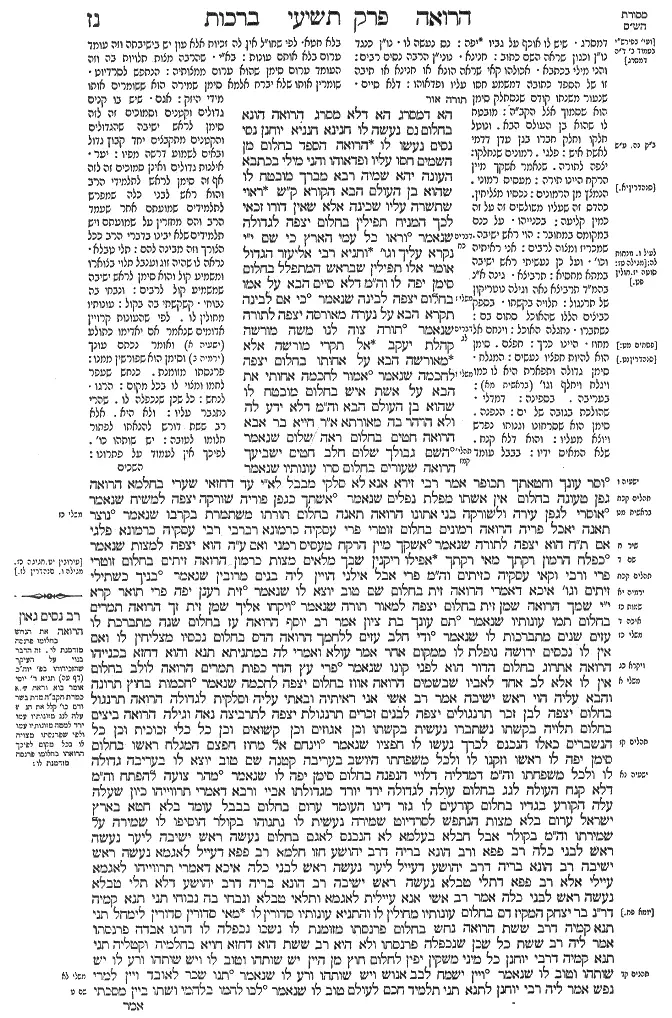
Berakhot 57a - Guemara
הא דמסרג הא דלא מסרג הרואה הונא בחלום נס נעשה לו חנינא חנניא יוחנן נסי נסים נעשו לו הרואה הספד בחלום מן השמים חסו עליו ופדאוהו והני מילי בכתבא העונה יהא שמיה רבא מברך מובטח לו שהוא בן העולם הבא הקורא קש ראוי שתשרה עליו שכינה אלא שאין דורו זכאי לכך המניח תפילין בחלום יצפה לגדולה שנאמר (דברים כח י) וראו כל עמי הארץ כי שם יי נקרא עליך וגו' ותניא רבי אליעזר הגדול אומר אלו תפילין שבראש המתפלל בחלום סימן יפה לו והמ דלא סיים הבא על אמו בחלום יצפה לבינה שנאמר (משלי ב ג) כי אם לבינה תקרא הבא על נערה מאורסה יצפה לתורה שנאמר (דברים לג ד) תורה צוה לנו משה מורשה קהלת יעקב אל תקרי מורשה אלא מאורשה הבא על אחותו בחלום יצפה לחכמה שנאמר (משלי ז ד) אמור לחכמה אחותי את הבא על אשת איש בחלום מובטח לו שהוא בן העולם הבא והמ דלא ידע לה ולא הרהר בה מאורתא אר חייא בר אבא הרואה חטים בחלום ראה שלום שנאמר (תהלים קמז יד) השם גבולך שלום חלב חטים ישביעך הרואה שעורים בחלום סרו עונותיו שנאמר (ישעיהו ו ז) וסר עונך וחטאתך תכופר אמר רבי זירא אנא לא סלקי מבבל לאי עד דחזאי שערי בחלמא הרואה גפן טעונה בחלום אין אשתו מפלת נפלים שנאמר (תהלים קכח ג) אשתך כגפן פוריה שורקה יצפה למשיח שנאמר (בראשית מט יא) אוסרי לגפן עירה ולשורקה בני אתונו הרואה תאנה בחלום תורתו משתמרת בקרבו שנאמר (משלי כז יח) נוצר תאנה יאכל פריה הרואה רמונים בחלום זוטרי פרי עסקיה כרמונא רברבי רבי עסקיה כרמונא פלגי אם תח הוא יצפה לתורה שנאמר (שיר השירים ח ב) אשקך מיין הרקח מעסיס רמני ואם עה הוא יצפה למצות שנאמר (שיר השירים ד ג) כפלח הרמון רקתך מאי רקתך אפילו ריקנין שבך מלאים מצות כרמון הרואה זיתים בחלום זוטרי פרי ורבי וקאי עסקיה כזיתים והמ פרי אבל אילני הויין ליה בנים מרובין שנאמר (תהלים קכח ג) בניך כשתילי זיתים וגו' איכא דאמרי הרואה זית בחלום שם טוב יוצא לו שנאמר (ירמיהו יא טז) זית רענן יפה פרי תואר קרא יי שמך הרואה שמן זית בחלום יצפה למאור תורה שנאמר (שמות כז כ) ויקחו אליך שמן זית זך הרואה תמרים בחלום תמו עונותיו שנאמר (איכה ד כב) תם עונך בת ציון אמר רב יוסף הרואה עז בחלום שנה מתברכת לו עזים שנים מתברכות לו שנאמר (משלי כז כז) ודי חלב עזים ללחמך הרואה הדס בחלום נכסיו מצליחין לו ואם אין לו נכסים ירושה נופלת לו ממקום אחר אמר עולא ואמרי לה במתניתא תנא והוא דחזא בכנייהו הרואה אתרוג בחלום הדור הוא לפני קונו שנאמר (ויקרא כג מ) פרי עץ הדר כפות תמרים הרואה לולב בחלום אין לו אלא לב אחד לאביו שבשמים הרואה אווז בחלום יצפה לחכמה שנאמר (משלי א כ) חכמות בחוץ תרונה והבא עליה הוי ראש ישיבה אמר רב אשי אני ראיתיה ובאתי עליה וסלקית לגדולה הרואה תרנגול בחלום יצפה לבן זכר תרנגולים יצפה לבנים זכרים תרנגולת יצפה לתרביצה נאה וגילה הרואה ביצים בחלום תלויה בקשתו נשתברו נעשית בקשתו וכן אגוזים וכן קשואים וכן כל כלי זכוכית וכן כל הנשברים כאלו הנכנס לכרך נעשו לו חפציו שנאמר (תהלים קז ל) וינחם אל מחוז חפצם המגלח ראשו בחלום סימן יפה לו ראשו וזקנו לו ולכל משפחתו היושב בעריבה קטנה שם טוב יוצא לו בעריבה גדולה לו ולכל משפחתו והמ דמדליה דלויי הנפנה בחלום סימן יפה לו שנאמר (ישעיהו נא יד) מהר צועה להפתח והמ דלא קנח העולה לגג בחלום עולה לגדולה ירד יורד מגדולתו אביי ורבא דאמרי תרווייהו כיון שעלה עלה הקורע בגדיו בחלום קורעים לו גזר דינו העומד ערום בחלום בבבל עומד בלא חטא בארץ ישראל ערום בלא מצות הנתפש לסרדיוט שמירה נעשית לו נתנוהו בקולר הוסיפו לו שמירה על שמירתו והמ בקולר אבל חבלא בעלמא לא הנכנס לאגם בחלום נעשה ראש ישיבה ליער נעשה ראש לבני כלה רב פפא ורב הונא בריה דרב יהושע חזו חלמא רב פפא דעייל לאגמא נעשה ראש ישיבה רב הונא בריה דרב יהושע דעייל ליער נעשה ראש לבני כלה איכא דאמרי תרווייהו לאגמא עיילי אלא רב פפא דתלי טבלא נעשה ראש ישיבה רב הונא בריה דרב יהושע דלא תלי טבלא נעשה ראש לבני כלה אמר רב אשי אנא עיילית לאגמא ותלאי טבלא ונבחי בה נבוחי תני תנא קמיה דרנ בר יצחק המקיז דם בחלום עונותיו מחולין לו והתניא עונותיו סדורין לו מאי סדורין סדורין לימחל תני תנא קמיה דרב ששת הרואה נחש בחלום פרנסתו מזומנת לו נשכו נכפלה לו הרגו אבדה פרנסתו אמר ליה רב ששת כל שכן שנכפלה פרנסתו ולא היא רב ששת הוא דחזא חויא בחלמיה וקטליה תני תנא קמיה דרבי יוחנן כל מיני משקין יפין לחלום חוץ מן היין יש שותהו וטוב לו ויש שותהו ורע לו יש שותהו וטוב לו שנאמר (תהלים קד טו) ויין ישמח לבב אנוש ויש שותהו ורע לו שנאמר (משלי לא ו) תנו שכר לאובד ויין למרי נפש אמר ליה רבי יוחנן לתנא תני תלמיד חכם לעולם טוב לו שנאמר (משלי ט ה) לכו לחמו בלחמי ושתו ביין מסכתי
Comments from Rashi on Masechet Berakhot Page 57a
דמסרג . שיש לו אוכף על גביו יפה: נס נעשה לו . נו"ן כנגד נו"ן וכגון שראה השם כתוב: חנינא . נוני"ן הרבה נסים רבים: והני מילי בכתבא . אכולהו קאי שראה הונא או חנינא או תיבה זו של הספד כתובה דמשמע חסו עליו ופדאוהו: דלא סיים . שנעור משנתו קודם שנסתלק סימן הוא שסמוך אצל הקב"ה: מובטח לו שהוא בן העולם הבא . ונוטל חלקו וחלק חברו בגן עדן דדמי לאשת איש: פלגי . רמונים שנחלקו: יצפה לתורה . שנאמר אשקך מיין הרקח היינו תורה: מעסיס רמוני . הנמצץ מן הרמונים: נכסיו מצליחין . כהדס זה שעליו משולשים זה על זה כמין קליעה: בכנייהו . על כנם במקומם במחובר: הוי ראש ישיבה . שמכריז ומצוה לרבים: אני ראיתיה וכו' . ועל כן נעשיתי ראש ישיבה במתא מחסיא: תרביצא . גינה א"נ בהמ"ד תרביצא נאה וגילה נוטריקון של תרנגול: תלויה בקשתו . בספק כביצים הללו שהאוכל סתום בם: נשתברו . נתגלה האוכל: וינחם אל מחוז . היינו כרך: חפצם . סימן הוא להיות חפציו נעשים: המגלח . סימן גדולה ותפארת היא לו כמו ויגלח ויחלף וגו' (בראשית מא): בעריבה . בספינה: דמדלי . שהולכת בגובה של ים: הנפנה . סימן הוא שסרחונו וגנותו נפרש ויוצא מעליו: והוא דלא קנח . שלא המאיס ידיו: בבבל עומד בלא חטא . לפי שחו"ל אין לה זכיות אלא עון יש בישיבתה וזה עומד ערום בלא אותם עונות: בא"י . שהרבה מצות תלויות בה וזה העומד ערום סימן שהוא ערום ממצותיה: הנתפש לסרדיוט . שומרין אותו שלא יברח אלמא סימן שמירה הוא ששומרים אותו מידי היזק: אגם . שיש בו קנים גדולים וקטנים וסמוכים זה לזה סימן לראש ישיבה שהגדולים והקטנים מתקבצים יחד קבוץ גדול ובאים לשמוע דרשה מפיו: יער . אילנות גדולים ואינן סמוכים זה לזה אף זה סימן לראש לתלמידי הרב והוא ראש לבני כלה שמפרש לתלמידים שמועתם אחר שעמד הרב והם מחזרין על שמועתם ויש תלמידים שלא יבינו בדברי הרב ככל הצורך וזה מבינה להם: תלי טבלא . נראה לו שהיה זוג וענבל תלוי בצוארו ומשמיע קול והוא סימן לראש ישיבה שמשמיע קול לרבים: ונבחי בה נבוחי . קשקשתי בה בקול: עונותיו מחולין לו . לפי שהעונות קרויין אדומים שנאמר אם יאדימו כתולע (ישעיהו א) ואומר נכתם עונך (ירמיהו ב') וסימן הוא שפורשין ממנו: פרנסתו מזומנת . כנחש שעפר לחמו ומצוי לו בכל מקום: הרגו . לנחש: כל שכן שנכפלה לו . שהרי נתגבר עליו: ולא היא . אלא רב ששת דורש להנאתו לפתור חלומו לטובה: יש שותהו כו' . לפיכך אין לעמוד על פתרונו:
Berakhot 57a - Mishnah translated into english
This opinion, that seeing an elephant is a good omen, refers to a case where one saw it saddled, while this opinion, that it is a bad omen, refers to a case where the elephant is not saddled. One who sees a man named Huna in a dream, it is a sign that a miracle will be performed for him, because the letter nun in the name Huna represents the word nes, miracle. One who sees a man named Ḥanina, Ḥananya, or Yoḥanan, it is a sign that many miracles will be performed for him, since the letter nun appears twice in those names. One who sees a eulogy in a dream, it is a sign that the heavens had mercy upon him, and spared him from a divine death sentence and there will be no need to eulogize him in reality. The Gemara restricts this statement and says that this only applies if he saw the eulogy written and not yet delivered.
One who answers in a dream: May His great name be blessed from kaddish is assured that he is one who has a place in the World-to-Come. One who sees himself reciting Shema in a dream is worthy of having the Divine Presence rest upon him, but his generation is unworthy, and, therefore, the Divine Presence does not actually rest upon him.
One who sees himself don phylacteries in a dream should anticipate greatness, as it is stated: “And all the peoples of the earth shall see that the name of the Lord is called upon you; and they shall be afraid of you” (Deuteronomy 28:10). And it was taught in a baraita that Rabbi Eliezer the Great says: That the Name of the Lord is called upon you, refers to phylacteries of the head, as they represent God’s name upon man. One who sees himself pray in a dream, it is an auspicious omen. However, the Gemara adds a caveat and says: This only applies in a case where he saw in the dream that he had not yet finished his prayer and is therefore still close to God. If, in the dream, he had already finished his prayer, it is not an omen.
One who sees that he had relations with his mother [em] in a dream, he should anticipate attaining understanding, as it is stated: “Yea if [im] you call for understanding” (Proverbs 2:3), and in this homiletic interpretation im is considered to be the equivalent of em. One who sees that he had relations with a betrothed young woman in a dream, he should anticipate Torah, as it is stated: “Moses commanded us Torah, an inheritance [morasha] of the congregation of Jacob” (Deuteronomy 33:4). Do not read it as morasha; rather, read it as me’orasa, betrothed. One who sees that he had relations with his sister in a dream, should anticipate wisdom, as it is stated: “Say unto wisdom: You are my sister” (Proverbs 7:4). One who sees that he had relations with a married woman in a dream is assured that he is one who has a place in the World-to-Come. He receives his place as well as that of another person in the Garden of Eden, as the married woman represents a portion belonging to someone else. However, the Gemara adds a caveat and says: This only applies in a case where he did not know her and was not thinking about her that evening; rather, he saw an unidentified woman in his dream by chance.
Rabbi Ḥiyya bar Abba said: One who sees wheat in a dream has seen peace, as it is stated: “He makes your borders peace; He gives you in plenty the fat of wheat” (Psalms 147:14). And one who sees barley [se’orim] in a dream has received a sign that his iniquities are taken away, as it is stated: “And your iniquity is taken away [vesar avonekh], and your sin expiated” (Isaiah 6:7); se’orim is an acronym for sar avon. Rabbi Zeira said: I did not ascend from Babylonia to Eretz Yisrael until I saw barley in my dream.
One who sees a vine laden with grapes in a dream, it is an omen that his wife will not miscarry, as it is stated: “Your wife shall be as a fruitful vine, in the innermost parts of your house” (Psalms 128:3). One who sees a planted vine branch in a dream should anticipate the Messiah, as it is stated: “Binding his foal unto the vine and his donkey’s colt unto the vine branch” (Genesis 49:11).
One who sees a fig tree in a dream, it is a sign that his Torah is preserved within him, as it is stated: “One who keeps the fig tree shall eat the fruit thereof” (Proverbs 27:18). One who sees pomegranates in a dream, if they were small, his business will flourish like the seeds of the pomegranate, which are numerous; and if they were large, his business will increase like a pomegranate. One who saw slices of pomegranates in his dream, if he is a Torah scholar, he should anticipate Torah, as it is stated: “I would cause you to drink of spiced wine, of the juice of my pomegranate” (Song of Songs 8:2), which is traditionally understood as an allusion to Torah. And if the dreamer is an ignoramus, he should anticipate mitzvot, as it is stated: “Your temples are like a split pomegranate” (Song of Songs 4:3). As the Gemara previously interpreted homiletically: What is the meaning of the word “Your temples [rakatekh]”? Even the most ignorant [reikanin] among you, Israel, are full of mitzvot like a pomegranate.
One who sees olives in a dream, and they were small, it is a sign that his business will flourish, increase and be durable like olives. However, the Gemara adds a caveat, saying that this applies only when he sees the fruit of an olive tree; but, one who sees olive trees, it is a sign that he will have many children, as it is stated: “Your children like olive plants, round about your table” (Psalms 128:3). Some say that one who sees an olive tree in a dream, it is a sign that a good reputation will spread for him, as it is stated: “The Lord called your name a leafy olive tree, fair with goodly fruit” (Jeremiah 11:16). One who sees olive oil in a dream should anticipate the light of Torah, as it is stated: “That they bring unto you pure olive oil beaten for the light” (Exodus 27:20). One who sees palm trees [temarim] in a dream has seen a sign that his transgressions have ceased, as it is stated: “Your iniquity is finished, O daughter of Zion” (Lamentations 4:22), as the Gemara likens temara, date, to tam ra, evil has ceased.
Rav Yosef says: One who sees a goat in a dream, it is a sign that his year will be blessed; one who sees goats, his years will be blessed, as it is stated: “And there will be goats’ milk enough for your food, for the food of your household; and sustenance for your maidens” (Proverbs 27:27). One who sees myrtle in a dream, it is a sign that his property will be successful. And if he does not own property, it is a sign that he will receive an inheritance. Ulla said, and some say it was taught in a baraita: This applies exclusively to a case where he saw them on their stem. One who sees a citron [etrog] in a dream has seen a sign that he is honored [hadur] before his Creator, as it is stated with regard to the citron: “The fruit of goodly trees [hadar], branches of palm trees” (Leviticus 23:40). One who sees a palm branch [lulav] in a dream, it is a sign that he has but one heart for his Father in heaven. Lulav is interpreted homiletically as lo lev, he has a heart.
One who sees a goose in a dream should anticipate wisdom, as it is stated: “Wisdoms cry aloud in the streets, she utters her voice in the broad places” (Proverbs 1:20); geese tend to sound their voices. One who dreams that he has relations with the goose will become head of the yeshiva. Rav Ashi said: I saw a goose and had relations with it in my dream and I ascended to greatness and became head of the yeshiva.
One who sees a rooster in a dream should anticipate a male child. One who sees multiple roosters should expect male children. One who sees a hen [tarnegolet] should anticipate a beautiful garden and reason to rejoice [tarbitza na’a vegila], as tarnegolet is interpreted as an acronym for tarbitza na’a vegila. One who sees eggs in a dream, it is a sign that his request is pending, as egg in Aramaic is beya, which is similar to the term for request. If one saw that the eggs broke, it is a sign that his request has already been granted, as that which was hidden inside the shell was revealed. The same is true of nuts, and the same is true of cucumbers, and the same is true of all glass vessels, and the same is true of anything similarly fragile that broke in his dream, it is a sign that his request was granted.
One who dreams that he entered a city, it is a sign that his desires will be fulfilled, as it is stated: “And He led them unto their desired haven” (Psalms 107:30). One who shaves his head in a dream, it is a good omen for him, as the removal of undesired hairs is a sign of renewal and greatness. If he shaved his head and his beard in a dream, it is a good omen for him and his entire family.
One who sits in a small boat in a dream, it is a sign that a good reputation will spread for him. If he sees himself sitting in a large boat in a dream, a good reputation will spread for him and his entire family. The Gemara notes that this only applies where the boat was floating high on the waves.
One who defecates in a dream, it is a good omen for him, as it is stated: “He that is bent down shall speedily be loosed; and he shall not go down dying into the pit, neither shall his bread fail” (Isaiah 51:14). The Gemara notes that this only applies where he does not wipe and get his hands dirty.
One who climbs up to the roof in a dream, it is a sign that he will ascend to greatness. If, after he climbed up, he climbed back down, it is a sign that he will descend from the greatness he achieved. Abaye and Rava both said: Once one ascended to the roof in his dream, he ascended, and even if he dreams that he descended, it remains a good omen for him. One who rips his clothing in a dream, it is a sign that they rip up his sentence. One who stands naked in Babylonia in a dream, it is a sign that he stands free of transgression. Although living outside Israel is itself a transgression, his nakedness symbolizes that he has been absolved of that sin. If one dreamed that he stood naked in Eretz Yisrael, it is a sign that he is naked without mitzvot. One who dreams that he was apprehended and guarded by a soldier [sardeyot], it is a sign that protection was provided him by heaven. If he sees that he is wearing a neck chain [kolar], it is a sign that they have increased his level of protection. However, the Gemara notes that this only applies to a case where his neck was placed in a neck chain; if his neck was simply placed in a noose, it does not indicate heavenly protection.
One who enters a marsh in a dream, it is a sign that he will become head of a yeshiva, as he appears to be standing alone with all the bulrushes, large and small, surrounding him like the head of a yeshiva, around whom all the students gather. One who dreams that he entered a forest and sees only large trees around him, it is a sign that he will be made head of only the advanced students [kalla], where he will explain the lessons only to the outstanding students in the yeshiva, each of whom is himself a great tree, set apart from the others.
The Gemara relates: Rav Pappa and Rav Huna, son of Rav Yehoshua, each saw a dream: Rav Pappa, who saw that he entered a marsh in his dream, was appointed head of a yeshiva. Rav Huna, son of Rav Yehoshua, who saw that he entered a forest in his dream, was appointed head of the advanced students. Some say that both of them dreamed that they entered a marsh, but Rav Pappa, who dreamed that a drum hung from his neck, was appointed head of the yeshiva, as banging a drum symbolizes the head of a yeshiva who sounds his voice in public. Rav Huna, son of Rav Yehoshua, who did not dream that a drum hung around his neck, was only appointed head of the advanced students. Rav Ashi said: I dreamed that I entered a marsh and hung a drum and beat it, and Rav Ashi became head of the yeshiva.
The tanna who recited mishnayot before Rav Naḥman bar Yitzḥak taught: One who lets blood in a dream, it is a sign that his transgressions have been forgiven, because red, the color of blood, is a metaphor for sin: “Though your sins be as scarlet…though they be red like crimson” (Isaiah 1:18). Consequently, bloodletting can symbolize transgressions leaving him.
The Gemara asks: Was it not taught in a baraita: One who sees that he is letting-blood in a dream, it is a sign that his transgressions are enumerated before him? The Gemara answers: What is meant by enumerated? This means that they are enumerated to be forgiven.
The tanna who recited mishnayot before Rav Sheshet taught: One who sees a snake in a dream, it is a sign that his livelihood is accessible to him just as dust is readily accessible to a snake. If one saw that the snake bit him in his dream, it is a sign that his livelihood will double. If he killed the snake, it is a sign that he will lose his livelihood. Rav Sheshet said to the tanna: On the contrary, if one dreamed that he killed the snake it is a sign that all the more so his livelihood will double. The Gemara remarks: But that is not so. Rav Sheshet saw a snake in his dream and killed it, so he sought to interpret his dream positively.
The tanna who recited mishnayot before Rabbi Yoḥanan taught: One who sees any kind of drink in a dream it is a good omen, except for wine, as there is one who drinks it in a dream and it is a good omen for him, and there is one who drinks it in a dream and it is a bad omen for him. The Gemara elaborates: There is one who drinks wine and it is a good omen for him, as it is stated: “And wine that makes glad the heart of man” (Psalms 104:15), and there is one who drinks it in a dream and it is a bad omen for him, as it is stated: “Give strong drink unto him that is ready to perish and wine unto the bitter in soul” (Proverbs 31:6).
Rabbi Yoḥanan said to the tanna: You should teach that for a Torah scholar, a dream of wine is always a good omen, as it is stated: “Come, eat of my bread and drink of the wine which I have mingled” (Proverbs 9:5).
Traduction : The William Davidson digital edition of the Koren Noé Talmud, with commentary by Rabbi Adin Even-Israel Steinsaltz.