 Talmud Bavli
Berakhot 30b : Youtube
Daf TubeYoutube
2 video classes :
Berakhot Page 30b
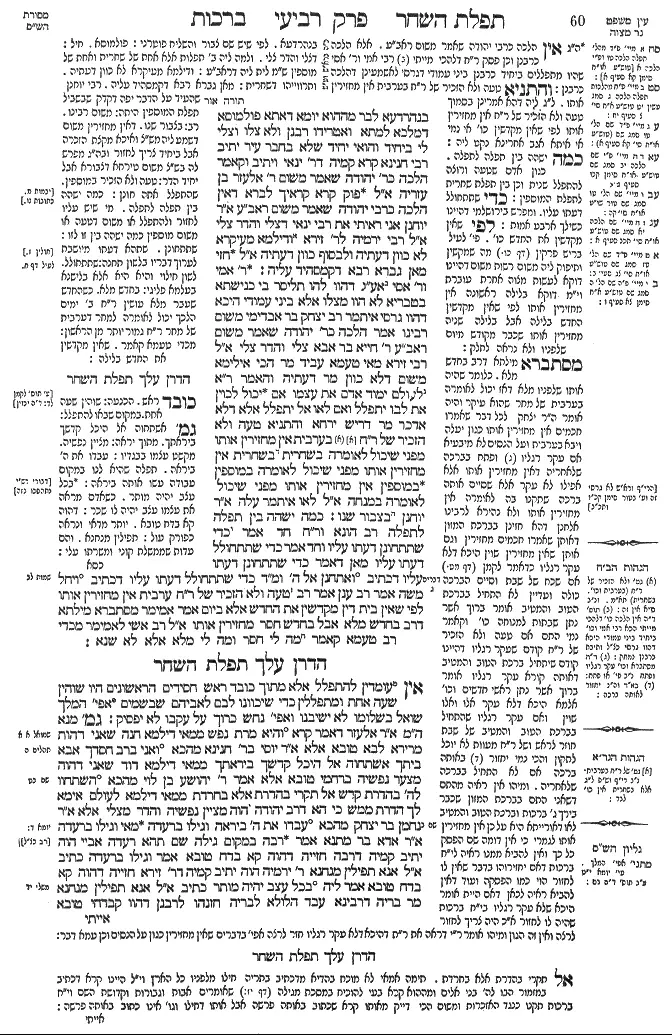
Berakhot 30b - Guemara
בנהרדעא לבר מההוא יומא דאתא פולמוסא דמלכא למתא ואטרידו רבנן ולא צלו וצלי לי ביחיד והואי יחיד שלא בחבר עיר יתיב רבי חנינא קרא קמיה דר' ינאי ויתיב וקאמר הלכה כר' יהודה שאמר משום ר' אלעזר בן עזריה אל פוק קרא קראיך לברא דאין הלכה כרבי יהודה שאמר משום ראבע אר יוחנן אני ראיתי את רבי ינאי דצלי והדר צלי אל רבי ירמיה לר' זירא ודילמא מעיקרא לא כוון דעתיה ולבסוף כוון דעתיה אל חזי מאן גברא רבא דקמסהיד עליה:
ר' אמי ור' אסי אעג דהוו להו תליסר בי כנישתא בטבריא לא הוו מצלו אלא ביני עמודי היכא דהוו גרסי איתמר רב יצחק בר אבדימי משום רבינו אמר הלכה כר' יהודה שאמר משום ראבע ר' חייא בר אבא צלי והדר צלי אל רבי זירא מאי טעמא עביד מר הכי אילימא משום דלא כוון מר דעתיה והאמר רא לעולם ימוד אדם את עצמו אם יכול לכוין את לבו יתפלל ואם לאו אל יתפלל אלא דלא אדכר מר דריש ירחא והתניא טעה ולא הזכיר של רח בערבית אין מחזירין אותו מפני שיכול לאומרה בשחרית בשחרית אין מחזירין אותו מפני שיכול לאומרה במוספין במוספין אין מחזירין אותו מפני שיכול לאומרה במנחה אל לאו איתמר עלה אר יוחנן בצבור שנו:
כמה ישהה בין תפלה לתפלה רב הונא ורח חד אמר כדי שתתחונן דעתו עליו וחד אמר כדי שתתחולל דעתו עליו מאן דאמר כדי שתתחונן דעתו עליו דכתיב (דברים ג כג) ואתחנן אל ה' ומד כדי שתתחולל דעתו עליו דכתיב (שמות לב יא) ויחל משה אמר רב ענן אמר רב טעה ולא הזכיר של רח ערבית אין מחזירין אותו לפי שאין בית דין מקדשין את החדש אלא ביום אמר אמימר מסתברא מילתא דרב בחדש מלא אבל בחדש חסר מחזירין אותו אל רב אשי לאמימר מכדי רב טעמא קאמר מה לי חסר ומה לי מלא אלא לא שנא:
הדרן עלך תפלת השחר
מתני׳ אין עומדין להתפלל אלא מתוך כובד ראש חסידים הראשונים היו שוהין שעה אחת ומתפללין כדי שיכוונו לבם לאביהם שבשמים אפי' המלך שואל בשלומו לא ישיבנו ואפי' נחש כרוך על עקבו לא יפסיק:
גמ׳ מנא המ אר אלעזר דאמר קרא (שמואל א א י) והיא מרת נפש ממאי דילמא חנה שאני דהות מרירא לבא טובא אלא אר יוסי בר' חנינא מהכא (תהלים ה ח) ואני ברב חסדך אבא ביתך אשתחוה אל היכל קדשך ביראתך ממאי דילמא דוד שאני דהוה מצער נפשיה ברחמי טובא אלא אמר ר' יהושע בן לוי מהכא (תהלים כט ב) השתחוו לה' בהדרת קדש אל תקרי בהדרת אלא בחרדת ממאי דילמא לעולם אימא לך הדרת ממש כי הא דרב יהודה הוה מציין נפשיה והדר מצלי אלא אר נחמן בר יצחק מהכא (תהלים ב יא) עבדו את ה' ביראה וגילו ברעדה מאי וגילו ברעדה אר אדא בר מתנא אמר רבה במקום גילה שם תהא רעדה אביי הוה יתיב קמיה דרבה חזייה דהוה קא בדח טובא אמר וגילו ברעדה כתיב אל אנא תפילין מנחנא ר' ירמיה הוה יתיב קמיה דר' זירא חזייה דהוה קא בדח טובא אמר ליה (משלי יד כג) בכל עצב יהיה מותר כתיב אל אנא תפילין מנחנא מר בריה דרבינא עבד הלולא לבריה חזנהו לרבנן דהוו קבדחי טובא
Comments from Rashi on Masechet Berakhot Page 30b
בנהרדעא . לפי שיש שם צבור והשליח פוטרני: פולמוסא . חיל: דצלי והדר צלי . ולמה ליה ב' תפלות אלא אחת של שחרית ואחת של מוספין ש"מ לית ליה דראב"ע: ודילמא מעיקרא לא כוון דעתיה . ותרווייהו דשחרית: מאן גברא רבא דקמסהיד עליה . רבי יוחנן שהעיד על הדבר יפה דקדק שבשביל תפלת המוספין היתה: משום רבינו . רב: טעה ולא הזכיר במוספין . שהתפלל אתה חונן: בצבור שנו . דאין מחזירין משום דשמע ליה מש"צ ואיכא מקצת הזכרה אבל ביחיד צריך לחזור ובה"ג מפרש לה בש"צ משום טירחא דצבורא אבל יחיד הדר: כמה ישהה בין תפלה לתפלה . מי שיש עליו לחזור ולהתפלל או משום דטעה או משום מוספין כמה ישהה בין זו לזו: שתתחונן . שתהא דעתו מיושבת לערוך דבריו בלשון תחנה: שתתחולל . לשון חילוי והיא היא אלא בלישנא בעלמא פליגי: בחדש מלא . כשהחדש שעבר מלא עושין ר"ח ב' ימים הלכך יכול לאומרה למחר דערבית של מחר ר"ח גמור יותר מן הראשון: מכדי טעמא קאמר . שאין מקדשין את החדש בלילה: הדרן עלך תפלת השחר כובד ראש . הכנעה: שוהין שעה אחת . במקום שבאו להתפלל: גמ' אשתחוה אל היכל קדשך ביראתך . מתוך יראה: מציין נפשיה . מקשט עצמו בבגדיו: עבדו את ה' ביראה . תפלה שהיא לנו במקום עבודה עשו אותה ביראה: דהוה קא בדח טובא . יותר מדאי ונראה כפורק עול: תפילין מנחנא . והם עדות שממשלת קוני ומשרתו עלי: בכל עצב יהיה מותר . כשאדם מראה את עצמו עצב יהיה לו שכר:
Comments from Tosafot - Berakhot 30b
ה״ג אין הלכה כרבי יהודה שאמר משום ראב"ע . אלא הלכה כרבנן וכן פסק ר"ח דלהכי מייתי רבי אמי ור' אסי שהיו מתפללים ביחיד כרבנן ביני עמודי דגרסי לאשמעינן דהלכה כרבנן: והתניא טעה ולא הזכיר של ר"ח בערבית אין מחזירין אותו . ל"ג ליה דהא אמרינן בסמוך טעה ולא הזכיר של ר"ח אין מחזירין אותו לפי שאין מקדשין כו' אי נמי אי איתא אגב אחרינא נקט ליה: כמה ישהה בין תפלה לתפלה . כגון אדם שטעה ורוצה להתפלל שנית וכן בין תפלת שחרית לתפלת המוספין: כדי שתתחולל דעתו עליו . ומפרש בירושלמי דהיינו כשילך ארבע אמות: לפי שאין מקדשין את החדש כו' . פי' לעיל בריש פרקין (ברכות כו א) מה שמקשין ותיפוק ליה משום רשות משום דהיינו דוקא לעשות מצוה אחרת עוברת וי"מ דוקא בלילה ראשונה אין מחזירין אותו לפי שאין מקדשין החדש בלילה אבל בלילה שניה מחזירין אותו שכבר מקודש מיום שלפניו ולא נראה לחלק: מסתברא מילתא דרב בחדש מלא . כלומר שהיה אותו שלפניו מלא דאז יכול לאומרה בערבית של מחר שהוא עיקר והיה אומר ה"ר יצחק לכל דבר שאמרו חכמים אין מחזירין אותו כגון יעלה ויבא בערבית ועל הנסים לא מיבעיא אם עקר רגליו ופתח בברכה שלאחריה דאין מחזירין אותו אלא אפילו לא עקר אלא שסיים אותה ברכה שתקנו בה לאומרה אין מחזירין אותו ולא נהירא לרבינו אלחנן דהא חזינן בברכת המזון דאותן שאמרו חכמים מחזירין וגם אותן שאין מחזירין שוין היכא דלא עקר רגליו כדאמר לקמן (ברכות מט א) אם שכח של שבת וסיים הברכה כולה ועדיין לא התחיל בברכת הטוב והמטיב אומר ברוך אשר נתן שבתות למנוחה כו' וקאמר נמי התם אם טעה ולא הזכיר של ר"ח קודם שעקר רגליו דהיינו קודם שיתחיל ברכת הטוב והמטיב דאותה קורא עקר רגליו אומר ברוך אשר נתן ראשי חדשים וכו' אלמא היכא דלא עקר אלו ואלו שוין ואם עקר רגליו שהתחיל בברכת הטוב והמטיב של שבת חוזר לראש ושל ר"ח מעוות לא יוכל לתקון והכי נמי יחזור באותה ברכה אם לא התחיל בברכה שלאחריה. ומיהו אין ראיה מהתם דשאני התם בברכת המזון שכבר בירך ג' ברכות וברכת הטוב והמטיב לאו דאורייתא היא על כן אין מחזירין אותו לגמרי כי אין דומה שם הפסק כל כך ואין להביא ממנו ראיה לי"ח ברכות דאם יחזירוהו בדבר שאין לו לחזור הוי כמו הפסקה ועוד דאין להביא ראיה לכאן דאם היית אומר היכא שלא עקר רגליו בי"ח ברכות שהיה לו לחזור א"כ היה צריך לחזור לרצה ואין זה הגון ומיהו אומר ר"י דראה את ר"ת דהיכא דלא עקר רגליו חזר לרצה אפי' בדברים שאין מחזירין כגון על הנסים וכן עמא דבר: הדרן עלך תפלת השחר אל תקרי בהדרת אלא בחרדת . תימה אמאי לא מוכח בהדיא מדכתיב בתריה חילו מלפניו כל הארץ וי"ל היינו קרא דכתיב במזמור הבו לה' בני אלים ומההוא קרא בעי להוכיח במסכת מגילה (יז ב) שאומרים אבות וגבורות וקדושת השם וי"ח ברכות תקנו כנגד האזכרות ומשום הכי דייק מאותו קרא שכתוב באותה פרשה אבל אותו דחילו וגו' אינו כתוב באותה פרשה: במקום גילה שם תהא רעדה . פשוטו של מקרא עבדו את ה' ביראה וכשיבא יום רעדה תגילו והכי מפורש בירושלמי עבדו את ה' ביראה היינו תפלה דאיקרי עבודה כדתניא בספרי (פ' עקב) ולעבדו בכל לבבכם זו תפלה:
Berakhot 30b - Mishnah translated into english
in Neharde’a, where there is always a prayer quorum, except for the day when the king’s army [pulmusa] came to the city, and the Sages were preoccupied and did not pray communally, and I prayed as an individual, and I was an individual who was not praying in a prayer quorum. Shmuel’s conduct was in accordance with the opinion of Rabbi Yehuda in this matter.
Yet this opinion was not universally accepted. The Gemara relates: Rabbi Ḥanina Kara, the Bible expert, sat before Rabbi Yannai, and he sat and he said: The halakha is in accordance with the opinion of Rabbi Yehuda who said it in the name of Rabbi Elazar ben Azarya. Rabbi Yannai said to him: Go and read your verses outside, as that halakha is not accepted by the Sages in the study hall, and it belongs outside, as the halakha is not in accordance with the opinion of Rabbi Yehuda who said it in the name of Rabbi Elazar ben Azarya.
Rabbi Yoḥanan said: I saw Rabbi Yannai, who prayed and then prayed again. Presumably, his first prayer was the morning prayer and his second prayer was the additional prayer. Apparently, he does not hold in accordance with the opinion of Rabbi Elazar ben Azarya. Rather, he holds that even when not part of a prayer quorum, an individual must recite the additional prayer. Later on, when this story was related in the study hall, Rabbi Yirmeya said to his teacher, Rabbi Zeira: What proof is there that the second prayer was the additional prayer? Perhaps initially he did not focus his mind on his prayer and ultimately he focused his mind, i.e., he repeated the morning prayer in order to do so with proper concentration. Rabbi Zeira said to him: Look at who the great man is who is testifying about him. Rabbi Yoḥanan certainly observed carefully before relating what he witnessed.
Regarding prayers of the Sages, the Gemara further relates that, although there were thirteen synagogues in Tiberias, Rabbi Ami and Rabbi Asi would only pray between the columns where they studied, as prayer is beloved in the eyes of God, specifically in a place of Torah.
It was stated: Rav Yitzḥak bar Avdimi in the name of Rabbeinu, Rav, said: The halakha is in accordance with the opinion of Rabbi Yehuda who said it in the name of Rabbi Elazar ben Azarya. The Gemara relates: Rabbi Ḥiyya bar Abba prayed and then prayed again. Rav Zeira said to him: Why did the Master do this? If you say because the Master did not focus his mind the first time, didn’t Rabbi Eliezer say: One must always evaluate himself before he prays? If he is able to focus his heart on prayer, he should pray, but if not, if he is unable to do so, he should not pray. Apparently, that was not the reason that he prayed twice. Rather, because my Master did not mention the New Moon in his prayer, so he prayed again.
The Gemara asks: Wasn’t it taught in a baraita: One who erred and did not mention the New Moon in the evening prayer, we do not require him to return to the beginning of the prayer and repeat it, because he can recite it in the morning prayer. One who erred and did not mention the New Moon in the morning prayer, we do not require him to return to the beginning of the prayer and repeat it, because he can recite it in the additional prayer. One who erred and did not mention the New Moon in the additional prayer, we do not require him to return to the beginning of the prayer and repeat it, because he can recite it in the afternoon prayer? Omitting mention of the New Moon does not require one to repeat the Amida prayer. Consequently, that was not the reason that Rabbi Ḥiyya bar Abba prayed a second time.
Rabbi Ḥiyya bar Abba said to him: Wasn’t it stated about that baraita that Rabbi Yoḥanan said: They taught this baraita specifically with regard to prayer in a communal framework? However, an individual who fails to mention the New Moon is required to pray again? That is why Rabbi Ḥiyya bar Abba prayed twice.
Stemming from the discussion about individuals who recite two prayers consecutively, the Gemara asks: How long should one wait between the first prayer and the second prayer? Rav Huna and Rav Ḥisda agreed about this in principle, but they formulated their opinions differently (Rashi). One said that an individual must wait long enough so that his mind will be in a pleading mode [titḥonen], enabling him to recite the second prayer as a plea. One of them said: Long enough so that his mind will be in a beseeching mode [titḥolel], enabling him to beseech God in his second prayer.
The Gemara points out that both Rav Huna and Rav Ḥisda based their positions on the prayers of Moses. The one who said: So that his mind will be in a pleading mode [titḥonen], as it is written: “And I pleaded [va’etḥanan] before the Lord” (Deuteronomy 3:23). And the one who said: So that his mind will be in a beseeching mode [titḥolel] as it is written: “And Moses besought [vayeḥal] the Lord” (Exodus 32:11).
The Gemara resumes the above discussion with regard to omission of the mention of the New Moon in the Amida prayer. Rav Anan said that Rav said: One who erred and did not mention the New Moon in the evening prayer, we do not require him to return to the beginning of the prayer and repeat it, because the court only sanctifies the new month by day, and the prayer of the New Moon, which parallels the court’s sanctification of the new month, belongs in the daytime prayer.
Ameimar said: Rav’s statement is reasonable in a full month, i.e., a month in which there are two potential days of the New Moon, the thirtieth day of the previous month and the first day of the new month. If one neglected to mention the New Moon on the night of the thirtieth, we do not require him to return to the beginning of the prayer and repeat it, because he can mention it the next night, which is the night of the first of the new month, which is the primary day of the New Moon. But in a short month of twenty-nine days, followed by one day of the New Moon, we require him to return to the beginning of the prayer and repeat it, even in the evening prayer.
Rav Ashi said to Ameimar: Since Rav states a reason for his statement, what difference is there to me if the month is short, and what difference is there to me if it is full? Rather, there is no difference. Rav based his opinion on the parallel drawn between the sanctification of the month and the mention of the New Moon in the Amida prayer; the sanctification of the month is not relevant at night.
May we return unto thee : The morning Tefillah !
MISHNA: One may only stand and begin to pray from an approach of gravity and submission. There is a tradition that the early generations of pious men would wait one hour, in order to reach the solemn frame of mind appropriate for prayer, and then pray, so that they would focus their hearts toward their Father in Heaven. Standing in prayer is standing before God and, as such, even if the king greets him, he should not respond to him; and even if a snake is wrapped on his heel, he should not interrupt his prayer.
GEMARA: We learned in the mishna that prayer should be undertaken in an atmosphere of gravity. The Gemara asks: From where are these matters derived? Rabbi Elazar said: They are derived from the verses describing the prayer of Hannah, mother of Samuel, as the verse states: “And she felt bitterness of soul, and she prayed to the Lord and she wept and wept” (I Samuel 1:10).
The Gemara rejects this proof: From what does that conclusion ensue? Perhaps Hannah is different, as her heart was extremely embittered, her prayer was embittered as well. This does not prove that everyone must pray in that frame of mind.
Rather, Rabbi Yosei, son of Rabbi Ḥanina, said, it can be proved from here, as David said: “But as for me, by Your abundant loving-kindness I will enter Your house, at Your Holy Temple I will bow in reverence for You” (Psalms 5:8). Entering into prayer like entering the Holy Temple must be performed reverentially.
The Gemara rejects this proof as well: From what does that conclusion ensue? Perhaps David is different, as he would excessively afflict himself in prayer in order to atone for his transgression with Bathsheba. Consequently, his cannot serve as a paradigm for proper conduct in prayer. Rather, Rabbi Yehoshua ben Levi said, it can be derived from here, from this verse that David said, not about his own worship, but about worship of God in general: “Give, unto the Lord, the honor of His name, bow to the Lord in the beauty of holiness [behadrat kodesh]” (Psalms 29:2). Do not read: In the beauty of [behadrat] holiness. Rather read: In trembling of [beḥerdat] holiness; one must enter into prayer from an atmosphere of gravity engendered by sanctity.
The Gemara rejects this too: From what does that conclusion ensue? Perhaps, actually I would say to you that it should be read as it is written: Specifically, “in the beauty,” and it means that one should pray in beautiful clothing, as in the case of Rav Yehuda who would adorn himself and then pray. Rav Yehuda believed that one who comes before the King must wear his most beautiful clothing. The Gemara has yet to find a source for the halakha that one must approach prayer from an atmosphere of gravity. Rather, Rav Naḥman bar Yitzḥak said it can be derived from here, from this verse: “Serve the Lord in fear and rejoice with trembling” (Psalms 2:11).
Having cited this verse from Psalms, the Gemara asks: What is the meaning of rejoice with trembling? Rav Adda bar Mattana said that Rabba said: One may not experience unbridled joy; even where there is rejoicing, there should be trembling.
On that note, the Gemara relates: Abaye was sitting before his teacher Rabba, and Rabba saw that he was excessively joyful. He said to Abaye: It is written: Rejoice with trembling, one’s joy should not be unrestrained.
Abaye said to him: It is permissible for me because I am donning phylacteries now and as long as they are upon me they ensure that the fear of God is upon me.
Similarly, the Gemara relates that Rabbi Yirmeya was sitting before Rabbi Zeira. He saw that Rabbi Yirmeya was excessively joyful. He said to him: It is written: “In all sorrow there is profit” (Proverbs 14:23); sorrow is appropriate, not excessive joy.
Rabbi Yirmeya said to him: It is permissible for me because I am donning phylacteries.
On a similar note, the Gemara relates: Mar, son of Ravina, made a wedding feast for his son and he saw the Sages, who were excessively joyous.
Traduction : The William Davidson digital edition of the Koren Noé Talmud, with commentary by Rabbi Adin Even-Israel Steinsaltz.