 Talmud Bavli
Berakhot 34b : Youtube
Daf TubeYoutube
2 video classes :
Berakhot Page 34b
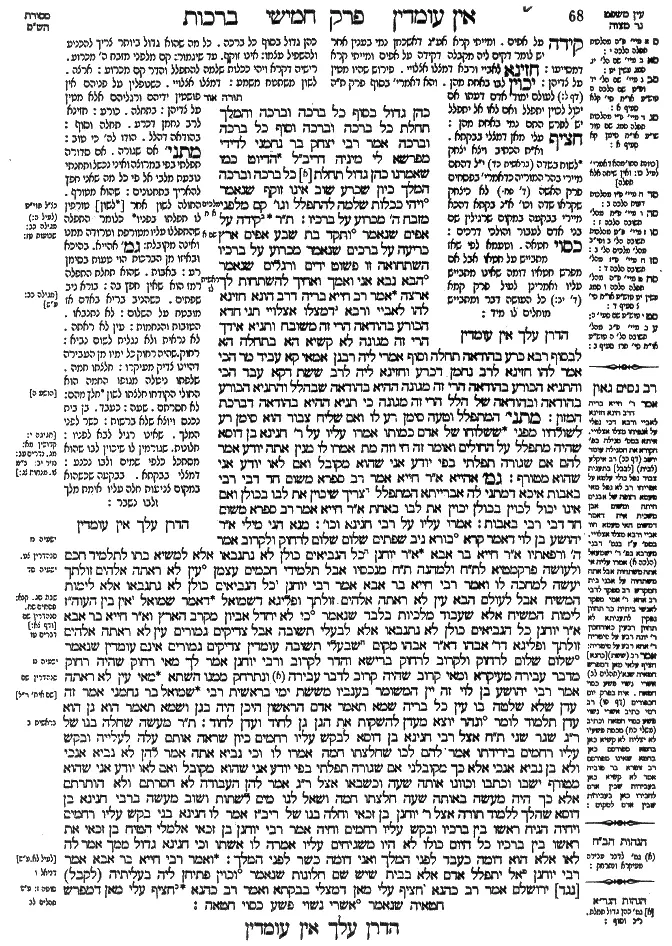
Berakhot 34b - Guemara
כהן גדול בסוף כל ברכה וברכה והמלך תחלת כל ברכה וברכה וסוף כל ברכה וברכה אמר רבי יצחק בר נחמני לדידי מפרשא לי מיניה דריבל הדיוט כמו שאמרנו כהן גדול תחלת כל ברכה וברכה המלך כיון שכרע שוב אינו זוקף שנאמר (מלכים א ח נד) ויהי ככלות שלמה להתפלל וגו' קם מלפני מזבח ה' מכרוע על ברכיו:
תר קידה על אפים שנאמר (מלכים א א לא) ותקד בת שבע אפים ארץ כריעה על ברכים שנאמר מכרוע על ברכיו השתחואה זו פשוט ידים ורגלים שנאמר (בראשית לז י) הבא נבא אני ואמך ואחיך להשתחות לך ארצה אמר רב חייא בריה דרב הונא חזינא להו לאביי ורבא דמצלו אצלויי תני חדא הכורע בהודאה הרי זה משובח ותניא אידך הרי זה מגונה לא קשיא הא בתחלה הא לבסוף רבא כרע בהודאה תחלה וסוף אמרי ליה רבנן אמאי קא עביד מר הכי אמר להו חזינא לרב נחמן דכרע וחזינא ליה לרב ששת דקא עבד הכי והתניא הכורע בהודאה הרי זה מגונה ההיא בהודאה שבהלל והתניא הכורע בהודאה ובהודאה של הלל הרי זה מגונה כי תניא ההיא בהודאה דברכת המזון:
מתני׳ המתפלל וטעה סימן רע לו ואם שליח צבור הוא סימן רע לשולחיו מפני ששלוחו של אדם כמותו אמרו עליו על ר' חנינא בן דוסא שהיה מתפלל על החולים ואומר זה חי וזה מת אמרו לו מנין אתה יודע אמר להם אם שגורה תפלתי בפי יודע אני שהוא מקובל ואם לאו יודע אני שהוא מטורף:
גמ׳ אהייא אר חייא אמר רב ספרא משום חד דבי רבי באבות איכא דמתני לה אברייתא המתפלל צריך שיכוין את לבו בכולן ואם אינו יכול לכוין בכולן יכוין את לבו באחת אר חייא אמר רב ספרא משום חד דבי רבי באבות אמרו עליו על רבי חנינא וכו':
מנא הני מילי אר יהושע בן לוי דאמר קרא (ישעיהו נז יט) בורא ניב שפתים שלום שלום לרחוק ולקרוב אמר ה' ורפאתיו אר חייא בר אבא אר יוחנן כל הנביאים כולן לא נתנבאו אלא למשיא בתו לתלמיד חכם ולעושה פרקמטיא לתח ולמהנה תח מנכסיו אבל תלמידי חכמים עצמן (ישעיהו סד ג) עין לא ראתה אלהים זולתך יעשה למחכה לו ואמר רבי חייא בר אבא אמר רבי יוחנן כל הנביאים כולן לא נתנבאו אלא לימות המשיח אבל לעולם הבא עין לא ראתה אלהים זולתך ופליגא דשמואל דאמר שמואל אין בין העוהז לימות המשיח אלא שעבוד מלכיות בלבד שנאמר (דברים טו יא) כי לא יחדל אביון מקרב הארץ ואר חייא בר אבא אר יוחנן כל הנביאים כולן לא נתנבאו אלא לבעלי תשובה אבל צדיקים גמורים עין לא ראתה אלהים זולתך ופליגא דר' אבהו דאר אבהו מקום שבעלי תשובה עומדין צדיקים גמורים אינם עומדין שנאמר (ישעיהו נז יט) שלום שלום לרחוק ולקרוב לרחוק ברישא והדר לקרוב ורבי יוחנן אמר לך מאי רחוק שהיה רחוק מדבר עבירה מעיקרא ומאי קרוב שהיה קרוב לדבר עבירה ונתרחק ממנו השתא מאי עין לא ראתה אמר רבי יהושע בן לוי זה יין המשומר בענביו מששת ימי בראשית רבי שמואל בר נחמני אמר זה עדן שלא שלטה בו עין כל בריה שמא תאמר אדם הראשון היכן היה בגן ושמא תאמר הוא גן הוא עדן תלמוד לומר (בראשית ב י) ונהר יוצא מעדן להשקות את הגן גן לחוד ועדן לחוד:
תר מעשה שחלה בנו של רג שגר שני תח אצל רבי חנינא בן דוסא לבקש עליו רחמים כיון שראה אותם עלה לעלייה ובקש עליו רחמים בירידתו אמר להם לכו שחלצתו חמה אמרו לו וכי נביא אתה אמר להן לא נביא אנכי ולא בן נביא אנכי אלא כך מקובלני אם שגורה תפלתי בפי יודע אני שהוא מקובל ואם לאו יודע אני שהוא מטורף ישבו וכתבו וכוונו אותה שעה וכשבאו אצל רג אמר להן העבודה לא חסרתם ולא הותרתם אלא כך היה מעשה באותה שעה חלצתו חמה ושאל לנו מים לשתות ושוב מעשה ברבי חנינא בן דוסא שהלך ללמוד תורה אצל ר' יוחנן בן זכאי וחלה בנו של ריבז אמר לו חנינא בני בקש עליו רחמים ויחיה הניח ראשו בין ברכיו ובקש עליו רחמים וחיה אמר רבי יוחנן בן זכאי אלמלי הטיח בן זכאי את ראשו בין ברכיו כל היום כולו לא היו משגיחים עליו אמרה לו אשתו וכי חנינא גדול ממך אמר לה לאו אלא הוא דומה כעבד לפני המלך ואני דומה כשר לפני המלך:
ואמר רבי חייא בר אבא אמר רבי יוחנן אל יתפלל אדם אלא בבית שיש שם חלונות שנאמר (דניאל ו יא) וכוין פתיחן ליה בעליתיה (לקבל) [נגד] ירושלם אמר רב כהנא חציף עלי מאן דמצלי בבקתא ואמר רב כהנא חציף עלי מאן דמפרש חטאיה שנאמר (תהלים לב א) אשרי נשוי פשע כסוי חטאה:
הדרן עלך אין עומדין
Comments from Rashi on Masechet Berakhot Page 34b
כהן גדול בסוף כל ברכה . כל מה שהוא גדול ביותר צריך להכניע ולהשפיל עצמו: אינו זוקף . עד שיגמור: קם מלפני מזבח ה' מכרוע . רישיה דקרא ויהי ככלות שלמה להתפלל והדר קם מכרוע: ארצה . לשון משתטח משמע: דמצלו אצלויי . כשנופלין על פניהם אין פושטין ידיהם ורגליהם אלא מטין על צדיהן: בתחלה . כורע: חזינא לרב נחמן דכרע . תחלה וסוף: בהודאה דהלל . הודו לה' כי טוב: מתני' אם שגורה . אם סדורה תפלתי בפי במרוצה ואיני נכשל ותחנתי נובעת מלבי אל פי כל מה שאני חפץ להאריך בתחנונים: שהוא מטורף . החולה לשון אחר [לשון] טורפין לו תפלתו בפניו כלומר התפלה שהתפללו עליו מטורפת וטרודה ממנו ואינה מקובלת: גמ' אהייא . בהיכא ובאיזו מן הברכות הוי טעות בסימן רע: באבות . שהוא תחלת התפלה רמז הוא שאין חפץ בה: בורא ניב שפתים . כשהניב בריא באדם אז מובטח על השלום: לא נתנבאו . הטובות והנחמות: עין לא ראתה . לא נראית ולא נגלית לשום נביא: רחוק . שהיה רחוק כל ימיו מן העבירה דהיינו צדיק מעיקרו: חלצתו חמה . שלפתו ניטלה מגופו החמה הוא החולי הקודחו חלצתו לשון חלץ מהם: לא חסרתם . שעה: כעבד . בן בית נכנס ויוצא שלא ברשות: כשר לפני המלך . שאינו רגיל לבא לפניו: חלונות . שגורמין לו שיכוין לבו שהוא מסתכל כלפי שמים ולבו נכנע: דמצלי בבקתא . בבקעה שכשהוא במקום צניעות חלה עליו אימת מלך ולבו נשבר: הדרן עלך אין עומדין
Comments from Tosafot - Berakhot 34b
קידה על אפים . ומייתי קרא אע"ג דאשכחן נמי בענין אחר יש לומר דקים ליה מקבלה דקידה על אפים ומייתי קרא דמסייעו: חזינא לאביי ורבא דמצלו אצלויי . פירוש שהיו מטין על צדיהן: יכוין לבו באחת מהן . והא דאמרי' בסוף פרק ת"ה (ברכות ל ב) לעולם ימוד אדם דעתו אם יכול לכוין יתפלל ואם לאו אל יתפלל יש לפרש התם נמי באחת מהן: חציף עלי מאן דמצלי בבקתא . וא"ת הכתיב ויצא יצחק לשוח בשדה (בראשית כד) י"ל דהתם מיירי בהר המוריה כדאמרי' בפסחים פרק האשה (פסחים פח א) לא כיצחק שקראו שדה וכו' א"נ בקתא דהכא מיירי בבקעה במקום שרגילין שם בני אדם לעבור והולכי דרכים: כסוי חטאה . וטעמא לפי שאז מתבייש על חטאו אבל אם מפרש חטאיו דומה שאינו מתבייש עליו ואמרינן לעיל פרק קמא (ברכות ד' יב:) כל העושה דבר ומתבייש מוחלים לו מיד: הדרן עלך אין עומדין
Berakhot 34b - Mishnah translated into english
It is appropriate, though, for a High Priest to bow at the end of each and every blessing; and for a king to bow at the beginning of each and every blessing and at the end of each and every blessing. This is because the more lofty one’s status, the more important it is to demonstrate his subservience to God.
Rabbi Yitzḥak bar Naḥmani said: It was explained to me directly from Rabbi Yehoshua ben Levi himself differently: An ordinary person, conducts himself as we said; a High Priest bows at the beginning of each and every blessing; the king, once he has bowed at the beginning of the first blessing, does not rise until he concludes the entire prayer, as it is stated: “And it was that when Solomon finished praying all of his prayer to the Lord, he rose from before the altar of the Lord, from kneeling upon his knees with his hands spread forth toward the heavens” (I Kings 8:54).
Having mentioned Solomon bowing, the Gemara distinguishes between various types of bowing. The Sages taught in a baraita: The term kidda means bowing upon one’s face, with his face toward the ground, as it is stated: “Then Bathsheba bowed [vatikod] with her face to the ground” (I Kings 1:31). Keria means bowing upon one’s knees, as regarding Solomon it is stated: He finished praying and “he rose from before the altar of the Lord, from kneeling [mikkeroa] upon his knees.” Finally, hishtaḥava’a, that is bowing with one’s hands and legs spread in total submission, as it is stated in Jacob’s question to Joseph in response to his dream: “Shall we, I and your mother and your brothers, come and bow down [lehishtaḥavot] to you to the ground?” (Genesis 37:10).
On the topic of bowing, Rav Ḥiyya, son of Rav Huna, said: I saw Abaye and Rava, who would lean their heads and not actually prostrate themselves on the ground.
The Gemara asks: One baraita taught: One who bows in the blessing of thanksgiving, it is praiseworthy. And it was taught in another baraita: One who bows in the blessing of thanksgiving, it is reprehensible. These baraitot are contradictory.
The Gemara reconciles these two baraitot: This is not difficult; this baraita, which praises one who bows in the blessing of thanksgiving, refers to one who bows at the beginning of the blessing. This baraita, which condemns one who bows in the blessing of thanksgiving, refers to one who bows at the end of the blessing.
Rava bowed in the blessing of thanksgiving, both beginning and end. The Sages said to him: Why does our master do this? He said to them: I saw Rav Naḥman who bowed in the blessing of thanksgiving, and I saw Rav Sheshet who did so as well.
But wasn’t it taught in a baraita that one who bows in thanksgiving, it is reprehensible?
Rava explained: That baraita refers to one who bows in the thanksgiving that is in hallel, when one recites: Give thanks to the Lord. Then, bowing is inappropriate.
The Sages continue to question Rava’s conduct: But wasn’t it taught explicitly in a baraita: One who bows in thanksgiving or in thanksgiving of hallel, it is reprehensible? The term thanksgiving unqualified does not refer to thanksgiving of hallel; it obviously refers to the blessing of thanksgiving recited in the Amida prayer. One who bows in either, it is reprehensible.
The Gemara rejects this challenge as well: When that baraita was taught, it was in reference to the blessing of thanksgiving, the second blessing recited in Grace after Meals: We thank You.
MISHNA: Concluding its discussion of the halakhot of prayer, the mishna discusses less practical aspects of prayer. One who prays and realizes that he erred in his prayer, it is a bad omen for him; it indicates to him that his prayer was not accepted. And if he who erred is the communal prayer leader, it is a bad omen for those who sent him, because a person’s agent has legal status equivalent to his own. On a similar note, they said about Rabbi Ḥanina ben Dosa that he would pray on behalf of the sick and immediately after his prayer he would say: This one shall recover from his illness and live and this one shall die. When they said to him: From where do you know? He said to them: If my prayer is fluent in my mouth as I recite it and there are no errors, I know that my prayer is accepted. And if not, I know that my prayer is rejected.
GEMARA: We learned in the mishna that if one errs in his prayer it is a bad omen. The Gemara asks: In which blessing is an error a bad omen?
Rabbi Ḥiyya said that Rav Safra said in the name of one of the Sages of the school of Rabbi Yehuda HaNasi: An error is a bad omen in the first blessing of the Amida prayer, the blessing of Patriarchs.”
Some teach that this statement was made on a baraita referring to another topic. It was taught in a baraita: One who prays must focus his heart in all of the blessings. And if he is unable to focus his heart in all of them, he should focus his heart at least in one.
Regarding this baraita, Rabbi Ḥiyya said that Rav Safra said in the name of one of the Sages of the school of Rabbi Yehuda HaNasi: In one refers to the blessing of Patriarchs.
We learned in the mishna: They said about Rabbi Ḥanina ben Dosa that the indication whether or not his prayer was accepted was whether the prayer was fluent in his mouth as he recited it. The Gemara asks: From where are these matters, that this is an accurate indication of whether or not his prayer was accepted, derived? Rabbi Yehoshua ben Levi said: As the verse stated: “The Lord that creates the expression of the lips says, Peace, peace, to him that is far off and to him that is near; and I will heal him” (Isaiah 57:19). It can be inferred from this verse that if speech of the lips, fluent speech, is granted to one who prays, it indicates that his prayer on behalf of the ill has been accepted and I will heal him, that person will be healed.
In conclusion of this discussion, the Gemara cites that which Rabbi Ḥiyya bar Abba said that Rabbi Yoḥanan said with regard to the reward of the righteous: All the prophets only prophesied in their prophecies of consolation, with regard to one who values wisdom and therefore marries his daughter to a Torah scholar and to one who conducts business [perakmatya] on behalf of a Torah scholar as well as to one who utilizes his wealth to benefit a Torah scholar in some other way. However, the prophets did not describe the extent of the reward for Torah scholars themselves, whose reward is not quantifiable as it is stated: “And from of old they have not heard, they have not lent an ear, no eye has seen it, God, aside from You, who will do for those who await Him” (Isaiah 64:3).
And Rabbi Ḥiyya bar Abba said that Rabbi Yoḥanan said: All the prophets only prophesied with regard to the change in world order in the end of days with regard to the days of the Messiah. However, with regard to the World-to-Come, which exists on a higher level, it is stated: “No eye has seen it, God, aside from You.”
And the Gemara notes that this statement disagrees with the opinion of Shmuel, as Shmuel said: The only difference between this world and the days of the Messiah is with regard to servitude to foreign kingdoms alone. While in the days of the Messiah, Israel will be independent and free from enslavement to foreign powers, the world order will remain otherwise unchanged, as it is stated: “For the poor shall not cease from the land” (Deuteronomy 15:11), which indicates that the ways of the world are set and unchanging.
And Rabbi Ḥiyya bar Abba said that Rabbi Yoḥanan said: All of the prophets only prophesied their prophecies of consolation with regard to penitents but with regard to the full-fledged righteous it is stated: “No eye has seen it, God, aside from You.”
And the Gemara notes that this statement disagrees with the opinion of Rabbi Abbahu who holds that penitents are superior to the righteous. As Rabbi Abbahu said: In the place where penitents stand, even the full-fledged righteous do not stand, as it is stated: “Peace, peace upon him who is far and him who is near.” Peace and greeting is extended first to him who is far, the penitent, and only thereafter is peace extended to him who is near, the full-fledged righteous.
And Rabbi Yoḥanan could have said to you: What is the meaning of him who is far? This refers to the full-fledged righteous who was distant from an act of transgression from the outset, and to whom peace is extended first. What is meant by him who is near? This refers to the penitent who was close to an act of transgression but has now distanced himself from it, and to whom peace is extended only after it has been extended to him who has been righteous from the outset.
Earlier, Rabbi Yoḥanan said that there is a reward referred to in the verse: “No eye has seen it.” The Gemara asks: What is this reward about which it is said: “No eye has seen it”? Rabbi Yehoshua ben Levi said: That is the wine that has been preserved in its grapes since the six days of creation and which no eye has ever seen. Rabbi Shmuel bar Naḥmani said: That is Eden, which no creature’s eye has ever surveyed.
Lest you will say: Where was Adam the first man? Wasn’t he there and didn’t he survey Eden? The Gemara responds: Adam was only in the Garden of Eden, not in Eden itself.
And lest you will say: It is the Garden and it is Eden; two names describing the same place. That is not the case, as the verse states: “And a river went out from Eden to water the Garden” (Genesis 2:10). Obviously, the Garden exists on its own and Eden exists on its own.
Having mentioned Rabbi Ḥanina ben Dosa in our mishna, the Gemara proceeds to further praise the efficacy of his prayer: The Sages taught: There was an incident where Rabban Gamliel’s son fell ill. Rabban Gamliel dispatched two scholars to Rabbi Ḥanina ben Dosa to pray for mercy and healing on his behalf. When Rabbi Ḥanina ben Dosa saw them approaching, he went up to the attic on the roof of his house and prayed for mercy on his behalf. Upon his descent, he said to the messengers: You may go and return to Rabban Gamliel, as the fever has already left his son and he has been healed. The messengers asked him: How do you know? Are you a prophet? He replied to them: I am neither a prophet nor son of a prophet (see Amos 7:14), but I have received a tradition with regard to this indication: If my prayer is fluent in my mouth as I recite it and there are no errors, I know that my prayer is accepted. And if not, I know that my prayer is rejected. The Gemara relates that these messengers sat and wrote and approximated that precise moment when Rabbi Ḥanina ben Dosa told them this. When they came before Rabban Gamliel and related all that had happened and showed him what they had written, Rabban Gamliel said to them: I swear by the Temple service that in the time you wrote you were neither earlier or later; rather, this is how the event transpired: Precisely at that moment his fever broke and he asked us for water to drink.
And there was another incident involving Rabbi Ḥanina ben Dosa, who went to study Torah before Rabbi Yoḥanan ben Zakkai, and Rabbi Yoḥanan’s son fell ill. He said to him: Ḥanina, my son, pray for mercy on behalf of my son so that he will live. Rabbi Ḥanina ben Dosa placed his head between his knees in order to meditate and prayed for mercy upon his behalf, and Rabbi Yoḥanan ben Zakkai’s son lived. Rabbi Yoḥanan ben Zakkai said about himself: Had ben Zakkai stuck his head between his knees throughout the entire day, they would have paid him no attention. His wife said to him: And is Ḥanina greater than you? He replied to her: No, but his prayer is better received than my own because he is like a servant before the King, and as such he is able to enter before the King and make various requests at all times. I, on the other hand, am like a minister before the King, and I can enter only when invited and can make requests only with regard to especially significant matters.
And on the topic of prayer, Rabbi Ḥiyya bar Abba said that Rabbi Yoḥanan said: One may only pray in a house with windows, as then he can see the heavens and focus his heart, as it is stated with regard to Daniel’s prayer: “In his attic there were open windows facing Jerusalem” (Daniel 6:11).
With regard to the appropriate place to pray, Rav Kahana said: I consider impudent one who prays in a field.
Employing parallel language, Rav Kahana also said: I consider impudent one who specifies his transgression, as it is stated: “Happy is he whose iniquity is forgiven, whose transgression is covered over” (Psalms 32:1); one who conceals his transgressions indicates that he is ashamed of them, and due to his shame he will be forgiven.
May we return unto thee : One must not stand.
Traduction : The William Davidson digital edition of the Koren Noé Talmud, with commentary by Rabbi Adin Even-Israel Steinsaltz.