 Talmud Bavli
Berakhot 7b : Youtube
Daf TubeYoutube
2 video classes :
Berakhot Page 7b
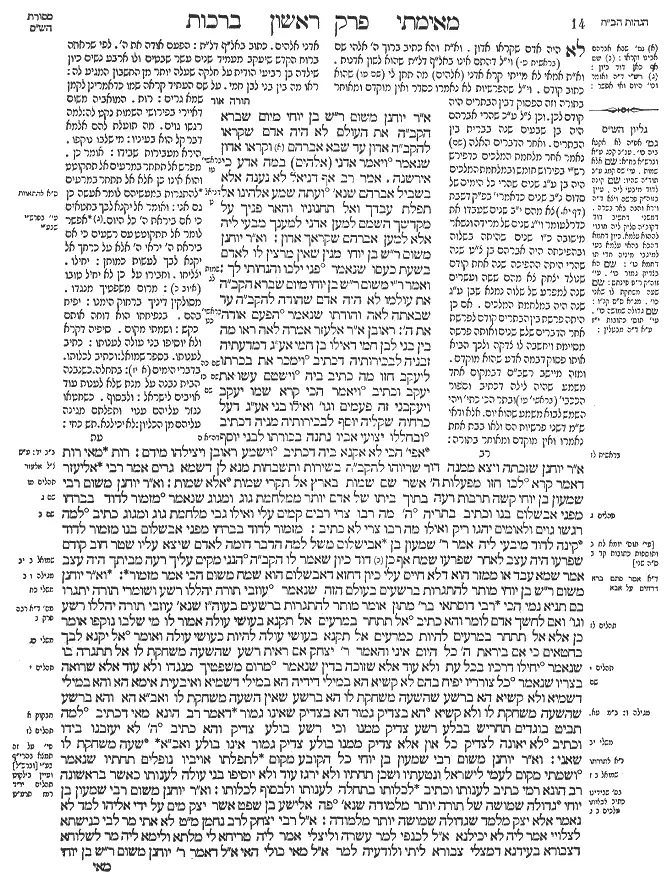
Berakhot 7b - Guemara
אר יוחנן משום רש בן יוחי מיום שברא הקבה את העולם לא היה אדם שקראו להקבה אדון עד שבא אברהם וקראו אדון שנאמר (בראשית טו ב) ויאמר אדני (אלהים) במה אדע כי אירשנה. אמר רב אף דניאל לא נענה אלא בשביל אברהם שנא' (דניאל ט יז) ועתה שמע אלהינו אל תפלת עבדך ואל תחנוניו והאר פניך על מקדשך השמם למען אדני למענך מבעי ליה אלא למען אברהם שקראך אדון:
ואר יוחנן משום רש בן יוחי מנין שאין מרצין לו לאדם בשעת כעסו שנאמר (שמות לג יד) פני ילכו והנחותי לך:
ואמר רי משום רש בן יוחי מיום שברא הקבה את עולמו לא היה אדם שהודה להקבה עד שבאתה לאה והודתו שנאמר (בראשית כט לה) הפעם אודה את ה':
ראובן אר אלעזר אמרה לאה ראו מה בין בני לבן חמי דאילו בן חמי אעג דמדעתיה זבניה לבכירותיה דכתיב (בראשית כה לג) וימכר את בכרתו ליעקב חזו מה כתיב ביה (בראשית כז מא) וישטם עשו את יעקב וכתיב (בראשית כז לו) ויאמר הכי קרא שמו יעקב ויעקבני זה פעמים וגו' ואילו בני אעג דעל כרחיה שקליה יוסף לבכירותיה מניה דכתיב (דברי הימים א ה א) ובחללו יצועי אביו נתנה בכורתו לבני יוסף אפי' הכי לא אקנא ביה דכתיב (בראשית לז כא) וישמע ראובן ויצילהו מידם:
רות מאי רות אר יוחנן שזכתה ויצא ממנה דוד שריוהו להקבה בשירות ותשבחות מנא לן דשמא גרים אמר רבי אליעזר דאמר קרא (תהלים מו ט) לכו חזו מפעלות ה' אשר שם שמות בארץ אל תקרי שמות אלא שמות:
ואר יוחנן משום רבי שמעון בן יוחי קשה תרבות רעה בתוך ביתו של אדם יותר ממלחמת גוג ומגוג שנאמר (תהלים ג א) מזמור לדוד בברחו מפני אבשלום בנו וכתיב בתריה (תהלים ג ב) ה' מה רבו צרי רבים קמים עלי ואילו גבי מלחמת גוג ומגוג כתיב (תהלים ב א) למה רגשו גוים ולאומים יהגו ריק ואילו מה רבו צרי לא כתיב:
מזמור לדוד בברחו מפני אבשלום בנו מזמור לדוד קינה לדוד מיבעי ליה אמר ר' שמעון בן אבישלום משל למה הדבר דומה לאדם שיצא עליו שטר חוב קודם שפרעו היה עצב לאחר שפרעו שמח אף כן דוד כיון שאמר לו הקבה (שמואל ב יב יא) הנני מקים עליך רעה מביתך היה עצב אמר שמא עבד או ממזר הוא דלא חייס עלי כיון דחזא דאבשלום הוא שמח משום הכי אמר מזמור:
ואר יוחנן משום רש בן יוחי מותר להתגרות ברשעים בעולם הזה שנאמר (משלי כח ד) עוזבי תורה יהללו רשע ושומרי תורה יתגרו בם תניא נמי הכי רבי דוסתאי בר' מתון אומר מותר להתגרות ברשעים בעוהז שנא' עוזבי תורה יהללו רשע וגו' ואם לחשך אדם לומר והא כתיב (תהלים לז א) אל תתחר במרעים אל תקנא בעושי עולה אמור לו מי שלבו נוקפו אומר כן אלא אל תתחר במרעים להיות כמרעים אל תקנא בעושי עולה להיות כעושי עולה ואומר (משלי כג יז) אל יקנא לבך בחטאים כי אם ביראת ה' כל היום איני והאמר ר' יצחק אם ראית רשע שהשעה משחקת לו אל תתגרה בו שנאמר (תהלים י ה) יחילו דרכיו בכל עת ולא עוד אלא שזוכה בדין שנאמר (תהלים י ה) מרום משפטיך מנגדו ולא עוד אלא שרואה בצריו שנאמר (תהלים י ה) כל צורריו יפיח בהם לא קשיא הא במילי דידיה הא במילי דשמיא ואיבעית אימא הא והא במילי דשמיא ולא קשיא הא ברשע שהשעה משחקת לו הא ברשע שאין השעה משחקת לו ואבא הא והא ברשע שהשעה משחקת לו ולא קשיא הא בצדיק גמור הא בצדיק שאינו גמור דאמר רב הונא מאי דכתיב (חבקוק א יג) למה תביט בוגדים תחריש בבלע רשע צדיק ממנו וכי רשע בולע צדיק והא כתיב (תהלים לז לג) ה' לא יעזבנו בידו וכתיב (משלי יב כא) לא יאונה לצדיק כל און אלא צדיק ממנו בולע צדיק גמור אינו בולע ואבא שעה משחקת לו שאני:
ואר יוחנן משום רבי שמעון בן יוחי כל הקובע מקום לתפלתו אויביו נופלים תחתיו שנאמר (שמואל ב ז י) ושמתי מקום לעמי לישראל ונטעתיו ושכן תחתיו ולא ירגז עוד ולא יוסיפו בני עולה לענותו כאשר בראשונה רב הונא רמי כתיב לענותו וכתיב לכלותו בתחלה לענותו ולבסוף לכלותו:
ואר יוחנן משום רבי שמעון בן יוחי גדולה שמושה של תורה יותר מלמודה שנא' (מלכים ב ג יא) פה אלישע בן שפט אשר יצק מים על ידי אליהו למד לא נאמר אלא יצק מלמד שגדולה שמושה יותר מלמודה:
אל רבי יצחק לרב נחמן מט לא אתי מר לבי כנישתא לצלויי אמר ליה לא יכילנא אל לכנפי למר עשרה וליצלי אמר ליה טריחא לי מלתא ולימא ליה מר לשלוחא דצבורא בעידנא דמצלי צבורא ליתי ולודעיה למר אל מאי כולי האי אל דאמר ר' יוחנן משום רש בן יוחי
Comments from Rashi on Masechet Berakhot Page 7b
אדני אלהים . כתוב באל"ף דל"ת: הפעם אודה את ה' . לפי שראתה ברוח הקדש שיעקב מעמיד שנים עשר שבטים ולו ארבע נשים כיון שילדה בן רביעי הודית על חלקה שעלה יותר מן החשבון המגיע לה: ראו מה בין בני לבן חמי . על שם העתיד קראה שמו כדאמרינן לקמן שמא גרים: רות . המואביה משום דאיירי בפירושי השמות נקט לה: למה רגשו גוים . מה תועלת להם אלמא דבר קל הוא בעיניו: מי שלבו נוקפו . הירא מעבירות שבידו: אומר כן . מפרש אל תתחר במרעים אל תתקוטט והוא אינו כן אלא אל תתחר במרעים להתגרות במעשיהם לומר אעשה כן גם אני: ואומר אל יקנא לבך בחטאים כי אם ביראת ה' כל היום . אפשר לומר אל תתקוטט עם רשעים כי אם ביראת ה' יראי ה' אלא על כרחך אל יקנא לבך לעשות כמותן: יחילו . יצליחו. וחבירו על כן לא יחיל טובו (איוב כ): מרום משפטיך מנגדו . מסולקין דיניך ברחוק הימנו: יפיח בהם . בנפיחתו הוא דוחה אותם כקש: ושמתי מקום . סיפיה דקרא ולא יוסיפו בני עולה לענותו: כתיב לענותו . בספר שמואל: וכתיב לכלותו . בדברי הימים (א יז): בתחלה . כשנבנה הבית נבנה על מנת שלא לענות עוד אויבים לישראל: ולבסוף . כשחטאו נגזר עליהם ענוי ותפלתם מגינה עליהם מן הכליון: לא יכילנא . תש כחי:
Comments from Tosafot - Berakhot 7b
לא היה אדם שקראו אדון . וא"ת והא כתיב ברוך ה' אלהי שם (בראשית ט) וי"ל דהתם אינו באל"ף דל"ת שהוא לשון אדנות. וא"ת אמאי לא מייתי קרא אדני (אלהים) מה תתן לי (שם טו) שהוא כתוב קודם. וי"ל שהפרשיות לא נאמרו כסדר ואין מוקדם ומאוחר בתורה וזה הפסוק דבין הבתרים היה קודם לכן. וכן צ"ל ע"כ שהרי אברהם היה בן שבעים שנה בברית בין הבתרים. ואחר הדברים האלה (שם) נאמר אחר מלחמת המלכים כדפירש רש"י בפירוש חומש ובמלחמת המלכים היה בן ע"ג שנים שהרי כל הימים של סדום נ"ב שנים כדאמרי' בפ"ק דשבת (דף יא.) צא מהם י"ב שנים שעבדו את כדרלעומר וי"ג שנים של מרידה ונשאר מישובה כ"ו שנים שהיתה בשלוה ובהפיכתה היה אברהם בן צ"ט שנה שהרי היתה ההפיכה שנה אחת קודם שנולד יצחק צא מהם ששה ועשרים שנה למפרע של שלוה נמצא שבן ע"ג שנה היה במלחמת המלכים. אם כן היתה פרשת בין הבתרים קודם לפרשת אחר הדברים שלש שנים ואותה פרשה מסיימת ויחשבה לו צדקה ולכך הביא אותו פסוק דבמה אדע שהוא מוקדם. ומזה מיישב רשב"ם דבמקום אחד משמע שהיה לילה דכתיב וספור הככבי' (בראשי' טו) ובתר הכי כתי' ויהי השמש לבוא משמע שהוא יום. אלא ודאי ש"מ דשני פרשיות הם ולאו בבת אחת נאמרו ואין מוקדם ומאוחר בתורה:
Berakhot 7b - Mishnah translated into english
Until now, the Gemara has cited statements made by Rabbi Yoḥanan in the name of the tanna, Rabbi Yosei. Now, the Gemara begins to cite what Rabbi Yoḥanan said in the name of Rabbi Shimon ben Yoḥai: From the day that the Holy One, Blessed be He, created the world there was no person who called him “Lord” until Abraham came and called him Lord. As it is stated: “And he said, ‘My Lord, God, by what shall I know that I will inherit it?’” (Genesis 15:8).
The Gemara cites another statement extolling that virtue of Abraham is mentioned, as Rav said: Even Daniel’s prayers were only answered on account of Abraham, as it is stated: “And now listen, God, to the prayer of Your servant and to his supplication; and cause Your face to shine upon Your desolate Temple, for the sake of the Lord” (Daniel 9:17). The verse should have said: And cause Your face to shine upon Your desolate Temple, for Your sake, as Daniel was addressing the Lord.
Rather, this verse contains an allusion that the prayer should be accepted for the sake of Abraham, who called You, Lord. Daniel utilized that name of God in order to evoke Abraham’s virtue and enhance his prayer.
And Rabbi Yoḥanan said in the name of Rabbi Shimon ben Yoḥai: From where is it derived that one must not placate a person while the person in the throes of his anger? As it is stated: “My face will go, and I will give you rest” (Exodus 33:14).
And Rabbi Yoḥanan said in the name of Rabbi Shimon ben Yoḥai: From the day the Holy One, Blessed be He, created the world, no one thanked the Holy One, Blessed be He, until Leah came and thanked Him, as it is stated: “And she became pregnant and gave birth to a son, and she said, ‘This time I will give thanks to God,’ and thus he was called Judah” (Genesis 29:35).
Tangential to the mention of Leah’s son, Judah, and the reason for his name, the Gemara explains the sources for other names, including Reuben. Rabbi Elazar said: Reuben’s name should be considered a prophecy by Leah, as Leah said: See [re’u] the difference between my son [beni] and the son of my father-in-law, Esau, son of Isaac. Even though Esau knowingly sold his birthright to his brother Jacob, as it is written: “And he sold his birthright to Jacob” (Genesis 25:33), nonetheless, behold what is written about him: “And Esau hated Jacob” (Genesis 27:41).
Esau was not only angry over Isaac’s blessing, but he was angry about another matter as well, as it is written: “And he said, ‘Is he not rightly named Jacob, for he has supplanted me twice? He took my birthright, and behold, now he has taken my blessing’” (Genesis 27:36). Despite having sold his birthright, he refused to relinquish it.
While my son, Reuben, even though Joseph took his birthright from him by force, as it is written: “And the sons of Reuben the firstborn of Israel, for he was the firstborn; but, since he defiled his father’s bed, his birthright was given to the sons of Joseph, son of Israel” (I Chronicles 5:1). Nevertheless, he was not jealous of him, as it is written when Joseph’s brothers sought to kill him: “And Reuben heard and he saved him from their hands, saying ‘Let us not take his life’” (Genesis 37:21).
Continuing on the topic of names, the Gemara asks: What is the meaning of the name Ruth? Rabbi Yoḥanan said: That she had the privilege that David, who inundated the Holy One, Blessed be He, with songs and praises, would descend from her. The name Ruth [Rut] is etymologically similar in Hebrew to the word inundate [riva].
Regarding the basic assumption that these homiletic interpretations of names are allusions to one’s future, the Gemara asks: From where do we derive that the name affects one’s life? Rabbi Eliezer said that the verse says: “Go, see the works of the Lord, who has made desolations [shamot] upon the earth” (Psalms 46:9). Do not read the word as shamot, rather as shemot, names. The names given to people are, therefore, “the works of the Lord upon the earth.”
And Rabbi Yoḥanan said other aggadic statements in the name of Rabbi Shimon ben Yoḥai: The existence of wayward children in a person’s home is more troublesome than the war of Gog and Magog, the ultimate war, the climax of the travails of Messianic times. As it is stated: “A Psalm of David, when he fled from his son, Absalom” (Psalms 3:1). And it is written thereafter: “Lord, how numerous are my enemies, many have risen against me” (Psalms 3:2). While concerning the war of Gog and Magog, which is alluded to in the second chapter of Psalms, it is written: “Why are the nations in an uproar? And why do the peoples speak for naught? The kings of the earth stand up and the rulers take counsel together, against the Lord, and against His anointed…He that sits in heaven laughs, the Lord mocks them” (Psalms 2:1–4). Yet in this chapter describing the war of Gog and Magog “how numerous are my enemies” is not written, as it is not as difficult as raising a wayward son like Absalom.
Regarding the opening phrase of the psalm, which serves as its title, the Gemara wonders: It is said: “A Psalm of David, when fleeing his son, Absalom.” A Psalm of David? It should have said: A lament of David.
Rabbi Shimon ben Avishalom said a parable: To what is this similar? It is similar to a person about whom a promissory note was issued stating that he must repay a debt to the lender. Before he repaid it, he was despondent, worried how he will manage to repay the debt. After he repaid it, he was glad.
So too was the case with David. When the Holy One, Blessed be He, told him, through Natan the prophet, after the incident with Bathsheba, “Behold, I will raise up evil against you from your house” (II Samuel 12:11), David was despondent. He said: Perhaps it will be a slave or a mamzer who will rise up in my house, a person of such lowly status, who will have no pity on me. But once David saw that Absalom was the one through whom the prophecy was to be fulfilled, he rejoiced, as he was certain that Absalom would show him mercy. That is why David said a psalm, not a lament, thanking God for punishing him in the least severe manner possible.
And Rabbi Yoḥanan said in the name of Rabbi Shimon ben Yoḥai: One is permitted to provoke the wicked in this world. Though the ways of the wicked prosper, one is still permitted to provoke them and need not fear (Maharsha), as it is stated: “Those who abandon the Torah will praise wickedness, and the keepers of the Torah will fight them” (Proverbs 28:4).
That statement was also taught in a baraita, as Rabbi Dostai, son of Rabbi Matun, says: One is permitted to provoke the wicked in this world, as it is stated: “Those who abandon the Torah will praise wickedness, and the keepers of the Torah will fight them.” And if someone whispered to you, saying, on the contrary, isn’t it also written: “Do not compete with evil-doers, and do not envy the unjust” (Psalms 37:1), meaning that one should avoid provoking the wicked, say to him: Only one whose heart strikes him with pangs of conscience over sins that he committed says this. Rather, the true meaning of the verse is: Do not compete with evil-doers, to be like the evil-doers, and do not envy the unjust to be like the unjust.
The Gemara cites proof from another verse. And it says: “One shall not envy the unjust, but be in fear of the Lord all the day” (Proverbs 23:17). In this context, to envy means to seek to emulate the unjust.
From these verses in Psalms and Proverbs, it would seem that one is encouraged to provoke the wicked. The Gemara asks: Is this so? Didn’t Rabbi Yitzḥak say: If you see a wicked person upon whom the hour is smiling, do not provoke him. As long as he is enjoying good fortune, there is no point in confronting him. As it is stated: “His ways prosper at all times; Your judgments are far beyond him; as for his adversaries, he snorts at them” (Psalms 10:5). The verse teaches us that the ways of the wicked will always succeed. And not only that, but he emerges victorious in judgment, as it is stated: “Your judgments are far beyond him,” meaning that even when he is brought to justice, it does not affect him. And not only that, but he witnesses his enemies’ downfall, as it is stated: “As for all his adversaries, he snorts at them.”
To resolve this contradiction with regard to whether or not one may provoke the wicked, the Gemara offers several explanations: This is not difficult, as it can be understood that this, which says that one may not provoke the wicked, is referring to his personal matters, while that, which says that it is a mitzva to confront them, is referring to matters of Heaven.
And if you wish, say instead that this, which says not to confront the wicked and that, which says to confront the wicked, are both referring to matters of Heaven, and, nevertheless, it is not difficult. This, which says that one may not provoke the wicked, is referring to a wicked person upon whom the hour is smiling, who is enjoying good fortune. While that, which says that it is a mitzva to confront them, is referring to a wicked person upon whom the hour is not smiling.
And if you wish, say instead that this, which says not to confront and that, which says to confront, are both referring to a wicked person upon whom the hour is smiling, but the question of whether one is permitted to confront him depends on who is confronting him. And nevertheless, this is not difficult. This, which says that it is a mitzva to confront them, is referring to a completely righteous person, while this, which says that one may not confront the wicked, is referring to one who is not completely righteous, as Rav Huna said: What is the meaning of that which is written: “Why do You look on those who deal treacherously and hold Your peace? When the wicked swallows the man more righteous than he?” (Habakkuk 1:13). This verse is difficult to understand. Do the wicked swallow the righteous? Isn’t it written: “The wicked looks to the righteous and seeks to kill him; the Lord will not leave him in his hand, nor allow him to be condemned when he is judged” (Psalms 37:32–33), and it is written: “No mischief shall befall the righteous” (Proverbs 12:21)? Rather, in light of these verses, the verse: “The wicked swallows the man more righteous than he” means: The man who is more righteous than he, but not completely righteous, he swallows. The completely righteous he does not swallow.
And if you wish, say: In general, the wicked cannot swallow the righteous, but when the hour is smiling upon him, it is different. When the wicked are enjoying good fortune, even the righteous can be harmed (Birkat Hashem).
And Rabbi Yoḥanan said in the name of Rabbi Shimon ben Yoḥai: Setting a fixed place for prayer is so important that one who sets a fixed place for his prayer, his enemies fall beneath him, as it is said: “And I will appoint a place for My nation, Israel, and I will plant them, that they may dwell in their own place.” Through setting aside a place for prayer, they will merit to “be disturbed no more; neither shall the children of wickedness afflict them anymore, as in the beginning” (II Samuel 7:10).
This verse, cited by the Gemara, leads to an additional point. Rav Huna raised a contradiction: In the book of Samuel, in this verse it is written: “To afflict them,” while in the parallel verse in I Chronicles (17:9) it is written: “To destroy them.”
The Gemara resolves this contradiction: The enemies of Israel intend first to afflict them, and, ultimately, to destroy them entirely.
And Rabbi Yoḥanan said in the name of Rabbi Shimon ben Yoḥai: Service of Torah is greater than its study, i.e., serving a Torah scholar and spending time in his company is greater than learning Torah from him. Torah study is one component of a Torah life, but one who serves a Torah scholar learns about every aspect of life from his actions. This is derived from the verse that speaks in praise of Elisha, as it is stated: “Here is Elisha son of Shafat, who poured water over Elijah’s hands” (II Kings 3:11). The verse does not say that he learned from Elijah, rather that he poured water, which teaches that the service of Torah represented by Elisha pouring water over Elijah’s hands is greater than its study.
As a prelude to another of the statements by Rabbi Yoḥanan in the name of Rabbi Shimon ben Yoḥai, the Gemara relates the following incident. Rabbi Yitzḥak said to Rav Naḥman: Why did the Master not come to the synagogue to pray? Rav Naḥman said to him: I was weak and unable to come. Rabbi Yitzḥak said to him: Let the Master gather ten individuals, a prayer quorum, at your home and pray. Rav Naḥman said to him: It is difficult for me to impose upon the members of the community to come to my home to pray with me (Sefer Mitzvot Gadol). Rabbi Yitzḥak suggested another option: The Master should tell the congregation to send a messenger when the congregation is praying to come and inform the Master so you may pray at the same time.
Rav Naḥman saw that Rabbi Yitzḥak was struggling to find a way for him to engage in communal prayer. He asked: What is the reason for all this fuss? Rabbi Yitzḥak said to him: As Rabbi Yoḥanan said in the name of Rabbi Shimon ben Yoḥai:
Traduction : The William Davidson digital edition of the Koren Noé Talmud, with commentary by Rabbi Adin Even-Israel Steinsaltz.