 Talmud Bavli
Berakhot 40b : Youtube
Daf TubeYoutube
2 video classes :
Berakhot Page 40b
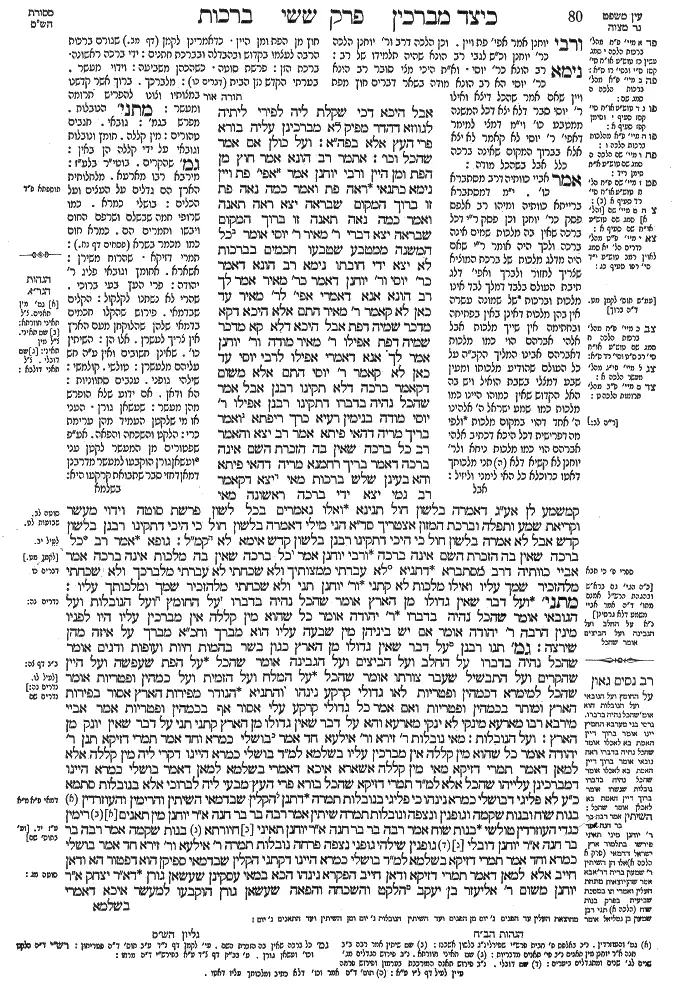
Berakhot 40b - Guemara
אבל היכא דכי שקלת ליה לפירי ליתיה לגווזא דהדר מפיק לא מברכינן עליה בורא פרי העץ אלא בפהא:
ועל כולן אם אמר שהכל וכו':
אתמר רב הונא אמר חוץ מן הפת ומן היין ורבי יוחנן אמר אפי' פת ויין נימא כתנאי ראה פת ואמר כמה נאה פת זו ברוך המקום שבראה יצא ראה תאנה ואמר כמה נאה תאנה זו ברוך המקום שבראה יצא דברי ר' מאיר ר' יוסי אומר כל המשנה ממטבע שטבעו חכמים בברכות לא יצא ידי חובתו נימא רב הונא דאמר כר' יוסי ור' יוחנן דאמר כר' מאיר אמר לך רב הונא אנא דאמרי אפי' לר' מאיר עד כאן לא קאמר ר' מאיר התם אלא היכא דקא מדכר שמיה דפת אבל היכא דלא קא מדכר שמיה דפת אפילו ר' מאיר מודה ור' יוחנן אמר לך אנא דאמרי אפילו לרבי יוסי עד כאן לא קאמר ר' יוסי התם אלא משום דקאמר ברכה דלא תקינו רבנן אבל אמר שהכל נהיה בדברו דתקינו רבנן אפילו ר' יוסי מודה בנימין רעיא כרך ריפתא ואמר בריך מריה דהאי פיתא אמר רב יצא והאמר רב כל ברכה שאין בה הזכרת השם אינה ברכה דאמר בריך רחמנא מריה דהאי פיתא והא בעינן שלש ברכות מאי יצא דקאמר רב נמי יצא ידי ברכה ראשונה מאי קמשמע לן אעג דאמרה בלשון חול תנינא ואלו נאמרים בכל לשון פרשת סוטה וידוי מעשר וקריאת שמע ותפלה וברכת המזון אצטריך סדא הני מילי דאמרה בלשון חול כי היכי דתקינו רבנן בלשון קדש אבל לא אמרה בלשון חול כי היכי דתקינו רבנן בלשון קדש אימא לא קמל:
גופא אמר רב כל ברכה שאין בה הזכרת השם אינה ברכה ורבי יוחנן אמר כל ברכה שאין בה מלכות אינה ברכה אמר אביי כוותיה דרב מסתברא דתניא (דברים כו יג) לא עברתי ממצותיך ולא שכחתי לא עברתי מלברכך ולא שכחתי מלהזכיר שמך עליו ואילו מלכות לא קתני ור' יוחנן תני ולא שכחתי מלהזכיר שמך ומלכותך עליו:
מתני׳ ועל דבר שאין גדולו מן הארץ אומר שהכל נהיה בדברו על החומץ ועל הנובלות ועל הגובאי אומר שהכל נהיה בדברו ר' יהודה אומר כל שהוא מין קללה אין מברכין עליו היו לפניו מינין הרבה ר' יהודה אומר אם יש ביניהן מין שבעה עליו הוא מברך וחכא מברך על איזה מהן שירצה:
גמ׳ תנו רבנן על דבר שאין גדולו מן הארץ כגון בשר בהמות חיות ועופות ודגים אומר שהכל נהיה בדברו על החלב ועל הביצים ועל הגבינה אומר שהכל על הפת שעפשה ועל היין שהקרים ועל התבשיל שעבר צורתו אומר שהכל על המלח ועל הזמית ועל כמהין ופטריות אומר שהכל למימרא דכמהין ופטריות לאו גדולי קרקע נינהו והתניא הנודר מפירות הארץ אסור בפירות הארץ ומותר בכמהין ופטריות ואם אמר כל גדולי קרקע עלי אסור אף בכמהין ופטריות אמר אביי מירבא רבו מארעא מינקי לא ינקי מארעא והא על דבר שאין גדולו מן הארץ קתני תני על דבר שאין יונק מן הארץ:
ועל הנובלות:
מאי נובלות ר' זירא ור' אילעא חד אמר בושלי כמרא וחד אמר תמרי דזיקא תנן ר' יהודה אומר כל שהוא מין קללה אין מברכין עליו בשלמא למד בושלי כמרא היינו דקרי ליה מין קללה אלא למאן דאמר תמרי דזיקא מאי מין קללה אשארא איכא דאמרי בשלמא למאן דאמר בושלי כמרא היינו דמברכינן עלייהו שהכל אלא למד תמרי דזיקא שהכל בורא פרי העץ מבעי ליה לברוכי אלא בנובלות סתמא כע לא פליגי דבושלי כמרא נינהו כי פליגי בנובלות תמרה דתנן הקלין שבדמאי השיתין והרימין והעוזרדין בנות שוח ובנות שקמה וגופנין ונצפה ונובלות תמרה שיתין אמר רבה בר בר חנה אר יוחנן מין תאנים רימין כנדי העוזרדין טולשי בנות שוח אמר רבה בר בר חנה אר יוחנן תאיני חיורתא בנות שקמה אמר רבה בר בר חנה אר יוחנן דובלי גופנין שילהי גופני נצפה פרחה נובלות תמרה ר' אילעא ור' זירא חד אמר בושלי כמרא וחד אמר תמרי דזיקא בשלמא למד בושלי כמרא היינו דקתני הקלין שבדמאי ספיקן הוא דפטור הא ודאן חייב אלא למאן דאמר תמרי דזיקא ודאן חייב הפקרא נינהו הכא במאי עסקינן שעשאן גורן דאר יצחק אר יוחנן משום ר' אליעזר בן יעקב הלקט והשכחה והפאה שעשאן גורן הוקבעו למעשר איכא דאמרי
Comments from Rashi on Masechet Berakhot Page 40b
חוץ מן הפת ומן היין . כדאמרינן לקמן (ברכות דף מב.) שגורם ברכות הרבה לעצמו בקדוש ובהבדלה ובברכת חתנים: ידי ברכה ראשונה . ברכת הזן: פרשת סוטה . כשהכהן משביעה: וידוי מעשר . בערתי הקדש מן הבית (דברים כו): מלברכך . ברוך אשר קדשנו במצותיו וצונו להפריש תרומה ומעשר: מתני' הנובלות . מפרש בגמרא: גובאי . חגבים טהורים: מין קללה . חומץ ונובלות וגובאי על ידי קללה הן באין: גמ' שהקרים . בוטי"ר בלע"ז: מירבא רבו מארעא . מלחלוחית הארץ הם גדלים על העצים ועל הכלים: בושלי כמרא . כמו שרופי חמה שבשלם ושרפם החום ויבשו ותמרים הם. כמרא חום כמו מכמר בשרא (פסחים דף נח.): תמרי דזיקא . שהרוח משירן: אשארא . אחומץ וגובאי פליג ר' יהודה: פרי העץ בעי ברוכי . שהרי לא נשתנו לקלקול: הקלים שבדמאי . פירוש שהקלו חכמים בדמאי שלהן שהלוקחן מעם הארץ אין צריך לעשרן. אלו הן: השיתין כו' . שאינן חשובים ואין ע"ה חש עליהם מלעשרן: טולשי . קולמש"י: שילהי גופני . ענבים סתווניות: הא ודאן . אם ידוע שלא הופרש מהן מעשר: שעשאן גורן . העני או מי שלקטן העמיד מהן ערימת כרי: הלקט והשכחה והפאה . אע"פ שפטורים מן המעשר לקטן עני ועשאן גורן הוקבעו למעשר מדרבנן דמאן דחזי סבר שתבואת קרקעו היא:
Comments from Tosafot - Berakhot 40b
ורבי יוחנן אמר אפי' פת ויין . וכן הלכה דרב ור' יוחנן הלכה כר' יוחנן וכ"ש לגבי רב הונא שהיה תלמידו של רב: נימא רב הונא כר' יוסי . וא"ת היכי מצי סובר רב הונא כר' יוסי הא רב הונא מודה בשאר דברים חוץ מפת ויין שאם אמר שהכל דיצא ואילו ר' יוסי סבר דלא יצא דכל המשנה ממטבע כו' וי"מ דמצי למימר דאפי' ר' יוסי לא קאמר לא יצא אלא בברוך המקום שאינה ברכה כלל אבל בשהכל מודה: אמר אביי כוותיה דרב מסתברא כו' . י"מ דמסתברא ברייתא כוותיה ומיהו רב אלפס פסק כר' יוחנן וכן פסק ר"י דכל ברכה שאין בה מלכות שמים אינה ברכה ולכך היה אומר ר"י שאם היה מדלג מלכות של ברכת המוציא שצריך לחזור ולברך ואפי' דלג תיבת העולם בלבד דמלך לבד אינו מלכות וברכות של שמונה עשרה אין בהן מלכות דאינן באין בפתיחה ובחתימה אין שייך מלכות אבל אלהי אברהם הוי כמו מלכות דאברהם אבינו המליך הקב"ה על כל העולם שהודיע מלכותו ומעין שבע דמצלי בשבת הואיל ויש בה האל הקדוש שאין כמוהו היינו כמו מלכות כמו שמע ישראל ה' אלהינו ה' אחד דהוי במקום מלכות ולפי מה דפרישית דכל היכא דכתיב אלהי אברהם הוי כמו מלכות ניחא ולר' יוחנן לא קשיא דלא תני מלכותך דאטו כרוכלא כל האי לימני וליזיל:
Berakhot 40b - Mishnah translated into english
However, in a situation where, when you take the fruit, the branch does not remain and again produce fruit, we do not recite the blessing: Who creates fruit of the tree, but rather: Who creates fruit of the ground.
We learned in the mishna: And on all food items, if he recited: By whose word all things came to be, he fulfilled his obligation. It was stated that the amora’im disputed the precise explanation of the mishna. Rav Huna said: This halakha applies to all foods except for bread and wine. Since they have special blessings, one does not fulfill his obligation by reciting the general blessing: By whose word all things came to be. And Rabbi Yoḥanan said: One fulfills his obligation with the blessing: By whose word all things came to be, even over bread and wine.
The Gemara remarks: Let us say that this dispute is parallel to a tannaitic dispute found elsewhere, as it was taught in a Tosefta: One who saw bread and said: How pleasant is this bread, blessed is the Omnipresent Who created it, fulfilled his obligation to recite a blessing. One who saw a fig and said: How pleasant is this fig, blessed is the Omnipresent Who created it, fulfilled his obligation. This is the statement of Rabbi Meir. Rabbi Yosei says: One who deviates from the formula coined by the Sages in blessings, did not fulfill his obligation. If so, let us say that Rav Huna, who said that one who recites: By whose word all things came to be, over bread or wine, did not fulfill his obligation, holds in accordance with the opinion of Rabbi Yosei; and Rabbi Yoḥanan, who said that one who recites: By whose word all things came to be, over bread or wine fulfills his obligation, holds in accordance with the opinion of Rabbi Meir.
The Gemara rejects this: Rav Huna could have said to you: I said my statement, even in accordance with the opinion of Rabbi Meir, as Rabbi Meir only stated his opinion, that one who alters the formula of the blessing fulfills his obligation, there, where the individual explicitly mentions the term bread in his blessing, but where he does not mention the term bread, even Rabbi Meir agrees that he did not fulfill his obligation.
And Rabbi Yoḥanan could have said to you: I said my statement, even in accordance with the opinion of Rabbi Yosei, as Rabbi Yosei only stated his opinion, that one who alters the formula of the blessing does not fulfill his obligation, there, because he recited a blessing that was not instituted by the Sages; however, if he recited: By whose word all things came to be, which was instituted by the Sages, even Rabbi Yosei agrees that, after the fact, he fulfilled his obligation to recite a blessing.
Regarding blessings that do not conform to the formula instituted by the Sages, the Gemara relates that Binyamin the shepherd ate bread and afterward recited in Aramaic: Blessed is the Master of this bread. Rav said, he thereby fulfilled his obligation to recite a blessing. The Gemara objects: But didn’t Rav himself say: Any blessing that does not contain mention of God’s name is not considered a blessing? The Gemara emends the formula of his blessing. He said: Blessed is the All-Merciful, Master of this bread.
The Gemara asks: But don’t we require three blessings in Grace after Meals? How did he fulfill his obligation with one sentence? The Gemara explains: What is: Fulfills his obligation, that Rav also said? He fulfills the obligation of the first of the three blessings, and must recite two more to fulfill his obligation completely.
The Gemara asks: What is he teaching us? The Gemara answers: Although he recited the blessing in a secular language, other than Hebrew, he fulfilled his obligation.
This remains difficult, as we already learned this in a mishna in Sota: And these are recited in any language that one understands: The portion of the swearing of the sota, the confession of the tithes when a homeowner declares that he has given all teruma and tithes appropriately, the recitation of Shema, and the Amida prayer and Grace after Meals. If Grace after Meals is clearly on the list of matters that may be recited in any language, what did Rav teach us? The Gemara answers: Rav’s ruling with regard to Binyamin the Shepherd is necessary, as it might have entered your mind to say: This, the permission to recite Grace after Meals in any language, applies only to a case where one recited it in a secular language, just as it was instituted by the Sages in the holy tongue. However, in a case where one did not recite the blessing in a secular language, just as it was instituted by the Sages in the holy tongue, say that no, he did not fulfill his obligation. Therefore, Rav teaches us that, after the fact, not only is the language not an impediment to fulfillment of his obligation to recite a blessing, the formula is not an impediment either.
The Gemara considers the matter of Rav’s opinion itself and cites the fundamental dispute in that regard. Rav said: Any blessing that does not contain mention of God’s name is not considered a blessing. And Rabbi Yoḥanan said: Any blessing that does not contain mention of God’s sovereignty is not considered a blessing. Abaye said: It stands to reason in accordance with the opinion of Rav, as it was taught in a Tosefta: In the confession of the tithes, one recites, “I did not transgress your mitzvot and I did not forget” (Deuteronomy 26:13). The meaning of phrase, I did not transgress, is that I did not refrain from blessing You when separating tithes; and the meaning of the phrase, and I did not forget, is that I did not forget to mention Your name in the blessing recited over it. However, this baraita did not teach that one must mention God’s sovereignty in the blessing.
And Rabbi Yoḥanan would say: Emend the baraita: And I did not forget to mention Your name and Your sovereignty in the blessing recited over it; indicating that one must mention both God’s name and God’s sovereignty.
MISHNA: And over a food item whose growth is not from the ground, one recites: By whose word all things came to be. And over vinegar, wine that fermented and spoiled, and over novelot, dates that spoiled, and over locusts, one recites: By whose word all things came to be. Rabbi Yehuda says: Over any food item that is a type resulting from a curse, one does not recite a blessing over it at all. None of the items listed exist under normal conditions, and they come about as the result of a curse.
On a different note: If there were many types of food before him, over which food should he recite a blessing first? Rabbi Yehuda says: If there is one of the seven species for which Eretz Yisrael was praised among them, he recites the first blessing over it. And the Rabbis say: He recites a blessing over whichever of them he wants.
GEMARA: The Sages taught: Over a food item whose growth is not from the earth, for example, meat from domesticated animals, non-domesticated animals, and fowl and fish, one recites: By whose word all things came to be. So too, over milk, and over eggs, and over cheese, one recites: By whose word all things came to be. This is not only true with regard to items that come from animals, but over moldy bread, and over wine that fermented slightly, and over a cooked dish that spoiled, one recites: By whose word all things came to be, because the designated blessing is inappropriate for food that is partially spoiled. Similarly, over salt and over brine, and over truffles and mushrooms, one recites: By whose word all things came to be. The Gemara asks: Is this to say that truffles and mushrooms are not items that grow from the ground? Wasn’t it taught in a baraita: One who vows not to eat from the fruit of the earth is forbidden to eat all fruit of the earth; however, he is permitted to eat truffles and mushrooms. And if he said: All items that grow from the ground are forbidden to me, he is forbidden to eat even truffles and mushrooms. Apparently, truffles and mushrooms are items that grow from the ground.
Abaye said: With regard to growth, they grow from the earth, but with regard to sustenance, they do not draw sustenance from the earth.
The Gemara asks: Why is that distinction significant? Wasn’t it taught: Over a food item whose growth is not from the ground one recites the blessing: By whose word all things came to be? Even according to Abaye, mushrooms grow from the ground. The Gemara answers: Emend the baraita to read: Over a food item that does not draw sustenance from the ground, one recites: By whose word all things came to be. Consequently, even over mushrooms one recites: By whose word all things came to be.
We learned in the mishna that over novelot one recites: By whose word all things came to be. The Gemara asks: What are novelot? The Gemara responds that the amora’im Rabbi Zeira and Rabbi Il’a disputed this. One said that the term refers to dates that, due to extreme conditions, were burned by the heat of the sun and ripened prematurely. And one said that they are dates that fell from the tree because of the wind.
We learned later in the mishna that Rabbi Yehuda says: Over any food item that is a type resulting from a curse, one does not recite a blessing over it at all. Granted, according to the one who said that novelot are dates burned by the heat of the sun, that is the reason that he considers them a type of curse; however, according to the one who said that novelot are dates that fell because of the wind, what is the reason that it is considered a type of curse? Dates that fell from the tree are no worse than other dates.
The Gemara reconciles: Rabbi Yehuda’s statement was about the rest, the vinegar and locusts, not about the novelot.
Some say that the Gemara raised the question differently: Granted, according to the one who said that novelot are dates burned by the heat of the sun, that is the reason that we recite over them: By whose word all things came to be, as they are of inferior quality. However, to the one who said that novelot are dates that fell because of the wind, should we recite over them: By whose word all things came to be? We should recite: Who creates fruit of the tree.
Rather, the conclusion is, with regard to novelot unmodified, everyone agrees that they are dates that were burned by the heat of the sun. When they argue, it is with regard to those dates known as novelot temara, as we learned in a mishna concerning the laws of doubtfully tithed produce [demai]: Although, under normal circumstances, fruits that come into one’s possession by means of an am ha’aretz must be tithed due to concern lest the am ha’aretz failed to do so, the following fruits of inferior quality are lenient with regard to demai and one need not tithe them: Shittin, rimin, uzradin, benot shuaḥ, benot shikma, gufnin, nitzpa, and novelot temara.
The Gemara identifies these plants. Shittin, Rabba bar bar Ḥana said that Rabbi Yoḥanan said: They are a type of figs. Rimin are lote. Uzradin are crabapples. Benot shuaḥ, Rabba bar bar Ḥana said that Rabbi Yoḥanan said: They are white figs. Benot shikma, Rabba bar bar Ḥana said that Rabbi Yoḥanan said: They are the fruit of the sycamore tree. Gufnin are the last grapes which remain on the tree at the end of the season. Nitzpa are the fruit of the caper-bush. Novelot temara, Rabbi Il’a and Rabbi Zeira disagreed. One said that they are dates burned by the heat of the sun, and one said that they are dates that fell because of the wind.
Here too, the Gemara asks: Granted, according to the one who said that novelot temara are dates burned by the heat of the sun, that is the reason that it was taught concerning them: Their halakhot are lenient with regard to demai, meaning that it is those with regard to which there is uncertainty whether or not they were tithed that are exempt from being tithed. Those with regard to which there is certainty that they were not tithed, one is obligated to tithe those dates. However, according to the one who said that novelot temara are dates felled because of the wind, this is difficult: Those regarding which there is certainty that they were not tithed, one is obligated? They are ownerless, and ownerless produce is exempt from the requirement to tithe.
The Gemara responds: With what are we dealing here? With a case where he gathered the dates that fell because of the wind and made them into a pile, like a pile of threshed grain, signifying that the produce is a finished product. As Rabbi Yitzḥak said that Rabbi Yoḥanan said in the name of Rabbi Eliezer ben Ya’akov: Even gifts to the poor such as gleanings, forgotten sheaves, and produce of the corners, which are normally exempt from tithes, if a poor person gathered them and made them into a pile of threshed grain, by rabbinic law they were rendered obligated in tithes. In that case, only demai would be exempt from tithes.
Some say that the discussion was as follows:
Traduction : The William Davidson digital edition of the Koren Noé Talmud, with commentary by Rabbi Adin Even-Israel Steinsaltz.