 Talmud Bavli
The learning on the whole site is dedicated : L'ilui Nishmat Ledicia bat David Banoun
The learning on the whole site is dedicated : L'ilui Nishmat Chemouel Eliezer ben Batcheva
The learning on the whole site is dedicated : L'ilui Nishmat Nissim ben Barukh Malka
Berakhot 24b : Youtube
Daf TubeYoutube
2 video classes :
Berakhot Page 24b
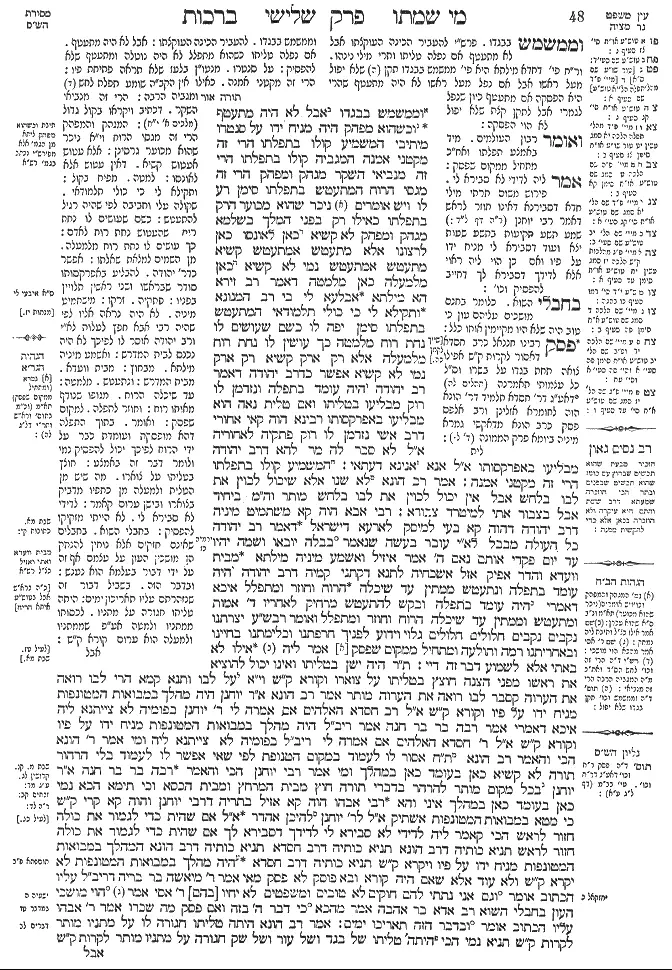
Berakhot 24b - Guemara
וממשמש בבגדו אבל לא היה מתעטף וכשהוא מפהק היה מניח ידו על סנטרו מיתיבי המשמיע קולו בתפלתו הרי זה מקטני אמנה המגביה קולו בתפלתו הרי זה מנביאי השקר מגהק ומפהק הרי זה מגסי הרוח המתעטש בתפלתו סימן רע לו ויש אומרים ניכר שהוא מכוער הרק בתפלתו כאילו רק בפני המלך בשלמא מגהק ומפהק לא קשיא כאן לאונסו כאן לרצונו אלא מתעטש אמתעטש קשיא מתעטש אמתעטש נמי לא קשיא כאן מלמעלה כאן מלמטה דאמר רב זירא הא מילתא אבלעא לי בי רב המנונא ותקילא לי כי כולי תלמודאי המתעטש בתפלתו סימן יפה לו כשם שעושים לו נחת רוח מלמטה כך עושין לו נחת רוח מלמעלה אלא רק ארק קשיא רק ארק נמי לא קשיא אפשר כדרב יהודה דאמר רב יהודה היה עומד בתפלה ונזדמן לו רוק מבליעו בטליתו ואם טלית נאה הוא מבליעו באפרקסותו רבינא הוה קאי אחורי דרב אשי נזדמן לו רוק פתקיה לאחוריה אל לא סבר לה מר להא דרב יהודה מבליעו באפרקסותו אל אנא אנינא דעתאי:
המשמיע קולו בתפלתו הרי זה מקטני אמנה:
אמר רב הונא לא שנו אלא שיכול לכוין את לבו בלחש אבל אין יכול לכוין את לבו בלחש מותר והמ ביחיד אבל בצבור אתי למיטרד צבורא:
רבי אבא הוה קא משתמיט מיניה דרב יהודה דהוה קא בעי למיסק לארעא דישראל דאמר רב יהודה כל העולה מבבל לאי עובר בעשה שנאמר (ירמיהו כז כב) בבלה יובאו ושמה יהיו עד יום פקדי אותם נאם ה' אמר איזיל ואשמע מיניה מילתא מבית וועדא והדר אפיק אזל אשכחיה לתנא דקתני קמיה דרב יהודה היה עומד בתפלה ונתעטש ממתין עד שיכלה הרוח וחוזר ומתפלל איכא דאמרי היה עומד בתפלה ובקש להתעטש מרחיק לאחריו ד' אמות ומתעטש וממתין עד שיכלה הרוח וחוזר ומתפלל ואומר רבשע יצרתנו נקבים נקבים חלולים חלולים גלוי וידוע לפניך חרפתנו וכלימתנו בחיינו ובאחריתנו רמה ותולעה ומתחיל ממקום שפסק אמר ליה אילו לא באתי אלא לשמוע דבר זה דיי:
תר היה ישן בטליתו ואינו יכול להוציא את ראשו מפני הצנה חוצץ בטליתו על צוארו וקורא קש ויא על לבו ותנא קמא הרי לבו רואה את הערוה קסבר לבו רואה את הערוה מותר אמר רב הונא אר יוחנן היה מהלך במבואות המטונפות מניח ידו על פיו וקורא קש אל רב חסדא האלהים אם אמרה לי ר' יוחנן בפומיה לא צייתנא ליה איכא דאמרי אמר רבה בר בר חנה אמר ריבל היה מהלך במבואות המטונפות מניח ידו על פיו וקורא קש אל ר' חסדא האלהים אם אמרה לי ריבל בפומיה לא צייתנא ליה ומי אמר ר' הונא הכי והאמר רב הונא תח אסור לו לעמוד במקום הטנופת לפי שאי אפשר לו לעמוד בלי הרהור תורה לא קשיא כאן בעומד כאן במהלך ומי אמר רבי יוחנן הכי והאמר רבה בר בר חנה אר יוחנן בכל מקום מותר להרהר בדברי תורה חוץ מבית המרחץ ומבית הכסא וכי תימא הכא נמי כאן בעומד כאן במהלך איני והא רבי אבהו הוה קא אזיל בתריה דרבי יוחנן והוה קא קרי קש כי מטא במבואות המטונפות אשתיק אל לר' יוחנן להיכן אהדר אל אם שהית כדי לגמור את כולה חזור לראש הכי קאמר ליה לדידי לא סבירא לי לדידך דסבירא לך אם שהית כדי לגמור את כולה חזור לראש תניא כותיה דרב הונא תניא כותיה דרב חסדא תניא כותיה דרב הונא המהלך במבואות המטונפות מניח ידו על פיו ויקרא קש תניא כותיה דרב חסדא היה מהלך במבואות המטונפות לא יקרא קש ולא עוד אלא שאם היה קורא ובא פוסק לא פסק מאי אמר ר' מיאשה בר בריה דריבל עליו הכתוב אומר (יחזקאל כ כה) וגם אני נתתי להם חוקים לא טובים ומשפטים לא יחיו [בהם] ר' אסי אמר (ישעיהו ה יח) הוי מושכי העון בחבלי השוא רב אדא בר אהבה אמר מהכא (במדבר טו לא) כי דבר ה' בזה ואם פסק מה שכרו אמר ר' אבהו עליו הכתוב אומר (דברים לב מז) ובדבר הזה תאריכו ימים:
אמר רב הונא היתה טליתו חגורה לו על מתניו מותר לקרות קש תניא נמי הכי היתה טליתו של בגד ושל עור ושל שק חגורה על מתניו מותר לקרות קש
Comments from Rashi on Masechet Berakhot Page 24b
וממשמש בבגדו . להעביר הכינה העוקצתו: אבל לא היה מתעטף . אם נפלה טליתו כשהוא מתפלל לא היה נוטלה ומתעטף שלא להפסיק: על סנטרו . מנטו"ן בלע"ז שלא תראה פתיחת פיו: הרי זה מקטני אמנה . כאילו אין הקב"ה שומע תפלת לחש ומגביה הרבה: הרי זה מנביאי השקר . דכתיב ויקראו בקול גדול (מלכים א יח): המגהק והמפהק הרי זה מגסי הרוח וי"א ניכר שהוא מכוער גרסינן: אלא עטוש אעטוש קשיא . דאין עטוש אלא לאונסו: למטה . מפיח בקול: ותקילא לי כי כולי תלמודאי . שקולה עלי וחביבה לפי שהיה רגיל להתעטש: כשם שעושים לו נחת רוח . שהעטוש נחת רוח לאדם: כך עושים לו נחת רוח מלמעלה . מן השמים למלאת שאלתו: אפשר כדרבי יהודה . להבליע באפרקסותו סודר שבראשו ושני ראשין תלויין בפניו: פתקיה . זרקו: מישתמיט מיניה . לא היה נראה אליו לפי שהיה רבי אבא חפץ לעלות לא"י ורב יהודה אוסר לו לפיכך לא היה נכנס לבית המדרש: ואשמע מיניה מילתא . מבחוץ: מבית וועדא . מבית המדרש: ונתעטש . מלמטה: עד שיכלה הרוח . מגופו שנודף מאותו רוח: וחוזר לתפלה . למקום שפסק: ואומר . בתוך התפלה דהא מופסקת ועומדת כבר על ידי הרוח לפיכך יכול להפסיק נמי ולומר דבר זה באמצע: חוצץ בטליתו על צוארו . מה שיש מן הטלית ולמעלה מן כתפיו מדביק בצוארו ובישן ערום קאמר: לדידי לא סבירא לי . לא הייתי מזקיקו להפסיק: בחבלי השוא . בחבלים שאינם חזקים אלא נוחין להנתק הן מושכין העון על עצמם אף זה על ידי דבור בעלמא הוא נענש: ובדבר הזה . בשביל דבור זה שנזהרתם עליו תאריכון ימים: היתה טליתו חגורה על מתניו . לכסותו ממתניו ולמטה אע"פ שממתניו ולמעלה הוא ערום קורא ק"ש:
Comments from Tosafot - Berakhot 24b
וממשמש בבגדו . פרש"י להעביר הכינה העוקצתו אבל לא מתעטף אם נפלה טליתו ותרי מילי נינהו. ור"ח פי' דחדא מילתא היא פי' ממשמש בבגדו תקן שלא יפול מעל ראשו אבל אם נפל מעל ראשו לא היה מתעטף שהרי היא הפסקה אם מתעטף כיון שנפל לגמרי אבל לתקן קצת שלא יפול לא הוי הפסקה: ואומר רבון העולמים . מיד באמצע תפלתו ואח"כ מתחיל ממקום שפסק: אמר ליה לדידי לא סבירא לי . פירוש משום תרתי מילי חדא דסבירנא דאינו חוזר לראש דאמר רבי יוחנן (ר"ה דף ל"ד:) שמע תשע תקיעות בתשע שעות יצא ועוד דסבירא לי מניח ידו על פיו ואם כן הוי ליה ראוי אלא לדידך דסבירא לך דחייב להפסיק וכו': בחבלי השוא . כלומר בחנם מושכים עליהם עון כי טוב היה שלא היו מקיימין אותו כלל:
Berakhot 24b - Mishnah translated into english
and if he was stung by a louse, he may feel for it and remove it with his garment, but he would not wrap himself in his prayer shawl if it fell during prayer. And when he would yawn he would place his hand on his chin so that his open mouth would not be visible.
The Gemara raises an objection based on a baraita: One who sounds his voice during his Amida prayer is among those of little faith, as he seems to believe that the Lord cannot hear his prayer when it is uttered silently. One who raises his voice during prayer is considered to be among the false prophets, as they too were wont to cry out and shout to their gods.
Furthermore, one who belches and yawns while praying is surely among the uncouth. One who sneezes during his prayer, for him it is a bad omen. And some say: It is clear that he is repulsive. Also, one who spits during prayer, it is tantamount to spitting in the face of the king. In light of all this, how could Rabbi Yehuda HaNasi have done all that while praying?
The Gemara explains: Granted, with regard to one who belches and yawns, it is not difficult: Here, in the case where Rabbi Yehuda HaNasi did so, it was involuntary and therefore permissible; here, where it is considered uncouth, is in a case where it is deliberate. However, the contradiction between sneezing in the case where Rabbi Yehuda HaNasi did so and sneezing where it is considered a bad omen is difficult.
The Gemara responds: The contradiction between sneezing in one case and sneezing in the other case is also not difficult: Here, in the case of Rabbi Yehuda HaNasi, it is referring to sneezing from above, his nose; here, where it is a bad omen, is referring to sneezing from below, flatulence. As Rav Zeira said: In the school of Rav Hamnuna I absorbed this matter in passing, and it is equal in significance to all the rest of my learning: One who sneezes in the midst of prayer, it is a good omen for him. Just as the sneeze soothes his irritation, giving him pleasure below, it is a sign that they are similarly giving him pleasure above. Since Rav Zeira sneezed often, he was extremely pleased to hear this.
However, The contradiction between spitting in the case where Rabbi Yehuda HaNasi did so and spitting where it is deemed tantamount to spitting in the face of the king is difficult. The Gemara replies: The contradiction between spitting in one case and spitting in the other case is also not difficult, as it is possible to resolve it in accordance with the opinion of Rav Yehuda, as Rav Yehuda said: One who was standing in prayer, and saliva happened to accumulate in his mouth, he absorbs it in his garment. And if it was a fine garment and he does not want it to become sullied, he may cover it up in his head covering. That way, one is permitted to spit. The Gemara relates: Ravina was standing behind Rav Ashi during prayer when saliva happened to accumulate in his mouth, so he discharged it behind him. Rav Ashi said to him: And does the Master not hold in accordance with that statement of Rav Yehuda, who said that one absorbs it in his head covering? He said to him: I am delicate, and the mere knowledge that there is spittle in my head covering disturbs my prayer.
It was taught in a baraita: One who sounds his voice during his Amida prayer is among those of little faith. Rav Huna said: This was only taught in a case where one is able to focus his heart while praying silently, but if he is unable to focus his heart while praying silently, he is permitted to sound his voice. This applies only to one praying alone, but when he is praying in a congregation his voice will come to disturb the congregation and it is prohibited.
The Gemara relates that Rabbi Abba was avoiding being seen by his teacher Rav Yehuda, as Rabbi Abba sought to ascend to Eretz Yisrael and his teacher disapproved, as Rav Yehuda said: Anyone who ascends from Babylonia to Eretz Yisrael transgresses a positive commandment, as it is stated: “They shall be taken to Babylonia and there they shall remain until the day that I recall them, said the Lord” (Jeremiah 27:22). Rabbi Abba did not want to discuss his desire to emigrate with Rav Yehuda. Nevertheless he said: I will go and hear something from him at the hall where the Sages assemble, without being seen, and afterwards I will leave Babylonia.
He went and found the tanna, who recites the tannaitic sources before the study hall, reciting the following baraita before Rav Yehuda: One who was standing in prayer and sneezed from below waits until the odor dissipates and resumes praying. Some say: One who was standing in prayer when he felt the need to sneeze from below, retreats four cubits, sneezes, waits until the odor dissipates and resumes praying. And before resuming his prayer, he says: Master of the universe, You have formed us with many orifices and cavities; our disgrace and shame in life are clear and evident before You, as is our destiny with maggots and worms, and so we should not be judged harshly. And he resumes his prayer from where he stopped.
Rabbi Abba said to him: Had I only come to the assembly of the Sages to hear this teaching, it would have been sufficient for me.
The Sages taught: One who was sleeping unclothed, but was covered with his garment, and he is unable to stick his head out from under the garment because of the cold, may form a barrier with his garment at his neck and recite Shema in bed. And some say: He must form a barrier with his garment at his heart.
The Gemara asks: And according to the first tanna, shouldn’t he be prohibited from reciting Shema because his heart sees his nakedness, as there is no barrier between them? The Gemara responds: Indeed, the first tanna holds that when one’s heart sees his nakedness, it is permitted to recite Shema, and a barrier is only necessary to separate between his mouth and his nakedness.
Rav Huna said that Rabbi Yoḥanan said: One who was walking in alleyways filthy with human excrement and he must recite Shema, he places his hand over his mouth and recites Shema. Rav Ḥisda said to him: By God! Even if Rabbi Yoḥanan had said it to me directly, with his own mouth, I would not have obeyed him.
Some say this halakha: Rabba bar bar Ḥana said that Rabbi Yehoshua ben Levi said: One who was walking in alleyways filthy with human excrement and he must recite Shema, he places his hand over his mouth and recites Shema. Rav Ḥisda said to him: By God! Even if Rabbi Yehoshua ben Levi had said it to me directly, with his own mouth, I would not have obeyed him.
The Gemara challenges this: Did Rav Huna really say that? Didn’t Rav Huna say: A Torah scholar is prohibited from standing in a place of filth, as he is unable to stand without contemplating Torah, and uttering Shema orally is graver than mere contemplation. The Gemara responds: This is not difficult; here, Rav Huna prohibited contemplating Torah in a case where one is standing in a place of filth, while here he permitted to recite Shema in a case where one is walking through a place of filth.
The Gemara asks: Did Rabbi Yoḥanan really say that? Didn’t Rabba bar bar Ḥana say that Rabbi Yoḥanan said: One is permitted to contemplate matters of Torah everywhere, except the bathhouse and the bathroom? Consequently, it is prohibited to even contemplate Torah in a place of filth. And if you say: Here, too, there is a distinction between the two cases, here, Rabbi Yoḥanan prohibited contemplating Torah in a case where one is standing; here, Rabbi Yoḥanan permitted to recite Shema in a case where one is walking, is that so? Wasn’t Rabbi Abbahu walking after Rabbi Yoḥanan and reciting Shema, and when he reached a filthy alleyway he fell silent and stopped reciting Shema. When they emerged, Rabbi Abbahu said to Rabbi Yoḥanan: To where in Shema should I return and resume reciting it? Rabbi Yoḥanan said to him: If you delayed continuing Shema for an interval sufficient to complete the entire Shema, return to the beginning and recite it from there. From the fact that Rabbi Yoḥanan did not admonish him for interrupting his recitation, apparently he, too, prohibits reciting Shema while walking through a filthy alleyway.
The Gemara responds: This is not a proof, as he says to him as follows: I do not hold that one must interrupt the recitation of Shema in this case, but for you, who holds that one must, if you delayed Shema for an interval sufficient to complete the entire Shema, return to the beginning and recite it from there.
The Gemara cites tannaitic sources to corroborate both the lenient and the stringent opinions. It is taught in a baraita in accordance with the opinion of Rav Huna, and it is taught in a baraita in accordance with the opinion of Rav Ḥisda. It is taught in a baraita in accordance with the opinion of Rav Huna: One who was walking in filthy alleyways places his hand over his mouth and recites Shema. It is taught in a baraita in accordance with the opinion of Rav Ḥisda: One who was walking in filthy alleyways may not recite Shema. Furthermore, if he was in the course of reciting Shema when he reached a filthy alleyway, he stops his recitation at that point.
The Gemara asks: If one did not stop, what is his status? Rabbi Meyasha, son of the son of Rabbi Yehoshua ben Levi, said: Of him the verse says: “Moreover, I gave them statutes that were not good and laws by which they could not live” (Ezekiel 20:25), as in this case following these statutes and laws led to sin, not to mitzva.
Rav Asi said that this is derived from the verse: “Woe to those who draw iniquity with cords of vanity” (Isaiah 5:18), meaning that this man brings sin upon himself for naught. Rav Adda bar Ahava said it is derived from here: “For he has shown contempt for the word of the Lord” (Numbers 15:31), meaning that uttering God’s word in a place of filth shows contempt for the Lord.
The Gemara asks: And if he stopped his recitation, what is his reward? Rabbi Abbahu said: Of him the verse says: “And it is through this matter that you will prolong your days” (Deuteronomy 32:47), meaning that by being careful with one’s speech one merits longevity.
Rav Huna said: One whose garment was tied around his waist, even if he was bare above the waist, is permitted to recite Shema. Indeed, that opinion was also taught in a baraita: One whose garment made of cloth, of leather, of sack or of any other material was strapped around his waist, he is permitted to recite Shema.
Traduction : The William Davidson digital edition of the Koren Noé Talmud, with commentary by Rabbi Adin Even-Israel Steinsaltz.