 Talmud Bavli
No video class on this page yet.
To add a video to this page please click here.Niddah Page 24b
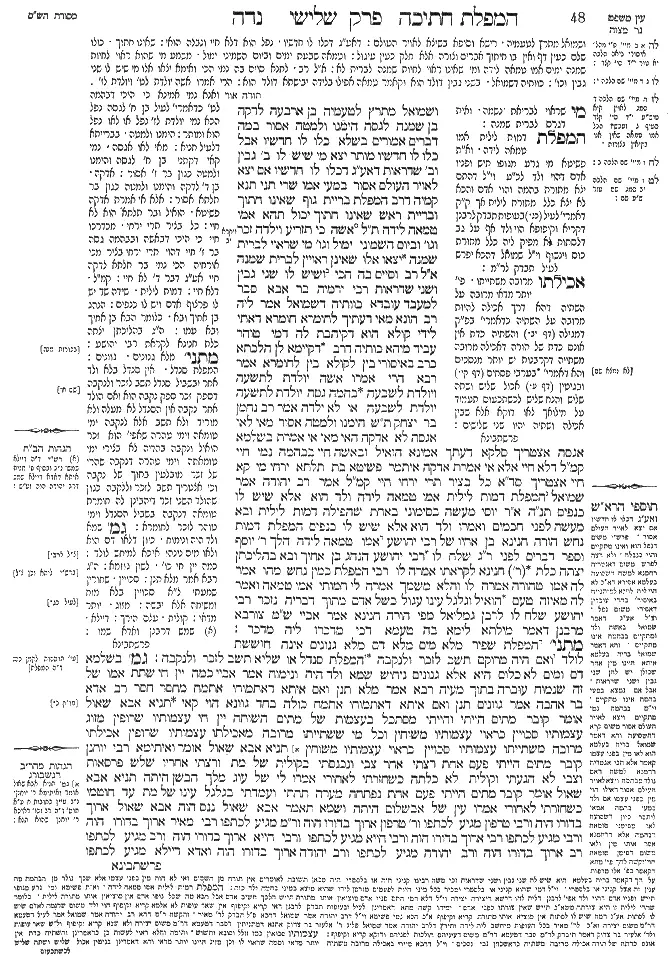
Niddah 24b - Guemara
ושמואל מתרץ לטעמיה בן ארבעה לדקה בן שמנה לגסה הימנו ולמטה אסור במה דברים אמורים בשלא כלו לו חדשיו אבל כלו לו חדשיו מותר יצא מי שיש לו ב' גבין וב' שדראות דאע"ג דכלו לו חדשיו אם יצא לאויר העולם אסור במעי אמו שרי תני תנא קמיה דרב המפלת בריית גוף שאינו חתוך ובריית ראש שאינו חתוך יכול תהא אמו טמאה לידה ת"ל (ויקרא יב, ב) אשה כי תזריע וילדה זכר וגו' וביום השמיני ימול וגו' מי שראוי לברית שמנה יצאו אלו שאינן ראויין לברית שמנה א"ל רב וסיים בה הכי ושיש לו שני גבין ושני שדראות רבי ירמיה בר אבא סבר למעבד עובדא כוותיה דשמואל אמר ליה רב הונא מאי דעתיך לחומרא חומרא דאתי לידי קולא הוא דקיהבת לה דמי טוהר עביד מיהא כותיה דרב דקיימא לן הלכתא כרב באיסורי בין לקולא בין לחומרא אמר רבא הרי אמרו אשה יולדת לתשעה ויולדת לשבעה בהמה גסה יולדת לתשעה יולדת לשבעה או לא ילדה אמר רב נחמן בר יצחק ת"ש הימנו ולמטה אסור מאי לאו אגסה לא אדקה האי מאי אי אמרת בשלמא אגסה אצטריך סלקא דעתך אמינא הואיל ובאשה חיי בבהמה נמי חיי קמ"ל דלא חיי אלא אי אמרת אדקה איתמר פשיטא בת תלתא ירחי מי קא חיי אצטריך סד"א כל בציר תרי ירחי חיי קמ"ל אמר רב יהודה אמר שמואל המפלת דמות לילית אמו טמאה לידה ולד הוא אלא שיש לו כנפים תנ"ה א"ר יוסי מעשה בסימוני באחת שהפילה דמות לילית ובא מעשה לפני חכמים ואמרו ולד הוא אלא שיש לו כנפים המפלת דמות נחש הורה חנינא בן אחיו של רבי יהושע אמו טמאה לידה הלך ר' יוסף וספר דברים לפני ר"ג שלח לו רבי יהושע הנהג בן אחיך ובא בהליכתן יצתה כלת (ר') חנינא לקראתו אמרה לו רבי המפלת כמין נחש מהו אמר לה אמו טהורה אמרה לו והלא משמך אמרה לי חמותי אמו טמאה ואמר לה מאיזה טעם הואיל וגלגל עינו עגול כשל אדם מתוך דבריה נזכר רבי יהושע שלח לו לרבן גמליאל מפי הורה חנינא אמר אביי ש"מ צורבא מרבנן דאמר מילתא לימא בה טעמא דכי מדכרו ליה מדכר מתני׳ המפלת שפיר מלא מים מלא דם מלא גנונים אינה חוששת לולד ואם היה מרוקם תשב לזכר ולנקבה המפלת סנדל או שליא תשב לזכר ולנקבה גמ׳ בשלמא דם ומים לא כלום היא אלא גנונים ניחוש שמא ולד הוה ונימוח אמר אביי כמה יין חי שתת אמו של זה שנמוח עוברה בתוך מעיה רבא אמר מלא תנן ואם איתא דאתמוחי אתמח מחסר חסר רב אדא בר אהבה אמר גוונים תנן ואם איתא דאתמוחי אתמח כולה בחד גוונא הוי קאי תניא אבא שאול אומר קובר מתים הייתי והייתי מסתכל בעצמות של מתים השותה יין חי עצמותיו שרופין מזוג עצמותיו סכויין כראוי עצמותיו משוחין וכל מי ששתייתו מרובה מאכילתו עצמותיו שרופין אכילתו מרובה משתייתו עצמותיו סכויין כראוי עצמותיו משוחין תניא אבא שאול אומר ואיתימא רבי יוחנן קובר מתים הייתי פעם אחת רצתי אחר צבי ונכנסתי בקולית של מת ורצתי אחריו שלש פרסאות וצבי לא הגעתי וקולית לא כלתה כשחזרתי לאחורי אמרו לי של עוג מלך הבשן היתה תניא אבא שאול אומר קובר מתים הייתי פעם אחת נפתחה מערה תחתי ועמדתי בגלגל עינו של מת עד חוטמי כשחזרתי לאחורי אמרו עין של אבשלום היתה ושמא תאמר אבא שאול ננס הוה אבא שאול ארוך בדורו הוה ורבי טרפון מגיע לכתפו ור' טרפון ארוך בדורו הוה ור"מ מגיע לכתפו רבי מאיר ארוך בדורו הוה ורבי מגיע לכתפו רבי ארוך בדורו הוה ורבי חייא מגיע לכתפו ורבי חייא ארוך בדורו הוה ורב מגיע לכתפו רב ארוך בדורו הוה ורב יהודה מגיע לכתפו ורב יהודה ארוך בדורו הוה ואדא דיילא מגיע לכתפו
Comments from Rashi on Masechet Niddah Page 24b
ושמואל מתרץ לטעמיה . רישא וסיפא בשיצא לאויר העולם: דאע"ג דכלו לו חדשיו . נפל הוא דלא חיי ונבלה הואי: שאינו חתוך . כולו שלם כעין דף ואין בו חיתוך אברים וצורה אלא חלק כעין עיגול: וטמאה שבעת ימים וביום השמיני ימול . משמע מי שהוא ראוי לחיות שמנה ימים אמו טמאה לידה ומי שאינו ראוי לחיות שמנה לברית לא: א"ל רב . לתנא סיים בה נמי הכי ואימא יצאו אלו מי שיש לו שני גבין וכו': כוותיה דשמואל . בשני גבין דולד הוא וקאמר טמאה אפילו בלידה יבישתא דולד הוא: הרי אמרו אשה יולדת לט' ויולדת לז' . ואנא נמי אמינא כי היכי דבהמה לט' כדאמרי' לעיל בן ח' לגסה נפל הכא נמי יולדת לז' נפל או לאו נפל הוא ומותר: הימנו ולמטה . בברייתא דלעיל תניא: מאי לאו אגסה . נמי קאי דקתני בן ח' לגסה והימנו ולמטה כגון בר ז' אסור: אדקה . בן ד' לדקה והימנו ולמטה כגון בר תלתא אסור: אלא אי אמרת אדקה פשיטא . הואיל ובר תלתא הוא לא חיי: כל בציר תרי ירחי . מכדרכו חיי כי היכי דבאשה ובבהמה גסה בר ז' חיי דהוי תרי ירחי בציר מכי אורחיה הכי נמי בר תלתא לדקה חיי אע"ג דבר ד' לא חיי: קמ"ל . דלא חיי: דמות לילית . שידה. שד יש לו פרצוף אדם ויש לו כנפים: הנהג בן אחיך ובא . כלומר הבא בן אחיך ובא עמו: ה"ג בהליכתן יצתה כלת חנינא לקראת רבי יהושע: מתני' מלא גנונים . גוונים: המפלת סנדל . אין סנדל בלא ולד אחר ובשביל סנדל תשב לזכר ולנקבה דספק זכר ספק נקבה הוא ואם הולד אחר נקבה אין הסנדל לא מעלה ולא מוריד ולא תשב אלא לנקבה ימי טומאה וימי טהרה שאפי' הוא זכר הואיל ונקבה בהדיה לא בצירי ימי טומאתה וימי טהרה דנקבה שהרי של זכר מובלעין בתוך של נקבה וכי אצטריך תשב לזכר ולנקבה כגון שהולד השני זכר דיהבינן לה חומרת טומאה דנקבה בשביל הסנדל וימי טוהר לזכר לחומרא: גמ' שמא ולד היה ונימוח . כיון דלאו דם הוא ולאו מים נינהו איכא למיחש לולד: כמה יין חי כו' . לשון גוזמא: ה"ג רבא אמר מלא תנן: סכויין . שחורין. שמעתי ל"א סכויין בלא מוח ומשיחה אלא יבשה: מזוג . יותר מדאי: קולית . עצם הירך: דיילא . שמש דרבנן ואדא שמו:
Comments from Tosafot - Niddah 24b
מי שראוי לבריאת נשמה. ואית דגרס לברית שמנה: המפלת דמות לילית אמו טמאה לידה. וא"ת פשיטא מי גרע מגופו תיש ופניו אדם דהוי ולד לכ"ע וי"ל דהתם יצא מתורת בהמה והוי אדם והכא לא יצא כלל מתורת לילית אך ק"ק דאמרי' לעיל (נדה כג.) בעופות תבדק לרבנן דקריא וקיפופא הוי ולד אף על גב דלסתות לא מפיק ליה כלל מתורת כוס וינשוף וי"ל שמואל דהכא יפרש לעיל תבדק לר"מ: המפלת סנדל או שליא תשב לזכר ולנקבה. וא"ת בשליא ליתני נמי ולנדה דאימא הרחיקה לידתה וכבר כלו ימי טוהר כדאיתא לקמן בפירקין (נדה דף כח.) גבי המפלת יד חתוכה אע"ג דאמר בסמוך אין תולין השליא בולד יותר מג' ימים להחמיר חוששין יותר מג' ימים וי"ל דלא דמו דבהמפלת יד חתוכה איכא למימר דהראש או רוב הגוף כבר ילדה מקודם וכלו ימי טוהר אבל שליא אימא הולד בתוכה או שלם או נימוק ועוד י"ל דאי הוה תני ולנדה ה"א מביאה קרבן ואינו נאכל דספק לידה היא קמ"ל מביאה קרבן ונאכל והכי נמי קאמר לקמן: אכילתו מרובה משתייתו. פי' יותר מדאי מרובה על השתיה דהא דרך אכילה להיות מרובה על השתיה כדאמרי' בפ"ק דמגילה (דף יב.) והשתיה כדת אין אונס כדת של תורה דאכילה מרובה משתייה דקרבנות יש יותר מנסכים והא דאמרי' בערבי פסחים (דף קי.) ובגיטין (דף ע.) אכול שליש ושתה שליש והנח שליש לכשתכעוס תעמוד על מילואך לאו דוקא אלא שבין אכילה ושתיה יהיו שני שלישים:
Niddah 24b - Mishnah translated into english
And Shmuel explains the baraita according to his line of reasoning, in the following manner: If an animal fetus is born in the fourth month of pregnancy in the case of small domesticated animals, or it is born in the eighth month of pregnancy in the case of large livestock, or if it was born from this stage of the pregnancy and earlier, the animal is forbidden. In what case is this statement said? In a case when the fetus’s months of gestation were not completed; but in a case when its months of gestation were completed, it is permitted for consumption even outside the womb. This excludes a fetus that has two backs and two spines, as even in a case where its months of gestation were completed, if it emerged into the airspace of the world, it is forbidden, whereas if it is found in the womb of its mother, it is permitted.
A tanna taught a baraita before Rav: In the case of a woman who discharges an entity that has a shapeless body, i.e., it does not have the outline of limbs, or an entity that has a shapeless head, one might have thought that its mother should be impure with the impurity of a woman after childbirth. Therefore, the verse states: “If a woman bears seed and gives birth to a male, she shall be impure seven days; as in the days of the menstruation of her sickness she shall be impure. And on the eighth day the flesh of his foreskin shall be circumcised” (Leviticus 12:2–3).
Those verses teach that the impurity of a woman after childbirth applies only to one who gave birth to a child that is fit for circumcision on the eighth day, excluding these cases, where the child is not fit for circumcision on the eighth day, as it cannot survive that long. Consequently, this woman does not have the impurity of a woman after childbirth. Rav said to the tanna: And conclude the baraita like this: Excluding these cases, where the child is not fit for circumcision on the eighth day, and excluding the case of a woman who discharges a child that has two backs and two spines.
Rabbi Yirmeya bar Abba thought to perform an action, i.e., to issue a ruling, in accordance with the opinion of Shmuel, that a woman who gives birth to a child with two backs and two spines is impure. Rav Huna said to him: What is your thinking? That as this matter is subject to a dispute, one should rule stringently? Your ruling is a stringency that leads to a leniency, as you have given the woman a period of thirty-three days following her period of impurity when any blood that emerges is blood of purity. In any event, you should perform, i.e., issue your ruling, in accordance with the opinion of Rav, as we maintain that the halakha is in accordance with the opinion of Rav with regard to ritual matters, whether his opinion leads to a leniency or to a stringency.
§ Rava says: The Sages said that a woman can give birth to a viable offspring after nine months of pregnancy or after seven months of pregnancy; but if a woman gives birth after eight months of pregnancy, the child cannot survive and is stillborn. Similarly, a large domesticated animal gives birth to a viable offspring after nine months of pregnancy, and if it discharges a fetus after only eight months, the newborn animal cannot survive. With this in mind, Rava asked: Can a large domesticated animal give birth to a viable offspring after seven months of pregnancy, like a human, or can such an animal not give birth to a viable offspring after only seven months?
Rav Naḥman bar Yitzḥak said: Come and hear a resolution to this dilemma from the aforementioned baraita: If an animal discharges from this stage of the pregnancy and earlier, the fetus is forbidden in consumption as an unslaughtered animal carcass. What, is it not referring to large livestock, which indicates that large livestock do not give birth to a viable offspring after only seven months of pregnancy? The Gemara answers: No, the reference is specifically to small domesticated animals, which do not give birth to a viable offspring until after five months of pregnancy.
The Gemara raises a difficulty with regard to this answer: What is this? Granted, if you say that the reference is to large livestock, it is necessary for the baraita to state that an animal does not give birth to a viable offspring after less than a complete period of pregnancy, as otherwise it might enter your mind to say that since in the case of a woman who gives birth after seven months the baby survives, it is logical that in the case of a large domesticated animal that gives birth after seven months the newborn also survives, and it is therefore permitted for consumption. Consequently, the baraita teaches us that such an animal does not survive.
But if you say that the ruling in the baraita, that if an animal discharged a fetus before the period of gestation was completed then the fetus is prohibited, was stated with regard to small domesticated animals, isn’t it obvious that if a sheep or goat fetus was discharged at this stage it cannot survive? Can it survive after only three months of gestation?
The Gemara answers that in fact it is necessary for the baraita to state this halakha with regard to small domesticated animals, as otherwise it might enter your mind to say that any mammal that is born two months less than its complete gestation survives, just as a human born at seven months of gestation survives. Therefore, the baraita teaches us that a sheep or goat that is born at three months of gestation cannot survive and is forbidden for consumption.
§ Rav Yehuda says that Shmuel says: In the case of a woman who discharges a fetus that has the form of a lilith, a female demon with wings and a human face, its mother is impure with the impurity of a woman after childbirth, as it is a viable offspring, only it has wings. This is also taught in a baraita: Rabbi Yosei said: An incident occurred in Simoni involving a certain woman who discharged a fetus that had the form of a lilith, and the incident was brought before the Sages; and they said that it is a viable offspring, only it has wings.
There was a case of a woman who discharged an item that had the form of a snake. Ḥanina, the son of Rabbi Yehoshua’s brother, ruled that its mother is impure with the impurity of a woman after childbirth. Rabbi Yosef went and told this matter to Rabban Gamliel. Rabban Gamliel sent to Rabbi Yehoshua: Take hold of your nephew and come to me, so that I may admonish him for his ruling.
While they were going to Rabban Gamliel, Ḥanina’s daughter-in-law went out to greet Rabbi Yehoshua, and said to him: My teacher, what is the halakha with regard to a woman who discharges an item that looks like a snake? Rabbi Yehoshua said to her: Its mother is pure. She said to him: But my mother-in-law said to me in your name that its mother is impure in such a case, and that you said to her: For what reason is she impure? It is because the pupil of a snake is round like that of a human. Due to her statement, Rabbi Yehoshua remembered that he had issued such a ruling. He subsequently sent a message to Rabban Gamliel: Ḥanina issued the ruling based on my own statement.
Abaye said: Conclude from this incident that a Torah scholar [tzurva merabbanan] who says a halakhic matter should say the reason for his statement, so that when his colleagues remind him of his reasoning, he will remember that ruling, as happened to Rabbi Yehoshua.
MISHNA: A woman who discharges a gestational sac full of fluid, full of blood, or full of different colors need not be concerned that it was an offspring. But if the sac was one in which tissue developed, her halakhic status is that of a woman after childbirth. Since the sex of the embryo is unknown, the woman observes the strictures of a woman who gave birth both to a male and to a female; she is impure for fourteen days like a woman who gave birth to a female, but blood that she sees thereafter is pure only until forty days after birth, like a woman who gave birth to a male. A woman who discharges a sandal fetus, i.e., one that has the form of a sandal fish, and one who discharges an afterbirth observes the strictures of a woman who gave birth both to a male and to a female.
GEMARA: The Gemara raises a difficulty: Granted, one can understand why a woman who discharges a gestational sac full of blood or water is pure, as such an item is nothing, i.e., it is not an offspring. But if the gestational sac was full of different colors, let us be concerned that perhaps it was an offspring and it liquefied. Abaye says in response: How much undiluted wine, which can be harmful to an embryo, did the mother of this purported embryo drink, that her embryo was liquefied in her womb? In other words, there is no such concern.
Rava says that there is a different explanation: We learned in the mishna that the gestational sac was full of different colors, and if it is so, that there was an embryo in the sac that liquefied, the sac would have been lacking some of the mass of the liquified portion. Rav Adda bar Ahava says that there is yet another explanation: We learned in the mishna that the gestational sac is full of different colors, and if it is so, that there was an embryo there that liquefied, it would all be of one color.
With regard to the effect of drinking wine on a person’s body, it is taught in a baraita that Abba Shaul says: I used to be a gravedigger, and I would observe the bones of corpses. I discovered that the bones of one who drinks too much undiluted wine during his lifetime look burnt, the bones of one who drinks too much diluted wine are black, and the bones of one who drinks the appropriate amount of wine are fat, i.e., full of marrow. And furthermore, I discovered that the bones of anyone who drinks much more than he eats look burnt, the bones of one who eats much more than he drinks are black, and the bones of one who eats and drinks appropriate amounts are fat.
It is taught in a baraita that Abba Shaul says the following, and some say that Rabbi Yoḥanan said it: I used to be a gravedigger. Once I ran after a deer, and I entered the thighbone of a corpse; and it was so large that I ran after the deer for three parasangs inside the thighbone, and although I did not reach the deer, the thighbone did not end. When I came back and related this to the Sages, they said to me: It was evidently the thighbone of Og, king of Bashan, a known giant.
It is likewise taught in a baraita that Abba Shaul says: I used to be a gravedigger. Once a burial cave opened up underneath where I was standing, and I found myself standing in the eye socket of a corpse until my nose. When I came back and told this to the Sages, they said to me: It was evidently the eye of Absalom.
And lest you say that Abba Shaul was a midget, and therefore he was capable of standing in an eye socket until his nose, Abba Shaul was the tallest person in his generation. And Rabbi Tarfon reached only his shoulder, and Rabbi Tarfon was the tallest person in his generation. And Rabbi Meir reached only the shoulder of Rabbi Tarfon, and Rabbi Meir was the tallest person in his generation. And Rabbi Yehuda HaNasi reached only the shoulder of Rabbi Meir, and Rabbi Yehuda HaNasi was the tallest person in his generation.
The Gemara continues: And Rabbi Ḥiyya reached only the shoulder of Rabbi Yehuda HaNasi, and Rabbi Ḥiyya was the tallest person in his generation. And Rav reached only the shoulder of Rabbi Ḥiyya, and Rav was the tallest person in his generation. And Rav Yehuda reached only the shoulder of Rav, and Rav Yehuda was the tallest person in his generation. And Adda the attendant [dayyala] reached only the shoulder of Rav Yehuda,
Traduction : The William Davidson digital edition of the Koren Noé Talmud, with commentary by Rabbi Adin Even-Israel Steinsaltz.