 Talmud Bavli
No video class on this page yet.
To add a video to this page please click here.Niddah Page 54b
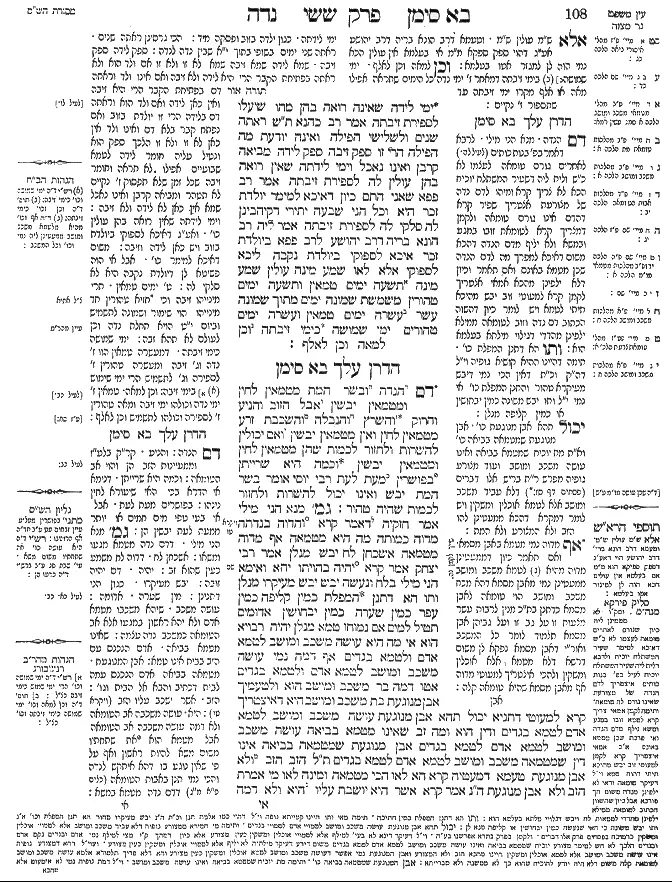
Niddah 54b - Guemara
ימי לידה שאינה רואה בהן מהו שיעלו לספירת זיבתה אמר רב כהנא ת"ש ראתה שנים ולשלישי הפילה ואינה יודעת מה הפילה הרי זו ספק זיבה ספק לידה מביאה קרבן ואינו נאכל וימי לידתה שאין רואה בהן עולין לה לספירת זיבתה אמר רב פפא שאני התם כיון דאיכא למימר יולדת זכר היא וכל הני שבעה יתירי דקיהבינן לה סלקי לה לספירת זיבתה אמר ליה רב הונא בריה דרב יהושע לרב פפא ביולדת זכר איכא לספוקי ביולדת נקבה ליכא לספוקי אלא לאו שמע מינה עולין שמע מינה תשעה ימים טמאין ותשעה ימים טהורין משמשת שמונה ימים מתוך שמונה עשר עשרה ימים טמאין ועשרה ימים טהורים ימי שמושה כימי זיבתה וכן למאה וכן לאלף
הדרן עלך בא סימן
מתני׳ דם הנדה ובשר המת מטמאין לחין ומטמאין יבשין אבל הזוב והניע והרוק והשרץ והנבלה והשכבת זרע מטמאין לחין ואין מטמאין יבשין ואם יכולין להשרות ולחזור לכמות שהן מטמאין לחין ומטמאין יבשין וכמה היא שרייתן בפושרין מעת לעת רבי יוסי אומר בשר המת יבש ואינו יכול להשרות ולחזור לכמות שהיה טהור גמ׳ מנא הני מילי אמר חזקיה דאמר קרא (ויקרא טו, לג) והדוה בנדתה מדוה כמותה מה היא מטמאה אף מדוה מטמאה אשכחן לח יבש מנלן אמר רבי יצחק אמר קרא {ויקרא טו } יהיה בהויתו יהא ואימא הני מילי בלח ונעשה יבש יבש מעיקרו מנלן ותו הא דתנן המפלת כמין קליפה כמין עפר כמין שערה כמין יבחושין אדומים תטיל למים אם נמוחו טמא מנלן יהיה רבויא הוא אי מה היא עושה משכב ומושב לטמא אדם ולטמא בגדים אף דמה נמי עושה משכב ומושב לטמא אדם ולטמא בגדים אטו דמה בר משכב ומושב הוא ולטעמיך אבן מנוגעת בת משכב ומושב היא דאיצטריך קרא למעוטי דתניא יכול תהא אבן מנוגעת עושה משכב ומושב לטמא אדם לטמא בגדים ודין הוא ומה זב שאינו מטמא בביאה עושה משכב ומושב לטמא אדם לטמא בגדים אבן מנוגעת שמטמאה בביאה אינו דין שמטמאה משכב ומושב לטמא אדם לטמא בגדים ת"ל הזב הזב ולא אבן מנוגעת טעמא דמעטיה קרא הא לאו הכי מטמאה ומינה לאו מי אמרת הזב ולא אבן מנוגעת ה"נ אמר קרא אשר היא יושבת עליו היא ולא דמה
Comments from Rashi on Masechet Niddah Page 54b
ימי לידתה . כגון ילדה בזוב ופסקה מיד: הכי גרסינן ראתה שנים . ראתה שני ימים בשופי בתוך י"א שבין נדה לנדה: ספק לידה ספק זיבה . שמא לידה שמא זיבה שמא לא זו ולא זו אם ולד הוא ולא ראתה בפתיחת הקבר הרי היא לידה ולא זיבה ואם אינו ולד וראתה דם בפתיחת הקבר הרי היא זיבה ואין כאן לידה ואם ולד הוא וראתה דם בלידה הרי זו יולדת בזוב ואם נפתח קבר בלא דם ואינו ולד אין כאן לא זו ולא זו הלכך ספק הוא ונטיל עליה חומר לידה לטמא שבועיים אפילו לא תראה וחומר זיבה שכל זמן שלא תפסוק ז' נקיים לא תטהר ומביאה קרבן ואינו נאכל שמא אין כאן לא לידה ולא זיבה: וימי לידתה שאין רואה בהן עולין כו' . ואע"ג דאיכא לספוקי ביולדת בזוב ויש כאן לידה וזיבה: משום דאיכא למימר כו' . אבל אי הוה פשיטא לן דיולדת נקבה היא לא סלקי לה: ט' ימים טמאין . תרי מינייהו זיבה וכי חזיא טהורין חד מינייהו הוי שימור ושמונה לתשמיש וביום י"ט הויא תחלת נדה וכן לעולם לא תהא זבה: ימי שמושה כימי זיבתה . דמעשרה טמאין הוו ז' נדה וג' זיבה ומעשרה טהורין ז' לספירה וג' לתשמיש הרי ימי שימוש בימי זיבה: וכן למאה . טמאין ז' ימי נדה וכולהו ימי זיבה ומאה טהורין ז' לספירה וכולהו לתשמיש וכן לאלף: מתני' דם הנדה: והניע . קר"ק בלע"ז. וממעיינות הזב הן והוי אב הטומאה: וכמה היא שרייתן . דנימא אי הדרא בכי האי שיעורא לחין נינהו: בפושרים מעת לעת . אבל אי בעי טפי מים חמים או יותר ממעת לעת יבשין הן: גמ' מנא הני מילי . דדם נדה מטמא מגעו ומשאו: אשכחן לח . דדוה לח משמע כעין שהוא זב: יהיה . דם יהיה זובה: יבש מעיקרו . כגון הני דתנינן: מין שערה . אדומה: עושה משכב . שיהא משכבו מטמא אדם ולא יהא ראשון במגעו אלא אב הטומאה כמשכב נדה עצמה: שאינו מטמא בביאה . אדם הנכנס עם הזב בבית אינו טמא: אבן המנוגעת . מטמאה בביאה אדם הנכנס עמה לבית דכתיב והבא אל הבית וגו': הזב . אשר ישכב עליו הזב (ויקרא טו): היא . עושה משכבה אב הטומאה ולא דמה עושה משכבה אב הטומאה אבל מטמא הוא את שתחתיו משום משא להיות ראשון ואף על פי שאין נוגע בו דהא איתקש לנדה והכי נמי תנן באבות הטומאה (כלים פ"א מ"ג) דדם נדה מטמא במשא:
Comments from Tosafot - Niddah 54b
אלא ש"מ עולין ש"מ. וטעמא דרב הונא בריה דרב יהושע אע"ג דהוי ספק ספקא מ"מ אי בעלמא אין עולין הכא נמי הוה לן למגזר אטו בעלמא: וכן למאה וכן לאלף. ימי שמושה בימי זיבתה דמאחר ז' ימי נדה כל הימים שתראה אפילו מאה או אלף מקרו ימי זיבתה עד שתספור ז' נקיים: דם הנדה. מנא הני מילי. לרבא דאמר בפ' בנות כותים (לעיל נדה לה.) לאחרים גורם טומאה לעצמו לא כ"ש ולית ליה דשעיר המשתלח יוכיח הכא לא צריך קרא ומיהו לדם נדה של מצורעת אצטריך שפיר קרא דהדם אינו גורם טומאה ולקמן דמצריך קרא לטומאת זובו במגע ובמשא ולא יליף מדם הנדה דהכא משום דאיכא למפרך מה לדם הנדה שכן מטמא באונס ואם תאמר וכיון דלא ילפינן מהכא אמאי אצטריך לקמן קרא למעוטי זוב יבש מהיכא תיתי לטמא ויש לומר כיון דהשוה הכתוב דם נדה וזוב לטומאה ממילא ילפינן מהדדי דגילוי מילתא בעלמא הוא: ותו הא דתנן המפלת כו'. תימה דהיינו ההיא קושיא גופיה וי"ל דה"ק וכ"ת דאין הכי נמי דיבש מעיקרא טהור והתנן המפלת כו' אי נמי י"ל ותו יבש משונה כמין יבחושין או כמין קליפה מנלן: יכול תהא אבן מנוגעת כו'. אבן מנוגעת שמטמאה בביאה כו' וא"ת מת יוכיח שמטמא בביאה ואינו עושה משכב ומושב ועוד מצורע גופיה מפרש ר"ת בריש אלו דברים (פסחים דף סז:) דלא עביד משכב ומושב אלא לטמא אוכלין ומשקין ויש לומר דמקרא דהכא ממעטינן להו הזב ולא המצורע ולא המת:
Niddah 54b - Mishnah translated into english
What is the halakha in the case of a woman who gave birth when she was a zava? There are seven days of impurity following the birth of a son and fourteen days of impurity following the birth of a daughter, during which the mother is impure even if she did not experience bleeding. With regard to those days during this period on which she does not see blood, are they reckoned in the counting of her seven clean days required to become purified from the status of ziva?
Rav Kahana says: Come and hear a baraita: A woman saw blood on two consecutive days during the period of ziva, and on the third day she miscarried, but she does not know what she miscarried, i.e., whether it was a stillborn human fetus for which a woman contracts the impurity of childbirth, or whether she discharged an amorphous piece of tissue. In addition, she does not know whether she emitted blood during the miscarriage.
In such a case, it is uncertain whether she has the status of one who experienced ziva or whether she has the status of a woman who gave birth. If she gave birth to a fetus and did not emit blood, she is a woman after childbirth but not a zava. If the discharge was an amorphous piece of tissue and she saw blood, she is a zava. If it was a human fetus and she saw blood, she is one who gives birth as a zava. Finally, if she did not emit blood and it was a discharge of an amorphous piece of tissue, she is not obligated to bring an offering at all.
Consequently, she brings an offering but it is not eaten by the priests, as it is uncertain whether it is an offering of ziva or an offering for her childbirth, or whether it is non-sacred. And the days of impurity following this uncertain birth, on which she does not see blood, are reckoned in the counting of her seven clean days required to become purified from the status of ziva. This resolves the dilemma raised by the Sages.
Rav Pappa says that this does not resolve the dilemma, as it is different there, since it can be said that she is a woman who gave birth to a male, and it is only for that reason that all of these additional seven days that we give her due to the concern that she might have given birth to a female, which would render her impure for fourteen days, are reckoned in the counting of her seven clean days of ziva. But if it was certain that she gave birth to a female, those days after the birth would not count toward her period of ziva.
Rav Huna, son of Rav Yehoshua, said to Rav Pappa: Is there uncertainty that perhaps she is a woman who gave birth to a male, but there is no uncertainty that she might be a woman who gave birth to a female? In fact, both possibilities must be taken into account. And yet, despite the fact that she might have given birth to a female, these seven days are included in the counting of her seven clean days. Rather, isn’t it correct to conclude from it that such days are reckoned in the counting? The Gemara comments: Indeed, conclude from the baraita that these days do count.
The Gemara concludes its citation of the baraita: In the case of a woman whose set pattern is that nine days she is impure, i.e., experiences bleeding, and nine days she is pure, she may engage in intercourse with her husband during eight days out of eighteen. The last two days of the nine with blood are part of her ziva period, after which she must observe one clean day, leaving her with eight days when she may engage in intercourse before the cycle begins again.
In the case of a woman whose set pattern is that ten days she is impure and ten days she is pure, the number of days of her being permitted to engage in intercourse with her husband is equivalent to the number of days of her experiencing the flow of ziva. In the first seven days she is a menstruating woman, followed by three days of blood that render her a zava. She must count seven of the ten days without blood to be purified from her ziva, which leaves her three days in which she may engage in intercourse, exactly the same as the three days of ziva on which she saw blood. And so too, the same applies in the case of one hundred days, as she experiences bleeding of ziva for ninety-three days, and is subsequently permitted to her husband for ninety-three days, and so too in the case of one thousand days.
MISHNA: The blood of a menstruating woman and the flesh of a corpse transmit impurity by contact and by carrying when they are moist, and likewise transmit impurity when they are dry. But with regard to the gonorrhea-like discharge of a zav [ziva], and the mucus and the saliva of a zav, and the carcass of a creeping animal, and an animal carcass, and semen, all transmit impurity when they are moist but do not transmit impurity when they are dry. And if one could soak those dry substances in water and thereby restore them to their previous state, they transmit impurity when moist and transmit impurity when dry.
The mishna asks: And how long is the process of soaking these substances that determines whether they can be restored to their previous state? This is referring to soaking them in lukewarm water for a twenty-four-hour period. Rabbi Yosei says: With regard to the flesh of a corpse that is dry and cannot be soaked to restore it to its previous state, it is ritually pure, in the sense that an olive-bulk of the flesh does not transmit impurity imparted by a corpse. But a ladleful of the flesh transmits the impurity of the decayed flesh of a corpse.
GEMARA: The mishna teaches that the blood of a menstruating woman transmits impurity by contact and by carrying both when moist and when dry. The Gemara asks: From where are these matters derived? Ḥizkiyya says: They are derived from a verse, as the verse states with regard to a menstruating woman: “This is the law of him that has an issue…And of her who experiences the flow of her menstrual impurity” (Leviticus 15:32–33). The verse compares the status of the menstrual flow to that of the menstruating woman. This teaches that the status of the menstrual flow is like the status of the woman herself: Just as she transmits impurity by contact and by carrying, so too, the menstrual flow transmits impurity by contact and by carrying.
The Gemara asks: We found a source for the impurity of the menstrual blood when it is moist, since it is called the menstrual flow; from where do we derive that dry menstrual blood also transmits impurity? Rabbi Yitzḥak says that the verse states with regard to menstrual impurity: “And if a woman should have an issue, and her issue in her flesh shall be blood, she shall be in her impurity seven days, and whoever touches her shall be impure until the evening” (Leviticus 15:19). The term “shall be” indicates that the blood shall remain in its impure status even once it is dry.
The Gemara objects: But one may say that this statement applies only to blood that was initially moist and subsequently became dry, as it retains its initial status. With regard to blood that was dry at the outset, from where do we derive that it too transmits impurity? And furthermore, this inference does not provide a source for that which we learned in a mishna (21a): In the case of a woman who discharges an item whose shape is similar to a type of shell, similar to a type of soil, similar to a type of hair, or similar to a type of mosquito, if such items are red, she should cast them into water to ascertain their nature. If they dissolved, it is blood, and the woman is impure. From where do we derive that even this type of blood is impure? The Gemara explains: The term “shall be” is an amplification, indicating that menstrual blood in all these forms is impure.
The Gemara objects: If so, one can likewise infer the following: Just as she, a menstruating woman, renders an item designated for lying or sitting impure to the extent that it transmits impurity to a person and to the extent that that person transmits impurity to his garments, despite the fact that the garments did not come into contact with the couch, so too, her blood also renders items designated for lying or sitting impure to the extent that they transmit impurity to a person and to the extent that he transmits impurity to his garments, in the manner of a primary source of ritual impurity. The Gemara replies: Is that to say that the concepts of lying and sitting apply to her menstrual blood? These categories of impurity are limited to people.
The Gemara asks: But according to your reasoning that this category of impurity is limited to people, do the concepts of lying and sitting apply to a stone afflicted with leprosy, so that a verse was necessary to exclude it? As it is taught in a baraita: One might have thought that a stone afflicted with leprosy should render an item designated for lying or sitting impure to the extent that it transmits impurity to a person and to the extent that he transmits impurity to his garments.
The baraita explains: And this ruling might be derived by logical inference: If one enters a house where there is a stone afflicted with leprosy he becomes impure, but one who enters a house together with a man who experienced a gonorrhea-like discharge [zav] does not become impure. One may therefore infer as follows: If a zav, who does not transmit impurity by entering a house, nevertheless renders an item designated for lying or sitting impure to the extent that it transmits impurity to a person and to the extent that that person transmits impurity to his garments, then with regard to a stone afflicted with leprosy, which does transmit impurity by entering a house, is it not logical that it renders an item designated for lying or sitting impure to the extent that it transmits impurity to a person and to the extent that he transmits impurity to the garments he is wearing?
The baraita concludes: Therefore, the verse states: “Every bed upon which the zav lies shall be impure, and every item upon which he sits shall be impure” (Leviticus 15:4). The term “the zav” indicates that only the zav, and not a stone afflicted with leprosy, renders items designated for lying or sitting impure. The Gemara infers from the baraita: The reason a stone afflicted with leprosy does not transmit impurity to items designated for lying or sitting is that the verse excluded it, but were it not so, the stone would transmit impurity to items designated for lying or sitting, despite the fact that the concepts of lying and sitting do not apply to a stone.
The Gemara replies that from this same derivation one can infer that menstrual blood does not render items designated for lying or sitting impure: Didn’t you say that the term “the zav” teaches that only the zav, and not a stone afflicted with leprosy, renders items designated for lying or sitting impure? So too, a verse excludes menstrual blood from this category of impurity, as the verse states: “And he if is on the bed, or on any item upon which she sits, when he touches it, he shall be impure until the evening” (Leviticus 15:23). The term “she” indicates that she, the menstruating woman, but not her blood, transmits impurity to items designated for lying or sitting.
Traduction : The William Davidson digital edition of the Koren Noé Talmud, with commentary by Rabbi Adin Even-Israel Steinsaltz.