 Talmud Bavli
No video class on this page yet.
To add a video to this page please click here.Niddah Page 42b
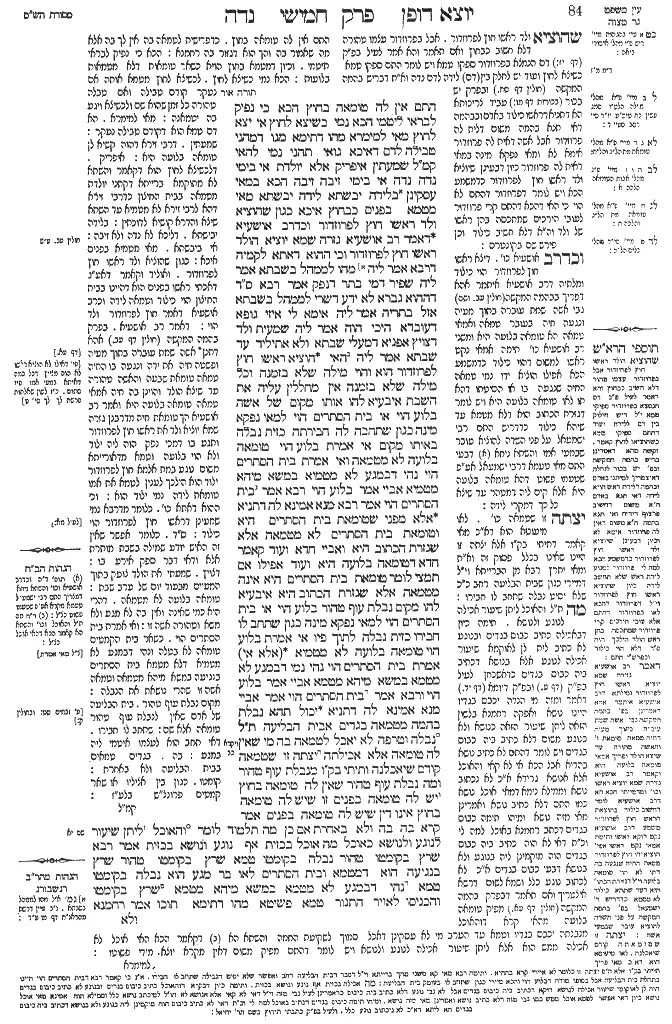
Niddah 42b - Guemara
התם אין לה טומאה בחוץ הכא כי נפיק לבראי ליטמי הכא נמי כשיצא לחוץ אי יצא לחוץ מאי למימרא מהו דתימא מגו דמהני טבילה לדם דאיכא גואי תהני נמי להאי קמ"ל שמעתין איפריק אלא יולדת אי בימי נדה נדה אי בימי זיבה זיבה הכא במאי עסקינן בלידה יבשתא לידה יבשתא מאי מטמא בפנים כבחוץ איכא כגון שהוציא ולד ראשו חוץ לפרוזדור וכדרב אושעיא דאמר רב אושעיא גזרה שמא יוציא הולד ראשו חוץ לפרוזדור וכי ההוא דאתא לקמיה דרבא אמר ליה מהו לממהל בשבתא אמר ליה שפיר דמי בתר דנפק אמר רבא ס"ד דההוא גברא לא ידע דשרי לממהל בשבתא אזל בתריה אמר ליה אימא לי איזי גופא דעובדא היכי הוה אמר ליה שמעית ולד דצויץ אפניא דמעלי שבתא ולא אתיליד עד שבתא אמר ליה האי הוציא ראשו חוץ לפרוזדור הוא והוי מילה שלא בזמנה וכל מילה שלא בזמנה אין מחללין עליה את השבת איבעיא להו אותו מקום של אשה בלוע הוי או בית הסתרים הוי למאי נפקא מינה כגון שתחבה לה חבירתה כזית נבלה באותו מקום אי אמרת בלוע הוי טומאה בלועה לא מטמאה ואי אמרת בית הסתרים הוי נהי דבמגע לא מטמיא במשא מיהא מטמיא אביי אמר בלוע הוי רבא אמר בית הסתרים הוי אמר רבא מנא אמינא לה דתניא אלא מפני שטומאת בית הסתרים היא וטומאת בית הסתרים לא מטמאה אלא שגזרת הכתוב היא ואביי חדא ועוד קאמר חדא דטומאה בלועה היא ועוד אפילו אם תמצי לומר טומאת בית הסתרים היא אינה מטמאה אלא שגזרת הכתוב היא איבעיא להו מקום נבלת עוף טהור בלוע הוי או בית הסתרים הוי למאי נפקא מינה כגון שתחב לו חבירו כזית נבלה לתוך פיו אי אמרת בלוע הוי טומאה בלועה לא מטמיא (אלא אי) אמרת בית הסתרים הוי נהי נמי דבמגע לא מטמא במשא מיהא מטמא אביי אמר בלוע הוי ורבא אמר בית הסתרים הוי אמר אביי מנא אמינא לה דתניא יכול תהא נבלת בהמה מטמאה בגדים אבית הבליעה ת"ל (ויקרא כב, ח) נבלה וטרפה לא יאכל לטמאה בה מי שאין לה טומאה אלא אכילתה יצתה זו שטמאה קודם שיאכלנה ותיתי בק"ו מנבלת עוף טהור ומה נבלת עוף טהור שאין לה טומאה בחוץ יש לה טומאה בפנים זו שיש לה טומאה בחוץ אינו דין שיש לה טומאה בפנים אמר קרא בה בה ולא באחרת אם כן מה תלמוד לומר {ויקרא יא } והאוכל ליתן שיעור לנוגע ולנושא כאוכל מה אוכל בכזית אף נוגע ונושא בכזית אמר רבא שרץ בקומטו טהור נבלה בקומטו טמא שרץ בקומטו טהור שרץ בנגיעה הוא דמטמא ובית הסתרים לאו בר מגע הוא נבלה בקומטו טמא נהי דבמגע לא מטמא במשא מיהא מטמא שרץ בקומטו והכניסו לאויר התנור טמא פשיטא מהו דתימא תוכו אמר רחמנא
Comments from Rashi on Masechet Niddah Page 42b
התם אין לה טומאה בחוץ . כדפרישית לטמאה בה אין לך בה אלא מה שאמור בה והך הוא דגזור בה רחמנא: הכא כי נפיק לבראי תיטמי . וכיון דמטמא בחוץ הויא כשאר טומאות דלא מטמאות בלועות: הכא נמי כשיצא לחוץ . לכשיצא לחוץ מטמא אותה אם נעקר קודם טבילה ואם טבלה טהורה כל זמן שהוא שם ולכשיצא ויגע בה יטמאנה: מאי למימרא . הא דם טמא הוא דקודם טבילה נעקר: שמעתין . דרבי זירא דהוה קשיא לן טומאה בלועה היא: איפריק . דלכשיצא לחוץ הוא דקאמר. והשתא לא מתוקמא ברייתא דקתני יולדת מטמאה בבית החיצון כדרבי זירא דהא לרבי זירא לא מטמיא עד השתא שיצא והדרא קושיא לדוכתין: בלידה יבישתא . דליכא לא נדה ולא זיבה: אי ביבשתא מאי מטמיא בפנים איכא: כגון שהוציא ולד ראשו חוץ לפרוזדור . ואוליד וקאמר דאע"ג דאכתי ראשו בפנים הוא דהיינו בבית החיצון הוי כילוד וטמאה לידה וכרב אושעיא דאמר חוץ לפרוזדור ולד הוי: דאמר רב אושעיא . בפרק בהמה המקשה (חולין דף עב.) אהא דתנן אשה שמת עוברה בתוך מעיה ופשטה חיה את ידה ונגעה בו החיה טמאה טומאת שבעה והאשה טהורה עד שיצא הולד והוינן בה חיה אמאי טמאה טומאה בלועה היא ואמר רב אושעיא הך טומאת חיה מדרבנן גזרה שמא יוציא ולד את ראשו חוץ לפרוזדור ותגע בו דמכי נפק הוה ליה ילוד ולא הוי בלועה וטמא מדאורייתא משום נוגע במת. אלמא חוץ לפרוזדור ילוד הוא הילכך לענין לטמא את אמו טומאת לידה נמי ילוד הוא: וכי ההוא דאתא כו' . כלומר מדרבא נמי שמעינן דראשו חוץ לפרוזדור הוי כילוד: ס"ד . כלומר אפשר שאין זה האיש יודע שמילה בשבת מותרת אלא ודאי דבר ספק אירע בו: דצויץ . שמעתי את הולד צועק בתוך המעיים מבעוד יום של ערב שבת: טומאה בלועה לא מטמאה . דהרי היא כמי שאינה ואין בה לא מגע ולא משא וטהורה אשה זו: ואי אמרת בית הסתרים הוי . כשאר בית הקמטים טומאה לא בטלה ונהי דבמגע לא מטמיא דלא מטמא בית הסתרים בנגיעה במשא מיהא מטמאה וטמאה אשה זו שהרי נושאת את הנבלה: מקום נבלת עוף טהור . בית הבליעה של אדם שאין לנבלת עוף טהור טומאה אלא שם: שתחב לו חבירו . דאי תחב הוא לעצמו איטמי ליה במגע: בה . בגדים טמאים בבית הבליעה ולא באחרת: קומטו . כגון בין אציליו או שאר קמטים פרונצ"ש בלע"ז:
Comments from Tosafot - Niddah 42b
שהוציא ולד ראשו חוץ לפרוזדור. אבל בפרוזדור עצמו טהורה דלא חשוב כבחוץ ואם תאמר והא אמר לעיל בפ"ק (נדה דף יז:) דם הנמצא בפרוזדור ספקו טמא ויש לומר התם ספקו טמא כשיצא לחוץ ועוד יש לחלק בין (דם) לידה לדם נדה וא"ת דבריש בהמה המקשה (חולין דף סח.) ובפרק יש בכור (בכורות דף מו:) עביד צריכותא הא דתניא דראשו כילוד באדם ובבהמה דאי תנא בהמה משום דלית לה פרוזדור אבל אשה דאית לה פרוזדור אימא לא ומאי נפקא מינה במאי דאית לה פרוזדור כיון דבעינן שיוציא ולד ראשו חוץ לפרוזדור כדמשמע הכא ויש לומר דפרוזדור דהתם לא הוי כי האי דהכא דהתם קרי פרוזדור לעובי הירכים שמתכסה בהן ראשו של ולד וה"א דלא חשיב כילוד וכן פירש שם בקונטרס: וכדרב אושעיא כו'. דיצא ראשו חוץ לפרוזדור הוי כילוד ומלתיה דרב אושעיא איתמר אהא דפריך בבהמה המקשה (חולין עב. ושם) גבי אשה שמת עוברה בתוך מעיה ונגעה חיה בעובר טמאה ואמאי טמאה הא טומאה בלועה היא ומשני רב אושעיא כו' תימה אמאי נקט ראשו למשום דהוי כילוד כדמשמע הכא אפילו הוציא ידו נמי טמאה החיה שנגעה בו או הסיטתו דהא תו לאו טומאה בלועה היא ויש לומר דגזרת הכתוב הוא דלא מטמא עד שיהא כילוד כדדריש התם רבי ישמעאל על פני השדה להוציא עובר שבמעי אמו והשתא ניחא דבעי התם מאי טעמא דרבי ישמעאל אע"פ שטעמו פשוט דהא טומאה בלועה היא אלא קים ליה דמטהר עד שיצא כל כך דמקרי לידה: יצתה זו שטמאה כו'. לאו מיעוטא הוא דא"כ מאי קאמר דתיתי בק"ו אלא יצתה זו היינו שאינו בכלל פסוק זה וא"ת ומאי יתרץ רבא מן הברייתא וי"ל דמיירי כגון שבית הבליעה רחב כ"כ שלא יסיט נבלה שתחב לו חבירו: מה ת"ל והאוכל ליתן שיעור אכילה לנוגע ולנושא. תימה כיון דבאכילה כתיב כבוס בגדים ובנוגע לא כתיב לית לן לאוקמא שיעור אכילה לנוגע אלא בנושא דכתיב ביה כבוס בגדים כדאשכחן לעיל בפ"ק (דף ט.) ובפ"ק דיומא (נדה דף יד.) דאמר ומזה מי הנדה יכבס בגדיו היינו נושא ואפקה רחמנא בלשון הזאה ליתן שיעור הזאה כנושא ולא כנוגע משום דלא כתיב ביה כבוס בגדים ויש לומר דהתם לא כתיב נושא בהדיא אבל הכא אי לא קאי והאוכל אלא אנושא גרידא א"כ לא נכתוב נושא וממילא נימא דמאי אוכל נושא כמו התם דלא כתיב נושא ואמרינן מאי מזה נושא ומיהו תימה כבוס בגדים דכתב רחמנא באוכל למה לי וכ"ת דאי לא הוה כתיב ביה כבוס בגדים הוה מוקמינן ליה בנוגע ולא בנושא דבעי כבוס בגדים א"כ לא לכתוב נוגע כלל ושמא לשום דרשא איצטריך ואם תאמר דבפרק בהמה המקשה (חולין דף עא.) מפיק טומאה בלועה מהאי קרא דוהאוכל מנבלתה יכבס בגדיו וטמא עד הערב מי לא עסקינן דאכל סמוך לשקיעת החמה והשתא הא דקאמר הכא האי אוכל לא אכילה ממש הוא אלא ליתן שיעור אכילה לנוגע ולנושא ויש לומר דהתם מפיק משום דאין מקרא יוצא מידי פשוטו:
Niddah 42b - Mishnah translated into english
Rabbi Yirmeya elaborates: There, with regard to the impurity contracted by swallowing an unslaughtered bird carcass, this unusual type of impurity does not have an equivalent form of impurity outside, since if one merely touches an unslaughtered bird carcass, he and his garments remain pure. By contrast, here, with regard to the blood of a woman after childbirth, let it become impure only when it emerges outside her body, like all other items that impart impurity by contact once they are no longer encapsulated. Rather, due to this difficulty one must explain that here too, Rabbi Zeira is referring to a case where the blood emerged outside her body after her immersion; otherwise she remains pure.
The Gemara asks: If the reason that the woman is pure is that the blood emerged outside her body, what is the purpose of stating this halakha? Certainly, this blood renders the woman impure upon contact. The Gemara answers that this ruling is necessary, lest you say: Since the woman’s immersion is effective for any blood that is inside her, i.e., it prevents that blood from rendering her impure, let it also be effective for this blood, which did not leave her body until after the immersion. Therefore, Rabbi Zeira teaches us that this is not the halakha.
The Gemara objects: We have resolved our halakha, the statement of Rabbi Zeira, but the difficulty remains with regard to the case of a woman after childbirth. In light of the explanation of Rabbi Zeira’s opinion, the baraita cited at the beginning of the discussion, which states that a woman after childbirth becomes impure by blood that is still inside her body, cannot be interpreted in accordance with his opinion, as Rabbi Zeira maintains that the blood does not render her impure unless it emerges outside her body. Accordingly, the original difficulty remains: If the baraita is referring to blood that she discharges in her days of menstruation, then she is a menstruating woman, and if the baraita is referring to her days of ziva, it has the status of ziva, both are which are already listed in the baraita.
The Gemara explains: Here we are dealing with a dry birth, without the emission of blood, and the baraita is teaching that the woman is rendered impure despite the fact that no blood emerged. The Gemara asks: If the baraita is referring to a dry birth, what blood is there that becomes impure while still inside the woman’s body just as it would when emerging outside her body? There is no blood at all in the case of a dry birth.
The Gemara answers that this clause is not referring to blood; rather, this is a situation where the offspring put his head out of the corridor, in which case it is considered born and renders its mother impure, despite the fact that the rest of its body has not emerged. And this is in accordance with the statement of Rav Oshaya, as Rav Oshaya said: If a midwife inserted her hand into the womb of a woman whose fetus is dead, she is rendered impure due to contact with a corpse. This is a rabbinic decree lest the midwife touch it after the offspring puts his head out of the corridor and it dies afterward, in which case the fetus is considered born and therefore she would be ritually impure by Torah law.
The Gemara adds: And this is similar to an incident involving a certain man who came before Rava and said to him: What is the halakha with regard to whether one may circumcise on Shabbat? Rava said to him: One may well do so. After that man left, Rava said to himself, perplexed: Can it enter your mind that that man did not know that it is permitted to circumcise on Shabbat, and he approached me to inquire about such a basic matter? There must be an unstated aspect to his question. Rava therefore went after him and said to him: Say to me, my friend [izi], how did the incident itself happen?
The man said to Rava: I heard the child making a noise at nightfall on Shabbat eve, before Shabbat began, but it was not born until Shabbat. Rava said to him: This is a baby who put his head out of the corridor, as otherwise his voice would not have been heard. Consequently, it is considered born already on Friday, which means that it should be circumcised on the following Friday, the eighth day after its birth. And if it is circumcised afterward, this is a circumcision performed not at its appointed time, and there is a halakha that although circumcision on the eighth day overrides Shabbat, nevertheless, with regard to any circumcision performed not at its appointed time, one does not desecrate Shabbat for its performance.
§ A dilemma was raised before the Sages: With regard to that place in a woman, i.e., her vagina, how is it defined? Is an impure substance located there considered encapsulated, or is it considered to be located in a concealed part of the body?
The Gemara explains: What is the practical difference as to whether it is considered encapsulated or concealed? The difference is in a case where another woman inserted an olive-bulk of an animal carcass, which is the size that imparts impurity, into that place. If you say that it is considered encapsulated, an encapsulated source of impurity does not impart impurity. But if you say that it is considered located in a concealed part of the body, although the woman does not become impure by contact, she at least becomes impure by carrying the olive-bulk of the carcass.
Abaye said: It is considered encapsulated. Rava said: It is considered located in a concealed part of the body. Rava further said: From where do I say this? As it is taught in a baraita: The verse states: “The woman also with whom a man shall lie carnally, they shall both bathe themselves in water, and be impure until the evening” (Leviticus 15:18). Rabbi Shimon said: Now what does this verse teach? If it teaches that one who touches semen is rendered impure, this is derived from the verse: “Or a man from whom the flow of seed goes out” (Leviticus 22:4). Rather, it must be teaching that a woman who engages in intercourse is rendered impure by the man’s semen, despite the fact that the semen did not touch her on the outside of her body.
The baraita continues: This is a novelty because the semen is a source of impurity located in a concealed part of the body, and ordinarily contact with a source of impurity by a concealed part of the body does not render one impure. But here it is a Torah edict that the woman does become impure in this manner. Evidently, an impure substance in the vagina is considered located in a concealed part of the body.
The Gemara asks: And Abaye, how does he respond to Rava’s proof? The Gemara answers that Abaye would explain that the tanna of this baraita, Rabbi Shimon, states one reason and adds another: One reason that this halakha is a novelty is that semen in the vagina is an encapsulated substance of impurity, and another reason is that even if you were to say that the semen is considered located in a concealed part of the body, which ordinarily does not render one impure, but here, it is a Torah edict that the woman does become impure in this manner.
§ A similar dilemma was raised before the Sages: With regard to the place in a person’s throat where an unslaughtered carcass of a kosher bird renders him ritually impure, how is it defined? Is the meat of the carcass considered encapsulated, or is it considered located in a concealed part of the body?
The Gemara explains: What is the practical difference? The difference is in a case where another individual inserted an olive-bulk of an animal carcass into his mouth. If you say that an impure item located in one’s throat is considered encapsulated, an encapsulated source of impurity does not impart impurity. But if you say that it is considered located in a concealed part of the body, although the one swallowing the meat of the carcass indeed does not become impure by contact, he at least becomes impure by carrying the meat.
Abaye and Rava disagree with regard to this issue as well. Abaye said: It is considered encapsulated, and Rava said: It is considered located in a concealed part of the body. Abaye further said: From where do I say that it is considered encapsulated? As it is taught in a baraita: One might have thought that an animal carcass should impart impurity to garments when it is in one’s throat, like an unslaughtered carcass of a kosher bird. Therefore, the verse states: “That which dies of itself, or is torn of animals, he shall not eat to render himself impure through it” (Leviticus 22:8).
The baraita continues: This verse, which is dealing with impurity through eating, applies to that which has impurity only by means of its consumption, i.e., an unslaughtered carcass of a kosher bird, which imparts impurity solely when it is in one’s throat. Therefore, the verse excludes this animal carcass from impurity by consumption, as it is impure, i.e., it imparts impurity, even before one eats it, by touch and carrying. This ruling, that other sources of impurity do not impart impurity in the throat, supports Abaye’s opinion that an item located in the throat is considered encapsulated, which is why it does not impart impurity.
The Gemara raises a difficulty with regard to the baraita: And let it be derived that an animal carcass imparts impurity to garments when it is in one’s throat by an a fortiori inference from the halakha of an unslaughtered carcass of a kosher bird, in the following manner: If an unslaughtered carcass of a kosher bird, whose status is relatively lenient, as it does not have impurity outside the body, since if one touched it or carried it he is not rendered impure, and yet it has impurity inside the throat, then with regard to this animal carcass, whose status is more stringent, as it does have impurity outside the body, is it not right that it should have impurity inside the throat?
The Gemara answers that the verse states: “That which dies of itself, or is torn of animals, he shall not eat to become impure through it,” which indicates that one becomes impure when the item is in the throat only through it, i.e., an unslaughtered carcass of a kosher bird, and not through another, i.e., an animal carcass.
The Gemara asks: If so, what is the meaning when the verse states with regard to an animal carcass: “And he who eats of its carcass shall wash his clothes and be impure until the evening” (Leviticus 11:40), which indicates that an animal carcass does impart impurity by means of consumption?
The Gemara explains that this verse is written to provide a measure for the impurity of an animal carcass, but this measure applies only to one who touches and to one who carries it, not to one who eats the carcass. This measure is like the amount that one eats. Just as the minimum amount that one eats is an olive-bulk, i.e., this is the minimum measure that has the halakhic status of consumption, so too, the minimum measure of an animal carcass that imparts impurity to one who touches or carries it is an olive-bulk.
§ The Gemara further discusses the impurity of a concealed part of the body. Rava says: If the carcass of a creeping animal is found in the folds [bekometo] of one’s body, e.g., the armpit, he is ritually pure. If the flesh of an animal carcass is found in the folds of one’s body, he is impure.
Rava elaborates: If the carcass of a creeping animal is found in the folds of one’s body he is ritually pure, as it is through contact that a creeping animal imparts impurity, and a concealed part of the body is not susceptible to impurity through contact. By contrast, if the flesh of an animal carcass is found in the folds of one’s body he is impure, as although it does not impart impurity through contact, since it is in a concealed part of the body, it at least imparts impurity by carrying, and he is considered to be carrying the animal carcass.
Rava further said: If there was the carcass of a creeping animal in the folds of one’s body, and he brought the creeping animal that was in the fold into the airspace of a large earthenware vessel, such as an oven, the oven is thereby rendered impure, as is the halakha when a creeping animal is placed in its airspace. The Gemara asks: Isn’t this obvious? The Gemara answers: Lest you say that as the Merciful One states with regard to the impurity of creeping animals: “And any earthenware vessel into whose interior any of them fall, whatever is in it shall be impure, and it you shall break” (Leviticus 11:33), this teaches that impurity applies only if the creeping animal fell inside the vessel itself,
Traduction : The William Davidson digital edition of the Koren Noé Talmud, with commentary by Rabbi Adin Even-Israel Steinsaltz.