 Talmud Bavli
Shevu'ot 42b : Youtube
Daf TubeYoutube
2 video classes :
Shevu'ot Page 42b
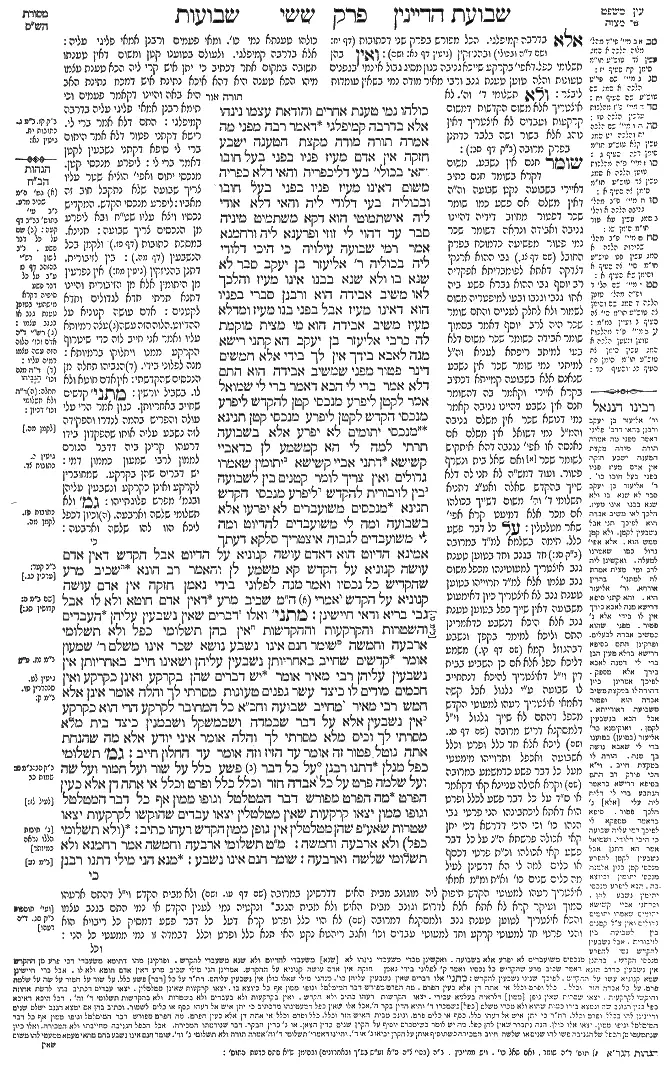
Shevu'ot 42b - Guemara
כולהו נמי טענת אחרים והודאת עצמו נינהו אלא בדרבה קמיפלגי דאמר רבה מפני מה אמרה תורה מודה מקצת הטענה ישבע חזקה אין אדם מעיז פניו בפני בעל חובו והאי בכולי' בעי דליכפריה והאי דלא כפריה משום דאינו מעיז פניו בפני בעל חובו ובכוליה בעי דלודי ליה והאי דלא אודי ליה אישתמוטי הוא דקא משתמיט מיניה סבר עד דהוי לי זוזי ופרענא ליה ורחמנא אמר רמי שבועה עילויה כי היכי דלודי ליה בכוליה ר' אליעזר בן יעקב סבר לא שנא בו ולא שנא בבנו אינו מעיז והלכך לאו משיב אבידה הוא ורבנן סברי בפניו הוא דאינו מעיז אבל בפני בנו מעיז ומדלא מעיז משיב אבידה הוא מי מצית מוקמת לה כרבי אליעזר בן יעקב הא קתני רישא מנה לאבא בידך אין לך בידי אלא חמשים דינר פטור מפני שמשיב אבידה הוא התם דלא אמר ברי לי הכא דאמר ברי לי שמואל אמר לקטן ליפרע מנכסי קטן להקדש ליפרע מנכסי הקדש לקטן ליפרע מנכסי קטן תנינא מנכסי יתומים לא יפרע אלא בשבועה תרתי למה לי הא קמשמע לן כדאביי קשישא דתני אביי קשישא יתומין שאמרו גדולים ואין צריך לומר קטנים בין לשבועה בין לזיבורית להקדש ליפרע מנכסי הקדש תנינא מנכסים משועבדים לא יפרעו אלא בשבועה ומה לי משועבדים להדיוט ומה לי משועבדים לגבוה איצטריך סלקא דעתך אמינא הדיוט הוא דאדם עושה קנוניא על הדיוט אבל הקדש דאין אדם עושה קנוניא על הקדש קא משמע לן והאמר רב הונא שכיב מרע שהקדיש כל נכסיו ואמר מנה לפלוני בידי נאמן חזקה אין אדם עושה קנוניא על הקדש אמרי ה"מ שכיב מרע דאין אדם חוטא ולא לו אבל גבי בריא ודאי חיישינן:
מתני׳ ואלו דברים שאין נשבעין עליהן העבדים והשטרות והקרקעות וההקדשות אין בהן תשלומי כפל ולא תשלומי ארבעה וחמשה שומר חנם אינו נשבע נושא שכר אינו משלם ר' שמעון אומר קדשים שחייב באחריותן נשבעין עליהן ושאינו חייב באחריותן אין נשבעין עליהן רבי מאיר אומר יש דברים שהן בקרקע ואינן כקרקע ואין חכמים מודים לו כיצד עשר גפנים טעונות מסרתי לך והלה אומר אינן אלא חמש רבי מאיר מחייב שבועה וחכ"א כל המחובר לקרקע הרי הוא כקרקע אין נשבעין אלא על דבר שבמדה ושבמשקל ושבמנין כיצד בית מלא מסרתי לך וכיס מלא מסרתי לך והלה אומר איני יודע אלא מה שהנחת אתה נוטל פטור זה אומר עד הזיז וזה אומר עד החלון חייב:
גמ׳ תשלומי כפל מנלן דתנו רבנן (שמות כב, ח) על כל דבר פשע כלל על שור ועל חמור ועל שה ועל שלמה פרט על כל אבדה חזר וכלל כלל ופרט וכלל אי אתה דן אלא כעין הפרט מה הפרט מפורש דבר המטלטל וגופו ממון אף כל דבר המטלטל וגופו ממון יצאו קרקעות שאין מטלטלין יצאו עבדים שהוקשו לקרקעות יצאו שטרות שאע"פ שהן מטלטלין אין גופן ממון הקדש רעהו כתיב:
(ולא תשלומי כפל) ולא ארבעה וחמשה:
מ"ט תשלומי ארבעה וחמשה אמר רחמנא ולא תשלומי שלשה וארבעה:
שומר חנם אינו נשבע:
מנא הני מילי דתנו רבנן
Comments from Rashi on Masechet Shevu'ot Page 42b
כולהו טענתא נמי כו' . ומאי פעמים ורבנן אמאי פליגי עליה: אלא בדרבה קמיפלגי . ולעולם בטוענו קטן ומשום דאין טענתו חשובה במקום אחר דכתיב כי יתן איש קרי ליה הכא טענת עצמו מיהו הכא טענה היא דהא איכא נתינת איש דמכח נתינת האב היא באה והיינו דקאמר פעמים וכי תימא רבנן אמאי פליגי עליה בדרבה קמיפלגי: התם דלא אמר ברי לי . רישא דקתני פטור דלא אמר היתום ברי לי סיפא דקתני נשבעין לקטן דאמר ברי לי: ליפרע מנכסי קטן . מנכסי יתום ואפי' הוציא שטר עליו צריך שבועה שלא נתקבל חוב זה מאביו: ליפרע מנכסי הקדש . המקדיש נכסיו ויצא עליו שט"ח ובא ליפרע מן הנכסים צריך שבועה: תנינא . במסכת כתובות (דף פז.) ולקמן בכל הנשבעין (שבועות דף מה.): בין לזיבורית . דתנן בהניזקין (גיטין מח:) אין נפרעין מן היתומין אלא מן הזיבורית והיינו דתנא תרתי חדא לגדולים וחדא לקטנים: אדם עושה קנוניא על ההדיוט . הלוה הזה עשה עצה רמיותא עליו ואמר אני חייב לזה כדי שיטרוף הקרקע ממנו ויחלוקו ברמיותא: מנה לפלוני בידי . הגביהו תחלה מן הנכסים שהקדשתי: אין אדם חוטא ולא לו . בשביל יורשין: מתני' קדשים שחייב באחריותן . כגון אמר הרי עלי עולה והפריש בהמה לנדרו והפקידה לזה נשבע עליה אותו שהפקדון בידו דרעהו קרינן ביה דדבר הגורם לממון לרבי שמעון כממון דמי: יש דברים שהן בקרקע . שמחוברין לקרקע ואינן כקרקע ונשבעין עליהן ובגמ' מפרש פלוגתייהו: גמ' ולא תשלומי שלשה וארבעה . וכיון דכפל ליכא הוו להו שלשה וארבעה:
Comments from Tosafot - Shevu'ot 42b
אלא בדרבה קמיפלגי. הכל מפורש בפרק שני דכתובות (דף יח: ושם ד"ה ובכולי) ובהניזקין (גיטין דף נא: ושם): ואין בהן תשלומי כפל. דאפי' בקרקע שייכא גניבה כגון מסיג גבול אי נמי בגפנים טעונות והלה טוען טענת גנב ורבי מאיר מודה נמי בשאין עומדות ליבצר: ולא תשלומי ד' וה'. לא איצטריך אלא משום הקדשות דמשום קרקעות ועבדים לא איצטריך דאין נוהג אלא בשור ושה בלבד כדתנן בפרק מרובה (ב"ק דף סב:): שומר חנם אין נשבע. משום דקרא בשומר חנם כתיב דאיירי בשבועה נקט שבועה וה"ה דאין משלם אם פשע כמו שומר שכר דפטור מחיוב דידיה דהיינו גניבה ואבידה ונראה דשומר שכר נמי פטור מפשיעה כדמוכח בפרק החובל (שם דף צג) גבי ההוא ארנקי . דצדקה דאתא לפומבדיתא אפקדיה רב יוסף גבי ההוא גברא פשע ביה אתו גנבי וגנבו ובעי למיפטריה משום לשמור ולא לחלק לעניים והתם שומר שכר היה לרב יוסף דאמר בסמוך שומר אבידה כשומר שכר משום דלא בעי למיתב ריפתא לעניא וה"ל למיתני נמי שומר שכר אין נשבע שנאנס אלא בשבועה קמייתא דכתיב בקרא איירי וקאמר בה דהשומר חנם אין נשבע דהיינו גניבה קאמר נמי דנושא שכר אין משלם גניבה והמ"ל נמי דשואל אין משלם אם נאנסה או אפי' נגנבה דהא איתקיש לשומר שכר ואם שאל בית ונשרף פטור. ועוד דמש"ה לא תני לה דלא שייך בהקדש שאלה ואע"ג דתניא תשלומי ד' וה' משום דשייך בכולהו אם מכר אלא דמיעט קרא אפי' שאר מטלטלין: על כל דבר פשע כלל. תימה בשלמא למ"ד במרובה (ב"ק סג:) חד בגנב וחד בטוען טענת גנב איצטריך למעוטינהו מכפל משום גנב עצמו אלא למ"ד תרוייהו בטוען טענת גנב לא איצטריך כיון דאימעוט משבועה דאין שייך כפל בטוען טענת גנב אלא היכא דנשבע כדאמרינן התם וליכא למימר בקפץ ונשבע דבהגוזל קמא (שם דף קו.) משמע דליכא כפל אלא אם כן השביע בבית דין וי"ל דאיצטריך להיכא דנתחייב לו שבועה ע"י גלגול אבל קשה דאמאי איצטריך רעהו למעוטי הקדש מכפל דהתם לא שייך גלגול וי"ל דלמסקנא דריש מרובה (שם דף סג. ושם) ליכא אלא חד כלל ופרט וכלל אשבועה ואכפל ותרוייהו מימעטי מעל כל דבר פשע כדמשמע במרובה (שם) וקרא אכולה עניינא קאי דקאמר אי ס"ד על כל דבר פשע לכלל ופרט הוא דאתא ליכתבינהו הני פרטי גבי הנהו כו' וכי היכי דדרשא דכי יתן קאי אכולה פרשתא ה"נ על כל דבר פשע קאי אכולהו וכ"ת פרטי דכסף או כלים למה לי הא דרשינן לעיל מה כלים שנים כו' וא"ת ומ"מ אמאי איצטריך רעהו למעוטי הקדש תיפוק ליה מוגונב מבית האיש דדרשינן במרובה (שם דף עו. ושם) ולא מבית הקדש וי"ל דהתם ארעהו סמוך ועיקר קרא לא אתא אלא לדרוש וגונב מבית האיש ולא מבית הגנב. ונקטיה נמי לענין הקדש אי נמי התם בגנב עצמו והכא איצטריך לטוען טענת גנב ולמסקנא דמרובה (שם) לא הוי כלל ופרט קרא דעל כל דבר פשע דמסיק כל ריבויא הוא והני פרטי חד למעוטי קרקע וחד למעוטי עבדים וכו' ואגב ריהטא נקט האי תנא כלל ופרט וכלל דבמדה זו נמי ממעטי כל הני:
Shevu'ot 42b - Mishnah translated into english
The Gemara challenges: All other cases where the defendant is required to take an oath due to a partial admission are also cases of a claim of others and his own admission. Yet in the baraita Rabbi Eliezer ben Ya’akov introduces his opinion with the term: There are times, indicating that the case to which he is referring, of one taking an oath on the basis of his own claim, is not the standard case of an oath due to a partial admission.
The Gemara answers: Rather, Rabbi Eliezer ben Ya’akov and the Rabbis disagree with regard to the statement of Rabba, as Rabba says: For what reason did the Torah say that one who admits to a part of the claim must take an oath? It is because there is a presumption that a person does not exhibit insolence by lying in the presence of his creditor, who did him a favor by lending money to him. And this person who denies part of the claim actually wants to deny all of the debt, so as to be exempt, and this fact, i.e., that he does not deny all of it, is because a person does not exhibit insolence in the presence of his creditor.
Rabba continues: And in order not to exhibit insolence, he wants to admit to the creditor with regard to all of the debt; and this fact, i.e., that he did not admit the entire debt to him, is because he may be temporarily avoiding paying him. He rationalizes doing so by saying to himself: I am avoiding him only until the time that I have enough money, and then I will repay him. And therefore, the Merciful One says in the Torah: Impose an oath on him in order to induce the debtor to admit the entire debt to him.
With regard to this principle, Rabbi Eliezer ben Ya’akov maintains: It is no different with regard to the creditor himself, and it is no different with regard to his son; the debtor would not exhibit insolence and deny the debt. And therefore, he is not deemed as one returning a lost item on his own initiative; rather, this is an ordinary case where one admits to a part of a claim and is therefore required to take an oath. And the Rabbis maintain: It is in the presence of the original creditor that one would not exhibit insolence; but in the presence of his son, who did not lend him the money, he would exhibit insolence and deny the claim entirely. And since this debtor is not exhibiting insolence, as he could have denied the loan completely but instead is opting to admit to part of the claim, he is deemed as one returning a lost item, and his claim is accepted without his taking an oath.
The Gemara asks: Can you interpret the mishna in accordance with the opinion of Rabbi Eliezer ben Ya’akov? Isn’t it taught in the former clause that if the claimant said: My late father had one hundred dinars in your possession, and the defendant responded: You have only fifty dinars in my possession, he is exempt from taking an oath, as he is like one returning a lost item? The Gemara answers: There, it is referring to a case where the claimant did not say: I am certain that you owe my father this money, but rather made an uncertain claim. In such a case, Rabbi Eliezer ben Ya’akov agrees that the defendant is like one returning a lost item. Here, by contrast, it is a case where he said: I am certain that you owe him.
Returning to the Gemara’s question with regard to the last clause of the mishna, which states that one takes an oath to a minor, or to a representative of the Temple treasury, Shmuel said a different answer: When the mishna spoke about taking an oath to a minor, it was referring to a case where the debtor died; the creditor must take an oath to the minor heir attesting that he was not repaid in order to collect from the minor’s property. Similarly, if one’s debtor consecrated his property, he takes an oath to a representative of the Temple treasury in order to collect from the consecrated property.
The Gemara challenges: The halakha that one takes an oath to a minor in order to collect from a minor’s property is one that we learn in the mishna (45a): A woman who comes to collect the payment for her marriage contract from the property of orphans collects only by means of an oath. Why do I need two mishnayot to teach this halakha?
The Gemara answers: By mentioning this halakha twice, the Mishna teaches us this: The halakha applies with regard to both minor and adult orphans, in accordance with the statement of Abaye the Elder; as Abaye the Elder taught: The orphans of which the Sages spoke are adult orphans, and needless to say, the same halakha also applies to minor orphans. This principle applies with regard to both the halakha that a debt can be collected from the property of an orphan only by means of an oath, and to the halakha that a debt can be collected from the property of an orphan only from inferior-quality land.
With regard to Shmuel’s explanation of the mishna that one takes an oath to a representative of the Temple treasury in order to collect a debt from consecrated property, the Gemara asks: We learn this halakha in the mishna (45a): From liened property that has been sold one collects a debt only by means of an oath. And what difference is it to me whether the property was liened to an ordinary person, and what difference is it to me whether the property was liened to the Most High, i.e., it was consecrated?
The Gemara answers: It was necessary for this halakha to be stated separately with regard to collecting a debt from the Temple treasury. Otherwise it might enter your mind to say that it is specifically in order to collect a debt from an ordinary person that one is required to take an oath, as a person is liable to collude with another against an ordinary person who purchased property, by producing a promissory note for a debt that was already repaid in order to collect property from the purchasers of land that had been liened to that debt. But one might have thought that in order to collect a debt from the Temple treasury, a person is not required to take an oath, as a person does not collude with another against the Temple treasury. Therefore, the mishna teaches us that one is required to take an oath even in order to collect a debt from the Temple treasury, as one is suspected of collusion in this case as well.
The Gemara asks: But doesn’t Rav Huna say that in the case of a person on his deathbed who consecrated all of his property, and said: So-and-so has one hundred dinars in my possession, his statement is deemed credible, as the presumption is that a person does not collude with another against the Temple treasury? The Sages said in response: That statement applies only in the case of a person on his deathbed, as a person sins only for his own benefit. One is not suspected of deceiving the Temple treasury for the benefit of his heirs. But with regard to a healthy person, we are certainly concerned about collusion, even against the Temple treasury.
MISHNA: And these are items concerning which one does not take an oath by Torah law: Canaanite slaves, and financial documents, and land, and consecrated property. In a case where these items are stolen, there is no payment of double the principal, nor is there payment of four or five times the principal in a case where one stole a consecrated animal and slaughtered or sold it. An unpaid bailee who lost one of these items does not take an oath that he was not negligent in safeguarding it, and a paid bailee does not pay for the loss or theft of one of these items.
Rabbi Shimon says there is a distinction between different types of consecrated property: With regard to consecrated property for which one bears the financial responsibility to compensate the Temple treasury in the event of their loss, such as in a case where he vowed to bring an offering and then set aside an animal to be sacrificed in fulfillment of the vow, one takes an oath concerning them, as they are considered his own property. But with regard to consecrated property for which he does not bear the financial responsibility for their loss, one does not take an oath concerning them.
Rabbi Meir says: There are certain items that are physically on the land but are not treated like land from a halakhic perspective, and the Rabbis do not concede to him concerning this point. How so? If one makes the claim: I assigned you ten grapevines laden with fruit to safeguard, and the other one says: They are only five vines, Rabbi Meir deems the defendant liable to take an oath, as he admitted to a part of the claim, and although the claim concerned grapevines, the primary aspect of the claim was the grapes. And the Rabbis say: The halakhic status of anything that is attached to the land is like the land itself, and therefore he is exempt from taking an oath.
One takes an oath only concerning an item that is defined by size, by weight, or by number. How so? If the claimant says: I transferred to you a house full of produce, or: I transferred to you a pouch full of money, and the other person says: I do not know how much you gave me, but what you left in my possession you may take, and the amount in the house or pouch at that time is less than that claimed by the claimant, the defendant is exempt from taking an oath, as the amounts in the claim and the admission are undefined. But if this party says that the house was full up to the ledge, and that party says that it was full up to the window, the defendant is liable to take an oath, as the dispute relates to a defined amount.
GEMARA: From where do we derive that one is exempt from the payment of double the principal with regard to the items mentioned in the mishna? It is as the Sages taught in a baraita with regard to the verse that discusses double payment: “For every matter of trespass, whether it be for an ox, for a donkey, for a sheep, for clothing, or for any manner of lost thing…he shall pay double to his neighbor” (Exodus 22:8). This verse is expounded in the following manner: The phrase “for every matter of trespass” is a generalization; the phrase “whether it be for an ox, for a donkey, for a sheep, for clothing” is a detail; and when the verse states: “Or for any manner of lost thing,” it then generalized again.
Consequently, this verse contains a generalization, and a detail, and a generalization, and one of the thirteen principles of exegesis states that in such a case you may deduce that the verse is referring only to items similar to the detail. Applying this principle here, one may conclude that just as each of the items mentioned in the detail is clearly defined as an item that is movable property and has intrinsic monetary value, so too, anything that is movable property and has intrinsic monetary value is subject to double payment.
Land is therefore excluded, as it is not movable property. Canaanite slaves are also excluded, as they are compared to land in many areas of halakha. Financial documents are excluded, since although they are movable property, they do not have intrinsic monetary value. The value of the paper itself is negligible; documents are valuable only because they serve as proof of monetary claims. Finally, consecrated property is excluded because it is written in the verse: “He shall pay double to his neighbor,” i.e., to his fellow man, but not to a representative of the Temple treasury.
The mishna teaches: And there is no payment of double the principal, nor is there payment of four or five times the principal for stealing consecrated animals. The Gemara asks: What is the reason for the exclusion of the payment of four or five times the principal? The Gemara answers: Since payment of double the principal is excluded, that leaves, in a case where one steals and then slaughters or sells a consecrated animal, a total payment of only three or four times the principal, as the payment of double the principal is included in the larger payment for selling or slaughtering it. Therefore, since the Merciful One states in the Torah fourfold or fivefold payment, and not threefold or fourfold payment, one who steals a consecrated animal and slaughters it or sells it is exempt from the additional payments.
§ The mishna teaches: An unpaid bailee who lost one of the excluded items does not take an oath. The Gemara asks: From where are these matters derived? The Gemara answers that it is as the Sages taught in a baraita:
Traduction : The William Davidson digital edition of the Koren Noé Talmud, with commentary by Rabbi Adin Even-Israel Steinsaltz.