 Talmud Bavli
The learning on the whole site is dedicated : For the success of Elyahou ben H'anna & family
The learning on the whole site is dedicated : L'ilui Nishmat Jacques Isaac Ben Amram Loubaton
The learning on the whole site is dedicated : L'ilui Nishmat רינה בת לדיסיה
Shevu'ot 5a : Youtube
Daf TubeYoutube
2 video classes :
Shevu'ot Page 5a
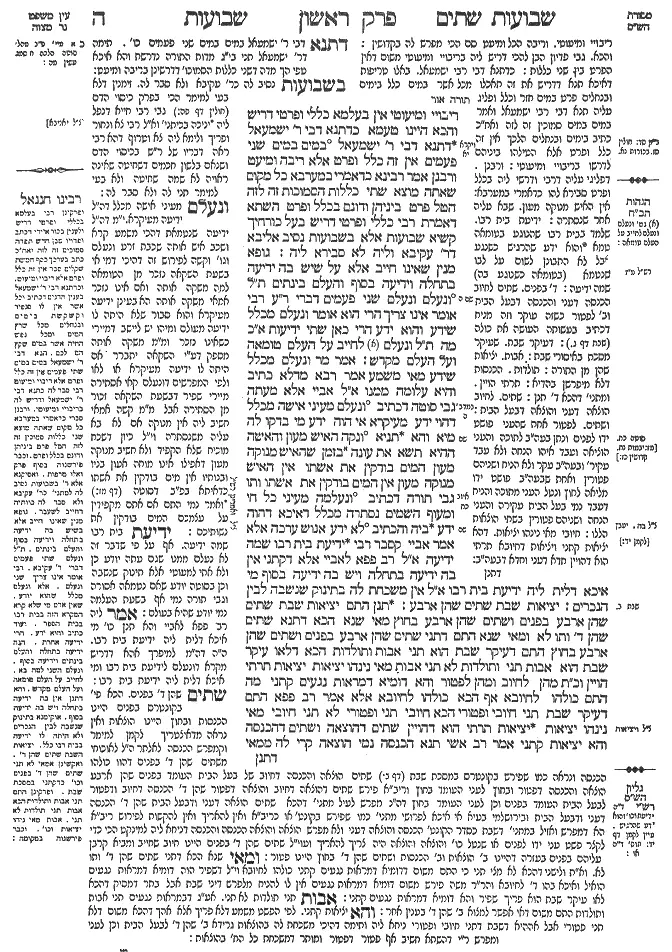
Shevu'ot 5a - Guemara
ריבויי ומיעוטי אין בעלמא כללי ופרטי דריש והכא היינו טעמא כדתנא דבי ר' ישמעאל דתנא דבי ר' ישמעאל (ויקרא יא, לב) במים במים שני פעמים אין זה כלל ופרט אלא ריבה ומיעט ורבנן אמר רבינא כדאמרי במערבא כל מקום שאתה מוצא שתי כללות הסמוכות זה לזה הטל פרט ביניהן ודונם בכלל ופרט השתא דאמרת רבי כללי ופרטי דריש בעל כורחיך קשיא שבועות אלא בשבועות נסיב אליבא דר' עקיבא וליה לא סבירא ליה:
גופא מנין שאינו חייב אלא על שיש בה ידיעה בתחלה וידיעה בסוף והעלם בינתים ת"ל (ויקרא ה, ב) ונעלם ונעלם שני פעמים דברי ר"ע רבי אומר אינו צריך הרי הוא אומר ונעלם מכלל שידע והוא ידע הרי כאן שתי ידיעות א"כ מה ת"ל ונעלם לחייב על העלם טומאה ועל העלם מקדש:
אמר מר ונעלם מכלל שידע מאי משמע אמר רבא מדלא כתיב והיא עלומה ממנו א"ל אביי אלא מעתה גבי סוטה דכתיב (במדבר ה, יג) ונעלם מעיני אישה מכלל דהוי ידע מעיקרא אי הוה ידע מי בדקו לה מיא והא תניא (במדבר ה, לא) ונקה האיש מעון והאשה ההיא תשא את עונה בזמן שהאיש מנוקה מעון המים בודקין את אשתו אין האיש מנוקה מעון אין המים בודקין את אשתו ותו גבי תורה דכתיב (איוב כח, כא) ונעלמה מעיני כל חי ומעוף השמים נסתרה מכלל דאיכא דהוה ידע ביה והכתיב (איוב כח, יג) לא ידע אנוש ערכה אלא אמר אביי קסבר רבי ידיעת בית רבו שמה ידיעה א"ל רב פפא לאביי אלא דקתני אין בה ידיעה בתחלה ויש בה ידיעה בסוף מי איכא דלית ליה ידיעת בית רבו א"ל אין משכחת לה בתינוק שנשבה לבין הנכרים:
יציאות שבת שתים שהן ארבע:
תנן התם יציאות שבת שתים שהן ארבע בפנים ושתים שהן ארבע בחוץ מאי שנא הכא דתנא שתים שהן ד' ותו לא ומאי שנא התם דתני שתים שהן ארבע בפנים ושתים שהן ארבע בחוץ התם דעיקר שבת הוא תני אבות ותולדות הכא דלאו עיקר שבת הוא אבות תני ותולדות לא תני אבות מאי נינהו יציאות יציאות תרתי הויין וכ"ת מהן לחיוב ומהן לפטור והא דומיא דמראות נגעים קתני מה התם כולהו לחיובא אף הכא כולהו לחיובא אלא אמר רב פפא התם דעיקר שבת תני חיובי ופטורי הכא חיובי תני ופטורי לא תני חיובי מאי נינהו יציאות יציאות תרתי הוא דהויין שתים דהוצאה ושתים דהכנסה והא יציאות קתני אמר רב אשי תנא הכנסה נמי הוצאה קרי לה ממאי
Comments from Rashi on Masechet Shevu'ot Page 5a
ריבויי ומיעוטי . וריבה הכל ומיעט סם הכי מפרש לה בקדושין: והכא . גבי פדיון הבן להכי דריש ליה בריבויי ומיעוטי משום דאין הפרט בין שני כללות: כדתנא דבי רבי ישמעאל . באלו טריפות דאיכא תנא דדריש את זה תאכלו מכל אשר במים כלל בימים ובנחלים פרט במים חזר וכלל ופליג עליה תנא דבי רבי ישמעאל ואמר במים במים סמוכין זה לזה ואח"כ כתיב בימים ובנחלים הלכך אין זה כלל ופרט אלא הטילהו ביניהם לדרשו בריבויי ומיעוטי: ורבנן . דפליגי עליה דרבי ודרשי ליה בכלל ופרט סבירא להו כדאמרי במערבא: אין האיש מנוקה מעון . שבא עליה אחר שנסתרה: ידיעת בית רבו . שלמד בבית רבו שהנוגע בטומאה טמא והוא ידע שהרגיש כשנגע אבל לא התבונן לשום על לבו שנטמא (בטומאה כשנוגע בה) שמה ידיעה: ד' בפנים . שתים לחיוב הכנסה דעני והכנסה דבעל הבית וב' לפטור כשזה עוקר וזה מניח דכתיב בעשותה העושה את כולה (שבת דף ג.): דעיקר שבת . שעיקר מסכת באיסורי שבת: אבות . יציאות שהן מן התורה: תולדות . הכנסות דלא מיפרשן בהדיא: תרתי הויין . ומתני' דהכא ד' תנן: שתים לחיוב . הוצאה דעני והוצאה דבעל הבית: ושתים לפטור . אחת שהעני פושט ידו לפנים ונתן בעה"ב לתוכה והעני הוציאה ועבד. איהו הנחה ולא עבד עקיר' ובעה"ב עקר ולא הניח ושניהם פטורין ואחת שבעה"ב פושט ידו מליאה לחוץ ונטל העני מתוכה והניח דעבד נמי בעל הבית עקירה והעני הנחה ושניהם פטורין בשתי הוצאות הללו. חיובי מאי נינהו יציאות . דהא יציאות קתני ויציאות דחיובא תרתי הוא דהויין חדא דעני וחדא דבעה"ב:
Comments from Tosafot - Shevu'ot 5a
דתנא דבי ר' ישמעאל במים במים שני פעמים כו'. תימה דר' ישמעאל תני בי"ג מדות התורה נדרשת והא איכא טפי הך מדה דשני כללות הסמוכו' דדרשינן בריבה ומיעט: בשבועות נסיב לה כר' עקיבא ולא סבר לה. זימנין דלא בעי למימר הכי בפרק כיסוי הדם (חולין דף פה:) גבי רבי חייא דנפל ליה. יניכה בכיתני' וא"ל רבי צא ונחור ופריך ולימא ליה צא וטרוף דהא רבי ראה דבריו של ר"ש בכיסוי הדם ושנאם בלשון חכמים דשחיטה שאינה ראויה לא שמה שחיטה ולא בעי למימר תני לה ולא סבר לה: ונעלם מעיני אישה מכלל דה"ל ידיעה מעיקרא. י"מ דה"ל ידיעה שנטמאת דהכי משמע קרא ושכב איש אותה שכבת זרע ונעלם וגו' וקשה לפירוש זה דהיכי דמי אי בשעת השקאה נזכר מן הטומאה למה משקה אותה ואם אינו נזכר אמאי משקה אותה הא בעינן ידיעה מעיקרא והוא סבור שלא היתה לו ידיעה מעולם ומיהו יש ליישב דמיירי כשאינו נזכר ומ"מ משקה אותה מספק דע"י השקאה יתברר אם היתה לו ידיעה מעיקרא או לאו ולפי המפרשים דונעלם קאי אסתירה מיירי שפיר דבשעת השקאה זכור מן הסתירה אבל מ"מ קשה אמאי חשיב ליה אין מנוקה אם לא בא עליה משנסתרה וי"ל כיון דשכח מוכיח שלא הקפיד ולא חשיב מנוקה מעון דאפילו אינו מוחה אעון בניו ובנותיו אין מים בודקין את אשתו כדאיתא בפ"ב דסוטה (דף מז:) ואמר נמי התם אם אתם מקפידין על עצמכם המים בודקין את נשותיכם: ידיעת בית רבו שמה ידיעה. אף על פי שדבר זה לא נעלם ממנו שגם עתה יודע כן ולא אתי למעוטי אלא תינוק שנשבה וכן בסוטה יודע שאם נטמאה אסורה וגבי תורה נמי אף בשעת העלמה נמי יודע שהיא בעולם: אמר ליה רב פפא לאביי והא תנן כו' מי איכא דלית ליה ידיעת בית רבו. ה"ה דה"מ למיפרך אהא דדריש מקרא דונעלם לידיעת בית רבו ומי איכא דלית ליה ידיעת בית רבו: שתים שהן ד' בפנים. הכא פי' בקונטרס בפנים היינו הכנסות ובחוץ היינו הוצאות ואין נראה מדאיצטריך לקמן למימר וקמפרש הכנסה לאלתר ה"ל לאוכוחי משתים שהן ד' בפנים דהוו כולהו הכנסה ונראה כמו שפירש בקונטרס במסכת שבת (דף ב.) שתים הוצאה והכנסה דחיוב של בעל הבית העומד בפנים שהן ארבע הוצאה והכנסה דפטור ובחוץ לעני העומד בחוץ וריב"א פירש שתים דהוצאה דחיוב והוצאה דפטור שהן ד' הכנסה דחיוב ודפטור לבעל הבית העומד בפנים וכן לעני העומד בחוץ דה"נ מפרש לעיל מתני' דהכא שתים הוצאה דעני ודבעל הבית שהן ד' הכנסה דעני ודבעל הבית ובירושלמי בעיא אי איכא לפרושי מתני' כמו שפירש בקונט' או כריב"א ואין להאריך ואין להקשות לפירוש ריב"א הא דמפרש ואזיל במתני' דשבת כסדר הקונט' הכנסה והוצאה דעני ולא מפרש הוצאה והוצאה הכנסה והכנסה דניחא ליה למינקט הכי כדי לקצר פשט עני ידו לפנים או שנטל כו' והוצאה והוצאה היה צריך להאריך ועוי"ל שתים שהן ד' בפנים היינו חיוב שחייב ומביא קרבן עליהם בפנים בעזרה דהיינו ב' הוצאות וב' הכנסות ושתים שהן ד' בחוץ היינו פטור: ומאי שנא הכא דתני שתים שהן ד' ותו לא. וא"ת ולישני דהכא לא מצי תני כי התם משום דדומיא דמראות נגעים קתני כולהו לחיובא וי"ל דשפיר הוה דומיא דמראות נגעים הואיל ואיכא בהו ד' לחיובא והר"ר משה פירש משום דומיא דמראות נגעים אין לו להניח מלפרש דיני שבת אבל בתר דמסיק דהכא לאו עיקר שבת הוא פריך שפיר והא דומיא דמראות נגעים קתני: אבות תני תולדות לא תני. אע"ג דבמראות נגעים תני אבות ותולדות התם משום דאי אפשר למצוא ב' שהן ד' בענין אחר: והא יציאות קתני. לפי הפשט משמע דלא פריך אלא אהך דהכא משום דלא תני פטורי אבל אההיא דשבת דתני חיובי ופטורי ניחא ליה ותימה דהיכי משכחת לה בהוצאות גרידא ב' שהן ד' לבעל הבית וכן לעני ומפרש ר"י דהשתא חשיב אף פטור דפטור ומותר דמשכחת כל הח' בהוצאות:
Shevu'ot 5a - Mishnah translated into english
using the method of amplifications and restrictions.
Ameimar answers: Yes, generally Rabbi Yehuda HaNasi expounds verses using the method of generalizations and details, but here, with regard to the redemption of the firstborn, this is the reason that he expounds the verses using the method of amplifications and restrictions: He holds in accordance with that which the school of Rabbi Yishmael taught.
As the school of Rabbi Yishmael taught: When defining which fish it is permitted to eat, the verse states: “This you may eat, from whatever is in the water, anything that has fins and scales in the water, in the seas and in the streams” (Leviticus 11:9). The verse first states the general term: “In the water,” “in the water,” mentioning it twice, and only afterward mentions the details, i.e., “in the seas and in the streams.” When the general and detailed phrases are ordered in this way, they are not expounded as a generalization and a detail, but rather as an amplification and a restriction. Similarly, although Rabbi Yehuda HaNasi generally expounds verses using the method of generalizations and details, with regard to the redemption of the firstborn, since the verse mentions the two general terms first and mentions the specific detail only afterward, he expounds it using the method of amplifications and restrictions.
The Gemara asks: And the Rabbis, why do they expound the verse about the redemption of a firstborn as a generalization and a detail? Ravina said: Like they say in the West, Eretz Yisrael: Wherever you find two generalizations juxtaposed to each other, followed by a specific detail, place the detail between the two generalizations and thereby expound them as a generalization and a detail followed by another generalization.
The Gemara concludes the question it asked earlier: Now that you said that Rabbi Yehuda HaNasi expounds verses using the method of generalizations and details, perforce the mishna’s ruling in the case of oaths is difficult, as it is derived by expounding the verse as an amplification and a restriction, and Rabbi Yehuda HaNasi does not generally expound verses in that manner. This contradicts Rav Kahana’s explanation that the mishna expresses Rabbi Yehuda HaNasi’s own opinion. Rather, one must say that with regard to oaths, Rabbi Yehuda HaNasi formulated the mishna in accordance with the opinion of Rabbi Akiva, but he himself does not hold accordingly.
§ Above (4a), the Gemara cited a baraita. Now the Gemara analyzes the matter itself. The baraita states: From where is it derived that one is liable to bring a sliding-scale offering only for cases in which he had awareness at the beginning and awareness at the end, but had a lapse of awareness in between, when he actually transgressed? The verse states with regard to a person’s awareness of the fact that he was impure: “And it was concealed,” “and it was concealed,” mentioning it twice (Leviticus 5:2–3). The first mention teaches that one is liable only if during the transgression he was unaware of his status, and the second mention teaches that one is liable only if he had awareness of his status before the transgression. This is the statement of Rabbi Akiva.
The baraita continues: Rabbi Yehuda HaNasi says: This proof is not necessary, as it states in the same verse: “And it was concealed,” which indicates, by inference, that initially he had been aware; and nevertheless the verse continues to state: “And he was aware.” It emerges, then, that the verse refers here to two different periods of awareness, one before the transgression and one afterward. But if so, why must the verse state: “And it was concealed,” a second time? It is in order to render one liable both for a violation due to a lapse of awareness of the fact that he was ritually impure and for a violation due to a lapse of awareness of the fact that the place he entered was actually the Temple.
The Master said in that baraita: The verse states: “And it was concealed,” which indicates, by inference, that initially he had been aware. The Gemara asks: From where is this inferred? Rava said: From the fact that it is not written: And it is concealed from him, which would have been the appropriate formulation had he never been aware of the matter at all. Accordingly, the phrase “and it was concealed” is to be understood as referring to a case in which he had been initially aware.
Abaye said to him: If that is so, then you should also make a similar inference with regard to a suspected adulteress [sota], as it is written that she is liable to undergo the ordeal of drinking the bitter waters when “a man lay with her carnally, and it was concealed from the eyes of her husband” (Numbers 5:13). This would indicate, by inference, that initially he had been aware of the fact that his wife committed adultery. Abaye explains the difficulty: If he was actually aware that his wife had committed adultery, would the bitter waters have the power to examine her?
But isn’t it taught in a baraita: The verse states with regard to a case in which she is found guilty: “And the husband will be free of sin and the wife shall bear her sin” (Numbers 5:31). This verse teaches that only when the husband is free of sin, the water examines his wife, but if the husband is not free of sin, the water does not examine his wife. If the husband had been aware that his wife had committed adultery, then she is forbidden to him and he is required to divorce her. The fact he did not divorce her is considered a sin; consequently, the waters cannot examine his wife.
Abaye presents another difficulty to Rava: And furthermore, according to your understanding, you should also make a similar inference with regard to Torah, as it is written: “And it was concealed from the eyes of all living creatures, and from those that soar in the heavens it was hidden” (Job 28:21), which would indicate, by inference, that initially there was someone who was aware of the Torah. But isn’t it written: “No man knew its value, and it is not known in the land of the living” (Job 28:13)?
Rather, Abaye said: The formulation of the verse does not indicate that he actually realized he was impure; it indicates only that he was initially aware of the fact that he had come into contact with a source of impurity, but he failed to reach the obvious conclusion that he was thereby rendered impure. And Rabbi Yehuda HaNasi holds that the elementary knowledge of the halakhot of ritual impurity that a person gained in his childhood from his school is sufficient, in light of his awareness of the fact he came into contact with a source of impurity, to be considered awareness of the fact that he was impure, and thereby render him liable to bring a sliding-scale offering.
Rav Pappa said to Abaye: But how can you explain the halakha that is taught in the mishna: For cases in which he did not have awareness at the beginning but had awareness at the end? According to your explanation, is there anyone who does not have the elementary knowledge of the halakhot of ritual impurity that he gained from his school? Abaye said to him: Yes, you find it in the case of a child who was taken captive among gentiles, who never received even the most elementary level of knowledge.
§ The mishna states (2a): With regard to acts of carrying out that are prohibited on Shabbat, there are two types that are four. We learned in a mishna there (Shabbat 2a): With regard to acts of carrying out that are prohibited on Shabbat, there are primarily two basic actions that are four cases with regard to transferring an item inside, to a private domain; and two basic actions that are four cases with regard to transferring an item outside, to a public domain. The Gemara asks: What is different here that the mishna teaches: There are two types that are four, and nothing more; and what is different there, in tractate Shabbat, that the mishna teaches: There are two actions that are four cases with regard to transferring an item inside, to a private domain, and two actions that are four cases with regard to transferring an item outside, to a public domain?
The Gemara answers: There, in tractate Shabbat, which is where the main discussion of the halakhot of Shabbat is found, the mishna teaches both the primary categories and the subcategories of labor prohibited on Shabbat. But here, in tractate Shevuot, which does not contain the main discussion of the halakhot of Shabbat, the mishna teaches the primary categories of labor prohibited on Shabbat but does not teach the subcategories of labor.
The Gemara asks: What are the primary categories of transferring an item on Shabbat? They are acts of carrying out from the private domain to the public domain. The Gemara objects: But the acts of carrying out are only two in number, i.e., where the carrying out is done by someone standing in the private domain and when it is done by someone in the public domain. Why then does the mishna state that there are four cases?
And if you would say that the mishna enumerates four types of carrying out, among them those for which there is liability and among them those for which there is exemption, that is not feasible, as doesn’t the mishna teach this case as similar to the different shades of leprous marks? This would indicate that just as there, all four of them are types for which there is liability, so too here, with regard to carrying out on Shabbat, all four of them are types for which there is liability.
Rather, Rav Pappa said that the difference between the manner in which the halakha is cited in tractates Shevuot and Shabbat must be understood as follows: There, in tractate Shabbat, which contains the main discussion of the halakhot of Shabbat, the mishna teaches both cases of liability and cases of exemption. But here, in tractate Shevuot, which does not contain the main discussion of the halakhot of Shabbat, the mishna teaches only cases of liability but does not teach cases of exemption.
The Gemara asks: What are the cases of liability? They are acts of carrying out from the private domain to the public domain. The Gemara objects: But the acts of carrying out are only two in number. Why then does the mishna state that there are four cases? The Gemara explains: There are two cases of carrying out an item from a private domain to a public domain and two more cases of bringing in an item from a public domain to a private domain.
The Gemara objects: But the mishna teaches: Acts of carrying out. It does not appear to mention acts of bringing in at all. Rav Ashi said: The tanna also refers to an act of bringing in an item as an act of carrying out an item. The Gemara asks: From where do we know this?
Traduction : The William Davidson digital edition of the Koren Noé Talmud, with commentary by Rabbi Adin Even-Israel Steinsaltz.