 Talmud Bavli
The learning on the whole site is dedicated : L'ilui Nishmat Jacques Isaac Ben Amram Loubaton
The learning on the whole site is dedicated : For the success of Elyahou ben H'anna & family
The learning on the whole site is dedicated : L'ilui Nishmat רינה בת לדיסיה
Shevu'ot 34a : Youtube
Daf TubeYoutube
2 video classes :
Shevu'ot Page 34a
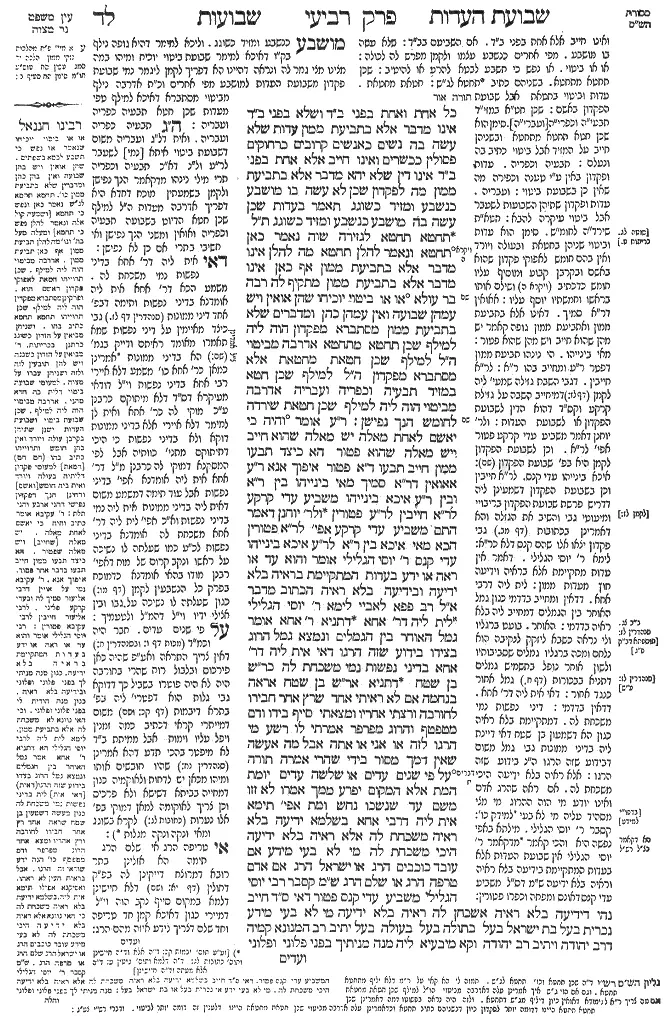
Shevu'ot 34a - Guemara
כל אחת ואחת בפני ב"ד ושלא בפני ב"ד אינו מדבר אלא בתביעת ממון עדות שלא עשה בה נשים כאנשים קרובים כרחוקים פסולין ככשרים ואינו חייב אלא אחת בפני ב"ד אינו דין שלא יהא מדבר אלא בתביעת ממון מה לפקדון שכן לא עשה בו מושבע כנשבע ומזיד כשוגג תאמר בעדות שכן עשה בה מושבע כנשבע ומזיד כשוגג ת"ל תחטא תחטא לגזירה שוה נאמר כאן (ויקרא ה, כא) תחטא ונאמר להלן תחטא מה להלן אינו מדבר אלא בתביעת ממון אף כאן אינו מדבר אלא בתביעת ממון מתקיף לה רבה בר עולא (ויקרא ה, ד) או או ביטוי יוכיחו שהן אואין ויש עמהן שבועה ואין עמהן כהן ומדברים שלא בתביעת ממון מסתברא מפקדון הוה ליה למילף שכן תחטא מתחטא אדרבה מביטוי ה"ל למילף שכן חטאת מחטאת אלא מסתברא מפקדון ה"ל למילף שכן חטא במזיד תבעיה וכפריה ועבריה אדרבה מביטוי הוה ליה למילף שכן חטאת שירדה לחומש הנך נפישן:
ר"ע אומר (ויקרא ה, ה) והיה כי יאשם לאחת מאלה יש מאלה שהוא חייב ויש מאלה שהוא פטור הא כיצד תבעו ממון חייב תבעו ד"א פטור איפוך אנא ר"ע אאואין דר"א סמיך מאי בינייהו בין ר"א ובין ר"ע איכא בינייהו משביע עדי קרקע לר"א חייבין לר"ע פטורין ולר' יוחנן דאמר התם משביע עדי קרקע אפי' לר"א פטורין הכא מאי איכא בין ר"א לר"ע איכא בינייהו עדי קנס ר' יוסי הגלילי אומר והוא עד או ראה או ידע בעדות המתקיימת בראיה בלא ידיעה ובידיעה בלא ראיה הכתוב מדבר א"ל רב פפא לאביי לימא ר' יוסי הגלילי לית ליה דר' אחא דתניא ר' אחא אומר גמל האוחר בין הגמלים ונמצא גמל הרוג בצידו בידוע שזה הרגו דאי אית ליה דר' אחא בדיני נפשות נמי משכחת לה כר"ש בן שטח דתניא אר"ש בן שטח אראה בנחמה אם לא ראיתי אחד שרץ אחר חבירו לחורבה ורצתי אחריו ומצאתי סייף בידו ודם מטפטף והרוג מפרפר אמרתי לו רשע מי הרגו לזה או אני או אתה אבל מה אעשה שאין דמך מסור בידי שהרי אמרה תורה (דברים יז, ו) על פי שנים עדים או שלשה עדים יומת המת אלא המקום יפרע ממך אמרו לא זזו משם עד שנשכו נחש ומת אפי' תימא אית ליה דרבי אחא בשלמא ידיעה בלא ראיה משכחת לה אלא ראיה בלא ידיעה היכי משכחת לה מי לא בעי מידע אם עובד כוכבים הרג או ישראל הרג אם אדם טרפה הרג או שלם הרג ש"מ קסבר רבי יוסי הגלילי משביע עדי קנס פטור דאי ס"ד חייב נהי דידיעה בלא ראיה אשכחן לה ראיה בלא ידיעה מי לא בעי מידע נכרית בעל בת ישראל בעל בתולה בעל בעולה בעל יתיב רב המנונא קמיה דרב יהודה ויתיב רב יהודה וקא מיבעיא ליה מנה מניתיך בפני פלוני ופלוני
Comments from Rashi on Masechet Shevu'ot Page 34a
ואינו חייב אלא אחת בפני ב"ד . אם השביעם בב"ד: שלא עשה בו מושבע . מפי אחרים כנשבע עצמו ולקמן מפרש לה לכולה: או או ביטוי . או נפש כי תשבע לבטא להרע או להיטיב: שכן תחטא מתחטא . בשניהם כתיב תחטא לג"ש: חטאת מחטאת . עדות וביטוי בחטאת אבל שבועת הפקדון באשם: שכן חט"א במזי"ד תבעי"ה וכפרי"ה [ועברי"ה] . סימן הוא שכן חטא תחטא מתחטא ובשניהן חייב על המזיד אבל ביטוי כתיב בה ונעלם: תבעיה וכפריה . עדות ופקדון באין ע"י טענה וכפירה מה שאין כן בשבועת ביטוי: ועבריה . עדות ופקדון שתיהן השבועות לשעבר אבל ביטוי עיקרה להבא: חטא"ת שירד"ה לחומ"ש . סימן הוא עדות וביטוי שניהן בחטאת ובעולה ויורד ואין בהם חומש לאפוקי פקדון שהוא באשם ובקרבן קבוע ומוסיף עליו חומש כדכתיב (ויקרא ה) ושילם אותו בראשו וחמשתיו יוסף עליו: אאואין דר"א סמיך . דאינו אלא בתביעת ממון ואתביעת ממון גופה קאמר יש מהן שהוא חייב ויש מהן שהוא פטור: מאי בינייהו . הי נינהו תביעת ממון דפטר ר"ע ומחייב בהו ר"א: לר"א חייבין . דגבי השבת גזילה שמעי' ליה לקמן (שבועות דף לז:) דמיחייב השבה על גזילת קרקע וקס"ד דהוא הדין לשבועת הפקדון או לשבועת העדות: ולר' יוחנן דאמר משביע עדי קרקע פטור אפי' לר"א . וכן לשבועת הפקדון לקמן היא בפ' שבועת הפקדון (שם): איכא בינייהו עדי קנס . לר"א חייבין וכן בשבועת הפקדון דשמעינן ליה דדריש פרשת שבועת הפקדון בריבויי ומיעוטי גבי והשיב את הגזלה והא דאמרינן בכתובות (דף מב.) גבי פקדון יצאו אלו שהם קנס דלא כר"א: לימא ר' יוסי הגלילי . דאמר אין עדות מתקיימת אלא בראיה וידיעה חוץ מעדות ממון: לית ליה דרבי אחא . דדאין ומחייב בדדמי כגון גמל האוחר בין הגמלים דמחייב ליה בלא ראיה בדדמי: האוחר . בועט ברגליו ולי נראה כשבא ליזקק לנקיבה הוא נלחם ומכה ברגליו גמלים שסביבותיו ולשון אוחר נופל בתשמיש גמלים דתניא בבכורות (דף ח.) גמל אחור כנגד אחור: דאי אית ליה דר' אחא . דדאין בדדמי: דיני נפשות נמי משכחת לה . דמתקיימת בלא ראיה כגון הא דשמעון בן שטח דאי דיינת ליה בדיני ממונות. גבי גמל משום דבידוע שזה הרגו ה"נ בידוע שזה הרגו: אלא ראיה בלא ידיעה היכי משכחת לה . אם ראה שהרג אדם ואינו יודע מי הוה ההרוג מי מצי מסהיד עליה מי לא בעי. למידק כו': קסבר ר' יוסי הגלילי . מילתא באפי נפשה היא והכי קאמר. מדקאמר ר' יוסי הגלילי אין שבועת העדות אלא בעדות המתקיימת בידיעה בלא ראיה וראיה בלא ידיעה ש"מ דס"ל משביע עדי קנס דאונס ומפתה וכפרו פטורין:
Comments from Tosafot - Shevu'ot 34a
מושבע כנשבע ומזיד כשוגג. וליכא למימר דהיא גופה נילף בק"ו דאיכא למימר שבועת ביטוי יוכיח ומיהו במה מצינו מצי גמר לה ונראה דהיינו הא דפריך לקמן ליגמר נמי שבועת פקדון משבועת העדות למושבע מפי אחרים וכ"ת אדרבה נילף מביטוי מסתברא דאיכא למילף טפי מעדות שכן חטא תבעיה כפריה ועבריה: ה"ג תבעיה כפריה ועבריה. ואית דל"ג ועבריה משום דשבועת ביטוי איתא [נמי] לשעבר לר"ע ול"נ דא"כ תבעיה וכפריה תרי מילי נינהו מדקאמר הנך נפישן ולקמן בשמעתין מוכח דחדא היא דפריך אדרבה מעדות ה"ל למילף שכן חטא הדיוט בשבועה תבעיה וכפריה ואואין ומשני הנך נפישן ואי חשיבי בתרי אם כן לא נפישן: דאי אית ליה דר' אחא בדיני נפשות נמי משכחת לה. משמע הכא דר' אחא אית ליה אומדנא בדיני נפשות ותימה דבפ' אחד דיני ממונות (סנהדרין דף לז.) גבי כיצד מאיימין על דיני נפשות שמא תאמרו מאומד ראיתם ודייק בגמ' (שם:) הא בדיני ממונות. אמרינן כמאן כר' אחא כו' משמע דלא איירי רבי אחא בדיני נפשות וי"ל דודאי מעיקרא דס"ד דלא מיתוקם כרבנן ע"כ מוקי לה כר' אחא ואית לן למימר דלא איירי אלא בדיני ממונות דוקא ולא בדיני נפשות כי היכי דתיתוקם מתני' כוותיה אבל לפי המסקנא דמוקי לה כרבנן מ"ל דר' אחא אית ליה אומדנא אפי' בדיני נפשות אבל עוד תימה דמשמע משום דאית ליה בדיני ממונות אית ליה נמי בדיני נפשות וא"כ אפי' לית ליה דר' אחא משכחת לה אומדנא בדיני נפשות לכ"ע כמו שעלתה לו נשיכה על ראשו ונקב קרום של מוח דאפי' רבנן מודו בהאי אומדנא כדמוכח בפרק כל הנשבעין לקמן (שבועות דף מו:) כגון שעלתה לו נשיכה על גבו ובין אצילי ידיו וי"ל דהמ"ל ולטעמיך: על פי שנים עדים. חבר היה וכמ"ד (מכות דף ו: ובסנהדרין ח:) דאין צריך התראה ואע"פ שהיה כאן פירכוס ובלבול רוח שהרי בחורבה היה לא היה פוטרו בשביל כך דדוקא גבי גלות הוא דפטרי' ליה בפ' בתרא דיבמות (דף קכ: ושם) משום דמייתרי קראי דכתיב כמה זמנין ויפל עליו וימות אבל ממיתת ב"ד לא מיפטר בהכי תדע דהא אמרינן (סנהדרין נח:) שהיו חובשים אותו ומיהו מכאן יש לדחות ולאוקמיה כגון דמחייה בביתא דשישא ולא פרכיס וכן צריך לאוקומה למאן דמוקי בפ' אלו נערות (כתובות לג:) לקרא בשוגג ומאי ונקה ונקה מגלות: אי טריפה הרג אי שלם הרג. תימה הא אזלינן בתר רובא דמרוצח דייקינן לה בפ"ק דחולין (דף יא: ושם) דלא חיישינן דלמא במקום סייף נקב הוה וי"ל דמיירי כגון דאיכא קמן חד טריפה וחד שלם דצריך לידע איזה מהם הרג:
Shevu'ot 34a - Mishnah translated into english
each and every oath if the plaintiff administered several oaths to him and he denied having the deposit in his possession, whether he took the oath before a court or not before a court, and despite the broad application of the halakha, the verse is speaking of liability only in cases involving a monetary claim, then in the case of an oath of testimony with regard to which the Torah did not render the halakhic status of women like that of men, the status of relatives like that of non-relatives, and the status of unfit witnesses like that of those fit to testify, and he is liable to bring only one sliding-scale offering if the plaintiff administered several oaths to him and he falsely denied knowledge of the matter in the presence of a court, is it not right that the verse is speaking of liability only in cases involving a monetary claim?
The baraita rejects this inference: What is notable about the case of a deposit? It is notable in that with regard to a deposit the Torah did not render the halakhic status of one to whom an oath was administered by others like that of one who himself took an oath, as one to whom an oath was administered by others is exempt; and the Torah did not render the halakhic status of one who takes an intentional false oath like that of one who takes an unwitting false oath. Will you say that the same is true with regard to an oath of testimony, as in that case the Torah rendered the halakhic status of one to whom an oath was administered by others like that of one who himself took an oath; and it rendered the halakhic status of one who takes an intentional false oath like that of one who takes an unwitting false oath, and one is liable to bring an offering in both instances?
Therefore, the verse states the term “shall sin” with regard to an oath of testimony and states “shall sin” with regard to an oath on a deposit in order to derive a verbal analogy. Here, it is stated with regard to an oath of testimony: “Shall sin” (Leviticus 5:1), and there, it is stated with regard to an oath on a deposit: “Shall sin” (Leviticus 5:21). Just as there, concerning an oath on a deposit, the verse is speaking only with regard to a monetary claim, so too here, concerning an oath of testimony, the verse is speaking only with regard to a monetary claim.
§ After presenting the different proofs cited in the baraita, the Gemara proceeds to analyze the opinions cited therein, beginning with the opinion of Rabbi Eliezer that one derives that one is liable for an oath of testimony only if it involves a monetary claim from the case of an oath on a deposit based on multiple instances of the term “or” that appear in both contexts, and there is an oath with those multiple instances of the term “or” and there is no priest in their context. Rabba bar Ulla objects to this: The multiple instances of the term “or” in the verse: “Or if any one shall take an oath to clearly express with his lips to do evil or to do good” (Leviticus 5:4), which is written with regard to an oath on an utterance, will prove that one is liable even without a monetary claim, as they are multiple instances of the term “or,” and there is an oath in their context, and there is no priest in their context, and they are not speaking with regard to a monetary claim.
The Gemara rejects this: It stands to reason that he should have derived the halakha with regard to an oath of testimony from an oath on a deposit and not from an oath on an utterance due to the verbal analogy between the terms “shall sin” and “shall sin.”
The Gemara rejects this: On the contrary, he should have derived the halakha with regard to an oath of testimony from the halakha with regard to an oath on an utterance, as it is a derivation of one case for which one is liable to bring a sin-offering for taking a false oath from another case for which one is liable to bring a sin-offering for taking a false oath. This is in contrast to an oath on a deposit, for which one is liable to bring a guilt-offering for taking a false oath.
Rather, it stands to reason that he should have derived the halakha with regard to an oath of testimony from the halakha with regard to an oath on a deposit, as there are many elements common to both oaths, represented by the mnemonic: Sin, intentionally, claimed from him, denied his claim, and his past. There is a verbal analogy between them, as the term “shall sin” appears in both contexts. In both cases one is liable for taking a false oath intentionally. Additionally, in both cases there is a claim presented by one of the parties and denial of that claim by the one taking the oath. And both oaths relate to events that transpired in the past.
The Gemara asks: On the contrary, he should have derived the halakha with regard to an oath of testimony from the halakha with regard to an oath on an utterance, as there are many elements common to both oaths, represented by the mnemonic: Sin-offering, that descended, to one-fifth. In both cases one is liable to bring a sin-offering for a false oath, as opposed to a guilt-offering for a false oath on a deposit. In each case the offering is a sliding-scale offering, as opposed to the fixed offering in the case of an oath on a deposit. In both cases there is no payment of an additional one-fifth for taking a false oath. And in the case of a false oath on a deposit, there is payment of an additional one-fifth. The Gemara answers: These elements common to an oath of testimony and an oath on a deposit are more numerous than the elements common to an oath of testimony and an oath on an utterance.
§ Rabbi Akiva says that it is written with regard to an oath of testimony: “And it shall be when he will be guilty of one of these” (Leviticus 5:5). The term “of these” is a restrictive expression from which it is derived: There are some of these for which he is liable and there are some of these for which he is exempt. How so? If the plaintiff demanded testimony from the witness with regard to a monetary claim, the witness is liable for taking a false oath; if the plaintiff demanded testimony from the witness with regard to another matter, he is exempt.
The Gemara challenges: Since it is not clear from the verse for which claim one is liable and for which claim one is exempt, I will reverse it and say that one is liable only when the claim was with regard to another matter, not when it involves monetary matters.
The Gemara answers: Rabbi Akiva relies on the multiple instances of the term “or,” as cited by Rabbi Eliezer, to derive from an oath on a deposit that one is liable only for a false oath that involves a monetary claim. From the term “of these” Rabbi Akiva derives that there are some cases involving monetary claims for which one is not liable for taking a false oath of testimony.
The Gemara asks: What is the practical difference between the opinions of Rabbi Eliezer and Rabbi Akiva? With regard to which cases involving monetary claims does Rabbi Akiva hold that one is not liable for taking a false oath of testimony?
The Gemara answers: The practical difference between their opinions is in the case of one who administers an oath to witnesses with regard to testimony involving land. According to Rabbi Eliezer, they are liable if they take a false oath. According to Rabbi Akiva they are exempt in that case, as it is excluded by the term “of these.”
The Gemara asks: And according to Rabbi Yoḥanan, who says there with regard to an oath on a deposit and an oath of testimony that in the case of one who administers an oath to witnesses with regard to testimony involving land, the witnesses are exempt even according to Rabbi Eliezer, what difference is there between the opinions of Rabbi Eliezer and Rabbi Akiva?
The Gemara answers: The practical difference between their opinions is in the case where one administers an oath to witnesses with regard to testimony involving a fine. According to Rabbi Eliezer they are liable, and according to Rabbi Akiva they are exempt.
§ Rabbi Yosei HaGelili cites a different proof and says: The verse states with regard to an oath of testimony: “And he is a witness or he saw or he knew” (Leviticus 5:1). It is with regard to testimony that is founded on sight without knowledge of the matter, or by means of knowledge without sight, that the verse is speaking. The reference is to testimony involving monetary matters, as all other testimony requires both knowledge and sight.
Rav Pappa said to Abaye: Shall we say that Rabbi Yosei HaGelili does not accept the opinion of Rabbi Aḥa? As it is taught in a baraita (Tosefta, Bava Kamma 3:6) that Rabbi Aḥa says: If there is a rutting male camel [gamal haoḥer] that is rampaging among other camels and then a camel was found killed at its side, it is evident that this rampaging camel killed it, and the owner must pay for the damage. Rabbi Aḥa rules that cases of monetary law can be decided based on circumstantial evidence. As, if he is of the opinion that the ruling is in accordance with the opinion of Rabbi Aḥa that witnesses may testify on the basis of circumstantial evidence, in cases of capital law too, you find a case of knowledge without sight, as in the case discussed by Rabbi Shimon ben Shataḥ.
As it is taught in a baraita that Rabbi Shimon ben Shataḥ said in the form of an oath: I will not see the consolation of Israel if I did not see one who was running after another into a ruin, and I ran after him and found a sword in his hand and blood dripping from the sword, and the slain person convulsing. I said to him: Wicked one, who killed this person? It was either me or you, as there is no one else here.
But what can I do, as your blood is not given to my control and I have no jurisdiction to execute you, as the Torah says: “On the basis of two witnesses or three witnesses shall he that is to die be put to death” (Deuteronomy 17:6), and there are no witnesses here. Rather, the Omnipresent will exact retribution from you. The Sages said: They did not move from there until a snake came and bit the pursuer and he died. Rabbi Aḥa would hold in that case that the pursuer could be executed by the court based on circumstantial evidence. Ostensibly, Rabbi Yosei HaGelili disagrees, as he says that testimony based on knowledge without sight exists only in cases of monetary law.
The Gemara answers: Even if you say that Rabbi Yosei HaGelili is of the opinion that the ruling is in accordance with the opinion of Rabbi Aḥa that one may rely on circumstantial evidence even in cases of capital law, one may nevertheless distinguish between cases of monetary law and cases of capital law. Granted, even in cases of capital law you find testimony based on knowledge without sight, but how can you find a case of sight without knowledge? Don’t the witnesses need to know if the one whom he witnessed killing another killed a gentile or he killed a Jew, if he killed one who has a wound that would have caused him to die within twelve months [tereifa] or he killed one whose body is intact?
The Gemara notes: Conclude from it that Rabbi Yosei HaGelili holds that in a case where one administers an oath to witnesses with regard to testimony involving a fine, the witnesses are exempt from liability for taking a false oath of testimony. As if it enters your mind to say that the witnesses are liable, although you find testimony with regard to fines based on knowledge without sight, and witnesses may testify based on circumstantial evidence, in cases of sight without knowledge, when it comes to fines, don’t the witnesses need to know if the rapist engaged in intercourse with a gentile woman or if he engaged in intercourse with a Jewish woman, if he engaged in intercourse with a virgin or if he engaged in intercourse with a non-virgin? Rabbi Yosei HaGelili holds that witnesses are liable for taking a false oath of testimony only in cases where both testimony based on sight alone and testimony based on knowledge alone are accepted, which is not the case concerning testimony involving fines.
§ Apropos the matter of sight without knowledge in cases of monetary law, the Gemara relates: Rav Hamnuna was sitting before Rav Yehuda, and Rav Yehuda was sitting and he was raising a dilemma: If one demands payment from another and claims: I counted for you and gave you one hundred dinars in the presence of so-and-so and so-and-so,
Traduction : The William Davidson digital edition of the Koren Noé Talmud, with commentary by Rabbi Adin Even-Israel Steinsaltz.