 Talmud Bavli
The learning on the whole site is dedicated : L'ilui Nishmat יוסף בן מושה
The learning on the whole site is dedicated : L'ilui Nishmat Ledicia bat David Banoun
The learning on the whole site is dedicated : L'ilui Nishmat Amram ben Itshak Loubaton
Shevu'ot 48b : Youtube
Daf TubeYoutube
2 video classes :
Shevu'ot Page 48b
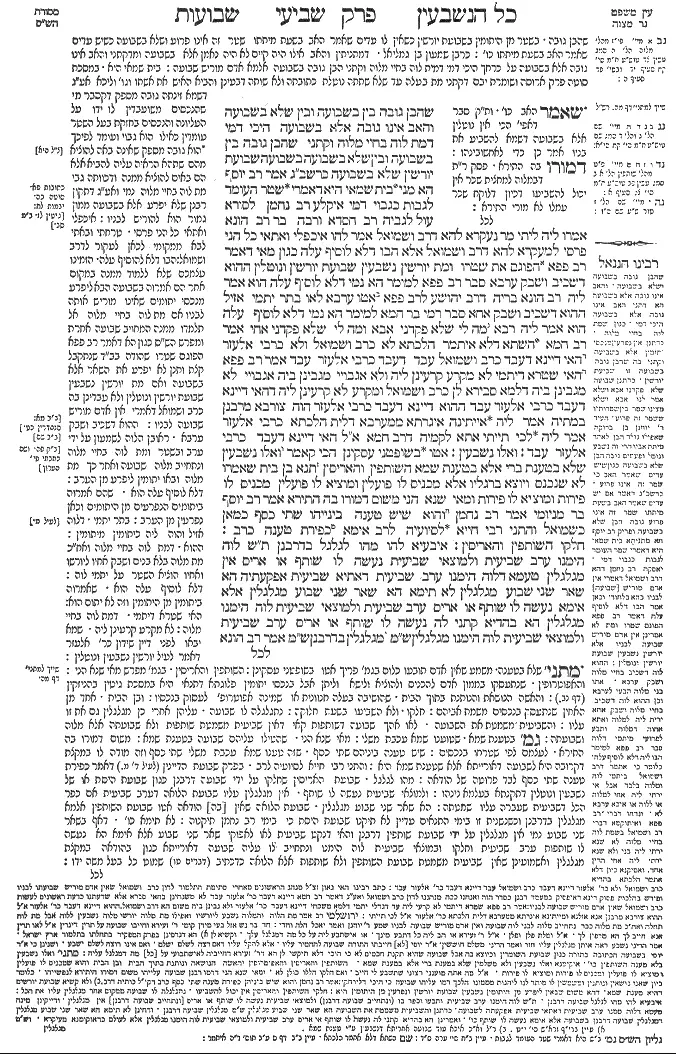
Shevu'ot 48b - Guemara
שהבן גובה בין בשבועה ובין שלא בשבועה והאב אינו גובה אלא בשבועה היכי דמי דמת לוה בחיי מלוה וקתני שהבן גובה בין בשבועה ובין שלא בשבועה בשבועה שבועת יורשין שלא בשבועה כרשב"ג אמר רב יוסף הא מני בית שמאי היא דאמרי שטר העומד לגבות כגבוי דמי איקלע רב נחמן לסורא עול לגביה רב חסדא ורבה בר רב הונא אמרו ליה ליתי מר נעקרא להא דרב ושמואל אמר להו איכפלי ואתאי כל הני פרסי למעקרא להא דרב ושמואל אלא הבו דלא לוסיף עלה כגון מאי דאמר רב פפא הפוגם את שטרו ומת יורשין נשבעין שבועת יורשין ונוטלין ההוא דשכיב ושבק ערבא סבר רב פפא למימר הא נמי דלא לוסיף עלה הוא אמר ליה רב הונא בריה דרב יהושע לרב פפא אטו ערבא לאו בתר יתמי אזיל ההוא דשכיב ושבק אחא סבר רמי בר חמא למימר הא נמי דלא לוסיף עלה הוא אמר ליה רבא מה לי שלא פקדני אבא ומה לי שלא פקדני אחי אמר רב חמא השתא דלא איתמר הלכתא לא כרב ושמואל ולא כרבי אלעזר האי דיינא דעבד כרב ושמואל עבד דעבד כרבי אלעזר עבד אמר רב פפא האי שטרא דיתמי לא מקרע קרעינן ליה ולא אגבויי מגבינן ביה אגבויי לא מגבינן ביה דלמא סבירא לן כרב ושמואל ומקרע לא קרעינן ליה דהאי דיינא דעבד כרבי אלעזר עבד ההוא דיינא דעבד כרבי אלעזר הוה צורבא מרבנן במתיה אמר ליה אייתינה איגרתא ממערבא דלית הלכתא כרבי אלעזר אמר ליה לכי תייתי אתא לקמיה דרב חמא א"ל האי דיינא דעבד כרבי אלעזר עבד:
ואלו נשבעין:
אטו בשופטני עסקינן הכי קאמר ואלו נשבעין שלא בטענת ברי אלא בטענת שמא השותפין והאריסין תנא בן בית שאמרו לא שנכנס ויוצא ברגליו אלא מכניס לו פועלין ומוציא לו פועלין מכניס לו פירות ומוציא לו פירות ומאי שנא הני משום דמורו בה התירא אמר רב יוסף בר מניומי אמר רב נחמן והוא שיש טענה בינייהו שתי כסף כמאן כשמואל והתני רבי חייא לסיועיה לרב אימא כפירת טענה כרב:
חלקו השותפין והאריסין:
איבעיא להו מהו לגלגל בדרבנן ת"ש לוה הימנו ערב שביעית ולמוצאי שביעית נעשה לו שותף או אריס אין מגלגלין טעמא דלוה הימנו ערב שביעית דאתיא שביעית אפקעתיה הא שאר שני שבוע מגלגלין לא תימא הא שאר שני שבוע מגלגלין אלא אימא נעשה לו שותף או אריס ערב שביעית ולמוצאי שביעית לוה הימנו מגלגלין הא בהדיא קתני לה נעשה לו שותף או אריס ערב שביעית ולמוצאי שביעית לוה הימנו מגלגלין ש"מ מגלגלין בדרבנן ש"מ אמר רב הונא
Comments from Rashi on Masechet Shevu'ot Page 48b
שהבן גובה . בשטר מן היתומין בשבועת יורשין כשאין לו עדים שאמר האב בשעת מיתתו שטר זה אינו פרוע ושלא בשבועה כשיש עדים שאמר האב בשעת מיתתו כו': נתגלגלה לו שבועה . עליהן אחרי כן מגלגלין גם את זו עליו: כרבן שמעון בן גמליאל . דמתניתין והאב אילו היה קיים לא היה נאמן אלא בשבועה ומדקתני והאב אינו גובה אלא בשבועה על כרחך היכי דמי דמית לוה בחיי מלוה וקתני הבן גובה בשבועה אלמא אדם מוריש שבועה: בית שמאי היא . במסכת סוטה פרק ארוסה ושומרת יבם דקתני מת בעלה עד שלא שתתה נוטלת כתובתה ולא שותה דבעינן והביא האיש את אשתו וגו' וליכא אע"ג דשמא זינתה גובה מספק דקסבר מי שהנכסים משועבדין לו ידו על העליונה והנכסים בחזקת בעל השטר עומדין כאילו הוא גבוי ועומד לפיכך . הוא גובה מספק שאינה באה להוציא מהם שתהא הראיה עליה להביא אלא הם באים להוציא ממנה ודכוותה גבי מת לוה בחיי מלוה נמי ואע"ג דתקון רבנן שלא יפרע אלא בשבועה ממון גמור הוא להוריש לבניו: איכפלי ואתאי כל הני פרסי . טרחתי. ובאתי לבא ממקומי לכאן לעקור לדרב ושמואל: הבו דלא להוסיף עלה . הזמינו עצמכם שלא ללמוד ממנה במקום אחר הם אמרוה בשבועה הבא ליפרע מנכסי יתומים שאינו מוריש אותה לבניו אם מת לוה בחיי מלוה אל תלמדו ממנה המחויב שבועה אחרת ומפרש הש"ס כגון הא דאמר רב פפא הפוגם שטרו שהודה בב"ד שנתקבל קצת ותנן לא יפרע את השאר אלא בשבועה ואם מת יורשין נשבעין שבועת יורשין ונוטלין ולא עבדינן בה כרב ושמואל דאמרי אין אדם מוריש שבועה לבניו: ההוא דשכיב ושבק ערבא . ראובן הלוה לשמעון על ידי ערב ובשטר ומת לוה בחיי מלוה ונתחייב מלוה שבועה ואחר כך מת מלוה ובאו יתומין ליפרע מן הערב: דלא לוסיף עלה הוא . שהם אמרוה ביתומים הנפרעים מן היתומים וכאן נפרעין מן הערב: בתר יתמי . דלוה אזיל והוה ליה כיתומין מיתומין: ההוא . דמת לוה בחיי מלוה ואח"כ מת מלוה בלא בנים ושבק אחיו ליורשו ואחיו הוציא השטר על יתמי לוה: דלא לוסיף עלה הוא . שאמרוה ביתומין מן היתומין וזה לא יתום הוא: האי שטרא דיתמי . דמת לוה בחיי מלוה: לא מקרע קרעינן ליה . שמא יבאו לפני דיין שידון כר' אלעזר דאמר לעיל יורשין נשבעין ונוטלין: מתני'. שלא בטענה . משמע שאין אדם תובעו כלום בגמ' פריך אטו בשופטני עסקינן: השותפין והאריסין . בגמ' מפרש מאי שנא הני: והאפוטרופין . שנתעסקו בממון אדם להכניס ולהוציא ולישא וליתן אבל בנכסי יתומין פלוגתא דתנאי היא במסכת גיטין בהניזקין (דף נב.): והאשה הנושאת והנותנת בתוך הבית . שהושיבה בעלה חנוונית או שמינה אפוטרופ' לעסוק בנכסיו ובן הבית. אחד מן האחין שנתעסק בנכסים משמת אביהם: חלקו . ולא השביעו בשעת חלוקה: נתגלגלה לו שבועה . עליהן אחרי כן מגלגלין גם את זו עליו: והשביעית משמטת את השבועה . לאו אהך שבועה דשותפות קאי דאין שביעית משמטת שותפות ולא שבועתה אלא מלוה ושבועתה: גמ' בטענת שמא . שטוענו שמא עכבת משלי: מאי שנא הני . שהטילו עליהם שבועה בטענת שמא: משום דמורו בה התירא . לעצמם לפי שטרחו בנכסים: שיש טענה ביניהם שתי כסף . שזה טענו שמא עכבת משלי שתי כסף וזה מודה לו במקצת דקרובה היא לשבועה דאורייתא אלא שטענת שמא היא: והתני רבי חייא לסיועיה לרב . בפרק שבועת הדיינין (לעיל שבועות ד' מ.) דאמר כפירת טענה שתי כסף לבד פרוטה של הודאה: מהו לגלגל . שבועת האריסין שחלקו על ידי שבועה דרבנן כגון שבועת היסת או של נשבעין ונוטלין דתקנתא בעלמא נינהו: ולמוצאי שביעית נעשה לו שותף . אין מגלגלין עליו שבועת הלואה דערב שביעית אם כפר הכל דשביעית שעברה עליו שמטתה: הא שאר שני שבוע מגלגלין . שבועת הלואה שאין הודאה אטו שבועת השותפין אלמא מגלגלין בדרבנן וכשנשנית זו בימי התנאים עדיין לא תיקנו שבועת היסת כי בימי רב נחמן תיקנוה: לא תימא כו' . דאף בשאר שני שבוע נמי אין מגלגלין על ידי שבועת שותפין דרבנן והאי דנקט שביעית לאו לאפוקי שאר שני שבוע אלא אימא הא נעשה לו שותפות ערב שביעית וחלקו ובמוצאי שביעית לוה הימנו ונתחייב לו עליה שבועה דאורייתא כגון בהודאה במקצת מגלגלין ואשמועינן שאין שביעית משמטת שבועת השותפין ולא שותפות אלא הלואה כדכתיב (דברים טו) שמוט כל בעל משה ידו:
Comments from Tosafot - Shevu'ot 48b
שאמר האב כו'. ות"ק סבר דאפי' הכי אין נוטלין אלא בשבועה דשמא להשביע את בניו אמר כן כדי לאחשובינהו: דמורו בה התירא. פסק ר"ת דבמלוה למחצית שכר אין יכול להשביעו דכיון דלוקח שכר עמלו לא מורי התירא:
Shevu'ot 48b - Mishnah translated into english
as the son can collect both by taking an oath and without taking an oath, while the father can collect only by taking an oath. What are the circumstances in which this occurs? It is when the borrower died during the life of the lender. The father who is the lender can collect from the borrower’s heirs only if he takes an oath.
And it is taught: As the son can collect both by taking an oath and without taking an oath. He collects by taking an oath when he takes the heirs’ oath, that he has no knowledge that his father’s debt was paid, and he collects without taking an oath in accordance with the opinion of Rabban Shimon ben Gamliel in the mishna, that when there are witnesses that the father said at the time of his death that a certain promissory note had not been paid, the son collects the debt without taking an oath. In any case, absent testimony to that effect, the father bequeaths the oath to his children and the son can collect by taking an oath, contrary to the ruling of Rav and Shmuel.
Rav Yosef said in response: In accordance with whose opinion is this baraita? It is in accordance with the opinion of Beit Shammai, who say that a debt recorded in a promissory note that stands to be collected is considered as if it is already collected. Therefore, the father is considered to be already in possession of the loan and bequeaths it to his son. Even though the Sages instituted that the son take an oath to the heirs of the borrower, this is not a case of the son inheriting an oath.
§ It is related that Rav Naḥman arrived in the city of Sura. Rav Ḥisda and Rabba bar Rav Huna came to see him. They said to him: Let our Master come, and together we will overturn that ruling of Rav and Shmuel. Rav Naḥman said to them: Did I exert myself and come all these parasangs to uproot that ruling of Rav and Shmuel? Rather, let us not extend their ruling by applying it to other situations outside the specific context of when the borrower died during the lifetime of the lender. The Gemara offers an example: This is like what Rav Pappa says: If a creditor vitiates his promissory note, by acknowledging that he has received partial payment and thereby rendering himself liable to take an oath in order to receive the rest, and then he dies, his heirs take the heirs’ oath and collect from the debtor.
The Gemara relates: There was a certain debtor who died and left a guarantor of his debt, and the orphans of the creditor came to collect from the guarantor. Rav Pappa thought to say: This, too, is a case to which one should not extend Rav and Shmuel’s ruling, as they said only that orphans do not inherit an oath to collect from other orphans, and this should not apply to collecting from a guarantor. Rav Huna, son of Rav Yehoshua, said to Rav Pappa: Is that to say that the guarantor will not pursue the orphans and collect from them? Ultimately, collecting from the guarantor is tantamount to collecting from the orphans, and no distinction should be made.
The Gemara relates: There was a certain creditor who died and left a brother as his heir, who wanted to collect from the orphans of the debtor. Rami bar Ḥama thought to say that this, too, is a case to which one should not extend Rav and Shmuel’s ruling, since Rav and Shmuel ruled that one does not bequeath an oath to one’s children, and they did not mention a case where the heir is a brother. Rava said to him: What difference does it make to me if the oath taken by the heir is: My father did not inform me that this debt has been paid, and what difference does it make to me if the oath taken is: My brother did not inform me?
Rav Ḥama says: Now that the halakha was not stated either in accordance with the opinion of Rav and Shmuel or in accordance with the opinion of Rabbi Elazar, a judge who rules in accordance with the opinion of Rav and Shmuel has ruled, and his ruling is accepted, and a judge who rules in accordance with the opinion of Rabbi Elazar has ruled, and his ruling is accepted.
Rav Pappa says: When that promissory note of orphans comes before our court, we do not tear it up, but we also do not collect the debt with it. We do not collect the debt with it, since perhaps we should hold in accordance with the opinion of Rav and Shmuel that orphans cannot collect debts in a case where their father was required to take an oath to collect, as they cannot take the appropriate oath; but we do not tear it up, since a judge who rules in accordance with the opinion of Rabbi Elazar has ruled.
The Gemara relates: There was a certain judge who ruled in accordance with the opinion of Rabbi Elazar. There was a Torah scholar in his city. He said to the judge: I will bring a letter from the West, Eretz Yisrael, stating that the halakha is not in accordance with the opinion of Rabbi Elazar. The judge said to him: When you bring such a letter, I will consider it, but for now I stand by my ruling. That Torah scholar came before Rav Ḥama, and Rav Ḥama said to him: A judge who rules in accordance with the opinion of Rabbi Elazar has ruled, and his ruling cannot be voided.
§ The mishna teaches: And these people are sometimes required to take an oath that they do not owe anything even when there is no explicit claim against them: Partners, sharecroppers, stewards, a woman who does business from home, where she manages the property of orphans, and the member of the household appointed to manage the household’s affairs. The Gemara asks: Is that to say that we are dealing with fools who take an oath even though no claim has been brought against them? The Gemara explains: This is what the mishna is saying: And these people take an oath without it being in response to a definite claim but only to an uncertain claim, i.e., the claimant cannot know with certainty that he is owed money: Partners, sharecroppers, and the others listed in the mishna.
The Sages taught in a baraita (Tosefta, Ketubot 9:3): With regard to the member of the household whom they mentioned in the mishna, this is not referring to one who enters and exits the house on foot as a family friend, but rather to one who engages laborers, and dismisses laborers, gathers produce, and sends out produce in managing the household.
The Gemara asks: And what is different about these people listed in the mishna, e.g., partners, such that they are liable to take an oath in response to an uncertain claim? It is because they tend to grant themselves permission to take for themselves from the property for which they are responsible, using as an excuse the effort they invest in their duties.
Rav Yosef bar Minyumi said that Rav Naḥman said: One takes an oath in response to an uncertain claim only when there is a claim between them worth at least two silver ma’a.
The Gemara asks: In accordance with whose opinion is this ruling? Is it in accordance with that of Shmuel? Shmuel holds that one becomes liable to take an oath after admitting to part of a claim when the value of the entire claim is at least two silver ma’a. Rav holds that the portion one denies he owes must be at least two ma’a (see 39b). But didn’t Rabbi Ḥiyya teach a baraita in support of Rav? The Gemara answers: Say that Rav Naḥman means that the value of the denial of a claim is at least two silver ma’a, in accordance with the opinion of Rav.
§ The mishna teaches: Once the partners or the sharecroppers have divided the common property, and each has taken his share, then one side may not require an oath of the other absent a definite claim. A question was raised before the Sages: What is the halakha about extending an oath to an additional situation, in a case where the original oath is by rabbinic law?
The Gemara suggests: Come and hear a baraita: If one borrowed from another on the eve of, i.e., before, the Sabbatical Year, and upon the conclusion of the Sabbatical Year became his partner or sharecropper, the lender may not extend the partner’s or sharecropper’s oath to an oath about the loan. The Gemara infers: The reason he may not extend the oath is that he borrowed from him on the eve of the Sabbatical Year, so that the Sabbatical Year came and abrogated the loan, rendering the oath irrelevant. Therefore, if he borrowed during the other years of the seven-year Sabbatical cycle, an oath may be extended from the partner’s oath or sharecropper’s oath, which are rabbinic ordinances, to an oath about the loan.
The Gemara rejects that inference: Do not say: Therefore, if he borrowed during the other years of the Sabbatical cycle, an oath may be extended. Rather, say that one should infer from the baraita that if he became his partner or sharecropper on the eve of the Sabbatical Year, and upon the conclusion of the Sabbatical Year he borrowed from him and incurred an oath by Torah law, that oath may be extended.
The Gemara asks: Isn’t that taught explicitly in a baraita? It teaches: If he became his partner or sharecropper on the eve of the Sabbatical Year, and upon the conclusion of the Sabbatical Year he borrowed from him, the oath may be extended. Therefore, the initial inference must be correct. Conclude from it that an oath incurred by rabbinic law may be extended. The Gemara affirms: Conclude from it that this is so.
Rav Huna says:
Traduction : The William Davidson digital edition of the Koren Noé Talmud, with commentary by Rabbi Adin Even-Israel Steinsaltz.