 Talmud Bavli
Shevu'ot 18b : Youtube
Daf TubeYoutube
2 video classes :
Shevu'ot Page 18b
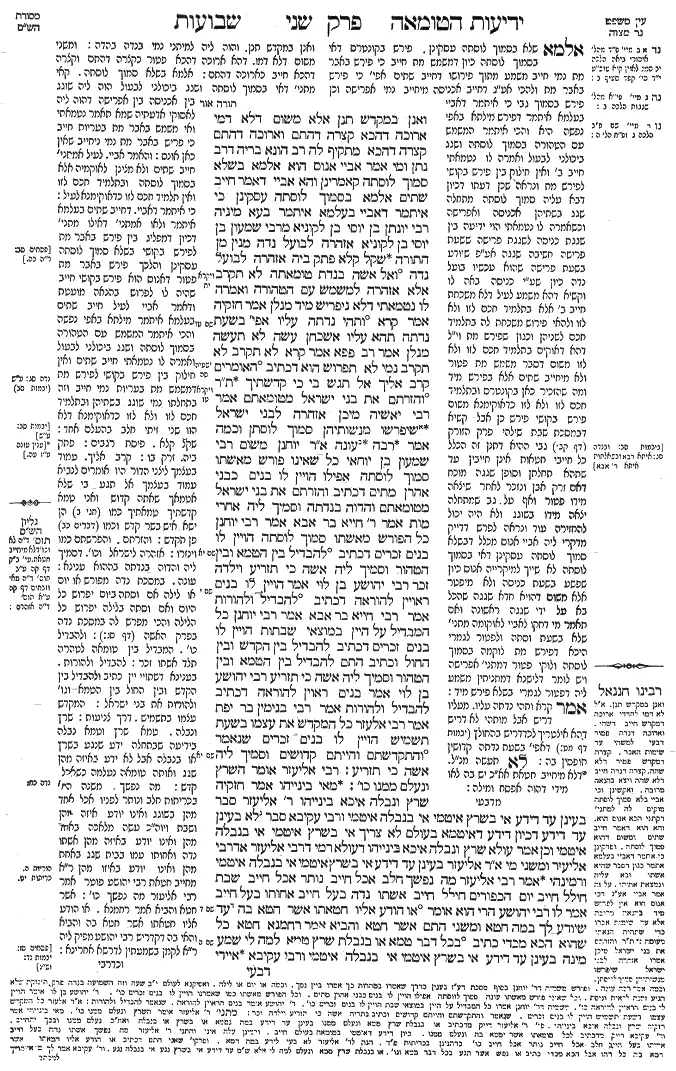
Shevu'ot 18b - Guemara
ואנן במקדש תנן אלא משום דלא דמי ארוכה דהכא קצרה דהתם וארוכה דהתם קצרה דהכא מתקיף לה רב הונא בריה דרב נתן ומי אמר אביי אנוס הוא אלמא בשלא סמוך לוסתה קאמרינן והא אביי דאמר חייב שתים אלמא בסמוך לוסתה עסקינן כי איתמר דאביי בעלמא איתמר בעא מיניה רבי יונתן בן יוסי בן לקוניא מרבי שמעון בן יוסי בן לקוניא אזהרה לבועל נדה מנין מן התורה שקל קלא פתק ביה אזהרה לבועל נדה (ויקרא יח, יט) ואל אשה בנדת טומאתה לא תקרב אלא אזהרה למשמש עם הטהורה ואמרה לו נטמאתי דלא ניפריש מיד מנלן אמר חזקיה אמר קרא (ויקרא טו, כד) ותהי נדתה עליו אפי' בשעת נדתה תהא עליו אשכחן עשה לא תעשה מנלן אמר רב פפא אמר קרא לא תקרב לא תקרב נמי לא תפרוש הוא דכתיב (ישעיהו סה, ה) האומרים קרב אליך אל תגש בי כי קדשתיך ת"ר (ויקרא טו, לא) והזרתם את בני ישראל מטומאתם אמר רבי יאשיה מיכן אזהרה לבני ישראל שיפרשו מנשותיהן סמוך לוסתן וכמה אמר רבה עונה א"ר יוחנן משום רבי שמעון בן יוחאי כל שאינו פורש מאשתו סמוך לוסתה אפילו הויין לו בנים כבני אהרן מתים דכתיב והזרתם את בני ישראל מטומאתם והדוה בנדתה וסמיך ליה אחרי מות אמר ר' חייא בר אבא אמר רבי יוחנן כל הפורש מאשתו סמוך לוסתה הויין לו בנים זכרים דכתיב (ויקרא יא, מז) להבדיל בין הטמא ובין הטהור וסמיך ליה אשה כי תזריע וילדה זכר רבי יהושע בן לוי אמר הויין לו בנים ראויין להוראה דכתיב (ויקרא י, י) להבדיל ולהורות אמר רבי חייא בר אבא אמר רבי יוחנן כל המבדיל על היין במוצאי שבתות הויין לו בנים זכרים דכתיב להבדיל בין הקדש ובין החול וכתיב התם להבדיל בין הטמא ובין הטהור וסמיך ליה אשה כי תזריע רבי יהושע בן לוי אמר בנים ראוין להוראה דכתיב להבדיל ולהורות אמר רבי בנימין בר יפת אמר רבי אלעזר כל המקדש את עצמו בשעת תשמיש הויין לו בנים זכרים שנאמר (ויקרא יא, מד) והתקדשתם והייתם קדושים וסמיך ליה אשה כי תזריע:
רבי אליעזר אומר השרץ ונעלם ממנו כו':
מאי בינייהו אמר חזקיה שרץ ונבלה איכא בינייהו ר' אליעזר סבר בעינן עד דידע אי בשרץ איטמי אי בנבלה איטמי ורבי עקיבא סבר לא בעינן עד דידע דכיון דידע דאיטמא בעולם לא צריך אי בשרץ איטמי אי בנבלה איטמי וכן אמר עולא שרץ ונבלה איכא בינייהו דעולא רמי דרבי אליעזר אדרבי אליעזר ומשני מי א"ר אליעזר בעינן עד דידע אי בשרץ איטמי אי בנבלה איטמי ורמינהי אמר רבי אליעזר מה נפשך חלב אכל חייב נותר אכל חייב שבת חילל חייב יום הכפורים חילל חייב אשתו נדה בעל חייב אחותו בעל חייב אמר לו רבי יהושע הרי הוא אומר (ויקרא ד, כג) או הודע אליו חטאתו אשר חטא בה עד שיודע לך במה חטא ומשני התם אשר חטא והביא אמר רחמנא חטא כל שהוא הכא מכדי כתיב (ויקרא ה, ב) בכל דבר טמא או בנבלת שרץ טמא למה לי שמע מינה בעינן עד דידע אי בשרץ איטמי אי בנבלה איטמי ורבי עקיבא איידי
Comments from Rashi on Masechet Shevu'ot Page 18b
ואנן במקדש תנן . והוה ליה למיתני נמי בנדה בהדה: ומשני משום דלא דמו . דהא ארוכה דהכא פטור כקצרה דהתם וקצרה דהכא חייב כארוכה דהתם: אלמא בשלא סמוך לוסתה . קאי מתני' דאי בסמוך לוסתה ושגג ביכולני לבעול הוה ליה שוגג בין אכניסה בין אפרישה דהוה ליה לאסוקי אדעתיה שמא תאמר נטמאתי ואי משמש באבר מת בעריות חייב כי פריש באבר מת נמי ניחייב שאין כאן אונס: והאמר אביי . לעיל אמתני' חייב שתים ולא מצינן לאוקמיה אלא בסמוך לוסתה ובתלמיד חכם לזו ואין תלמיד חכם לזו כדאוקימנא לעיל: כי איתמר דאביי . דחייב שתים בעלמא איתמר ולאו אמתני' דאילו מתני' דכיון דמפליג בין פירש באבר מת לפירש בקושי בשלא סמוך לוסתה עסקינן והלכך פירש באבר מת פטור דאנוס הוא פירש בקושי חייב שהיה לו לפרוש בהנאה מועטת ודאמר אביי לעיל חייב שתים בעלמא איתמר מילתא באפי נפשה והכי איתמר המשמש עם הטהורה בסמוך לוסתה ושגג ביכולני לבעול ואמרה לו נטמאתי חייב שתים ואין חילוק בין פירש בקושי לפירש מת דמשמש מת בעריות נמי חייב וזה בתחלתו נמי שוגג בשתיהן ובתלמיד חכם לזו ולא לזו כדאוקימנא דלא הוו שני זיתי חלב בהעלם אחד: שקל קלא . פיסת רגבים: פתק ביה . זרק בו: קרב אליך . עמוד בעצמך ליצני הדור היו אומרים לנביא עמוד בעצמך אל תגע בי שלא אטמאך שאתה קדוש ואני טמא קדשתיך טמאתיך כמו (חגי ב) הן ישא איש בשר קדש וכמו (דברים כב) פן תקדש: והזרתם . והפרשתם כמו וינזרו: אזהרה לישראל וכו' . דסמיך ליה והדוה בנדתה בההוא ענינא: עונה . במסכת נדה מפורש או יום או לילה אם וסתה ביום יפרוש כל היום ואם וסתה בלילה יפרוש כל הלילה והכי מפרש לה במסכת נדה בפרק האשה (דף סג:): ולהבדיל כו' . המבדיל בין טומאה לטהרה תלד אשתו זכר: להבדיל ולהורות . בענינא דשתויי יין כתיב ולהבדיל בין הקדש ובין החול בין הטמא וגו' ולהורות את בני ישראל: המקדש עצמו בתשמיש . דרך צניעות: שרץ ונבלה . טמא שרץ וטמא נבלה בידיעה שבתחלה ידע שנגע בשרץ או בנבלה אבל לא ידע באיזה מהן שגג ואותה טומאה נעלמה כשאכל קדש: מה נפשך . משנה היא בכריתות חלב ונותר לפניו אכל אחד מהן בשוגג ואינו יודע איזה מהן ושבת ויוה"כ עשה מלאכה באחד מהן ואינו יודע באיזה מהן אשתו נדה ואחותו עמו בבית שגג באחת מהן ואינו יודע באיזו מהן ר"א מחייב חטאת רבי יהושע פוטר אמר רבי אליעזר מה נפשך כו': אשר חטא והביא אמר רחמנא . או הודע אליו חטאתו אשר חטא בה והביא והאי בה דקדריש רבי יהושע מפיק ליה ר"א לקמן בשמעתין לדרשא אחרינא:
Comments from Tosafot - Shevu'ot 18b
אלמא שלא בסמוך לוסתה עסקינן פירש בקונטרס דאי . בסמוך לוסתה כיון דמשמש מת חייב כי פירש באבר מת נמי חייב משמע מתוך פירושו דחייב שתים אפי' כי פירש באבר מת ולהכי אע"ג דחייב אכניסה מיחייב נמי אפרישה וכן פירש בסמוך גבי כי איתמר דאביי בעלמא איתמר דפירש מילתא באפי נפשה היא והכי איתמר המשמש עם הטהורה בסמוך לוסתה ושגג ביכולני לבעול ואמרה לו נטמאתי חייב ב' ואין חילוק בין פירש בקושי לפירש מת ונראה שכן דעתו דכיון דבא עליה סמוך לוסתה מתחלה שגג בשתיהן אכניסה ואפרישה וכשאמרה לו נטמאתי הוי ידיעה בין שגגת כניסה לשגגת פרישה ששעת פרישה חשיבה שגגה אע"פ שיודע בשעת פרישה שהוא עכשיו בועל נדה כיון שע"י כניסה באה לו וקשיא דהא משמע לעיל דלא משכחת חייב ב' אלא בתלמיד חכם לזו ולא לזו ולהאי פירוש משכחת לה בתלמיד חכם לשניהן וכגון שפירש מת וי"ל דהא דאוקים בתלמיד חכם לזו ולא לזו משום דסבר משמש מת פטור ולא מיחייב שתים אלא בפירש מיד ומה שהזכיר כאן בקונטרס ובתלמיד חכם לזו ולא לזו כדאוקימנא משום פירש בקושי פירש כן אבל קשיא דבמסכת שבת שילהי פרק הזורק (דף קב.) גבי ההיא דתנן זה הכלל כל חייבי חטאות אינן חייבין עד שתהא תחלתן וסופן שגגה מוכח דאם זרק אבן ונזכר לאחר שיצאה מידו פטור ואף על גב שמתחלה יצאה מידו בשוגג ולא היה יכול להחזירה עוד ונראה לפרש דדייק מדקרי ליה אביי אנוס מכלל דבשלא סמוך לוסתה עסקינן דאי בסמוך לוסתה לא שייך למיקרייה אנוס כיון שפשע בשעת כניסה ולא מיפטר אלא משום דהויא חדא שגגה שהכל בא על ידי שגגה ראשונה ואם תאמר מי דחקו לאביי לאוקומה מתני' שלא בשעת וסתה ולפטור לגמרי היכא דפירש מת לוקמה בסמוך לוסתה ולוקי פטור דמתני אפרישה ויש לומר דלישנא דמתניתין משמע ליה דפטור לגמרי בשלא פירש מיד: אמר קרא ותהי נדתה עליו. מעליו דריש אבל מותהי לא דריש דהא איצטריך לכדדריש בהחולץ (יבמות דף מט:) דאפי' בשעת נדתה קדושין תופסין בה: לא תעשה מנ"ל. דלא מיחייב חטאת אא"כ יש בה לאו מידי דהוה אפסח ומילה:
Shevu'ot 18b - Mishnah translated into english
And we learned this difference in the mishna specifically with regard to ritual impurity in the Temple. If such a distinction were also in effect with regard to a menstruating woman, the mishna would mention it. Rather, one can explain: No parallel distinction is made, because the two cases are not similar in their details. The long way here, with regard to a menstruating woman, namely, that the man must wait, is like the shortest way there, with regard to impurity in the Temple, namely, that the impure person must leave the Temple by way of the most direct route. And the long way there, with regard to the Temple, is like the shortest way here, with regard to a menstruating woman.
Rav Huna, son of Rav Natan, objects to what Abaye said: Did Abaye really say with regard to the mishna that if the man withdraws with a flaccid penis he is exempt because he is considered a victim of circumstances beyond his control? Apparently, then, we are speaking of a man who engaged in intercourse with a woman not near the expected date of her menstruation, and therefore the situation is considered beyond his control. But is it not Abaye who says that he is liable to bring two sin-offerings for this transgression, one for his initial entry and one for his withdrawal? Apparently, we are dealing with a man who engaged in intercourse with a woman near the expected date of her menstruation, so he is considered an unwitting transgressor, who is liable to bring a sin-offering, and is not the victim of circumstances beyond his control. Consequently, Abaye’s two statements contradict each other.
The Gemara answers: When this statement of Abaye was stated, that the man is liable to bring two sin-offerings, it was stated in general. It was not relating to the case in the mishna, but was an independent ruling concerning one who engages in intercourse with a woman near the expected date of her menstruation.
§ Rabbi Yonatan ben Yosei ben Lakonya asked Rabbi Shimon ben Yosei ben Lakonya: From where in the Torah is the prohibition concerning one who engages in intercourse with a menstruating woman [nidda] derived? Rabbi Shimon ben Yosei ben Lakonya took a clod [kala] of earth and threw it at him in reproach and said to him: Is there a need to search the Torah for a derivation for the prohibition concerning one who engages in intercourse with a menstruating woman? The verse states: “And a woman who is impure by her uncleanness [nidda] you shall not approach, to uncover her nakedness” (Leviticus 18:19)?
The Gemara explains the intent of the question of Rabbi Yonatan ben Yosei ben Lakonya: Rather, from where do we derive the prohibition with regard to the case in the mishna concerning one who was engaging in intercourse with a ritually pure woman, and she experienced menstrual bleeding and said to him: I have become impure, that he must not withdraw immediately? In response to this question Ḥizkiyya said: The verse states: “And if any man lies with her, and her menstrual flow shall be upon him” (Leviticus 15:24), teaching that even at any time when she is menstruating, the prohibition shall be upon him; therefore, he must not withdraw from her immediately.
The Gemara asks: We found a source for a positive mitzva with regard to the manner in which one must withdraw from a menstruating woman; from where do we derive that immediate withdrawal is also subject to a prohibition? Rav Pappa said: The verse states: “And a woman who is impure by her uncleanness you shall not approach, to uncover her nakedness” (Leviticus 18:19). The Gemara explains: “You shall not approach [tikrav]” means also the opposite: You shall not withdraw, as it is written: “Those who say: Withdraw [kerav] to yourself, come not near to me, for I am holier than you” (Isaiah 65:5), where “kerav” means remove or withdraw.
§ Having mentioned that it is prohibited for a man to engage in intercourse with a woman near the expected date of her menstruation, the Gemara cites a baraita in which the Sages taught: The verse with regard to a menstruating woman states: “And shall you separate the children of Israel from their uncleanness” (Leviticus 15:31), Rabbi Yoshiya says: From here we derive a prohibition to the children of Israel that they must separate from their wives near the expected date of their menstruation. And how long before must they separate? Rabba says: A set interval of time for the ritual impurity of a menstruating woman, which is half of a twenty-four hour day, either the daytime or the nighttime.
Rabbi Yoḥanan says in the name of Rabbi Shimon ben Yoḥai: With regard to anyone who does not separate from his wife near the expected date of her menstruation, even if he has sons who are fit to be great and holy like the sons of Aaron, these sons will die due to his sin, as it is written: “And shall you separate the children of Israel from their uncleanness…this is the law…of her that is sick with her menstrual flow” (Leviticus 15:31–33), and it is stated near it: “After the death of the two sons of Aaron” (Leviticus 16:1).
Concerning this matter, Rabbi Ḥiyya bar Abba says that Rabbi Yoḥanan says: Anyone who separates himself from his wife near the expected date of her menstruation will have male children, as it is written: “To distinguish between the impure and the pure” (Leviticus 11:47), and it is stated near it: “If a woman conceive and bear a male child” (Leviticus 12:2). Rabbi Yehoshua ben Levi says: He will have sons who are worthy of teaching halakha, as it is written: “To distinguish…between the impure and the pure, and to teach the children of Israel all the statutes” (Leviticus 10:10–11).
The Gemara continues to expound these verses: Rabbi Ḥiyya bar Abba says that Rabbi Yoḥanan says: Anyone who recites havdala over wine at the conclusion of Shabbatot, and not over some other beverage, will have male children, as it is written: “To distinguish between the holy and the unholy, and between the impure and the pure” (Leviticus 10:10), and it is written there once again: “To distinguish between the impure and the pure” (Leviticus 11:47), and it is stated near it: “If a woman conceive and bear a male child” (Leviticus 12:2). Rabbi Yehoshua ben Levi says: Anyone who recites havdala over wine at the conclusion of Shabbatot will have sons who are worthy of teaching halakha, as it is written: “To distinguish between the holy and the unholy…and to teach” (Leviticus 10:10–11).
Rabbi Binyamin bar Yefet says that Rabbi Elazar says: Anyone who sanctifies himself with modest conduct while engaging in sexual intercourse will have male children, as it is stated: “You shall sanctify yourselves, and you shall be holy” (Leviticus 11:44), and it is stated near it: “If a woman conceive and bear a male child” (Leviticus 12:2).
§ The mishna teaches: Rabbi Eliezer says: With regard to the sliding-scale offering the verse states: “Or if a person touches any impure thing, whether it is the carcass of a non-kosher undomesticated animal, or the carcass of a non-kosher domesticated animal, or the carcass of a non-kosher creeping animal, and it is hidden from him, so that he is impure” (Leviticus 5:2). The juxtaposition of the words “and it is hidden” to the words “a creeping animal” teaches that one is liable to bring a sliding-scale offering when it was hidden from him that he had contracted ritual impurity from a creeping animal, but not when it was hidden from him that he was entering the Temple or partaking of sacrificial food. Rabbi Akiva says that it is from the words “and it is hidden from him, so that he is impure” that it is derived that one is liable to bring a sliding-scale offering for a lapse of awareness about his impurity, but not for a lapse of awareness about the Temple or the sacrificial food. The Gemara asks: Since Rabbi Eliezer and Rabbi Akiva agree about the halakha, what is the practical difference between them?
Ḥizkiyya says: There is a practical difference between them in a case where one initially knew that he had contracted ritual impurity, but he did not know whether the impurity was contracted from a creeping animal or from the carcass of an unslaughtered animal. Rabbi Eliezer holds that for him to be liable to bring an offering, we require that he initially know whether he contracted impurity from a creeping animal or he contracted impurity from an unslaughtered animal carcass, and if he never knew this, he does not bring an offering. And Rabbi Akiva holds that for him to be liable to bring an offering, we do not require that he know this detail; since he knows in general terms that he contracted impurity, it is not necessary that one know whether he contracted the impurity from a creeping animal or he contracted the impurity from an unslaughtered animal carcass.
And Ulla also says: There is a practical difference between them in a case where the person did not know whether he contracted impurity from a creeping animal or from the carcass of an unslaughtered animal. Ulla did not say this explicitly, but rather he raises a contradiction between this statement of Rabbi Eliezer and another statement of Rabbi Eliezer, and then resolves it. He asked: Does Rabbi Eliezer actually say that in order to be liable to bring a sliding-scale offering, we require that one initially know whether he contracted impurity from a creeping animal or he contracted impurity from an unslaughtered animal carcass?
And he raises a contradiction from a baraita with regard to one who ate a forbidden food but did not know whether it was forbidden fat or it was notar, part of a sacrifice left over after the time allotted for its consumption; or one who performed labor but did not know whether it was Shabbat or Yom Kippur; or one who engaged in intercourse but did not know whether it was with his menstruating wife or with his sister. In all these cases Rabbi Eliezer holds that he must bring a sin-offering, whereas Rabbi Yehoshua deems him exempt. Rabbi Eliezer says: Whichever way you look at it, he is liable. If he ate forbidden fat he is liable; if he ate notar he is liable. If he desecrated Shabbat he is liable; if he desecrated Yom Kippur he is liable. If he engaged in intercourse with his menstruating wife, he is liable; if he engaged in intercourse with his sister, he is liable. In all these cases, he knows that he transgressed, and he is liable to bring a sin-offering.
Rabbi Yehoshua said to Rabbi Eliezer: The verse states with regard to a sin-offering: “Or if his sin, in which he sinned, became known to him” (Leviticus 4:23), teaching that there is no liability for an offering until it becomes known to the sinner the manner in which he sinned. According to this baraita, Rabbi Eliezer himself holds that in order to become liable to bring a sin-offering, it is not necessary that one know precisely which prohibition he violated.
And Ulla resolves the contradiction: There, with regard to liability to bring a sin-offering, the Merciful One states: “Or if his sin, in which he sinned, became known to him, he shall bring his offering” (Leviticus 4:23), teaching that it suffices that he knows that he committed some type of sin. Here, with regard to ritual impurity in the Temple, since it is written at the beginning of the verse: “Or if a person touches any impure thing” (Leviticus 5:2), why do I need that which is stated immediately afterward: “Or the carcass of a non-kosher creeping animal”? Conclude from it that we require that he initially know whether he contracted impurity from a creeping animal or he contracted impurity from an unslaughtered animal carcass, and if he never knew this, he does not bring an offering.
The Gemara asks: And Rabbi Akiva, who does not expound the verses in this way, what does he say to this? The Gemara answers: He maintains that since
Traduction : The William Davidson digital edition of the Koren Noé Talmud, with commentary by Rabbi Adin Even-Israel Steinsaltz.