 Talmud Bavli
The learning on the whole site is dedicated : L'ilui Nishmat Jamila bat Chlomo Abensour
The learning on the whole site is dedicated : L'ilui Nishmat יוסף בן מושה
The learning on the whole site is dedicated : L'ilui Nishmat Yaakov ben Myriam
Bekhorot 55a : Youtube
Rabbi Dr. Moshe WeisblumYoutube
1 video class :
Bekhorot Page 55a
Bekhorot 55a - Guemara
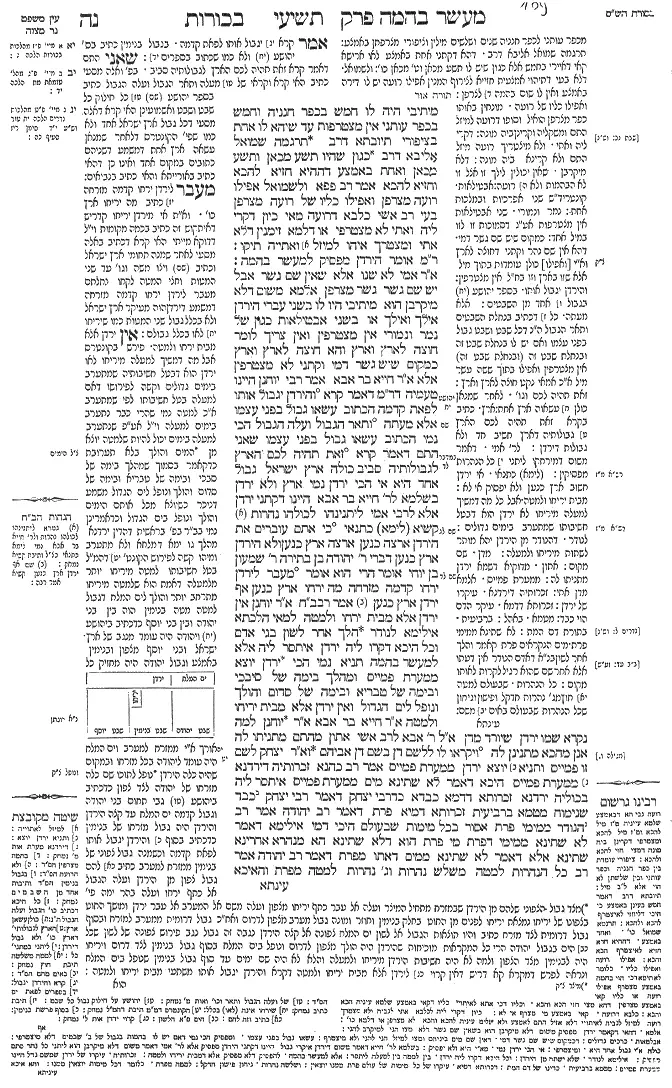
מיתיבי היה לו חמש בכפר חנניה וחמש בכפר עותני אין מצטרפות עד שיהא לו אחת בציפורי תיובתא דרב תרגמה שמואל אליבא דרב כגון שהיו תשע מכאן ותשע מכאן ואחת באמצע דההיא חזיא להכא וחזיא להכא אמר רב פפא ולשמואל אפילו רועה מצרפן ואפילו כליו של רועה מצרפן בעי רב אשי כלבא דרועה מאי כיון דקרי ליה ואתי לא מצטרפי או דלמא זימנין דלא אתי ומצטרך איהו למיזל ואתייה תיקו:
ר"מ אומר הירדן מפסיק למעשר בהמה:
א"ר אמי לא שנו אלא שאין שם גשר אבל יש שם גשר גשר מצרפן אלמא משום דלא מיקרבן הוא מיתיבי היו לו בשני עברי הירדן אילך ואילך או בשני אבטילאות כגון של נמר ונמורי אין מצטרפין ואין צריך לומר חוצה לארץ וארץ והא חוצה לארץ וארץ כמקום שיש גשר דמי וקתני לא מצטרפין אלא א"ר חייא בר אבא אמר רבי יוחנן היינו טעמיה דר"מ דאמר קרא (יהושע יח, כ) והירדן יגבול אותו לפאת קדמה הכתוב עשאו גבול בפני עצמו אלא מעתה (יהושע יח, יד) ותאר הגבול ועלה הגבול הכי נמי הכתוב עשאו גבול בפני עצמו שאני התם דאמר קרא (במדבר לד, יב) זאת תהיה לכם הארץ לגבולותיה סביב כולה ארץ ישראל גבול אחד היא אי הכי ירדן נמי ארץ ולא ירדן בשלמא לר' חייא בר אבא היינו דקתני ירדן אלא לרבי אמי ליתנינהו לכולהו נהרות קשיא לימא כתנאי (במדבר לג, נא) כי אתם עוברים את הירדן ארצה כנען ארצה ארץ כנען ולא הירדן ארץ כנען דברי ר' יהודה בן בתירה ר' שמעון בן יוחי אומר הרי הוא אומר (במדבר לד, טו) מעבר לירדן ירחו קדמה מזרחה מה ירחו ארץ כנען אף ירדן ארץ כנען אמר רבב"ח א"ר יוחנן אין ירדן אלא מבית ירחו ולמטה למאי הלכתא אילימא לנודר הלך אחר לשון בני אדם וכל היכא דקרו ליה ירדן איתסר ליה אלא למעשר בהמה תניא נמי הכי ירדן יוצא ממערת פמייס ומהלך בימה של סיבכי ובימה של טבריא ובימה של סדום והולך ונופל לים הגדול ואין ירדן אלא מבית יריחו ולמטה א"ר חייא בר אבא א"ר יוחנן למה נקרא שמו ירדן שיורד מדן א"ל ר' אבא לרב אשי אתון מהתם מתניתו לה אנן מהכא מתנינן לה (שופטים יח, כג) ויקראו לו ללשם דן בשם דן אביהם וא"ר יצחק לשם זו פמייס ותניא יוצא ירדן ממערת פמייס אמר רב כהנא זכרותיה דירדנא ממערת פמייס היכא דאמר לא שתינא מים ממערת פמייס איתסר ליה בכוליה ירדנא זכרותא דדמא כבדא כדרבי יצחק דאמר רבי יצחק כבד שנימוח מטמא ברביעית זכרותא דמיא פרת דאמר רב יהודה אמר רב הנודר ממימי פרת אסור בכל מימות שבעולם היכי דמי אילימא דאמר לא שתינא ממימי דפרת מי פרת הוא דלא שתינא הא מנהרא אחרינא שתינא אלא דאמר לא שתינא ממים דאתו מפרת דאמר רב יהודה אמר רב כל הנהרות למטה משלש נהרות וג' נהרות למטה מפרת והאיכא
Comments from Rashi on Masechet Bekhorot Page 55a
מכפר עותני לכפר חנניה שנים ושלשים מילין וציפורי מצרפתן באמצע: תרגמה שמואל אליבא דרב . דהא דקתני אחת באמצע לאו ארישא קאי דאיירי בחמש אלא כגון שיש לו תשע מכאן וט' מכאן כו': ולשמואל . דלא בעי דתיהוי אמצעית חזייא לצירוף המנין אפילו רועה יש לו דירה באמצע ואין לו שום בהמה לצרפן: ואפילו כליו של רועה . מונחין באותו כפר מצרפן הואיל וסופו דרועה למיזל התם ומשקליה וקרינן ביה מונה: דקרי ליה ואתי . ולא מיצטריך רועה מיזל התם ולא קרינא ביה מונה: דלא מיקרבן . שאין יכולין לילך זו אצל זו לא הבהמות ולא רועה: אבטילאות . קונטריד"ש שני אפרכיות ובמלכות אחת: נמר ונמורי . שני אבטילאות אין מצטרפות אע"ג דסמוכות זו לזו במיל אחד: כמקום שיש שם גשר דמי . דהא אין שם נהר וקתני דחוצה לארץ וא"י [ואפילו] כולן עומדות בתוך מיל אלא שזו בארץ וזו בח"ל אין מצטרפין: והירדן יגבול אותו . בספר יהושע (יח) בגבול אחד מן השבטים: אלא מעתה . כל דכתיב בנחלת השבטים ותאר הגבול ה"נ דכל שבט ושבט גבול בפני עצמו ואם יש לו בנחלת שבט זה ובנחלת שבט זה (ובנחלת שבט זה) אין מצטרפין ואפילו בתוך ששה עשר מיל א"כ אמאי נקט חוצה לארץ וארץ: זאת תהיה לכם וגו' . לאחר שמנאן כולן עשאוה ארץ אחת: ארץ . כתיב בקרא זאת תהיה לכם הארץ גבולותיה דארץ חשיב חד ולא גבולות דירדן: לר' אמי . דאמר משום דמירחקו ליתני כל הנהרות מפסיקין: (לימא) כתנאי . אי ירדן חשוב ארץ כנען ולא יפסיק אי לא: מבית יריחו ולמטה . אבל כל מה דמשיך למעלה מיריחו לא ירדן הוא דבטל חשיבותו שמתערב בימים גדולים: לנודר . דהנודר מן הירדן יהא מותר לשתות מיריחו ולמעלה: מדן . שם מקום: אתון . מדוקיא דשמא ירדן מתניתו לה: ממערת פמייס . אלמא מדן אתי: זכרותיה דירדנא . עיקרו של ירדן: זכרותא דדמא . עיקר הדם הוי כבד: מטמא . באהל: ברביעית . בתורת דם המת: לא שתינא ממימי פרת . מים הנקראים פרת קאמר והלך אחר לשון בנ"א דאדם הנודר אין דעתו אלא אחר שם שהוא רגיל לקרות לאותו מקום: כל הנהרות . שבעולם למטה חוץ מג' נהרות חדקל ופישון וגיחון שכל הנהרות שבעולם באים משם:
Comments from Tosafot - Bekhorot 55a
אמר קרא יגבול אותו לפאת קדמה . בגבול בנימין כתיב בס' יהושע ולא כמו שכתוב בספרים: שאני התם דאמר קרא זאת תהיה לכם הארץ לגבולותיה סביב . בפ' ואלה מסעי כתיב האי קרא וקראי של מעלה ותאר הגבול ועלה הגבול כתיב בספר יהושע (שם) כל חילוק כל שבט ושבט ואשמועינן האי קרא דאלה מסעי דכל גבול ארץ ישראל אחד ולא כמו שפי' הקונטרס דלאחר שמנאן עשאה ארץ אחת דמשמע דשניהם כתובים במקום אחד ואינו כן דהאי כתיב באורייתא והאי כתיב בנביאים: מעבר לירדן ירחו קדמה מזרחה כתיב מה יריחו ארץ כו' . וא"ת אי מירדן יריחו קדריש דאיתקוש זה כתיב בכמה מקומות וי"ל דדוקא מייתי האי קרא דכתיב באלה מסעי לאחר שמנה תחומי ארץ ישראל וכתיב (שם) ויצו משה וגו' עד שני המטות וחצי המטה לקחו נחלתם מעבר לירדן ירחו קדמה מזרחה דמשמע דירדן הוה מעיקר ארץ ישראל ולא בכלל גבול שני המטות כמו שיריחו לאו בכלל גבולם: אין ירדן אלא מבית ירחו ולמטה . פירש בקונטרס אבל מה דמשיך למעלה מיריחו לאו ירדן הוא דבטל חשיבותיה שמתערב בימים גדולים וקשה לפירושו דאם למעלה בטל חשיבותו לפי שמתערב א"כ למטה נמי שהרי כבר נתערב בימים למעלה וי"ל אע"פ שנתערב למעלה בימים יכול להיות שלמטה יוצא מן המים והולך בלא תערובת כדקאמר בסמוך שמהלך בימה של סבכי ובימה של טבריא ובימה של סדום והולך ונופל לים הגדול משמע דניכר כשיוצא מכל אותם הימים והולך ונופל בים הגדול וכדאמרינן נמי בב"ר בפ' בראשית דהדין ירדנא מהלך גו ימא דמלחא ולא מתערב ומיהו קשה לפירוש הקונט' דהמ"ל בטל חשיבותו למטה מיריחו יותר מלמעלה דאמת הוא שלמטה מיריחו מתרחב יותר והולך לים המלח דגבול למטה מטה בנימין הוה בין בני יהודה ובין בני יוסף כדכתיב ביהושע (יח) ויהודה היה עומד מנגב של ארץ ישראל ובני יוסף מצפון ובנימין באמצע וגבול יהודה היה מחזיק כל אורך א"י ממזרח למערב וים המלח היה עומד ליהודה בכל מזרחו ובמקום שהיה כלה הירדן נופל לתוכו שם כלה מזרחו של יהודה לצד צפון  כדכתיב ביהושע (טו) גבי תחום בני יהודה וגבול קדמה ים המלח עד קצה הירדן והירדן היה גבול מזרחו של בנימין כדכתיב בסוף והירדן יגבול אותו לפאת קדמה וכשמנה גבול צפוני של בנימין ממזרח למערב כתיב להם גבול צפון מן הירדן ועלה הגבול אל כתף ירחו ועלה בהר ימה פי' מצד גבול הצפוני שלהם מן הירדן שבמזרח מתחיל המיצר ועלה אל עבר כתף יריחו מצפון ועלה משם אל המערב אל עבר ירדן ומושך החוט בצפונו של יריחו נמצאת יריחו לפנים מן החוט בחלק בנימין וחוזר ומונה גבול מערב מצפון לדרום ואח"כ גבול דרומית ממערב למזרח ובסוף גבול דרומית לצד מזרח כתיב והיו תוצאות הגבול אל לשון ים המלח צפונה אל קצה הירדן נגבה זה גבול נגב פירוש צפונה של לשון שכל הים בגבול יהודה הרי כל המקראות מוכיחות שהירדן היה הולך מצפון לדרום ונופל בים המלח בסוף גבול בנימין לצד דרום ויריחו היה לבנימין מצד הצפון ולמה לא היה חשיבות הירדן מיריחו ולמעלה והלא לא היה שם ימים עד סוף גבול בנימין שנופל בים המלח ונראה לפרש דמקרא קא דריש דאין קרוי לירדן אלא מבית יריחו ולמטה דקרא והירדן יגבול אותו משתעי מבית יריחו ולמטה:
Bekhorot 55a - Mishnah translated into english
The Gemara raises an objection to the opinion of Rav from a baraita: If one had five sheep in the village of Ḥananya and five sheep in the village of Otnai, which is a distance of thirty-two mil from the village of Ḥananya, they do not combine, unless he also has one sheep between them, in Tzippori. This is apparently a conclusive refutation of the opinion of Rav that there must be at least five sheep in the middle.
Shmuel interpreted the baraita in accordance with the opinion of Rav. The baraita does not mean he had five sheep on either side, but rather it is referring to a case where he had nine sheep from here and nine sheep from there and one in the middle. This case is different, as that one sheep in the middle is fit to combine with the animals here and is fit to combine with the animals there, to constitute a total of ten animals on either side, to which the obligation applies.
Rav Pappa says: And according to the opinion of Shmuel that one animal in the middle is sufficient to combine the two groups on either side of it, even if the shepherd himself is in the middle without any sheep, he combines the two flocks on either side. And even if only the implements of the shepherd are in the middle, they combine the two flocks on either side into one flock. Since the shepherd must go there to collect his implements it is considered as though he is already there and therefore the two flocks are combined.
Rav Ashi raises a dilemma: What is the halakha in a case where the dog of the shepherd is in the middle? Does it combine the two flocks into one or not? Since the shepherd can call the dog and it comes, perhaps it does not combine the two flocks, as the shepherd himself has no need to go to the middle, so the dog is not like the implements of the shepherd. Or perhaps, because sometimes the dog does not come when the shepherd calls it, and in such cases the shepherd himself must go and bring it, it does combine the two flocks. The Gemara states that the dilemma shall stand unresolved.
§ The mishna teaches that Rabbi Meir says: The Jordan River divides between animals on two sides of the river with regard to animal tithe, even if the distance between them is minimal. Rabbi Ami says: They taught that the Jordan River serves as a partition only when there is no bridge there, but if there is a bridge there, the bridge combines the two flocks into one for the purposes of tithing.
The Gemara notes: Apparently, the Jordan River serves as a partition because the flock on one side is not close and is unable to join the flock on the other side due to the river between them. The Gemara raises an objection from a baraita: If one had sheep on both sides of the Jordan River, here and there; or if the flocks were in two counties [avtilaot], e.g., Namer and Namori, even if they were under the control of the same ruler, the flocks do not combine, even if there is no river between them and they are less than thirty-two mil apart. And needless to say, if one flock is outside of Eretz Yisrael and the other is inside Eretz Yisrael, they do not combine.
The Gemara clarifies its objection: But the partition between outside of Eretz Yisrael and inside Eretz Yisrael is like a place that has a bridge, as the two areas are not necessarily separated by water. And yet the baraita teaches that they do not combine.
Rather, the Gemara retracts its previous explanation. Rabbi Ḥiyya bar Abba says that Rabbi Yoḥanan says: This is the reason for the opinion of Rabbi Meir: As the verse states: “And the Jordan was to be its border on the east side. This was the inheritance of the children of Benjamin, by its borders round about, according to their families” (Joshua 18:20). Here, the verse renders the Jordan River as a border in and of itself.
The Gemara raises a difficulty: But if that is so, should one say that the demarcation of the land allotted to each tribe has the status of a border? Consider the verse: “And the border was drawn and turned about on the west side southward, from the mountain that lies before Beit Horon southward; and its goings out were at Kiriath Ba’al, which is Kiriath Jearim, a city of the children of Judah; this was the west side” (Joshua 18:14). And consider the verse: “And the border went up to the side of Jericho on the north, and went up through the hill country westward; and its goings out were at the wilderness of Beit Aven” (Joshua 18:12). Here also, the verse apparently renders each of these places a border by itself. If so, flocks on either side should not combine for purposes of tithing.
The Gemara answers: There, with regard to the demarcation of each inheritance, it is different, as the verse states: “And the border shall go down to the Jordan, and its goings out shall be at the Dead Sea; this shall be your land according to its borders round about” (Numbers 34:12). This teaches that all of Eretz Yisrael is considered to be within one border, notwithstanding the demarcations of each inheritance within.
The Gemara raises a further difficulty: If so, the Jordan River also should not be considered a border with regard to animal tithes. The Gemara explains that the verse states: “This shall be your land,” which is referring to those parts of land that are connected, but not to areas separated by the Jordan River, which is not land but water.
The Gemara asks: Granted, according to Rabbi Ḥiyya bar Abba, who maintains that the ruling of Rabbi Meir is a Torah edict, this is the reason that the tanna teaches: The Jordan River divides between animals on two sides of the river with regard to animal tithe. But according to Rabbi Ami, who holds that the Jordan River serves as a partition because the animals are unable to cross from one side to the other, let Rabbi Meir teach his principle with regard to all rivers that cannot be crossed. They should all divide flocks with regard to animal tithe. The Gemara comments: This is difficult.
The Gemara suggests: Let us say that the question of whether or not the Jordan River is part of Eretz Yisrael is the subject of a dispute between tanna’im, as it is taught in a baraita: The verse states: “Speak to the children of Israel, and say to them: When you pass over the Jordan into the land of Canaan” (Numbers 35:10). The term “into the land” indicates that the land of Canaan is considered part of Eretz Yisrael, but the Jordan River itself is not considered part of the land of Canaan; this is the statement of Rabbi Yehuda ben Beteira.
Rabbi Shimon ben Yoḥai says: The verse states with regard to the portions of the tribes of Reuben, Gad, and half of Manasseh: “The two tribes and the half tribe have received their inheritance beyond the Jordan at Jericho eastward, toward the sunrise” (Numbers 34:15). Just as Jericho is part of the land of Canaan, so too, the Jordan River is part of the land of Canaan.
§ Rabba bar bar Ḥana says that Rabbi Yoḥanan says: The river is called Jordan only from Beit Jericho and below, i.e., to the south. The Gemara asks: With regard to what halakha is this statement relevant? If we say it is relevant for one who takes a vow, e.g., that water from the Jordan River is forbidden to him, this cannot be so, as there is a principle with regard to vows that one must follow the ordinary language of people. The meaning of a vow is interpreted in accordance with the manner in which the words are used in common speech. And therefore, anywhere that most people call the river by the name Jordan, it is prohibited for him to drink from it, regardless of whether it is north or south of Beit Jericho. Rather, the Gemara explains that Rabbi Yoḥanan’s statement is relevant for animal tithe.
According to the opinion of Rabbi Meir the Jordan River acts as a partition only south of Beit Jericho, but north of that point it is not a partition. The Gemara notes: That is also taught in a baraita: The Jordan River issues forth from the Cave of Pamyas and flows via the Sea of Sivkhi, i.e., Lake Hula, and via the Sea of Tiberias, i.e., the Sea of Galilee, and via the Sea of Sodom, i.e., the Dead Sea, and continues and falls down to the Great Sea. But it is called Jordan only from Beit Jericho and below, i.e., to the south.
Rabbi Ḥiyya bar Abba says that Rabbi Yoḥanan says: Why is the river called Jordan? Because it descends [yored] from the city of Dan. Rabbi Abba said to Rav Ashi: You learned that the Jordan River emerges from the territory of Dan from there, i.e., from its name. We learn it from here: “And the border of the children of Dan went out from them; and the children of Dan went up and fought against Leshem, and took it, and smote it with the edge of the sword, and possessed it, and dwelt there, and called Leshem: Dan, after the name of Dan their father” (Joshua 19:47). And Rabbi Yitzḥak says that this Leshem is a city that was known in the talmudic period as Pamyas. And it is taught in a baraita that the Jordan River emerges from the Cave of Pamyas.
Rav Kahana says: The source of the Jordan River is from the Cave of Pamyas. Therefore, in a case where one says: I will not drink water from the Cave of Pamyas, it is prohibited for him to drink water from the entire Jordan River.
Rav Kahana also states: The source of blood is the liver. The halakhic ramification of this observation is in accordance with a statement of Rabbi Yitzḥak, as Rabbi Yitzḥak says: A liver that dissolved, i.e., a decomposed liver from a corpse, imparts ritual impurity if it has the volume of a quarter-log, which is the minimum amount of blood that imparts ritual impurity.
Rav Kahana also states: The source of all the water in the world is the Euphrates River. The halakhic ramification of this is in accordance with a statement of Rav Yehuda, as Rav Yehuda says that Rav says: With regard to one who takes a vow rendering the waters of the Euphrates River forbidden to him, it is prohibited for him to drink from any water in the world.
The Gemara asks: What are the circumstances in which it is prohibited to drink from any water in the world? If we say this is a case where he says: I will not drink from the water of the Euphrates River, it is only the waters of the Euphrates River that he may not drink, whereas he may drink water from another river, since one follows the ordinary language of people.
Rather, it is referring to a case where he says: I will not drink from any water that comes from the Euphrates River. It is prohibited for him to drink any water at all, as Rav Yehuda says that Rav says: All the rivers are below, i.e., they receive their waters from, three rivers: The Pishon, the Gihon, and the Tigris (see Genesis 2:11–14). And these three rivers are below and receive their waters from the Euphrates River. The Gemara asks: But there are
Traduction : The William Davidson digital edition of the Koren Noé Talmud, with commentary by Rabbi Adin Even-Israel Steinsaltz.