 Talmud Bavli
Bekhorot 35a : Youtube
Rabbi Dr. Moshe WeisblumYoutube
1 video class :
Bekhorot Page 35a
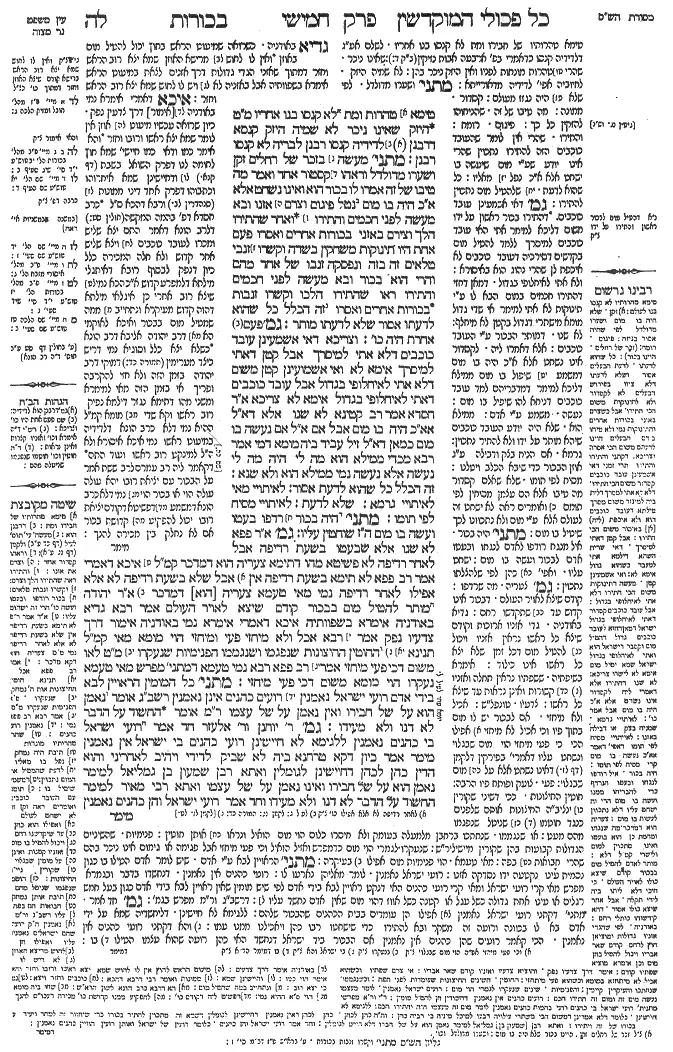
Bekhorot 35a - Guemara
טימא טהרות ומת לא קנסו בנו אחריו מ"ט היזק שאינו ניכר לא שמיה היזק קנסא דרבנן לדידיה קנסו רבנן לבריה לא קנסו רבנן:
מתני׳ מעשה בזכר של רחלים זקן ושערו מדולדל וראהו קסטור אחד ואמר מה טיבו של זה אמרו לו בכור הוא ואינו נשחט אלא א"כ היה בו מום נטל פיגום וצרם אזנו ובא מעשה לפני חכמים והתירו ואחר שהתירו הלך וצירם באזני בכורות אחרים ואסרו פעם אחת היו תינוקות משחקין בשדה וקשרו זנבי טלאים זה בזה ונפסקה זנבו של אחד מהם והרי הוא בכור ובא מעשה לפני חכמים והתירו ראו שהתירו הלכו וקשרו זנבות בכורות אחרים ואסרו זה הכלל כל שהוא לדעתו אסור שלא לדעתו מותר:
גמ׳ פעם אחרת היה כו':
וצריכא דאי אשמעינן עובד כוכבים דלא אתי למיסרך אבל קטן דאתי למיסרך אימא לא ואי אשמועינן קטן משום דלא אתי לאיחלופי בגדול אבל עובד כוכבים דאתי לאיחלופי בגדול אימא לא צריכא א"ר חסדא אמר רב קטינא לא שנו אלא דא"ל אא"כ היה בו מום אבל אם א"ל אם נעשה בו מום כמאן דא"ל זיל עביד ביה מומא דמי אמר רבא מכדי ממילא הוא מה לי היה מה לי נעשה אלא נעשה נמי ממילא הוא ולא שנא:
זה הכלל כל שהוא לדעת אסור:
לאיתויי מאי לאיתויי גרמא:
שלא לדעת:
לאיתויי מסיח לפי תומו:
מתני׳ היה בכור רדפו בעטו ועשה בו מום ה"ז שוחטין עליו:
גמ׳ א"ר פפא לא שנו אלא שבעטו בשעת רדיפה אבל לאחר רדיפה לא פשיטא מהו דתימא צעריה הוא דמדכר קמ"ל איכא דאמרי אמר רב פפא לא תימא בשעת רדיפה אין אבל שלא בשעת רדיפה לא אלא אפילו לאחר רדיפה נמי מאי טעמא צעריה דמדכר א"ר יהודה מותר להטיל מום בבכור קודם שיצא לאויר העולם אמר רבא גדיא באודניה אימרא בשפוותיה איכא דאמרי אימרא נמי באודניה אימור דרך צדעיו נפק אמר רבא אכל ולא מיחזי פעי ומיחזי הוי מומא מאי קמ"ל תנינא החוטין החיצונות שנפגמו ושנגממו הפנימיות שנעקרו מ"ט לאו משום דכי פעי מיחזי אמר רב פפא רבא נמי טעמא דמתני' מפרש מאי טעמא נעקרו הוי מומא משום דכי פעי מיחזי:
מתני׳ כל המומין הראויין לבא בידי אדם רועי ישראל נאמנין רועים כהנים אינן נאמנין רשב"ג אומר נאמן הוא על של חבירו ואין נאמן על של עצמו ר"מ אומר החשוד על הדבר לא דנו ולא מעידו:
גמ׳ ר' יוחנן ור' אלעזר חד אמר רועי ישראל בי כהנים נאמנין ללגימא לא חיישינן רועי כהנים בי ישראל אין נאמנין מימר אמר כיון דקא טרחנא ביה לא שביק לדידי ויהיב לאחריני והוא הדין כהן לכהן דחיישינן לגומלין ואתא רבן שמעון בן גמליאל למימר נאמן הוא על של חבירו ואינו נאמן על של עצמו ואתא רבי מאיר למימר החשוד על הדבר לא דנו ולא מעידו וחד אמר רועי ישראל והן כהנים נאמנין
Comments from Rashi on Masechet Bekhorot Page 35a
טימא טהרותיו של חבירו ומת לא קנסו בנו אחריו . לשלם אע"ג דלדידיה קנסו כדאמרי' בפ' ארבעה אבות נזיקין (ב"ק ד:): שאינו ניכר . שהרי טהרות מונחות לפניו ואין היזק ניכר בהן: לא שמיה היזק . לחיוביה אפי' לדידיה מדאורייתא: מתני' ושערו מדולדל . לפי שלא היה נגזז מעולם: קסדור . ממונה: מה טיבו של זה . שהניחוהו להזקין כל כך: פיגום . רומח: והתירו . שהרי אין לומר שהעובד כוכבים הזה להתירו נתכוין שהרי אינו יודע שע"י מום שיעשה בו ישחט אלא א"כ נפל מאליו: כל שהוא לדעת . שלהטיל מום נתכוין להתירו: גמ' דאי אשמעינן עובד כוכבים . דהתירו בכור ראשון על ידו משום דליכא למימר אתי האי עובד כוכבים למיסרך ללמד להטיל מום בקדשים דסירכיה דעובד כוכבים לא איכפת לן שהרי נהוג הוא באיסורא: ולא אתי לאיחלופי בגדול . דמאן דחזי דהתירו חכמים במום הבא לו ע"י תינוקות לא אתי למימר אי שדי גדול מומא מישתרי דגדול בקטן לא מיחלף: לא שנו . דמותר הבכור ע"י העובד כוכבים: אלא דאמרו ליה . לקסדור אינו נשחט אלא א"כ היה בו מום דמשמע שיפול בו מום ממילא דליכא למימר דמדבריהם למד עובד כוכבים דניחא להו שיפיל בו מום: נעשה . משמע ע"י אדם: ממילא הוא . שלא היה יודע העובד כוכבים שיהא מותר על ידו ולא להתיר נתכוין: גרמא . אם הניח בצק ודבילה ע"ג אוזן הבכור כדי שיבא הכלב ויטלנו: מסיח לפי תומו . שלא שאלם קסדור מה טיבו אלא הם עצמן מסיחין לפי תומם ואומרים ראה לא ישחט זה לעולם אלא ע"י מום ולא נתכוונו לכך שיטיל בו מום: מתני' היה בכור . איל מנגח רודפו לאדם לנגחו ובעטו אדם לבכור ועשה בו מום: ישחט עליו . ואפי' כהן לפי שלהצלתו נתכוין: גמ' צעריה . מה שרדפו: קודם שיצא לאויר העולם . דבכור אינו קדוש עד שתקדשו רחם: גדיא באודניה . גדי אזניו ארוכות וקודם שיצא כל ראשו נראין אזניו ויכול להטיל מום דכל זמן שלא יצא כל ראשו אינו כילוד: אימרא בשיפתיה . ששפתיו נראין תחלה ואזניו קשורות ואינן נראות עד שיצא כל ראשו: צדעיו . טונפל"ש: אכיל ולא מיחזי . אם לבכור יש לו מום בתוך פיו וכי אכיל לא מיחזי אפילו הכי כי פעי מיחזי הוי מום שבגלוי ונשחט עליו דאמרי' בפירקין דלקמן (בכורות דף לז.) דאינו נשחט אלא על מום שבגלוי: פעי . צועק ופותח פיו הרבה: חוטין החיצונות . ככי דשיני שקורין ינציב"ה. החיצונות אותם שלפנים כנגד חוטמו שניטל שנפגמו מהם מעט: או שנגממו . שנחתכו ברחבן מלמעלה בעומק ולא חיסרו כלום הוי מום הואיל ונראו אותן חוטין: פנימיות . שהשיניים הגדולות קבועות בהן שקורין מיישיליר"ש: שנעקרו . לגמרי הוי מום כדמפרש ואזיל הואיל וכי פעי מיחזי אבל פגימה או גימום אינו ניכר בהם שהרי חבואות בפה: מאי טעמא . הוי פנימיות מום אפילו בעיקרה: מתני' הראויין לבא ע"י אדם . שיש לומר אדם הטילו בו כגון נסמית עינו נקטעה ידו נסדקה אזנו: רועי ישראל נאמנין . לומר מאליהן נארעו לו: רועי כהנים אין נאמנין . דנחשדו בדבר. ובגמרא מפרש מאי קרי רועי ישראל ומאי קרי רועי כהנים. האי דנקט ראויין לבא בידי אדם לפי שיש מומין שאין ראויין לבא בידי אדם כגון בעל חמש רגלים או עינו אחת גדולה כשל עגל או קטנה כשל אווז דהוי מום שאין אדם נחשד עליו:
דרשב"ג ור"מ מפרש בגמ': גמ' חד אמר . מתני' דקתני רועי ישראל נאמנין אפילו הן עומדים בבית הכהנים שהבכור שלהם: ללגימא לא חיישינן . דליחשדיה שמא על ידי אדם בא לו בכוונה ורועה זה משקר ובא להתירו כדי שישחטו רבו כהן ויאכילנו ממנו עמו: והא דקתני רועי כהנים אין נאמנין הכי קאמר רועים שהן כהנים אין נאמנין אם הבכור ביד ישראל דנחשד האי כהן רועה שהוא עצמו הטילו בו: דמימר אמר . לא שביק לדידי ויהיב ליה לכהן אחרינא: וה"ה כהן לכהן . כלומר ומסברא נפקא לן דכהן רועה אינו נאמן להעיד על הבכור של כהן אחר דחיישינן לגומלין דסבר אעידנו עכשיו והוא יגמול לי כשיתן לי ישראל בכור תם ואטיל בו מום ויבא כהן זה ויעידני שמאליו נפל בו מום: על של חבירו . בין רבו בין אחר דלא נחשדו כהנים אלא על הבכור עצמו שכבר נתנו לו ישראל:
החשוד על הדבר . דהיינו כהנים שנחשדו על הבכורות: לא דנו ולא מעידו . ולקמיה פריך ר"מ היינו ת"ק: וחד אמר . מתניתין דקתני רועי ישראל נאמנין ה"ק רועי בהמות ישראל אע"פ שהן כהנים הרועין נאמנין דמה לו לשקר:
Comments from Tosafot - Bekhorot 35a
גדיא באודניה . כשרואה שמיעוט הראש בחוץ יכול להטיל מום באוזן ואין לו לחוש מרישא האוזן שמא יצא רוב הראש וחזר דמתוך שאזני הגדי גדולות דרך אזנים לצאת במיעוט הראש אימרא בשפוותיה אבל באזניה לא ויש לו לחוש שמא יצא רוב הראש וחזר: איכא דאמרי אימרא נמי באודניה [אימור] דרך צדעין נפק . כיון שרואה עכשיו מיעוט אוזן אין לומר שמא יצא ראשו ורובו וחזר והא אימר כמו ודאי כמו חיישי' שמא חוץ לחומה לנו דפרק השואל בשבת (דף קנא.) ודחיישינן שמא איחרוהו וכתבוהו דפרק אחד דיני ממונות (סנהדרין לב.) ורבא דהכא ס"ל כרב חסדא דפ' בהמה המקשה (חולין סט:) דלרב הונא דאמר התם יצא שליש ומכרו לעובד כוכבים ויצא שליש אחר קדוש ולא חלה המכירה כלל כיון דנפק לבסוף רובא דאיתגלי מילתא דלמפרע קדוש א"כ הכא נמי שיצא רוב אחרי כן איגלאי מילתא דהוה קדוש מעיקרא ונתחייב ממה שמטיל מום בבכור ואיכא לאוקמי הא דרב יהודה אליבא דרב הונא כשלא יצא כלל וסוגיא נמי דריש כיצד מערימין (תמורה כד:) דמוקי דרב יהודה בזמן הזה ולא חזי להקרבה ופריך אי בזמן הזה מאי למימרא ומשני מהו דתימא נגזר דילמא נפיק רוב ראשו וקא שדי מומא קמ"ל ההיא נמי דלא כרב הונא דלדידיה במיעוט ראשו נמי איכא איסורא ולא ה"ל למינקט רוב ראשו ועוד התם דקאמר ליה רב עמרם לרב ששת אמר על הבכור עם יציאת רובו יהא עולה עולה הוי או בכור הוי נמי דלא כרב הונא דמשמע דפשיטא דקודם יציאת רובו יכול להפקיע קדושת בכור אם לא נחלק בין מכירה להנך:
Bekhorot 35a - Mishnah translated into english
that if one rendered impure the ritually pure items of another and died before paying, the Sages did not penalize his son after his death and require him to pay for the damage. What is the reason for this? The reason is that damage that is not evident, i.e., which does not involve any visible change, is not considered damage by Torah law. There is a penalty imposed by rabbinic law, as the injured party suffered a loss, but the Sages penalized only him; the Sages did not penalize his son.
MISHNA: There was an incident involving an old ram whose hair was long and dangling, because it was a firstborn offering. And one Roman quaestor [kastor] saw it and said to its owner: What is the status [tivo] of this animal that you allowed it to grow old and you did not slaughter it? They said to him: It is a firstborn offering, and therefore it may be slaughtered only if it has a blemish. The quaestor took a dagger [pigom] and slit its ear. And the incident came before the Sages for a ruling, and they deemed its slaughter permitted. And after the Sages deemed its slaughter permitted, the quaestor went and slit the ears of other firstborn offerings, but in these cases the Sages deemed their slaughter prohibited, despite the fact that they were now blemished.
One time children were playing in the field and they tied the tails of lambs to each other, and the tail of one of them was severed, and it was a firstborn offering. And the incident came before the Sages for a ruling and they deemed its slaughter permitted. The people who saw that they deemed its slaughter permitted went and tied the tails of other firstborn offerings, and the Sages deemed their slaughter prohibited. This is the principle: With regard to any blemish that is caused intentionally, the animal’s slaughter is prohibited; if the blemish is caused unintentionally, the animal’s slaughter is permitted.
GEMARA: The mishna mentions that one time children were involved in a case in which they unintentionally blemished a firstborn offering whose subsequent slaughter the Sages deemed permitted. The Gemara notes: And although the first clause of the mishna mentions a similar occurrence, the incident involving the children is necessary. As, had the tanna taught us only the incident involving the gentile, it might have been thought that the Sages permitted the slaughter of the firstborn offering only there, as it is not a problem if the gentile will acquire the habit of causing blemishes, because that prohibition does not apply to gentiles. But with regard to a Jewish minor, it is a concern that he is likely to acquire the habit of causing blemishes in firstborn offerings, and therefore one might say that even the first, unintentional time should not be permitted.
And had the tanna taught us only the incident involving a minor, it might have been thought that the Sages deemed the firstborn offering permitted only there, since there is no concern that people will come to confuse a minor with an adult. People would not erroneously conclude that it is permitted to cause a blemish on a firstborn offering intentionally merely due to an incident involving a minor. But in the case of a gentile adult, where this is a concern that people would come to confuse him with a Jewish adult, one might say that even the first, unintentional time should not be permitted. It is therefore necessary for the mishna to teach both cases.
§ The Gemara analyzes the incident involving the Roman quaestor. Rav Ḥisda says that Rav Ketina says: They taught that the firstborn offering is permitted only in a case where the bystanders said to the quaestor: A firstborn offering may not be slaughtered unless it has a blemish, as this is referring to a blemish that develops naturally. But if they said to him that a firstborn offering may be slaughtered only if a blemish was caused to form upon it, which indicates human intervention, it is considered as though they explicitly told him: Go and cause a blemish on it, in which case the animal is prohibited.
The Gemara cites a dissenting opinion. Rava said: Now consider, both expressions in fact indicate that the blemish occurred by itself, as both statements are in the passive. Accordingly, what difference is it to me whether the bystanders used the expression: If it had a blemish, or the expression: A blemish was caused in it? Rather, the expression: Was caused, also indicates that it occurred by itself, and there is no difference between the expressions. In both instances the firstborn offering would be permitted.
The mishna teaches that this is the principle: In the case of any blemish that is caused with his intent, the animal’s slaughter is prohibited. The Gemara explains: What does this principle serve to add? It serves to add an indirect action, i.e., a blemish caused in this manner is also considered an intentional act and the animal may not be slaughtered on its account.
The Gemara further inquires: What is added by the phrase in the second part of the principle: If the blemish was caused without his intent, the animal’s slaughter is permitted? This serves to add an instance where a gentile did not inquire about the nature of the firstborn offering, but rather discovered it from one who speaks offhandedly. Although the gentile intentionally caused a blemish in the animal, since the Jew did not intentionally prompt him to cause it, the animal is permitted.
MISHNA: If one’s firstborn offering was pursuing him, and he kicked the animal and caused a blemish in it, he may slaughter the animal on account of that blemish.
GEMARA: Rav Pappa says: They taught that the firstborn offering may be slaughtered only in an instance where he kicked it at the time of its pursuit. But if the individual kicked the animal after its pursuit, it may not be slaughtered, as he intended to cause a blemish in order to render it permitted to be slaughtered. The Gemara raises a difficulty: It is obvious that it is not permitted to slaughter the animal in such a case.
The Gemara explains: Rav Pappa’s statement is necessary, lest you say that it is in fact permitted to slaughter the firstborn offering since he kicked it after its pursuit only out of anger, as he recalls his distress caused by its pursuit of him, and not in order to render the animal permitted to be slaughtered. Rav Pappa therefore teaches us that it is assumed that he kicked the animal with the express intention of causing a blemish in it, not merely out of anger, and therefore it may not be slaughtered.
There are those who say the opposite version of this discussion. Rav Pappa says: Do not say that if the individual kicked the firstborn offering at the time of the pursuit, then yes, it is permitted to slaughter it, but if he kicked it not at the time of the pursuit, it is not permitted to slaughter it. Rather, even if he kicked it after its pursuit of him, it is also permitted. What is the reason? It is assumed that he kicked it after the pursuit not with the intention of causing a blemish, but because he recalls his distress caused by its pursuit of him.
§ Rav Yehuda says: It is permitted to cause a blemish in a firstborn fetus before it emerges into the air of the world, as it obtains its sacred status only when it is born. Applying this ruling, Rava said: In the case of a kid, it is practical to cause a blemish on its ear. Since a kid’s ears are long they emerge from the birth canal prior to the head. With regard to a lamb, whose ears are short and do not appear before the head, it is practical to cause a blemish only on its lip. There are those who say that there is a different version of this statement: In the case of a lamb as well, it is practical to cause a blemish on its ear, as one can say that it emerges from the birth canal through its temples, in which case its ears are visible first.
Rava says: In a case where a firstborn has a blemish in its mouth, if, when it eats, the blemish is not visible, but when it opens its mouth wide and cries out, it is visible, this is considered a blemish, rendering the animal fit for slaughter. The Gemara asks: What is this teaching us? We learn this in the mishna (39a) with regard to blemishes that render a firstborn offering fit for slaughter: The external gums that were damaged and lacking or that were scratched, and likewise, the internal gums that were entirely extracted, are considered blemished. What is the reason that if the internal gums were extracted it is considered a blemish? Is it not because when the animal opens its mouth wide and cries out, it is visible? If so, what is the novelty of Rava’s statement?
Rav Pappa says in response: Rava is not in fact teaching a novel halakha. Rather, he is explaining the reason for the ruling of the mishna: What is the reason that if the internal gums were extracted it is considered a blemish? It is that when the animal opens its mouth wide and cries out, the blemish is visible.
MISHNA: With regard to all the blemishes that are capable of being brought about by a person, Israelite shepherds are deemed credible to testify that the blemishes were not caused intentionally. But priest-shepherds are not deemed credible, as they are the beneficiaries if the firstborn is blemished. Rabban Shimon ben Gamliel says: A priest is deemed credible to testify about the firstborn of another, but is not deemed credible to testify about the firstborn belonging to him. Rabbi Meir says: A priest who is suspect about the matter of causing a blemish may neither adjudicate nor testify in cases involving that matter, even on behalf of another.
GEMARA: Rabbi Yoḥanan and Rabbi Elazar disagree with regard to the meaning of the mishna. One of them says that the case of Israelite shepherds is where the shepherds are in the house of priests, i.e., in the employ of a priest. These shepherds are deemed credible to testify that the blemishes were not caused intentionally, as we are not concerned they are lying for a swallow [lilegima] of the firstborn that their priest employer might give them in exchange.
And the case of priest-shepherds is where the shepherds are in the house of an Israelite, i.e., in the latter’s employ. In such a case, the priest-shepherds are not deemed credible to testify that the blemishes were not caused intentionally, as the priest-shepherd can say: Since I have toiled with this firstborn offering, my Israelite employer will not forsake me and give it to another priest. The priest is assumed to be lying, as he has a motive to cause a blemish in the animal.
And the same is true in the case of a priest who testifies for the sake of another priest. Although the first priest would not derive benefit from his testimony immediately, he is nevertheless not deemed credible to testify, as we are concerned about reciprocal behavior, i.e., the other priest might later repay the favor and lie on his behalf.
And Rabban Shimon ben Gamliel comes to say that the testimony of a priest in such a case, when he testifies about the firstborn of another priest, is deemed credible, as there is no concern about reciprocal behavior. But he is not deemed credible with regard to his own firstborn. And Rabbi Meir comes to say that a priest, who is suspect about the matter of causing a blemish, may neither adjudicate nor testify in cases involving that matter, even on behalf of another. The difference between the opinion of Rabbi Meir and that of the first tanna will be discussed further on.
The Gemara cites the other explanation of the mishna: And the other one of the two amora’im says: The case of Israelite shepherds is where the shepherds are priests in the employ of an Israelite. The mishna is teaching that these shepherds are deemed credible to testify that the blemishes on their employer’s firstborn offering were not caused intentionally, as they are not suspected of lying in order to obtain its meat.
Traduction : The William Davidson digital edition of the Koren Noé Talmud, with commentary by Rabbi Adin Even-Israel Steinsaltz.