 Talmud Bavli
Bekhorot 3b : Youtube
Rabbi Dr. Moshe WeisblumYoutube
1 video class :
Bekhorot Page 3b
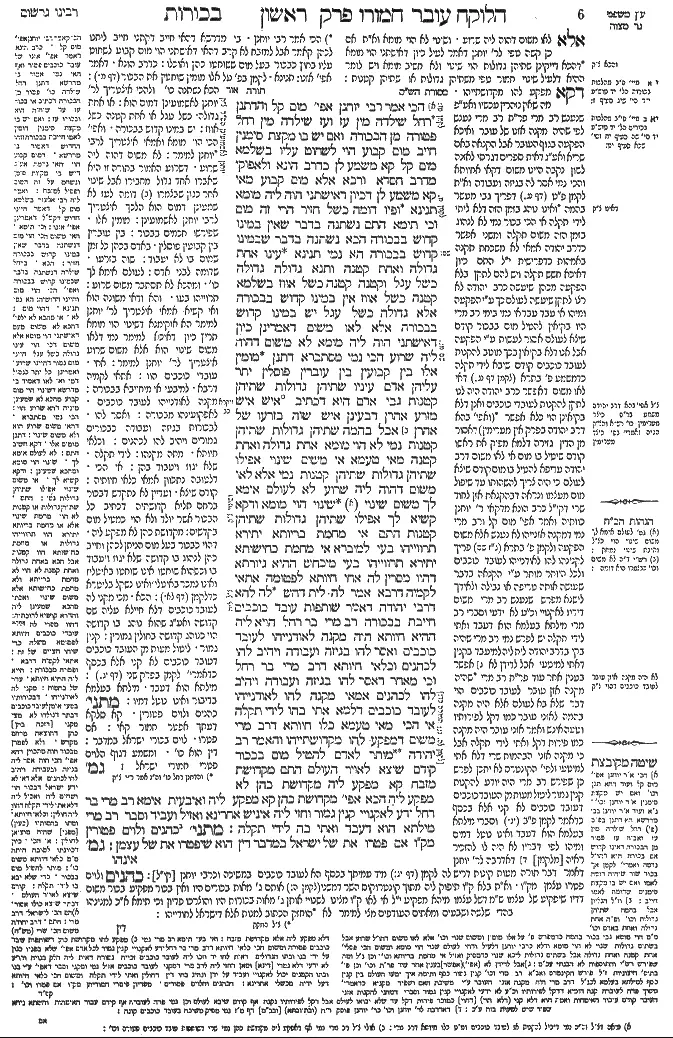
Bekhorot 3b - Guemara
הכי אמר רבי יוחנן אפי' מום קל והדתנן רחל שילדה מין עז ועז שילדה מין רחל פטורה מן הבכורה ואם יש בו מקצת סימנין חייב מום קבוע הוי לשחוט עליו בשלמא מום קל קא משמע לן כדרב הונא ולאפוקי מדרב חסדא ורבא אלא מום קבוע מאי קא משמע לן דכיון דאישתני הוה ליה מומא תנינא ופיו דומה כשל חזיר הרי זה מום וכי תימא התם נשתנה בדבר שאין במינו קדוש בבכורה הכא נשתנה בדבר שבמינו קדוש בבכורה הא נמי תנינא עינו אחת גדולה ואחת קטנה ותנא גדולה גדולה כשל עגל וקטנה קטנה כשל אווז בשלמא קטנה כשל אווז אין במינו קדוש בבכורה אלא גדולה כשל עגל יש במינו קדוש בבכורה אלא לאו משום דאמרינן כיון דאישתני הוה ליה מומא לא משום דהוה ליה שרוע הכי נמי מסתברא דתנן מומין אלו בין קבועין בין עוברין פוסלין יתר עליהן אדם עיניו שתיהן גדולות שתיהן קטנות גבי אדם הוא דכתיב (ויקרא כב, ד) איש איש מזרע אהרן דבעינן איש שוה בזרעו של אהרן אבל בהמה שתיהן גדולות שתיהן קטנות נמי לא הוי מומא אחת גדולה ואחת קטנה מאי טעמא אי משום שינוי אפילו שתיהן גדולות שתיהן קטנות נמי אלא לאו משום דהוה ליה שרוע לא לעולם אימא לך משום שינוי שינוי הוי מומא ודקא קשיא לך אפילו שתיהן גדולות שתיהן קטנות התם אי מחמת בריותא יתירא תרווייהו בעי למיברא אי מחמת כחישותא יתירא תרווייהו בעי מיכחש ההיא גיורתא דהוו מסרין לה אחי חיותא לפטומה אתאי לקמיה דרבא אמר לה לית דחש לה להא דרבי יהודה דאמר שותפות עובד כוכבים חייבת בבכורה רב מרי בר רחל הויא ליה ההיא חיותא הוה מקנה לאודנייהו לעובד כוכבים ואסר להו בגיזה ועבודה ויהיב להו לכהנים וכלאי חיותא דרב מרי בר רחל וכי מאחר דאסר להו בגיזה ועבודה ויהיב להו לכהנים אמאי מקנה להו לאודנייהו לעובד כוכבים דלמא אתי בהו לידי תקלה אי הכי מאי טעמא כלו חיותא דרב מרי משום דמפקע להו מקדושתייהו והאמר רב יהודה מותר לאדם להטיל מום בבכור קודם שיצא לאויר העולם התם מקדושת מזבח קא מפקע ליה מקדושת כהן לא מפקע ליה הכא אפי' מקדושת כהן קא מפקע ליה ואיבעית אימא רב מרי בר רחל ידע לאקנויי קנין גמור וחזי ליה איניש אחרינא ואזיל ועביד וסבר רב מרי מילתא הוא דעבד ואתי בה לידי תקלה:
מתני׳ כהנים ולוים פטורין מק"ו אם פטרו את של ישראל במדבר דין הוא שיפטרו את של עצמן:
Comments from Rashi on Masechet Bekhorot Page 3b
הכי אמר רבי יוחנן . בי מדרשא דהאי חייב דקתני חייב ליתנו לכהן קאמר אבל למזבח לא קרב דהאי דאישתני הוי מום קבוע לשחוט עליו בחוץ כבכור בעל מום ששוחטו כהן ואוכלו: אפי' מום קל . ואפי' אין לעובד כוכבים שותפות אלא באזנה שאם היה נוטל חלקו אינה לא נבלה ולא טרפה אלא מום קל בעלמא פטורה מן הבכורה: כדרב הונא . דאמר אפי' אזנו: תנינא . לקמן בפ' על אלו מומין שוחטין את הבכור (דף מ.): הכא נשתנה כו' . ולהכי איצטריך לר' יוחנן לאשמועינן דמום הוא: או אחת גדולה . כשל עגל או אחת קטנה כשל אווז: יש במינו קדוש בבכורה . ואפי' הכי הוי מומא ואמאי איצטריך לרבי יוחנן למימר: לא משום דהוה ליה שרוע . דשרוע האמור בתורה זו היא שאברו אחד גדול מחבירו אבל שינוי אחר כגון שבצמרו דומה לעז לא שמעינן דמום הוא הלכך איצטריך לרבי יוחנן לאשמועינן: מומין אלו . שפירשו חכמים בבכור: בין עוברין בין קבועין פוסלין . באדם בכהן כל זמן שמום בו לא יעבוד: שוה בזרעו . שדומה לבני אדם: לעולם אימא לך כו' . ומהכא לא תסתבר משום שרוע: תרוייהו בעו . והא ודאי משונה הוא. ואי קשיא אמאי איצטריך לר' יוחנן למימר הא אוקימנא דשינוי הוי מומא תריץ כיון דאיכא למימר נמי דלאו משום שינוי הוא אלא משום שרוע איצטריך לר' יוחנן למימר: אחי . עובדי כוכבים הוו: אתאי לקמיה דרבא . למיבעי אי מיחייבא בבכורה: מקנה לאודנייהו לעובד כוכבים . לאפקועינהו מבכורה: ואסר להו . לבכורות בגיזה ועבודה כבכורים גמורים ויהיב להו לכהנים: וכלאי חיותא . מתה מקנהו: לידי תקלה . שלא יגוז ויעבוד בהן: אי הכי . דלטובה נתכוון אמאי כלאי חיותיה: קודם שיצא . ועדיין לא נתקדש דבכור ברחם תליא קדושתיה דכתיב כל הבכור אשר יולד ולא הוי כמטיל מום בקדשים: מקדושת כהן לא מפקע ליה . דהוי כבכור בעל מום הניתן לכהן וחייב כהן לנהוג בו קדושה שלא יגוז ויעבוד בו וכשהוא שוחטו אינו שוחטו באיטליז ואינו נמכר באיטליז ואינו נשקל בליטרא כדלקמן (בכורות דף לא.): הכא . מכי מקני לה לעובד כוכבים דלא חיילא עליה שם קדושה ואע"ג שהוא נוהג בו קדושה הוי כנוהג קדושה בחולין גמורין: קנין גמור . ליטול מעות מן העובד כוכבים דעובד כוכבים לא קני אלא בכסף כדאמרי' לקמן בפרק שני (בכורות דף יג.): מילתא הוא דעבד . מילתא בעלמא בדיבור ואינו נוטל דמיו: מתני' כהנים ולוים פטורין . קא סלקא דעתך אפטר חמור קאי: אם פטרו . לוים בכורי ישראל במדבר: דין הוא כו' . ומשמע דגוף הלוים פטרי חמורי ישראל:
Comments from Tosafot - Bekhorot 3b
אלא לאו משום דהוה ליה שרוע . ושינוי לא הוי מומא וא"ת אם כן קשה טפי לר' יוחנן דאמר לעיל כיון דאישתני הוי מומא דהכא דייקינן שתיהן גדולות הוי שינוי ולא חשיב מומא ויש לומר ההיא דלעיל שינוי חמור טפי משתיהן גדולות או שתיהן קטנות: דקא מפקע להו מקדושתייהו . מה שאין נזהרין עכשיו ואע"פ שנענש רב מרי פר"ת רב מרי נענש לפי שהיה מקנה אזנו של עובר ואיכא הפקעה בגוף העובר אבל הקנאה באם שריא ואע"ג דאית ספרים דגרסי לאזנה לשון נקבה היינו משום דקאי אחיותא והכי נמי אסר לה בגיזה ועבודה וא"ת לקמן פ"ט (בכורות דף נג.) דפריך גבי מעשר בהמה ואינו נוהג בזמן הזה דלא ליתי לידי תקלה אי הכי בכור נמי לא לנהוג בזמן הזה משום תקלה ומשני אפשר כדרב יהודה אמאי לא משכחת תקנה באמהות כדפרישית י"ל התם כיון דאיכא חשש תקלה ויש להם לתקן בלא הפקעה מכהן שיעשה כרב יהודה לא רצו לתקן שיעשה לעולם כך ע"י הפקעה ומיהו אי עבד עבד אי נמי בימי רב מרי היו בקיאין להטיל מום בבכור קודם שיצא לעולם אסור לעשות ע"י הפקעה אבל אנו דלא בקיאין בכך מוטב להקנות לעובד כוכבים קודם שיבא לידי תקלה כדמשמע פ' בתרא (לקמן בכורות דף נג.) דאי לאו משום דאפשר כרב יהודה היה לנו לתקן להקנות לעובדי כוכבים ואנן דלא בקיאינן הוי כלא אפשר (ואפי' בהא דרב יהודה בפרק אין מערימין) דאסור מן הדין גזירה דלמא מפיק את ראשו קודם שיטיל בו מום אי לאו משום דרב יהודה עדיפא להטיל בו מום קודם שיצא לעולם כי היה צריך להשהותו עד שיפול מום מעצמו ונראה דבהקנאת אזן לחוד שרי דקי"ל כרב הונא מדקאי ר' יוחנן כוותיה ואמר אפי' מום קל ורב מרי נמי דמקנה אזנייהו לא נענש אלא משום הפקעה ולקמן פ' בתרא (ג"ז שם) פריך לקנינהו להו לאודנייהו לעובד כוכבים ולכל היותר מותר ע"י הקנאה בדבר שעושה אותה טריפה או נבילה ולאידך לישנא מפרש שנענש רב מרי משום דידע לאקנויי וכ"ע לא ידעי וסברי רב מרי מילתא בעלמא הוא דעבד ואתי לידי תקלה יש לפרש נמי רב מרי שהיה בקי בדרב יהודה לית ליה למיעבד בקנין דאתי למיטעי אבל לדידן לא אפשר בענין אחר עוד פר"ת רב מרי שהיה מקנה אזן עובר לעובד כוכבים הוי דבר שלא בא לעולם אלא היה מקנה בהמה לאזני עובר כמו דקל לפירותיו וטעה אינש ואמר אזני עובר היה מקנה כמו פירות דקל ואתי לידי תקלה אבל כי מקנה אזני הבהמות שרי דלא אתי למיטעי ולפי' הקונטרס לא יתכן לפרש כן שפירש רב מרי היה יודע להקנות קנין גמור ליטול מעות מן העובד כוכבים דעובד כוכבים לא קני אלא בכסף כדאמר לקמן פ"ב (בכורות יג.) וסברי מילתא בעלמא הוא דעבד ואינו נוטל דמים ומיהו לפי דבריו לא היה לו להזכיר ראיה [מלקמן] דאדרבה לר' יוחנן דאמר דבר תורה מעות קונות דריש לה לקמן (בכורות דף יג:) מיד עמיתך בכסף הא לעובד כוכבים במשיכה וכרבי יוחנן [קי"ל]: כהנים ולוים פטרו עצמן מק"ו . וא"ת בלא ק"ו תיפוק ליה מתוך קונטרוקוס השר דמשני (לקמן בכורות ה:) אותם ג' מאות בכורים היו ואין בכור מפקיע בכור משום דדיו שיפקיע של עצמו ש"מ דשל עצמו מיהא מפקיע י"ל אי לאו ק"ו מצינו לשנויי אותן ג' מאות בכורות היו והוצרכו פדיון וכי תימא א"כ למנינהו בהדי שלשה ושבעים ומאתים העודפים מצי למימר לא הוחזק הכתוב למנות אלא דישראל לחודייהו:
Bekhorot 3b - Mishnah translated into english
This is what Rabbi Yoḥanan said: Even if only a slight blemish would result from the removal of the portion of the animal owned by the gentile, the animal still does not have firstborn status. And in addition, Rabbi Yoḥanan also commented on that which we learned in a mishna (16b): A ewe that gave birth to a goat of sorts and a goat that gave birth to a ewe of sorts are exempt from the mitzva of the firstborn. And if the offspring has some of the characteristics of its mother, it is obligated, i.e., subject to the obligations of firstborn status. Rabbi Yoḥanan commented: Nevertheless, it may not be sacrificed on the altar because this is a permanent blemish. Therefore, a priest is permitted to slaughter it outside of the Temple.
The Gemara asks: Granted that Rabbi Yoḥanan’s first statement that the animal does not have firstborn status even if it has a slight blemish is necessary, as he teaches us that he holds in accordance with the opinion of Rav Huna, who said previously (2b) that even if the gentile owns only the ear of the firstborn it does not have firstborn status, and his statement is to the exclusion of the opinions of Rav Ḥisda and Rava, who said the gentile must own a portion of the fetus that would render it a carcass or a tereifa if it were removed.
But with regard to Rabbi Yoḥanan’s second statement that a goat of sorts that was born to a ewe but has some characteristics of the mother is considered to have a permanent blemish, what is it teaching us? Is it teaching that since it looks different from the normal appearance of a sheep this appearance is considered a blemish? We already learned this in the mishna (40a): Or with regard to a lamb whose mouth is similar to that of a pig, that is a blemish that enables slaughter of the firstborn.
And if you would say that there, where the animal’s mouth is similar to that of a pig, its appearance was altered into a being in whose species there is no sanctity of the firstborn, while here, where it looks like a goat, its appearance was altered into a being in whose species there is sanctity of the firstborn, and Rabbi Yoḥanan teaches that this animal too is considered to be blemished, we already learned this, too, in the subsequent mishna (40b): An animal with one of its eyes large and one small is also considered blemished.
And a tanna taught in explanation of the mishna: A large eye is referring to one as large as that of a calf, and a small eye is referring to one as small as that of a goose. Granted, in the case of an eye as small as that of a goose the reason it is considered a blemish is that there is no sanctity of the firstborn among its species, i.e., that of a bird. But in the case of an eye that is as large as that of a calf there is sanctity of a firstborn among its species. Rather, is it not considered blemished because we say that since it has changed from the appearance of a sheep it is considered a blemish? Therefore, Rabbi Yoḥanan’s statement has still not introduced any novelty.
The Gemara responds: No, an eye as large as that of a calf is considered a blemish because the animal is one that has a limb that is too large [sarua], which is listed in the Torah as one of the blemished animals (see Leviticus 22:23). The Gemara comments: This, too, stands to reason, as we learned in a mishna (43a): Concerning these blemishes that were taught with regard to an animal, whether they are permanent or transient, they also disqualify a priest from performing the Temple service. And the subsequent mishna (44a) adds: Beyond those are additional blemishes that apply exclusively to a person, i.e., a priest: If both of his eyes are large, or both of them are small.
The reason for the latter halakha is that it is with regard to a person that it is written: “Any man from the offspring of Aaron” (Leviticus 22:4), which indicates that we require a man who is equal to the seed of Aaron, i.e., he has an ordinary appearance like other priests; but with regard to an animal, if both eyes are big or both eyes are small, it is also not a blemish.
Accordingly, if one of the animal’s eyes is big or one is small, what is the reason that it is considered a blemish? If it is due to the deviation in appearance, meaning it does not look like a sheep, then even if both eyes are big or both are small it should be considered a blemish. Rather, is it not because it is an animal with a limb that is too large?
The Gemara responds: No, actually I will say to you that the reason an animal with one big eye and one small eye is considered blemished is because of its deviation, as a deviation is considered a blemish. And as for that which is difficult for you, that if it is due to an anomalous appearance then even if both are big or both are small it should be considered a blemish, there it is not considered a deviation. This is because a particularly healthy animal has large eyes, while a particularly weak animal has small eyes. Therefore, only an animal with one large eye and with one small eye is considered to be blemished, as if the large eye is due to extreme health both should have been healthy, and if the small eye is due to extreme weakness both should have been weak.
§ In connection with the dispute between Rabbi Yehuda and the Rabbis whether an animal owned in partnership with a gentile has firstborn status, the Gemara relates the following incident: There was a certain female convert whose gentile brothers would give her animals to fatten and would then divide the profits with her. She came before Rava to ask whether firstborn status applies to the firstborn of these animals. Rava said to her: There is no one who is concerned with this ruling of Rabbi Yehuda, who says an animal owned in partnership with a gentile is obligated, i.e., subject to counting its first offspring a firstborn.
The Gemara relates another incident: Rav Mari bar Raḥel had a certain flock of animals. He would transfer ownership of the ears of the firstborn fetuses to a gentile in order to exempt them from the obligations of firstborn status. But nevertheless he prohibited them from being sheared and used for labor, and gave them to the priests, halakhot that apply to a standard firstborn animal. And ultimately, the animals of Rav Mari bar Raḥel died.
The Gemara asks: But since he prohibited them from being sheared and used for labor and also gave them to the priests, why did he initially transfer ownership of their ears to the gentile, abrogating their firstborn status? The Gemara answers that he did so lest the priests come to experience a mishap with them, improperly shearing them or using them for labor. The Gemara asks: If so, what is the reason that the animals of Rav Mari died as a punishment? The Gemara answers: It was because he abrogated their sanctity by selling their ears.
The Gemara asks: But doesn’t Rav Yehuda say it is permitted for a person to inflict a blemish on a firstborn animal fetus before it emerges into the air of the world? Here, too, Rav Mari abrogated his firstborn animals’ sanctity by selling their ears before their birth. The Gemara answers: There, when one inflicts a blemish on a firstborn animal, he abrogates the animal’s sanctity of the altar, as it is no longer fit for an offering, but does not abrogate its sanctity of the priest, as it is still given to the priest. Here, by contrast, when Rav Mari sold his animals’ ears to a gentile, he abrogated even their sanctity of the priest, as the partnership exempts the animals from the obligations of firstborn status entirely.
And if you wish, say instead that the reason the animals of Rav Mari bar Raḥel died is that he himself knew that is was necessary to transfer ownership of the ears of the fetus to the gentile through a complete transaction. And another person would see him transferring ownership of the ears to a gentile and would go and do it himself but not perform a complete transaction, and would think that Rav Mari performed the same matter in abrogating its firstborn status, and would come to experience a mishap with his animal by not treating it with the sanctity of firstborn status. Due to this concern, Rav Mari should not have transferred ownership of the ears to a gentile, and consequently his animals died.
MISHNA: Priests and Levites are exempt from the obligation to redeem a firstborn donkey; this is derived from an a fortiori inference: In the wilderness the firstborn were redeemed in exchange for the Levites, as it is stated: “Take the Levites in exchange for all the firstborn among the children of Israel and the animal of the Levites in exchange for their animals” (Numbers 3:45). If the priests and Levites rendered exempt the firstborn children and donkeys of the Israelites in the wilderness from being counted firstborns, it is only logical that the priests and the Levites should render the firstborn of their own donkeys exempt from being counted firstborns.
Traduction : The William Davidson digital edition of the Koren Noé Talmud, with commentary by Rabbi Adin Even-Israel Steinsaltz.
Bekhorot 3b : Significance
Next step
Finished studying Bekhorot 3b? Carry on with the rest of the tractate.
Study Bekhorot 4aFrequently asked questions: Bekhorot 3b
Where is Bekhorot 3b in tractate Bekhorot?
Bekhorot 3b is page 4 of 119 in tractate Bekhorot (Seder Kodashim).
When is daf 3 of Bekhorot studied in Daf Yomi?
Daf Yomi covers one daf a day, both sides. Daf 3 of Bekhorot will be studied on February 22, 2034.
Is there a video class on Bekhorot 3b?
Yes, by Rabbi Dr. Moshe Weisblum. These classes were published on YouTube by their authors and are gathered on this site.
What is tractate Bekhorot about?
Masechet Bekhorot is the fourth tractate of the Seder Kodashim. The Gemara Bekhorot is the study of the laws concerning the ritual sacrifice (or slaughter) of firstborn animals. The Bekhorot tractate has 9 chapters.
Your study is also dedicated to them
- L'ilui Nishmat אליעזר בן רחל
- L'ilui Nishmat Amram ben Itshak Loubaton
- L'ilui Nishmat Chemouel Eliezer ben Batcheva