 Talmud Bavli
The learning on the whole site is dedicated : L'ilui Nishmat אסתר בת חיים
The learning on the whole site is dedicated : L'ilui Nishmat Avraham Ben Simha
The learning on the whole site is dedicated : L'ilui Nishmat Rav Chlomo Ben Jamilla
Shevu'ot 33b : Youtube
Daf TubeYoutube
2 video classes :
Shevu'ot Page 33b
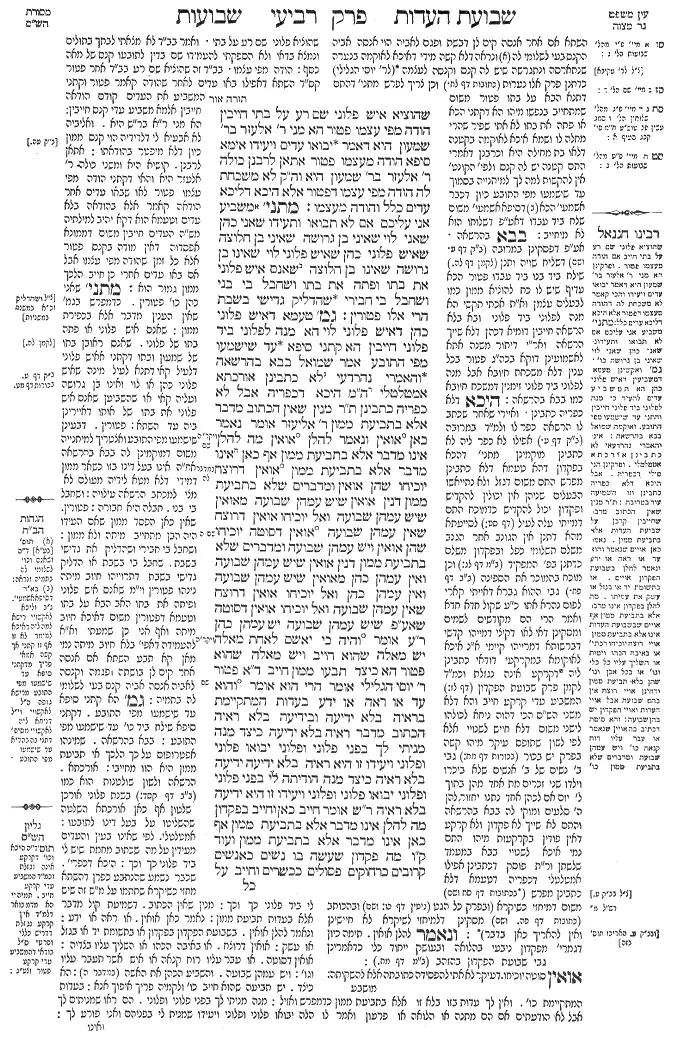
Shevu'ot 33b - Guemara
שהוציא איש פלוני שם רע על בתי חייבין הודה מפי עצמו פטור הא מני ר' אלעזר בר' שמעון היא דאמר יבואו עדים ויעידו אימא סיפא הודה מעצמו פטור אתאן לרבנן כולה ר' אלעזר בר' שמעון היא וה"ק לא משכחת לה הודה מפי עצמו דפטור אלא היכא דליכא עדים כלל והודה מעצמו:
מתני׳ משביע אני עליכם אם לא תבואו ותעידו שאני כהן שאני לוי שאיני בן גרושה שאיני בן חלוצה שאיש פלוני כהן שאיש פלוני לוי שאינו בן גרושה שאינו בן חלוצה שאנס איש פלוני את בתו ופתה את בתו ושחבל בי בני ושחבל בי חבירי שהדליק גדישי בשבת הרי אלו פטורין:
גמ׳ טעמא דאיש פלוני כהן דאיש פלוני לוי הא מנה לפלוני ביד פלוני חייבין הא קתני סיפא עד שישמעו מפי התובע אמר שמואל בבא בהרשאה והאמרי נהרדעי לא כתבינן אורכתא אמטלטלי ה"מ היכא דכפריה אבל לא כפריה כתבינן ת"ר מנין שאין הכתוב מדבר אלא בתביעת ממון ר' אליעזר אומר נאמר כאן (ויקרא ה, א) אואין ונאמר להלן (ויקרא ה, כא) אואין מה להלן אינו מדבר אלא בתביעת ממון אף כאן אינו מדבר אלא בתביעת ממון (במדבר לה, כא) אואין דרוצח יוכיחו שהן אואין ומדברים שלא בתביעת ממון דנין אואין שיש עמהן שבועה מאואין שיש עמהן שבועה ואל יוכיחו אואין דרוצח שאין עמהן שבועה (במדבר ה, יד) אואין דסוטה יוכיחו שהן אואין ויש עמהן שבועה ומדברים שלא בתביעת ממון דנין אואין שיש עמהן שבועה ואין עמהן כהן מאואין שיש עמהן שבועה ואין עמהן כהן ואל יוכיחו אואין דרוצח שאין עמהן שבועה ואל יוכיחו אואין דסוטה שאע"פ שיש עמהן שבועה יש עמהן כהן ר"ע אומר (ויקרא ה, ה) והיה כי יאשם לאחת מאלה יש מאלה שהוא חייב ויש מאלה שהוא פטור הא כיצד תבעו ממון חייב ד"א פטור ר' יוסי הגלילי אומר הרי הוא אומר (ויקרא ה, א) והוא עד או ראה או ידע בעדות המתקיימת בראיה בלא ידיעה ובידיעה בלא ראיה הכתוב מדבר ראיה בלא ידיעה כיצד מנה מניתי לך בפני פלוני ופלוני יבואו פלוני ופלוני ויעידו זו היא ראיה בלא ידיעה ידיעה בלא ראיה כיצד מנה הודיתה לי בפני פלוני ופלוני יבואו פלוני ופלוני ויעידו זו היא ידיעה בלא ראיה ר"ש אומר חייב כאן וחייב בפקדון מה להלן אינו מדבר אלא בתביעת ממון אף כאן אינו מדבר אלא בתביעת ממון ועוד ק"ו מה פקדון שעשה בו נשים כאנשים קרובים כרחוקים פסולים ככשרים וחייב על
Comments from Rashi on Masechet Shevu'ot Page 33b
שהוציא פלוני שם רע על בתי . ואמר בב"ד לא מצאתי לבתך בתולים ונמצא בדאי ולא הספקתי להעמידו שם בדין לתובעו קנס של מאה כסף: הודה מפי עצמו . בב"ד זה שהוציא שם רע בב"ד אחר פטור קס"ד השתא דאפילו באו עדים לאחר שהודה קאמר פטור וקתני המשביע את העדים קודם הודאה חייבין אלמא משביע עדי קנס חייבין: הא מני ר"א בר"ש היא . ואליביה לא אבעיא לי דלדידיה הוי קנס ממון כיון דלא מיפטר בהודאתו: אתאן לרבנן . קושיא היא ומשני כולה ר' אלעזר היא והאי דקתני הודה מפי עצמו פטור לאו שבאו עדים אחר הודאה קאמר אלא בהודאה בלא עדים וטעמא הוא דקא יהיב למילתיה מש"ה העדים חייבין משום דממונא אפסדוה דאין מודה בקנס פטור אלא כל זמן שהודה מפי עצמו אבל אם באו עדים אחרי כן חייב הלכך ממון גמור הוא: מתני' שאני כהן כו' פטורין . כדמפרש בגמ' שאין הענין מדבר אלא בכפירת ממון: שאנס איש פלוני או פתה בתו של פלוני . שאנס ראובן בתו של שמעון ובתו דקתני אאיש פלוני דלעיל קאי דתנא לעיל מינה שאיש פלוני כהן או לוי ואינו בן גרושה ועליה קאי או שהשביען שאנס איש פלוני את בתו של אותו דאיירינן ביה עד השתא: פטורין . דבעינן שישמעו מפי התובע ואצטריך למיתנייה משום דמוקמינן לה בבא בהרשאה אפ"ה אינו בעל דינו בזו כשאר ממון דמידי דלא מטא לידיה מעולם לא מצי למכתב הרשאה עילויה: ושחבל בי בני . חבלה היא חבורה: פטורין . שאין כאן הפסד ממון שאם העידו היה הבן מתחייב מיתה ולא ממון: ושחבל בי חבירי ושהדליק את גדישי בשבת . שחבל בי בשבת או הדליק גדישי בשבת דתרוייהו חיוב מיתה נינהו פטורין וי"מ שאנס איש פלוני ופיתה את בתו האב הבא על בתו וטעמא דפטורין משום דאיכא חיוב מיתה ואף אני כן שמעתי וא"א להעמידה דאפי' בלא חיוב מיתה נמי מאן קא תבע השתא אם אנסה אחר קים לן בושתה ופגמה וקנסה לאביה אנסה אביה קנס בעי לשלומי לה בתמיה: גמ' הא קתני סיפא עד שישמעו מפי התובע . דקתני סיפא שילח ביד כו' עד שישמעו מפי התובע: בבא בהרשאה . שמינהו אפטרופוס על כך הלכך אי תביעת ממון היא הוו מחייבי: אורכתא . הרשאה ולשון שולטנות הוא כמו (ב"ב דף קסד:) בשנת פלוני אורכן שלטון אף כאן אורכתא השלטה שהשליטו על בעל דינו לתובעו: אמטלטלי . לפי שאינו בעין והעדים מעידין על מה שכתוב מחמת שיש לי ביד פלוני כך וכך: היכא דכפרי' . שכבר נשמע שהנתבע כפרן דהשתא מחזי כשיקרא שחתמו על מ"ש זה שיש לי ביד פלוני כך וכך: מנין שאין הכתוב . דשמיעת קול מדבר אלא בעדות תביעת ממון: נאמר כאן אואין . או ראה או ידע: ונאמר להלן אואין . בשבועת הפקדון בפקדון או בתשומת יד או בגזל או עשק: אואין דרוצח . או באיבה הכהו או השליך עליו בצדיה: אואין דסוטה . או עבר עליו רוח קנאה או איש אשר תעבר עליו וגו': ויש עמהן שבועה . והשביע הכהן את האשה (במדבר ה): הא כיצד . יש תביעה שהוא חייב כו' ולקמיה פריך איפוך אנא: בעדות המתקיימת כו' . ואין לך עדות בזו בלא זו אלא בתביעת ממון כדמפרש ואזיל: מנה מניתי לך בפני פלוני ופלוני . הם ראו שמניתים לך אבל לא הודעתים אם הם מתנה או הלואה או פרעון ואמר לו הלה יבואו פלוני ופלוני ויעידו שמנית לי בפניהם ואני פורע לך:
Comments from Tosafot - Shevu'ot 33b
ושאנס איש פלוני או פתה את בתו. פי' בקונט' די"מ בתו של עצמו וטעמא דפטורין משום דאיכא חיוב מיתה ואי אפשר להעמידו דאפילו בלא חיוב מיתה מאן קתבע השתא אם אחר אנסה קים לן דבשת ופגם לאביה הוי אנסה אביה הקנס בעי לשלומי לה ונראה דלא קשה מידי דאיכא לאוקמה בנערה שנתארסה ונתגרשה שיש לה קנס וקנסה לעצמה (לר' יוסי הגלילי) כדתנן פרק אלו נערות (כתובות דף לח.) וכן צריך לפרש מתני' דהתם דתנא הבא על בתו פטור משום שמתחייב בנפשו מיהו הא דקתני הכא או פתה את בתו לא אתי שפיר שהרי מחלה לו ושמא איכא לאוקמה בקטנה דלאו בת מחילה היא וכרבנן דאמרי התם קטנה יש לה קנס ולפי' הקונט' אין להקשות למה לך למיתנייה בסמוך עד שישמעו מפי התובע כיון דכבר אשמעי' הכא דסיפא אשמעי' משום שלח ביד עבדו דאע"פ דשלוחו הוא לא מיחייב: בבא בהרשאה. אע"פ דפסקינן במרובה (ב"ק דף ע. ושם) דשליח שויה ותנן (לקמן שבועות דף לה.) שילח ביד בנו ביד עבדו פטור הכא עדיף שיש לו כח להוציא ממון כמו לבעלים עצמן וא"ת אכתי תקשי הא מנה לפלוני ביד פלוני ובא בלא הרשאה חייבין דומיא דכהן דלא שייך הרשאה ואר"י דיתור משנה אתא לאשמועינן דוקא בכה"ג פטור בכל ענין דלא משכחת חיובא אבל מנה לפלוני ביד פלוני זימנין דמשכח חיובא כמו בבא בהרשאה: היכא דלא כפריה כתבינן. ואיירי שאחר שכתב לו הרשאה כפר לו ולמ"ד במרובה (ב"ק דף ע.) אפילו לא כפר ליה לא כתבינן מוקמינן מתני' דהכא בפקדון דהא טעמא דלא כתבינן מפרש התם משום דגזל ולא נתייאשו הבעלים שניהן אין יכולין להקדיש ופקדון יכול להקדיש כדמוכח התם דמייתי עלה לעיל (דף סט:) לסייעתא מהא דתנן אין הגונב אחר הגנב משלם תשלומי כפל ובפקדון משלם כדתנן בפ'. המפקיד (ב"מ דף לג:) וכן מוכח בהמוכר את הספינה (ב"ב דף פח.) גבי ההוא גברא דאייתי קארי לפום נהרא אתו כ"ע שקול חדא חדא ואמר הרי הם מקודשים לשמים ומסקינן דאי לאו דקיצי דמייהו קדשי דברשותא דמרייהו קיימי א"נ איכא לאוקומא במקרקעי דודאי כתבינן ליה דקרקע אינה נגזלת וכמ"ד לקמן פרק שבועת הפקדון (שבועות דף לז:) המשביע עדי קרקע חייב והא דלא משני הש"ס הכי דהוה ניחא לכולהו לישני משום דלא חייש לשנויי אלא לפי לשון שתופס עיקר מיהו קשה בפרק יש בכור (בכורות דף מח:) גבי ב' נשים של ב' אנשים שלא ביכרו וילדו שני זכרים מת אחד מהן בתוך ל' יום אם לכהן אחד נתנו יחזור להן ה' סלעים ומוקי לה בבא בהרשאה והתם לא שייך לא פקדון ולא קרקע דאין פודין בקרקעות מיהו התם נמי איכא לשנויי בבא במעמד שלשתן ור"ת פוסק דכתבינן אפילו אמטלטלי דכפריה דטעמא דלא כתבינן מפרש (בכתובות דף סח ושם) משום דמיחזי כשיקרא (ובפרק כל הגט (גיטין דף כו: ושם) ובהכותב (כתובות דף פה. ושם) מסקינן דלמיחזי לשיקרא לא חיישינן ואין להאריך כאן בדבר): ונאמר להלן אואין. תימה כיון דגמרי' מפקדון ניבעי בהלואה ובעושק ייחוד כלי כדאמרינן גבי שבועת הפקדון בהזהב (ב"מ דף מח.): אואין סוטה יוכיחו. דעיקר לא אתי להפסידה כתובתה אלא להשקותה:
Shevu'ot 33b - Mishnah translated into english
that so-and-so slandered my daughter. In such a case, the witnesses are liable for taking a false oath of testimony. If the accused admitted on his own that he slandered the young woman, he is exempt from paying the fine. The only payment in the case of a husband who falsely accuses his bride of adultery is payment of a fine, and yet the baraita says that the witnesses are liable for taking a false oath of testimony.
The Gemara answers: In accordance with whose opinion is this baraita? It is in accordance with the opinion of Rabbi Elazar, son of Rabbi Shimon, who says: Even if the one who is liable to pay the fine admits his liability, the witnesses shall come and testify and render the one who performed the action liable to pay the fine.
The Gemara asks: Say the latter clause of the baraita: If that man admitted on his own that he slandered the young woman, he is exempt from paying the fine. Ostensibly, in this we arrive at the opinion of the Rabbis, who hold that if the one who is liable admits his liability before the witnesses testify, he is exempt from paying the fine, contrary to the opinion of Rabbi Elazar, son of Rabbi Shimon.
The Gemara explains: The baraita in its entirety is the opinion of Rabbi Elazar, son of Rabbi Shimon, and this is what the tanna is saying in the latter clause: You find a case of one who admitted liability on his own that he is exempt from paying the fine, only in a case where there are no witnesses at all and he admitted liability on his own. In a case where there are witnesses, he is liable to pay the fine on the basis of their testimony even if he admitted liability.
MISHNA: In a case where the plaintiff said to two witnesses: I administer an oath to you concerning your refusal to testify if you do not come and testify that I am a priest, or that I am a Levite, or that I am not the son of a priest and a divorced woman, or that I am not the son of a priest and a ḥalutza, or that so-and-so is a priest, or that so-and-so is a Levite, or that he is not the son of a priest and a divorced woman, or that he is not the son of a priest and a ḥalutza; in all these cases the witnesses are exempt from liability for taking a false oath of testimony, because these do not involve monetary claims.
Likewise, if the plaintiff said to them: I administer an oath to you concerning your refusal to testify if you do not come and testify that so-and-so raped his daughter, or that he seduced his daughter, or that my son injured me, or that another person wounded me on Shabbat, or that he set my stack of grain on fire on Shabbat; in all these cases these witnesses are exempt, as each case is punishable with the death penalty, and therefore they are cases that do not involve monetary payment.
GEMARA: The Gemara infers: The reason that the witnesses are exempt is that the plaintiff demanded that they testify that so-and-so is a priest or that so-and-so is a Levite, which are claims that do not involve monetary payment; but were the plaintiff to say: I administer an oath to you concerning your refusal to testify if you do not come and testify that one hundred dinars belonging to so-and-so are in the possession of another so-and-so, they would be liable. But isn’t it taught in the latter clause of the mishna (35a): The witnesses are exempt until they hear a demand to come and testify directly from the mouth of the plaintiff, and here the individual administering the oath is not the plaintiff.
Shmuel says: The reference here is to a case where the individual administering the oath comes with authorization to demand that the witnesses testify on his behalf. The Gemara asks: But didn’t the Sages of Neharde’a say: We do not write an authorization document concerning movable property? The Gemara answers: This statement that one does not write authorization for movable property applies only in a case where the respondent already denied the claim against him. But in a case where the respondent did not yet deny the claim against him, we write authorization even for movable property.
§ The Sages taught: From where is it derived that the verse with regard to an oath of testimony is speaking only about cases involving a monetary claim? Rabbi Eliezer says: Multiple instances of the term “or” are stated here, with regard to an oath of testimony: “And he hears the voice of an oath and he is a witness or he saw or he knew” (Leviticus 5:1), and multiple instances of the term “or” are stated there, with regard to an oath on a deposit: “And he deals falsely with his neighbor in a matter of deposit, or of an outstanding loan, or of robbery, or he exploited his colleague, or he found a lost item” (Leviticus 5:21–22); just as there, the verse is speaking only about cases involving a monetary claim, so too here, the verse is speaking only about cases involving a monetary claim.
The Gemara challenges: The multiple instances of the term “or” that are stated with regard to a murderer: “And if he shoved him with hatred or cast upon him any vessel without lying in wait or in enmity smote him with his hand” (Numbers 35:20–21), will prove that multiple instances of the term “or” are unrelated to limiting the application of the halakha to cases involving a monetary claim, as these are multiple instances of the term “or” in verses that are not speaking about cases involving a monetary claim.
The Gemara answers: One infers multiple instances of the term “or” with which there is an oath administered, i.e., an oath of testimony, from multiple instances of the term “or” with which there is an oath administered, i.e., an oath on a deposit, and the multiple instances of the term “or” that are stated with regard to a murderer will not prove anything to the contrary, as there is no oath in their context.
The Gemara challenges: The multiple instances of the term “or” that are stated with regard to a sota in the Torah: “Or if the spirit of jealousy came upon him…or a man upon whom a spirit of jealousy came” (Numbers 5:14, 30), will prove that multiple instances of the term are unrelated to a monetary claim, as these are multiple instances of the term “or,” and there is an oath administered by the priest to the sota in their context, and the verse is speaking about cases not involving a monetary claim.
The Gemara rejects this: One infers multiple instances of the term “or” with which there is an oath administered and with which there is no priest administering it, i.e., the case of an oath of testimony, from multiple instances of the term “or” with which there is an oath administered and with which there is no priest administering it, i.e., an oath on a deposit, and the multiple instances of the term “or” that are stated with regard to a murderer will not prove anything to the contrary, as there is no oath in their context, and the multiple instances of the term “or” that are stated with regard to a sota will not prove anything to the contrary, as even though there is an oath in their context, there is a priest administering the oath in their context. This is the source from which Rabbi Eliezer proves that liability for an oath of testimony is limited to cases involving a monetary claim.
Rabbi Akiva says that it is written with regard to an oath of testimony: “And it shall be when he will be guilty of one of these” (Leviticus 5:5). The term “of these” is a restrictive expression from which it is derived: There are some of these for which he is liable and there are some of these for which he is exempt. How so? If the plaintiff demanded testimony from the witness with regard to a monetary claim, the witness is liable for taking a false oath; if the plaintiff demanded testimony from the witness with regard to another matter, he is exempt.
Rabbi Yosei HaGelili cites a different proof and says: The verse states with regard to an oath of testimony: “And he is a witness or he saw or he knew” (Leviticus 5:1). It is with regard to testimony that is founded on sight, i.e., direct observation, without knowledge of the matter, or by means of indirect knowledge of the matter without sight that the verse is speaking.
Sight without knowledge, how so? It is a case where the creditor claims: I counted one hundred dinars for you before so-and-so and so-and-so, and the debtor responds: Let so-and-so and so-and-so come and testify. This is a case of sight without knowledge, as the witnesses do not know whether the money was counted as a loan, a deposit, or repayment of a loan.
Knowledge without sight, how so? It is a case where the creditor claims: You admitted to owing me one hundred dinars before so-and-so and so-and-so, and the debtor replied: Let so-and-so and so-and-so come and testify. This is a case of knowledge of the debt without sight of the loan taking place. Testimony based on sight without knowledge or based on knowledge without sight is possible only in cases involving a monetary claim.
Rabbi Shimon cites a different proof and says: The Torah rendered one liable if he takes a false oath here with regard to testimony, and the Torah rendered one liable if he takes a false oath with regard to a deposit; just as there, the verse is speaking of liability only in cases involving a monetary claim, so too here, the verse is speaking of liability only in cases involving a monetary claim.
And furthermore, one can infer this halakha by means of an a fortiori inference from the halakha of a deposit. If in the case of a deposit, with regard to which the Torah rendered the halakhic status of women like that of men, the halakhic status of relatives like that of non-relatives, and the halakhic status of unfit witnesses like that of those fit to testify, and he is liable for
Traduction : The William Davidson digital edition of the Koren Noé Talmud, with commentary by Rabbi Adin Even-Israel Steinsaltz.