 Talmud Bavli
The learning on the whole site is dedicated : L'ilui Nishmat Reuven ben Rivka SEBBAG
The learning on the whole site is dedicated : L'ilui Nishmat אליעזר בן רחל
The learning on the whole site is dedicated : L'ilui Nishmat Jacques Isaac Ben Amram Loubaton
Shevu'ot 23b : Youtube
Daf TubeYoutube
2 video classes :
Shevu'ot Page 23b
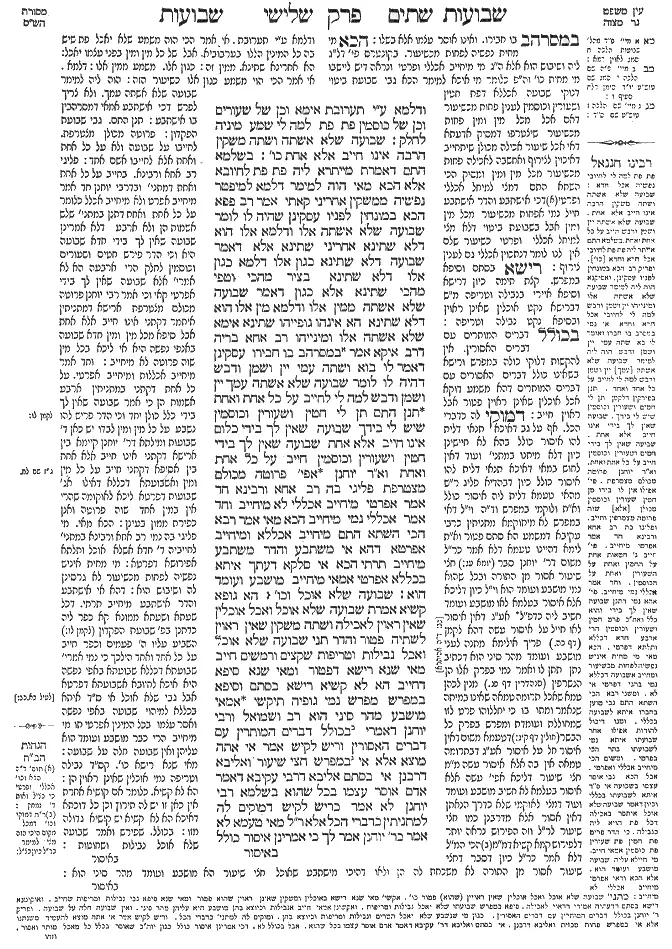
Shevu'ot 23b - Guemara
ודלמא ע"י תערובת אימא וכן של שעורים וכן של כוסמין פת פת למה לי שמע מיניה לחלק:
שבועה שלא אשתה ושתה משקין הרבה אינו חייב אלא אחת כו':
בשלמא התם דאמרת מייתרא ליה פת פת לחיובא אלא הכא מאי הוה למימר דלמא למיפטר נפשיה ממשקין אחריני קאתי אמר רב פפא הכא במונחין לפניו עסקינן שהיה לו לומר שבועה שלא אשתה אלו ודלמא אלו הוא דלא שתינא אחריני שתינא אלא דאמר שבועה דלא שתינא כגון אלו דלמא כגון אלו דלא שתינא בציר מהכי וטפי מהכי שתינא אלא כגון דאמר שבועה שלא אשתה ממין אלו ודלמא מין אלו הוא דלא שתינא הא אינהו גופייהו שתינא אימא שלא אשתה אלו ומינייהו רב אחא בריה דרב איקא אמר במסרהב בו חבירו עסקינן דאמר לו בוא ושתה עמי יין ושמן ודבש דהיה לו לומר שבועה שלא אשתה עמך יין ושמן ודבש למה לי לחייב על כל אחת ואחת תנן התם תן לי חטין ושעורין וכוסמין שיש לי בידך שבועה שאין לך בידי כלום אינו חייב אלא אחת שבועה שאין לך בידי חטין ושעורין וכוסמין חייב על כל אחת ואחת וא"ר יוחנן אפי' פרוטה מכולם מצטרפת פליגי בה רב אחא ורבינא חד אמר אפרטי מיחייב אכללי לא מיחייב וחד אמר אכללי נמי מיחייב הכא מאי אמר רבא הכי השתא התם מיחייב אכללא ומיחייב אפרטא דהא אי משתבע והדר משתבע מיחייב תרתי הכא אי סלקא דעתך איתא בכללא אפרטי אמאי מיחייב מושבע ועומד הוא:
שבועה שלא אוכל וכו':
הא גופא קשיא אמרת שבועה שלא אוכל ואכל אוכלין שאין ראוין לאכילה ושתה משקין שאין ראוין לשתיה פטור והדר תני שבועה שלא אוכל ואכל נבילות וטריפות שקצים ורמשים חייב מאי שנא רישא דפטור ומאי שנא סיפא דחייב הא לא קשיא רישא בסתם וסיפא במפרש מפרש נמי גופיה תיקשי אמאי מושבע מהר סיני הוא רב ושמואל ורבי יוחנן דאמרי בכולל דברים המותרין עם דברים האסורין וריש לקיש אמר אי אתה מוצא אלא אי במפרש חצי שיעור ואליבא דרבנן אי בסתם אליבא דרבי עקיבא דאמר אדם אוסר עצמו בכל שהוא בשלמא רבי יוחנן לא אמר כריש לקיש דמוקים לה למתניתין כדברי הכל אלא ר"ל מאי טעמא לא אמר כר' יוחנן אמר לך כי אמרינן איסור כולל
Comments from Rashi on Masechet Shevu'ot Page 23b
ודלמא ע"י תערובת . אי אמר הכי הוה משמע שלא יאכל פת שיש בה כל המינין הללו בערבוביא אבל של כל מין ומין בפני עצמו יאכל: הא אחרינא שתינא . ממין זה: כגון אלו . משמע ממין אלו: דלמא . אי אמר הכי הוי משמע כגון אלו כשיעור הזה: הוה ליה למימר שבועה שלא אשתה עמך . ולא צריך לפרש דכי אישתבע אמאי דמסרהבין בו אישתבע: תנן התם . גבי שבועת הפקדון: פרוטה מכולן מצטרפת . לחייבו על שבועה ולא על כל אחת ואחת אלא לחייבו אשם אחד: פליגי רב אחא ורבינא . בחייב על כל. אחת ואחת דמתני' ובדרבי יוחנן חד אמר מיחייב אפרט ולא מיחייב אכלל כלומר על כל אחת ואחת דתנן במתני' שלש אשמות הן ולא ארבע דלא אמרינן שבועה שאין לך בידי חדא שבועה היא וכי הדר פירש חטים ושעורים וכוסמין לחלק הרי ארבעה הא לא אמרי' אלא שבועה שאין לך בידי אפרטי קאי וכי אמר רבי יוחנן פרוטה מכולם מצטרפת ארישא דמתניתין איתמר דקתני אינו חייב אלא אחת אבל סיפא מכל מין ומין חדא שבועה באנפי נפשה היא אי ליכא בכל מין שוה פרוטה לא מיחייב: וחד אמר מיחייב אכללות ומיחייב אפרטי . על כל אחת דקתני במתניתין ארבע אשמות הן כי אמר שבועה שאין לך בידי כלל כולן יחד וכי הדר פריש להו נשבע על כל מין ומין לבדו יש כאן ד' שבועות ומילתא דר' יוחנן קיימא בין ארישא דקתני אינו חייב אלא אחת בין אסיפא דקתני חייב על כל מין ומין ואשבועתא דכללא דאילו אג' שבועות דפרטא ליכא לאוקומה שהרי אין במין אחד שוה פרוטה ואנן כפירת ממון בעינן: הכא מאי . מי פליגי בה נמי רב אחא ורבינא במתני' לחייביה ד' חדא אשלא אוכל ותלתא אפירושא דפרטא: מי מחית איניש נפשיה לפחות מכשיעור לא גרסינן לה ושיבוש הוא: דהא אי אישתבע והדר אישתבע מיחייב תרתי . דכל שעתא ושעתא ממונא קא כפר ליה כדתנן בפ' שבועת הפקדון (לקמן שבועות לו:) השביע עליו ה' פעמים וכפר חייב על כל אחד ואחד הילכך כי נמי אמרי' שבועתא דכללא שבועתא באפי נפשה היא איכא לחיובא אשבועתא דפרטא אבל גבי שלא אוכל אי ס"ד איתא בכללא למיהוי שבועה באפי נפשה ואסר עצמו בכל המינין אפרטי תו מי מיחייב הרי כבר מושבע ועומד הוא עליהן ואין שבועה חלה על שבועה: מאי שנא רישא כו' . קס"ד נבילה וטריפה נמי אוכלין שאינן ראוין הן: הא לא קשיא . כלומר אם קושיא אחרת אין כאן זו יש לה תירוץ וכן כל דוכתא דאיכא הא לא קשיא יש קושיא גדולה מזו: בכולל . שפירש ואמר שבועה שלא אוכל נבילות ושחוטות:
Comments from Tosafot - Shevu'ot 23b
במסרהב בו חבירו. ואינו אוסר עצמו אלא בשלו: הכא מי מחית נפשיה לפחות מכשיעור. בקונטרס פי' דל"ג ליה ושיבוש הוא אלא ה"ג מי מיחייב אכללי ופרטי ונראה דיש ליישבו מי מחית כו' וה"פ כלומר מי איכא למימר הכא גבי שבועת ביטוי דנוקי שבועה אכללא דפת חטין ושעורין וכוסמין לענין פחות מכשיעור דאם אכל מכל מין ומין פחות מכשיעור שיצטרפו דמסיק אדעתא דאי אכל שיעור אכילה מכולן שיתחייב דאיכוין לצירוף ואחשבה לאכילה פחות מכשיעור מכל מין ומין ומסיק הכי השתא התם דמצי למיחל אכללי ופרטי דכי אישתבע והדר אישתבע חייל נמי אפחות מכשיעור מכל מין ומין אבל בשבועת ביטוי דלא מצי למיחל אכללי ופרטי כשיעור שלם אין לנו לומר דנתכוין אכללי גם לענין צירוף: רישא בסתם וסיפא במפרש. קצת תימה כיון דרישא וסיפא איירי בנבילה וטריפה מ"ש דברישא נקט אוכלין שאינן ראוין ובסיפא נקט נבילה וטריפה: בכולל דברים המותרים עם דברים האסורין. אין להקשות דלוקי כולה במפרש ורישא בשאינו כולל דברים האסורים עם דברים המותרים דהא משמע דוקא אכל אוכלין שאינן ראוין פטור אבל ראוין חייב: דמוקי לה כדברי הכל. אף על גב דאיכא תנאי דלית להו איסור כולל בהא לא חיישינן כיון דלא מיתנו במתני' ועוד דאין לחוש במאי דאיכא תנאי דלית להו איסור כולל כיון דבהדיא פליג ר"ש מהאי טעמא דלית ליה איסור כולל וא"ת ולוקמי במפרש וד"ה וי"ל דאי במפרש לא מיתוקמא מתניתין כרבי עקיבא דמשמע הא סתם פטור וא"ת לימא דהיינו טעמא דלא אמר כר"ל משום דר' יוחנן סבר (יומא עג:) חצי שיעור אסור מן התורה ובכל שהוא נמי מושבע ועומד הוא וי"ל כיון דליכא אלא איסור בעלמא לאו מושבע ועומד חשיב ליה כדפ"ל. אע"ג דאין איסור לאו חייל על איסור עשה דהא לקמן (שבועות דף כה.) פריך אילימא מתנה לעני מושבע ועומד מהר סיני הוא דכתיב נתן תתן לו ואמר נמי בפרק אלו הן הנשרפין (סנהדרין דף פג.) מנין לכהן טמא שאכל תרומה טמאה שאינו במיתה שנאמר ומתו בו כי יחללוהו פרט לזו שמחוללת ועומדת ומפרש בפרק כל הבשר (חולין דף קיג:) דטעמא משום דאין איסור חל על איסור אע"ג דבתרומה טמאה אין בה אלא איסור עשה מ"מ חצי שיעור דליכא אפי' עשה אלא איסור בעלמא לא חשיב מושבע ועומד ועוד דמצי לאוקמי שלא כדרך הנאתן דאין אסור אלא מדרבנן כמו חצי שיעור לר"ל וזה הפירוש נראה יותר דלפירוש קמא קשיא דמ"מ הכי המ"ל דלא אמר כר"ל כיון דסבר דחצי שיעור אסור מן התורה לא משכחת לה הן ולאו דהיכי מישתבע שאוכל חצי שיעור הא מושבע ועומד מהר סיני הוא:
Shevu'ot 23b - Mishnah translated into english
The Gemara rejects this: But if he had said it that way, perhaps his oath could be interpreted to prohibit only bread made from a mixture of all these grains.
The Gemara suggests: If the specification in the mishna serves merely to ensure that his oath does not extend to other foods, have him say: Bread made from wheat and so from barley and so from spelt. Why do I need to repeat: Bread, bread, each time? Conclude from it that the point of repeating the word bread each time is to individuate each statement as a separate oath.
§ The mishna teaches: If he said: On my oath I will not drink, and then he drank several kinds of liquids, he is liable to bring only one offering. If he says: On my oath I will not drink wine, or oil, or honey, and he drank all of them, he is liable to bring an offering for each and every one. The Gemara asks: Granted, there, in the case of the bread, the ruling of the mishna is understood, as you said that the word bread before barley, and the word bread before spelt are superfluous and serve to extend his liability so that each is considered an independent oath. But here, where there is no superfluous language, what was there to say? Perhaps the oath comes to ensure that he exempts himself so that the oath does not extend to other liquids. Since that is a possibility, he should not be liable for breaking three separate oaths when he drank all three liquids.
Rav Pappa said: We are dealing here with a situation where all three liquids are placed before him. Under the circumstances, if he merely wished to indicate that his oath is limited to these liquids, he could have said: On my oath I will not drink these. Since he instead specified the liquids in the oath, it was in order to indicate that each should be considered as a separate oath. The Gemara challenges: But had he said: I will not drink these, perhaps his oath would be interpreted as meaning: It is these liquids, which are before me right now, that I will not drink, but I will drink other wine, oil, and honey.
The Gemara answers: Rather, if he merely wished to indicate that his oath is limited to these types of liquids, it would be a case where he said: On my oath I will not drink liquids such as these. The Gemara challenges: Had he said it that way, perhaps it could be interpreted as referring to the volume of the liquids: I will not drink liquids such as these, but I will drink less than this or more than this.
The Gemara answers: Rather, if he merely wished to indicate that his oath is limited to these types of liquids, it is a case where he said: On my oath I will not drink from these types of liquids. The Gemara challenges: But had he said it that way, perhaps his oath would be interpreted to mean: I will not drink these types of liquids in general, but I will drink these particular liquids in front of me.
The Gemara suggests: If the point of the specification of the liquids in the mishna was merely to ensure that his oath does not extend to other liquids, have him say: On my oath I will not drink these and liquids of their types. Since he instead specified: Wine, oil, and honey, one may conclude that his intention was to individuate each liquid as a separate oath.
Rav Aḥa, son of Rav Ika, said: We are dealing with a case in which another is importuning him to drink, as he said to him: Come, drink wine, and oil, and honey with me; if he wanted him to desist, he should have said: On my oath I will not drink with you. Under these circumstances, why do I need him to specify: Wine, and oil, and honey? The specification of the liquids serves to indicate his intention to render himself liable for each and every one.
§ We learned in a mishna elsewhere (36b) with regard to an oath concerning a deposit, that if one says to his bailee: Give me my wheat, barley, and spelt that are in your possession, and the bailee lies and says: On my oath nothing of yours is in my possession, he is liable to bring only one guilt-offering. But if the bailee says: On my oath I do not have in my possession any wheat, barley, or spelt that belong to you, he is liable to bring a separate offering for each and every one.
And Rabbi Yoḥanan says with regard to that mishna that he is liable even if the value of all three species combines to amount to as little as one peruta.
Rav Aḥa and Ravina disagree with regard to this. One said: When the bailee says: On my oath I do not have in my possession any wheat, barley, or spelt that belong to you, he is liable to bring a guilt-offering only for violating the specific oaths for individual types of grain, and he is not liable for violating a general oath that he does not have anything in his possession. Consequently, Rabbi Yoḥanan’s statement that the different types of grains can be combined to amount to one peruta is referring only to the oath in the first clause of the mishna where he did not specify the grains. And one said: He is also liable for violating a general oath, and in the latter clause of the mishna he is liable for violating four oaths: One general oath that he does not have anything in his possession and three specific oaths, one for each type of grain. Consequently, Rabbi Yoḥanan’s statement applies also to where he specifies the grains, and he is liable to bring one offering even when all three species combine to amount to only one peruta.
The Gemara asks: Here, in the case of one who takes an oath that he will not eat wheat bread, barley bread, or spelt bread, what is the halakha? Is there a dispute as to whether he is considered to have taken a general oath alongside the specific oaths?
Rava said: How can these cases be compared? There, in the case of an oath of a deposit, he is liable for the general oath and for the specific oath, since if a bailee takes an oath denying that he is in possession of a deposit and then takes another oath to the same effect, he is liable for taking two false oaths on a deposit. Here, with regard to an oath to prohibit oneself from eating, if it enters your mind that he is bound by a general oath, why would he be liable for the specific oaths? He is already under an oath due to the general oath, and an oath cannot take effect when the matter it prohibits is already forbidden by another oath.
§ The mishna teaches that if one said: On my oath I will not eat, and he ate foods that are inedible, he is exempt. If he said: On my oath I will not eat, and then he ate the meat of unslaughtered carcasses, he is liable. The Gemara asks: This mishna itself is difficult. You said that if one said: On my oath I will not eat, and he ate foods that are inedible, or drank liquids that are not potable, he is exempt. And then the mishna teaches that if one says: On my oath I will not eat, and then he ate the meat of unslaughtered carcasses or tereifot, repugnant creatures or creeping animals, he is liable. What is different about the first clause that he is exempt and what is different about the latter clause that he is liable? Non-kosher animals are also unfit to be eaten.
The Gemara answers: This is not difficult. The first clause is where he took an oath not to eat without specifying what is included in it. Presumably, his oath did not include items that are not ordinarily eaten. And the latter clause is a case where he specifies what it is he will not eat, e.g., unslaughtered carcasses, and nevertheless eats them.
The Gemara asks: You may also raise a difficulty with regard to the case where he specifies that he will not eat non-kosher items: Why? He is under oath from Mount Sinai, and an oath does not take effect to prohibit that which is already forbidden.
Rav and Shmuel and Rabbi Yoḥanan all say that this is a case where he incorporates into the oath that he will not eat some permitted items, along with the statement concerning the forbidden items. Since the oath takes effect with regard to the permitted items, it extends also to the forbidden ones.
And Reish Lakish says: You find that one is liable for eating non-kosher food as the result of an oath only if it is an oath where he specifies that it includes a half-measure, and in accordance with the opinion of the Rabbis that one is not liable for eating a half-measure unless it is specified in the oath. Since eating a half-measure is not prohibited by Torah law, the oath takes effect. Alternatively, you find that one is liable if he took the oath without specifying that the oath prohibits less than the usual measure, and in accordance with the opinion of Rabbi Akiva, who says that a person renders himself prohibited from eating any amount by taking an oath not to eat.
The Gemara asks: Granted, it is understood why Rabbi Yoḥanan did not say like Reish Lakish, as he interprets the mishna so that it is in accordance with the opinion of everyone; but what is the reason that Reish Lakish does not say like the opinion of Rabbi Yoḥanan?
The Gemara answers: Reish Lakish could say to you: When we say that a more inclusive prohibition, which adds additional aspects to the prohibition for the same individual, can take effect where there already is a prohibition in place,
Traduction : The William Davidson digital edition of the Koren Noé Talmud, with commentary by Rabbi Adin Even-Israel Steinsaltz.