 Talmud Bavli
Mo'ed Katan 28a : Youtube
Daf TubeYoutube
2 video classes :
Mo'ed Katan Page 28a
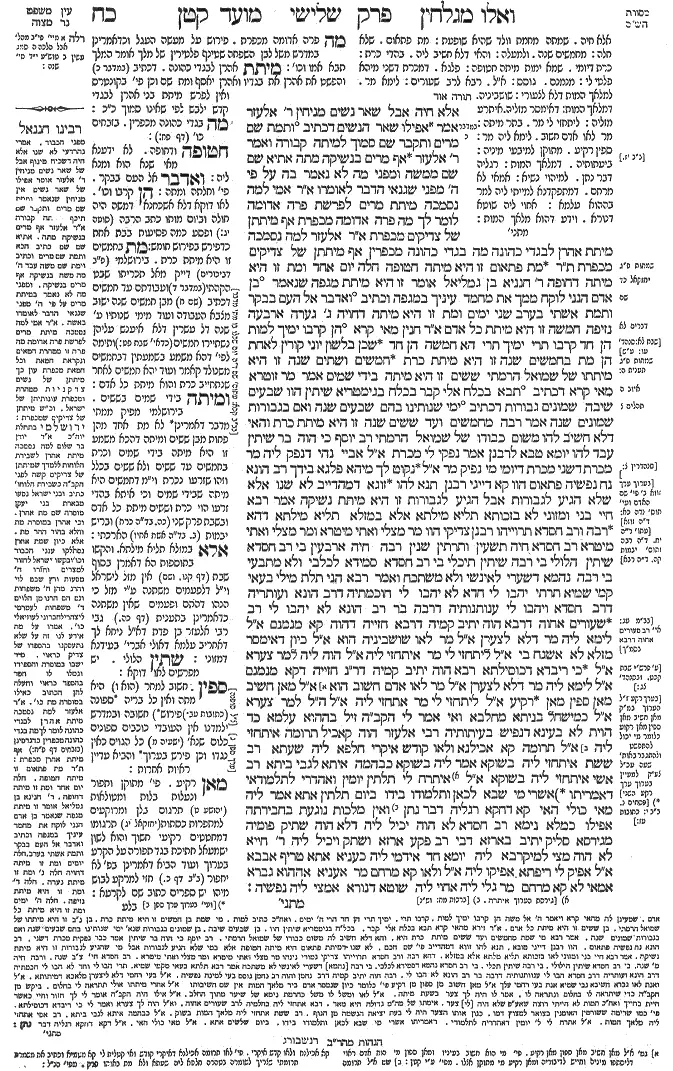
Mo'ed Katan 28a - Guemara
אלא חיה אבל שאר נשים מניחין ר' אלעזר אמר אפילו שאר הנשים דכתיב (במדבר כ, א) ותמת שם מרים ותקבר שם סמוך למיתה קבורה ואמר ר' אלעזר אף מרים בנשיקה מתה אתיא שם שם ממשה ומפני מה לא נאמר בה על פי ה' מפני שגנאי הדבר לאומרו א"ר אמי למה נסמכה מיתת מרים לפרשת פרה אדומה לומר לך מה פרה אדומה מכפרת אף מיתתן של צדיקים מכפרת א"ר אלעזר למה נסמכה מיתת אהרן לבגדי כהונה מה בגדי כהונה מכפרין אף מיתתן של צדיקים מכפרת ת"ר מת פתאום זו היא מיתה חטופה חלה יום אחד ומת זו היא מיתה דחופה ר' חנניא בן גמליאל אומר זו היא מיתת מגפה שנאמר (יחזקאל כד, טז) בן אדם הנני לוקח ממך את מחמד עיניך במגפה וכתיב (יחזקאל כד, יח) ואדבר אל העם בבקר ותמת אשתי בערב שני ימים ומת זו היא מיתה דחויה ג' גערה ארבעה נזיפה חמשה זו היא מיתת כל אדם א"ר חנין מאי קרא (דברים לא, יד) הן קרבו ימיך למות הן חד קרבו תרי ימיך תרי הא חמשה הן חד שכן בלשון יוני קורין לאחת הן מת בחמשים שנה זו היא מיתת כרת חמשים ושתים שנה זו היא מיתתו של שמואל הרמתי ששים זו היא מיתה בידי שמים אמר מר זוטרא מאי קרא דכתיב (איוב ה, כו) תבא בכלח אלי קבר בכלח בגימטריא שיתין הוו שבעים שיבה שמונים גבורות דכתיב (תהלים צ, י) ימי שנותינו בהם שבעים שנה ואם בגבורות שמונים שנה אמר רבה מחמשים ועד ששים שנה זו היא מיתת כרת והאי דלא חשיב להו משום כבודו של שמואל הרמתי רב יוסף כי הוה בר שיתין עבד להו יומא טבא לרבנן אמר נפקי לי מכרת א"ל אביי נהי דנפק ליה מר מכרת דשני מכרת דיומי מי נפיק מר א"ל נקוט לך מיהא פלגא בידך רב הונא נח נפשיה פתאום הוו קא דייגי רבנן תנא להו זוגא דמהדייב לא שנו אלא שלא הגיע לגבורות אבל הגיע לגבורות זו היא מיתת נשיקה אמר רבא חיי בני ומזוני לא בזכותא תליא מילתא אלא במזלא תליא מילתא דהא רבה ורב חסדא תרוייהו רבנן צדיקי הוו מר מצלי ואתי מיטרא ומר מצלי ואתי מיטרא רב חסדא חיה תשעין ותרתין שנין רבה חיה ארבעין בי רב חסדא שיתין הלולי בי רבה שיתין תיכלי בי רב חסדא סמידא לכלבי ולא מתבעי בי רבה נהמא דשערי לאינשי ולא משתכח ואמר רבא הני תלת מילי בעאי קמי שמיא תרתי יהבו לי חדא לא יהבו לי חוכמתיה דרב הונא ועותריה דרב חסדא ויהבו לי ענותנותיה דרבה בר רב הונא לא יהבו לי רב שעורים אחוה דרבא הוה יתיב קמיה דרבא חזייה דהוה קא מנמנם א"ל לימא ליה מר דלא לצערן א"ל מר לאו שושביניה הוא א"ל כיון דאימסר מזלא לא אשגח בי א"ל ליתחזי לי מר איתחזי ליה א"ל הוה ליה למר צערא א"ל כי ריבדא דכוסילתא רבא הוה יתיב קמיה דר"נ חזייה דקא מנמנם א"ל לימא ליה מר דלא לצערן א"ל מר לאו אדם חשוב הוא א"ל מאן חשיב מאן ספין מאן רקיע א"ל ליתחזי לי מר אתחזי ליה א"ל ה"ל למר צערא א"ל כמישחל בניתא מחלבא ואי אמר לי הקב"ה זיל בההוא עלמא כד הוית לא בעינא דנפיש בעיתותיה רבי אלעזר הוה קאכיל תרומה איתחזי ליה א"ל תרומה קא אכילנא ולאו קודש איקרי חלפא ליה שעתא רב ששת איתחזי ליה בשוקא אמר ליה בשוקא כבהמה איתא לגבי ביתא רב אשי איתחזי ליה בשוקא א"ל איתרח לי תלתין יומין ואהדרי לתלמודאי דאמריתו אשרי מי שבא לכאן ותלמודו בידו ביום תלתין אתא אמר ליה מאי כולי האי קא דחקא רגליה דבר נתן ואין מלכות נוגעת בחבירתה אפילו כמלא נימא רב חסדא לא הוה יכיל ליה דלא הוה שתיק פומיה מגירסא סליק יתיב בארזא דבי רב פקע ארזא ושתק ויכיל ליה ר' חייא לא הוה מצי למיקרבא ליה יומא חד אידמי ליה כעניא אתא טריף אבבא א"ל אפיק לי ריפתא אפיקו ליה א"ל ולאו קא מרחם מר אעניא אההוא גברא אמאי לא קא מרחם מר גלי ליה אחוי ליה שוטא דנורא אמצי ליה נפשיה:
Comments from Rashi on Masechet Mo'ed Katan Page 28a
אלא חיה . שמתה מחמת וולד שהיא שופעת: מת פתאום . שלא חלה: מחמשים שנה . ולמעלה: והאי דלא חשיב ליה . בהדי כרת: כרת דיומי . שמא ימות מיתה חטופה: פלגא . דמכרת דשני מיהא פלטי לי: מנמנם . גוסס: א"ל . רבא לרב שעורים: לימא מר . למלאך המות דלא לצעורי: שושביניה . דמלאך המות: דאימסר מזליה . איתרע מזליה: ליתחזי לי מר . בתר מיתה: מר לאו אדם חשוב . לימא ליה מר: ספין רקיע . מתוקן למיבעי מיניה: ביעתותיה. דמלאך המות: רגליה דבר נתן . למיהוי נשיא: אמאי לא מרחם . דמתפקדנא למייתי ליה למר בההוא עלמא: אחוי ליה שוטא דנורא . וידע דהוא מלאך המות:
Comments from Tosafot - Mo'ed Katan 28a
מה פרה אדומה מכפרת. פירוש על מעשה העגל וכדאמרינן במדרש משל לבן השפחה שטינף פלטירין של מלך אומר המלך תבא אמו וכו': מיתת אהרן לבגדי כהונה. דכתיב (במדבר כ) והפשט את אהרן את בגדיו ואהרן יאסף ומת שם וכן פי' בקונטרס ואין לפרש מיתת בני אהרן לבגדי קדש ילבש לפי שאינו סמוך כ"כ: מה בגדי כהונה מכפרין. בזבחים כו' (דף פח:): חטופה ודחופה. לא ידענא מאי שנא הוא ומנא ליה: ואדבר אל העם בבקר. פי' וחלתה ומתה: הן קרבו וכו'. לאו דוקא דלא אשכחנא דמשה היה חולה וביום מותו כתב הרבה (סוטה יג:) ופסע כמה פסיעות בבת אחת כדפירש בפירוש חומש: מת בחמשים זו היא מיתת כרת. בירושלמי (פ"ב דביכורים) דייק מאל תכריתו שבט הקהתי (במדבר ד) ועבודתם עד חמשים דכתיב (שם ח) מבן חמשים שנה ישוב מצבא העבודה ועוד מימי שנותיו ע' שנה דל עשרין דלא איענש עליהן נשתיירו חמשים (כדאי' שבת פט:) ותימה לפי' דהא משמע בשמעתין דבחמשים משנולד קאמר ועוד יהא חמשים לאחר שנתחייב כרת והוא מיתת כל אדם: ומיתה בידי שמים בששים. בירושלמי מפיק ממתי מדבר דאמרינן לא מת אחד מהן פחות מבן ששים ומיתה דהכא משמע זו היא מיתה בידי שמים וכרת בחמשים עד ששים ולא ששים בכלל וזהו שזרעו נכרת וי"מ דחמשים היא מיתה שבידי שמים וכי איתא בהדי זרעו הוי כרת וששים מיתת כל אדם ובשבת פרק שני (כה. בד"ה כרת) ובריש יבמות (ב. בד"ה אשת אחיו) הארכתי: אלא במזלא תליא מילתא. והקשו בתוספות הא דאמרן בסוף שבת (דף קנו. ושם) אין מזל לישראל וי"ל דלפעמים משתנה ע"י מזל כי הנהו דהתם ופעמים שאין משתנה כדאמרינן בתענית (דף כה.) גבי רבי אלעזר בן פדת דא"ל ניחא לך דאחריב עלמא דאולי אברי' בעידנא דמזוני: שתין הלולי. יש מפרשים לאו דוקא: ספין. חשוב למחר (הוא ו) היא מתה ואין כל בריה ספונה (כתובות עב.) פירוש חשובה ובמדרש ילמדנו אין העובדי כוכבים ספונים כלום שנא' (ישעיהו מ) כל הגוים כאין נגדו וכן פירש בערוך והביא עדיין ראיות אחרות: מאן רקיע. פי' מתוקן ותפור ונעלות בלות ומטולאות (יהושע ט) תרגום בלן ומרוקעים למתפרות כסתות (יחזקאל יג) תרגומו דמחטטים רקיעי חשוך והוא לשון ישמעאל חתיכת בגד תפורה על הקרע בערוך ועוד הביא דאמרינן בפ' לא יחפור (ב"ב דף כ.) חזי למרקע לבוש מיהו יש ספרים כתוב שם לקרעא:
Mo'ed Katan 28a - Mishnah translated into english
with regard to a woman who died in childbirth, and therefore continues to bleed. But the biers of other women may be set down in the street.
Rabbi Elazar said: Even the biers of other women must not be set down in the street, as it is written: “And Miriam died there and was buried there” (Numbers 20:1), which teaches that the site of her burial was close to the place of her death. Therefore, it is preferable to bury a woman as close as possible to the place where she died.
With regard to that same verse Rabbi Elazar said further: Miriam also died by the divine kiss, just like her brother Moses. What is the source for this? This is derived through a verbal analogy between the word “there” stated with regard to Miriam and the word “there” mentioned with regard to Moses. With regard to Moses it says: “So Moses the servant of the Lord died there in the land of Moab by the mouth of the Lord” (Deuteronomy 34:5). For what reason was it not explicitly stated with regard to her, as it is stated with regard to Moses, that she died “by the mouth of the Lord”? It is because it would be unseemly to say such a thing, that a woman died by way of a divine kiss, and therefore it is not said explicitly.
Rabbi Ami said: Why was the Torah portion that describes the death of Miriam juxtaposed to the portion dealing with the red heifer? To tell you: Just as the red heifer atones for sin, so too, the death of the righteous atones for sin. Rabbi Elazar said: Why was the Torah portion that describes the death of Aaron juxtaposed to the portion discussing the priestly garments? This teaches that just as the priestly garments atone for sin, so too, the death of the righteous atones for sin.
§ The Sages taught the following baraita: If one dies suddenly without having been sick, this is death through snatching. If he became sick for a day and died, this is an expedited death. Rabbi Ḥananya ben Gamliel says: This is death at a stroke, as it is stated: “Son of man, behold, I am about to take away from you the delight of your eyes at a stroke” (Ezekiel 24:16). And when this prophecy is fulfilled it is written: “So I spoke to the people in the morning and at evening my wife died” (Ezekiel 24:18).
If he was sick for two days and died, this is a quickened death. If he was sick for three days and died, this is a death of rebuke. If he died after being sick for four days, this is a death of reprimand. If one died after a sickness lasting five days, this is the ordinary death of all people.
Rabbi Ḥanin said: What is the verse from which this is derived? It is stated: “Behold, your days approach that you must die” (Deuteronomy 31:14). This verse is expounded in the following manner: “Behold [hen]” indicates one; “approach [karvu],” a plural term, indicates two; “your days [yamekha],” also a plural term, indicates another two; and therefore in total this is five. How does the word hen indicate one? Because in the Greek language they call the number one hen.
The Gemara discusses the significance of death at different ages: If one dies when he is fifty years old, this is death through karet, the divine punishment of excision, meted out for the most serious transgressions. If he dies when he is fifty-two years old, this is the death of Samuel from Ramah. If he dies at the age of sixty, this is death at the hand of Heaven.
Mar Zutra said: What is the verse from which this is derived? As it is written: “You shall come to your grave in a ripe age [bekhelaḥ]” (Job 5:26). The word “ripe age” [bekhelaḥ] has the numerical value of sixty, and it is alluded to there that dying at this age involves a divine punishment.
One who dies at the age of seventy has reached old age. One who dies at the age of eighty dies in strength, as it is written: “The days of our years are seventy, or if by reason of strength, eighty years” (Psalms 90:10). Rabba said: Not only is death at the age of fifty a sign of karet, but even death from fifty to sixty years of age is death by karet. And the reason that all of these years were not counted in connection with karet is due to the honor of Samuel from Ramah, who died at the age of fifty-two.
The Gemara relates that when Rav Yosef turned sixty he made a holiday for the Sages. Explaining the cause for his celebration, he said: I have passed the age of karet. Abaye said to him: Master, even though you have passed the karet of years, have you, Master, escaped the karet of days? As previously mentioned, sudden death is also considered to be a form of karet. He said to him: Grasp at least half in your hand, for I have at least escaped one type of karet.
It was related that Rav Huna died suddenly, and the Sages were concerned that this was a bad sign. The Sage Zuga from Hadayeiv taught them the following: They taught these principles only when the deceased had not reached the age of strength, i.e., eighty. But if he had reached the age of strength and then died suddenly, this is death by way of a divine kiss.
Rava said: Length of life, children, and sustenance do not depend on one’s merit, but rather they depend upon fate. As, Rabba and Rav Ḥisda were both pious Sages; one Sage would pray during a drought and rain would fall, and the other Sage would pray and rain would fall.
And nevertheless, their lives were very different. Rav Ḥisda lived for ninety-two years, whereas Rabba lived for only forty years. The house of Rav Ḥisda celebrated sixty wedding feasts, whereas the house of Rabba experienced sixty calamities. In other words, many fortuitous events took place in the house of Rav Ḥisda and the opposite occurred in the house of Rabba.
In the house of Rav Ḥisda there was bread from the finest flour [semida] even for the dogs, and it was not asked after, as there was so much food. In the house of Rabba, on the other hand, there was coarse barley bread even for people, and it was not found in sufficient quantities. This shows that the length of life, children, and sustenance all depend not upon one’s merit, but upon fate.
Apropos Rav Ḥisda’s great wealth, the Gemara reports that Rava said: These three things I requested from Heaven, two of which were given to me, and one was not given to me: I requested the wisdom of Rav Huna and the wealth of Rav Ḥisda and they were given to me. I also requested the humility of Rabba bar Rav Huna, but it was not given to me.
The Gemara continues its discussion of the deaths of the righteous. Rav Seorim, Rava’s brother, sat before Rava, and he saw that Rava was dozing, i.e., about to die. Rava said to his brother: Master, tell him, the Angel of Death, not to torment me. Knowing that Rava was not afraid of the Angel of Death, Rav Seorim said to him: Master, are you not a friend of the Angel of Death? Rava said to him: Since my fate has been handed over to him, and it has been decreed that I shall die, the Angel of Death no longer pays heed to me. Rav Seorim said to Rava: Master, appear to me in a dream after your death. And Rava appeared to him. Rav Seorim said to Rava: Master, did you have pain in death? He said to him: Like the prick of the knife when letting blood.
It was similarly related that Rava sat before Rav Naḥman, and he saw that Rav Naḥman was dozing, i.e., slipping into death. Rav Naḥman said to Rava: Master, tell the Angel of Death not to torment me. Rava said to him: Master, are you not an important person who is respected in Heaven? Rav Naḥman said to him: In the supernal world who is important? Who is honorable? Who is complete?
Rava said to Rav Naḥman: Master, appear to me in a dream after your death. And he appeared to him. Rava said to him: Master, did you have pain in death? Rav Naḥman said to him: Like the removal of hair from milk, which is a most gentle process. But nevertheless, were the Holy One, Blessed be He, to say to me: Go back to that world, the physical world, as you were, I would not want to go, for the fear of the Angel of Death is great. And I would not want to go through such a terrifying experience a second time.
The Gemara relates that Rabbi Elazar was once eating teruma, when the Angel of Death appeared to him. He said to the Angel of Death: I am eating teruma; is it not called sacred? It would be inappropriate for me to die now and thereby defile this sacred teruma. The Angel of Death accepted his argument and left him. The moment passed, and he lived for some time afterward.
It was similarly related that the Angel of Death once appeared to Rav Sheshet in the marketplace. Rav Sheshet said to the Angel of Death: Shall I die in the market like an animal? Come to my house and kill me there like a human being.
So too, the Angel of Death appeared to Rav Ashi in the marketplace. Rav Ashi said to the Angel of Death: Give me thirty days so that I may review my studies, for you say above: Fortunate is he who comes here to Heaven with his learning in his hand. On the thirtieth day the Angel of Death came to take him. Rav Ashi said to the Angel of Death: What is all of this? Why are you in such a hurry to take me? Why can you not postpone my death? He said to him: The foot of Rav Huna bar Natan is pushing you, as he is ready to succeed you as the leader of the generation, and one sovereignty does not overlap with its counterpart, even by one hairbreadth. Therefore, you cannot live any longer.
The Angel of Death was unable to take Rav Ḥisda because his mouth was never silent from study. So the Angel of Death went and sat on the cedar column that supported the roof of the study hall of the Sages. The cedar cracked and Rav Ḥisda was silent for a moment, as he was startled by the sound. At that point the Angel of Death was able to take him.
The Angel of Death could not come near Rabbi Ḥiyya, owing to his righteousness. One day the Angel of Death appeared to him as a poor person. He came and knocked on the door. He said to Rabbi Ḥiyya: Bring out bread for me, and he took out bread for him. The Angel of Death then said to Rabbi Ḥiyya: Master, do you not have mercy on a poor person? Why, then, do you not have mercy upon that man, i.e., upon me, and give me what I want? The Angel of Death then revealed his identity to him, and showed him a fiery rod in order to confirm that he was the Angel of Death. At this point Rav Ḥiyya surrendered himself to him.
Traduction : The William Davidson digital edition of the Koren Noé Talmud, with commentary by Rabbi Adin Even-Israel Steinsaltz.