 Talmud Bavli
The learning on the whole site is dedicated : L'ilui Nishmat Nissim ben Barukh Malka
The learning on the whole site is dedicated : L'ilui Nishmat Reuven ben Rivka SEBBAG
The learning on the whole site is dedicated : L'ilui Nishmat Yaakov ben Myriam
Mo'ed Katan 4a : Youtube
Daf TubeYoutube
3 video classes :
Mo'ed Katan Page 4a
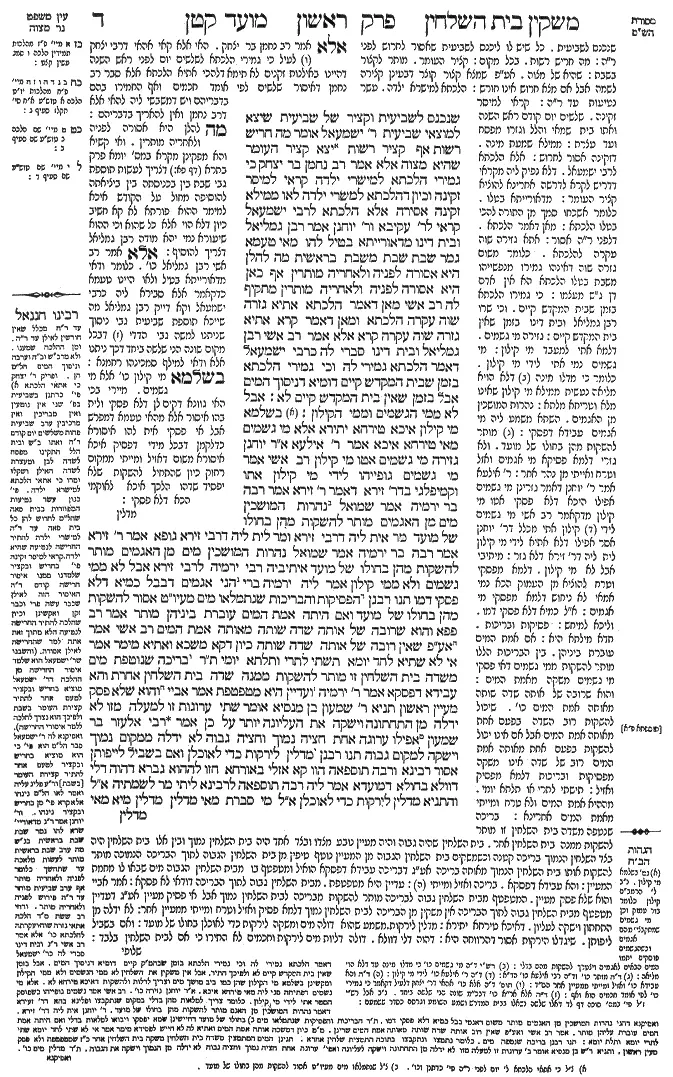
Mo'ed Katan 4a - Guemara
שנכנס לשביעית וקציר של שביעית שיצא למוצאי שביעית ר' ישמעאל אומר מה חריש רשות אף קציר רשות יצא קציר העומר שהיא מצוה אלא אמר רב נחמן בר יצחק כי גמירי הלכתא למישרי ילדה קראי למיסר זקינה וכיון דהלכתא למשרי ילדה לאו ממילא זקינה אסירה אלא הלכתא לרבי ישמעאל קראי לר' עקיבא ור' יוחנן אמר רבן גמליאל ובית דינו מדאורייתא בטיל להו מאי טעמא גמר שבת שבת משבת בראשית מה להלן היא אסורה לפניה ולאחריה מותרין אף כאן היא אסורה לפניה ולאחריה מותרין מתקיף לה רב אשי מאן דאמר הלכתא אתיא גזרה שוה עקרה הלכתא ומאן דאמר קרא אתיא גזרה שוה עקרה קרא אלא אמר רב אשי רבן גמליאל ובית דינו סברי לה כרבי ישמעאל דאמר הלכתא גמירי לה וכי גמירי הלכתא בזמן שבית המקדש קיים דומיא דניסוך המים אבל בזמן שאין בית המקדש קיים לא:
אבל לא ממי הגשמים וממי הקילון:
בשלמא מי קילון איכא טירחא יתירא אלא מי גשמים מאי טירחא איכא אמר ר' אילעא א"ר יוחנן גזירה מי גשמים אטו מי קילון רב אשי אמר מי גשמים גופייהו לידי מי קילון אתו וקמיפלגי בדר' זירא דאמר ר' זירא אמר רבה בר ירמיה אמר שמואל נהרות המושכין מים מן האגמים מותר להשקות מהן בחולו של מועד מר אית ליה דרבי זירא ומר לית ליה דרבי זירא גופא אמר ר' זירא אמר רבה בר ירמיה אמר שמואל נהרות המושכין מים מן האגמים מותר להשקות מהן בחולו של מועד איתיביה רבי ירמיה לרבי זירא אבל לא ממי גשמים ולא ממי קילון אמר ליה ירמיה ברי הני אגמים דבבל כמיא דלא פסקי דמו תנו רבנן הפסיקות והבריכות שנתמלאו מים מעיו"ט אסור להשקות מהן בחולו של מועד ואם היתה אמת המים עוברת ביניהן מותר אמר רב פפא והוא שרובה של אותה שדה שותה מאותה אמת המים רב אשי אמר אע"פ שאין רובה של אותה שדה שותה כיון דקא משכא ואתיא מימר אמר אי לא שתיא לחד יומא תשתי לתרי ותלתא יומי ת"ר בריכה שנוטפת מים משדה בית השלחין זו מותר להשקות ממנה שדה בית השלחין אחרת והא עבידא דפסקא אמר ר' ירמיה ועדיין היא מטפטפת אמר אביי והוא שלא פסק מעיין ראשון תניא ר' שמעון בן מנסיא אומר שתי ערוגות זו למעלה מזו לא ידלה מן התחתונה וישקה את העליונה יותר על כן אמר רבי אלעזר בר שמעון אפילו ערוגה אחת חציה נמוך וחציה גבוה לא ידלה ממקום נמוך וישקה למקום גבוה תנו רבנן מדלין לירקות כדי לאוכלן ואם בשביל לייפותן אסור רבינא ורבה תוספאה הוו קא אזלי באורחא חזו לההוא גברא דהוה דלי דוולא בחולא דמועדא אמר ליה רבה תוספאה לרבינא ליתי מר לשמתיה א"ל והתניא מדלין לירקות כדי לאוכלן א"ל מי סברת מאי מדלין מדלין מיא מאי
Comments from Rashi on Masechet Mo'ed Katan Page 4a
שנכנס לשביעית . כל שיש לו ליכנס לשביעית שאסור לחרוש לפני ר"ה: מה חריש רשות . בכל מקום: קציר העומר . מותר לקצור בשבת: שהיא של מצוה . אע"פ שמצא קצור קוצר דבעינן קצירה לשמה אבל אם מצא חרוש אינו חורש: הלכתא למישרא ילדה . עשר נטיעות עד ר"ה: קראי למיסר זקינה . שלשים יום קודם ראש השנה ואתו בית שמאי והלל וגזרו מפסח ועד עצרת: ממילא שמעת מינה . דזקינה אסור לחרוש: אלא הלכתא לרבי ישמעאל . דלא נפיק ליה מקראי דדריש לקרא לדרשה אחרינא להוציא קציר העומר: מדאורייתא בטלו . כלומר אשכחו סמך מן התורה להכי בטלו הלכתא: מאן דאמר הלכתא . דלפני ר"ה אסור: אתא גזירה שוה עקרה להלכתא . כלומר משום גזרה שוה דאינהו גמירו מנפשייהו משבת בטלו הלכתא הא אין אדם דן ג"ש מעצמו: כי גמירו הלכתא בזמן שבית המקדש קיים . וכי שרו רבן גמליאל ובית דינו בזמן שאין בית המקדש קיים: גזירה מי גשמים . דלמא אתי למעבד מי קילון: מי גשמים נמי אתי לידי מי קילון . כלומר כי מדלו מינה דלא הויא מליאה נעשית ממילא מי קילון שאינו מלא וטריחא מלתא: נהרות המושכין מן האגמים . השתא משמע ליה מי אגמים עבידא דפסקי: מותר להשקות מהן בחולו של מועד . ולא גזרי דלמא פסיקא מי אגמים ואזל וטרח ואייתי מן נהר אחר: ר' אילעא אמר ר' יוחנן דאמר גזרינן מי גשמים אפילו היכא דלא פסקי אטו מי קילון מדקאמר רב אשי מי גשמים לידי קילון אתי מכלל דר' יוחנן אסר אפילו דלא אתיא לידי מי קילון לית ליה דר' זירא דלא גזר: מיתיבי אבל לא מי קילון . דלמא מפסקי וטרח להוציא מן העמוק הכא נמי אמאי לא ניחוש דלמא מפסקי מי אגמים: א"ל כמיא דלא פסקי דמו . וליכא למיחש: פסיקות ובריכות . חדא מילתא היא: אם אמת המים עוברת ביניהן . בין הבריכות הללו מותר להשקות ממי גשמים דאי פסקי מי גשמים משקה מאמת המים: והוא שרובה של אותה שדה שותה מאותה אמת המים כו' . שיכול להשקות רוב השדה בפעם אחת מאותה אמת המים אבל אם אינו יכול להשקות בפעם אחת מאותה אמת המים רוב של שדה אינו משקה מפסיקות ובריכות דלמא מפסיק ואזיל: תישתי לתרי או תלתא יומי . מההיא אמת המים ולא טרח ומייתי מאמת המים אחרינא: בריכה שנטפה משדה בית השלחין זו מותר להשקות ממנה בית השלחין אחר. בית השלחין שהיה גבוה והיה מעיין נובע מצדו ובצד אחד היה בית השלחין נמוך ובין אלו בית השלחין היה בצד השלחין הנמוך בריכה קטנה וכשמשקים בית השלחין הגבוה מן המעיין נוטף טיפין מן בית השלחין הגבוה לבריכה הנמוכה מותר להשקות אותו בית השלחין הנמוך מאותה בריכה אע"ג דבריכה עבידא דפסקא הואיל ומטפטף בו מבית השלחין הגבוה מים שבאו לו מחמת המעיין: והא עבידא דפסקא . בריכה ואזיל ומייתי: עדיין היא מטפטפת . מבית השלחין גבוה לתוך הבריכה דודאי לא פסקא: אמר אביי והוא שלא פסק מעיין . המטפטף מבית השלחין גבוה לבריכה מותר להשקות מבריכה לבית השלחין נמוך אבל אי פסיק מעיין אע"ג דעדיין מטפטף מבית השלחין גבוה לתוך הבריכה אין משקין מן הבריכה לבית השלחין נמוך דלמא פסיק ואזיל וטרח ומייתי ממעיין אחר: לא ידלה מן התחתון וישקה לעליון . דאיכא טירחא יתירא: מדלין לירקות . משמע שהוא דולה מים ומשקה לירקות כדי לאוכלן בחולו של מועד: ואם בשביל ליפותן . שיגדלו הירקות אסור דהרווחה היא: דהוה דלי דוולא . דולה דליות מים לירקות וחכמים לא התירו כי אם לבית השלחין בלבד:
Comments from Tosafot - Mo'ed Katan 4a
אלא אמר רב נחמן בר יצחק. האי אלא קאי אהאי דרבי יצחק לעיל כי גמירי הלכתא לשלשים יום לפני ראש השנה דהיינו באילנות זקנים לא תימא דלהכי אתיא הלכתא אלא סבר רב נחמן דאיסור שלשים לפי אומד חכמים ואף החמירו בהם בדבריהם ויש דמשבשי ליה להאי אלא דרב נחמן ואין להאריך בדבריהם: מה להלן היא אסורה לפניה ולאחריה מותרין. ואי קשיא והא מפקינן מקרא במס' יומא פרק בתרא (דף פא:) דצריך לעשות תוספת גבי שבת בין בכניסתה בין ביציאתה להוסיפה מחול על הקודש איכא למימר ההוא פורתא לא קא חשיב כיון דלא הוי אלא כל שהוא וכי ההוא שיעורא נמי יהא מודה רבן גמליאל דצריך להוסיף: אלא אמר רב אשי רבן גמליאל כו'. כלומר ודאי מדאורייתא בטיל ולאו היינו טעמא כדקאמר אלא סבירא ליה כרבי ישמעאל וקא דייק רבן גמליאל מה שייכא תוספת שביעית גבי ניסוך שניתנו למשה גבי הדדי דבכל מקום שונה הני שלשה ביחד דכך ניתנו אלא ודאי למילף סמכינהו רחמנא: בשלמא מי קילון כו' אלא מי גשמים. מיירי בכי האי גוונא דקים לן דלא פסקי ולית בהו איסור אלא מהאי טעמא דמפרש אבל אי פסקי אית להו איסורא כדלקמן דבכל מידי דפסיק איכא איסורא משום דאזיל ומייתי ממקום רחוק כיון שהתחיל להשקות שלא יפסיד שדהו הלכך איכא לאוקמי הכא דלא פסקי:
Mo'ed Katan 4a - Mishnah translated into english
that entered into the Sabbatical Year, i.e., plowing in the sixth year that will benefit crops growing in the seventh year, and reaping the crops of the Sabbatical Year that continued into the conclusion of the Sabbatical Year, i.e., reaping seventh-year produce that continued to grow into the eighth year.
Rabbi Yishmael says that this verse is to be understood as referring to Shabbat and not to the Sabbatical Year, in accordance with the straightforward meaning of the verse. It teaches as follows: Just as only optional plowing is prohibited on Shabbat, as there is no instance where plowing fulfills a biblical mitzva, so too, only optional reaping is prohibited, to the exclusion of the reaping of the omer offering, which is a mitzva, and consequently permitted on Shabbat. Nonetheless, the first opinion cited in the baraita, that of Rabbi Akiva, holds that the prohibition against plowing on the eve of the Sabbatical Year is derived from an explicit verse.
Rather, Rav Naḥman bar Yitzḥak said: When we learned this as a halakha transmitted to Moses from Sinai, it was to permit plowing in the case of young saplings until Rosh HaShana. In contrast, the verses that were cited come to prohibit plowing in the case of mature and well-rooted trees thirty days before Rosh HaShana of the Sabbatical Year.
The Gemara asks: But since the halakha transmitted to Moses from Sinai comes to permit plowing in the case of young saplings until Rosh HaShana, does it not automatically follow that in the case of mature trees, plowing is prohibited before Rosh HaShana? Therefore, not only the allowance, but the prohibition as well was learned by tradition as a halakha transmitted to Moses from Sinai, and not from the verses.
Rather, the halakha transmitted to Moses from Sinai is the basis of the prohibition against plowing on the eve of the Sabbatical Year according to the opinion of Rabbi Yishmael, who interprets the verse as referring to Shabbat, and not to the Sabbatical Year, whereas the verses are the basis of the prohibition according to the opinion of Rabbi Akiva.
The Gemara previously cited Rabbi Yitzḥak, who explained how Rabban Gamliel’s court nullified the extension to the prohibition against plowing before the Sabbatical Year that had been enacted by Beit Shammai and Beit Hillel. The Gemara now cites another opinion, which holds that Rabban Gamliel’s court abolished the prohibition against plowing before the Sabbatical Year entirely. And Rabbi Yoḥanan said that Rabban Gamliel and his court nullified the restrictions on working the land on the eve of the Sabbatical Year based on a source written in the Torah.
What is the reason? He derives it by means of a verbal analogy between the word Shabbat stated with regard to the Sabbatical Year in the verse: “But in the seventh year shall be a sabbath of solemn rest for the land” (Leviticus 25:4), and the word Shabbat stated with regard to the weekly Shabbat, which commemorates the Shabbat of Creation. Just as there, on Shabbat itself it is prohibited to perform labor, but before and after Shabbat it is permitted, so too here, in the case of the Sabbatical Year, during the Sabbatical Year itself it is prohibited to perform labor, but before and after the Sabbatical Year it is permitted.
Rav Ashi strongly objects to this: If Rabban Gamliel and his court nullified the restrictions based on a verbal analogy, then according to the one who said that the prohibition against plowing thirty days before Rosh HaShana of the Sabbatical Year is a halakha that was transmitted to Moses from Sinai, can a verbal analogy come and uproot a halakha that was transmitted to Moses from Sinai? And similarly, according to the one who said that the prohibition against plowing is derived from a verse, can a verbal analogy come and uproot a verse?
Rather, Rav Ashi said: Rabban Gamliel and his court held in accordance with the opinion of Rabbi Yishmael, who said that they learned this prohibition as a halakha transmitted to Moses from Sinai. But they learned this halakha only with regard to the time period when the Temple is standing. This is evidenced by the fact that it is similar to the other halakha stated along with it, that of the water libation, which was part of the service in the Temple. But when the Temple is not standing this halakha does not apply, and therefore Rabban Gamliel and his court nullified the prohibition after the destruction of the Temple.
§ It was taught in the mishna: However, one may not irrigate a field on the intermediate days of a Festival with rainwater collected in a cistern or with water drawn with a shadoof. The Gemara asks: Granted, irrigating a field with water drawn with a shadoof involves excessive effort, and so it is prohibited on the intermediate days of a Festival. But what excessive effort is involved in irrigating a field with rainwater? Rainwater collects on its own and one merely has to channel it to where it is needed.
Rabbi Ile’a said that Rabbi Yoḥanan said: A rabbinic decree was enacted with regard to rainwater due to its similarity to water drawn with a shadoof. Rav Ashi said: Rainwater itself will come to be like water drawn with a shadoof. Once the level of the collected rainwater drops, it will become necessary to draw it with a bucket, a procedure involving excessive effort.
The Gemara comments: Rabbi Ile’a and Rav Ashi disagree with regard to the ruling issued by Rabbi Zeira, as Rabbi Zeira said that Rabba bar Yirmeya said that Shmuel said: With regard to streams that draw water from pools of collected water, one is permitted to irrigate his field from them on the intermediate days of a Festival, because the flow of water is steady.
One Sage, Rav Ashi, is of the opinion that the ruling is in accordance with the opinion of Rabbi Zeira, as he prohibits only irrigating with rainwater, because the supply might come to an end, but he does not prohibit watering from a source whose flow is steady. And one Sage, Rabbi Yoḥanan, is not of the opinion that the ruling is in accordance with the opinion of Rabbi Zeira, as he prohibits irrigating with rainwater due to its similarity to water drawn with a shadoof. This applies regardless of whether the level of the rainwater will drop, and therefore Rabbi Yoḥanan would prohibit using collected water even if a stream flows through it and it will not dry up.
After mentioning the statement of Rabbi Zeira in the course of the previous discussion, the Gemara examines the matter itself. Rabbi Zeira said that Rabba bar Yirmeya said that Shmuel said: With regard to streams that draw water from pools of water, one is permitted to irrigate his field from them on the intermediate days of a Festival.
Rabbi Yirmeya raised an objection to Rabbi Zeira from what is taught in the mishna: However, one may not irrigate a field on the intermediate days of a Festival with rainwater collected in cisterns or with water drawn with a shadoof. This indicates that whenever there is a concern that the water might run out, it is prohibited to irrigate from this water source. Consequently, Rabbi Yirmeya wanted to know why this concern did not exist in the case of the pools of water as well. Rabbi Zeira said to him: Yirmeya, my son, these pools in Babylonia are like water that does not stop flowing. Therefore, there is no concern that the water level in these pools might go down to such an extent that it will become necessary to draw the water with buckets.
The Sages taught in a baraita: With regard to temporary pools and regular pools that were filled with water on the eve of a Festival, it is prohibited for one to irrigate his field from them on the intermediate days of the Festival, lest they run out of water and he will come to exert himself and bring water from elsewhere. But if a water channel passes between them so that water flows from the one to the other, it is permitted.
Rav Pappa said: And this allowance applies only when the majority of that field can be irrigated from that water channel, such that most of the field can be irrigated at the same time. In this case, there is no concern that when the water runs out, he will come to exert himself and irrigate the rest of the field from another source of water. Rav Ashi said: It applies even though the majority of that field cannot be irrigated from that water channel at the same time. Since the channel continuously draws water, constantly replenishing its supply, even if it does so at a slow rate, one will say to himself that even if the entire field cannot be irrigated from that water channel on a single day, it can be irrigated from it over the course of two or three days. Accordingly, he will not find it necessary to exert himself to quickly irrigate that portion of the field that did not already receive its water.
The Sages taught in a baraita: With regard to a pool that receives drips of water from this field that requires irrigation, which itself receives water from a spring, one is permitted to irrigate from this pool another field situated below it that requires irrigation.
The Gemara asks: But isn’t the pool likely to stop flowing, which will force him to exert himself and draw water from somewhere else? Rabbi Yirmeya said: The case is where the upper field is still trickling water into the pool and does not stop. Abaye said: And this allowance applies only when the water from the first spring that irrigates the upper field has not stopped flowing. Only in that case can one rely on the water trickling from the upper field and consequently irrigating the lower field from the pool.
It is taught in a baraita that Rabbi Shimon ben Menasya says: With regard to two garden beds located one above the other, one may not draw water from the channel supplying the lower garden bed in order to irrigate the upper garden bed, due to the excessive exertion involved. Furthermore, Rabbi Elazar bar Shimon said: Even in the case of a single garden bed, half of which is lower and half of which is higher, one may not draw water from the channel supplying the lower area to irrigate the upper area, even though they are two parts of the same garden bed.
The Sages taught in a baraita: One may draw water and irrigate vegetables in order to eat them on the intermediate days of a Festival. But if he does this in order to improve their growth and to enhance their appearance it is prohibited, as he is considered to be unnecessarily exerting himself on the Festival.
The Gemara relates that Ravina and Rabba Tosefa’a were once walking along the road when they saw a certain man that was drawing water with a bucket on the intermediate days of a Festival. Rabba Tosefa’a said to Ravina: Let the Master come and excommunicate him for transgressing the words of the Sages. Ravina said to him: But isn’t it taught in a baraita: One may draw for vegetables in order to eat them, and so he has not committed a transgression. Rabba Tosefa’a said to him: Do you maintain that what is meant by one may draw [madlin] is that one may draw water in order to irrigate the vegetables? This is not so. Rather, what is meant by
Traduction : The William Davidson digital edition of the Koren Noé Talmud, with commentary by Rabbi Adin Even-Israel Steinsaltz.