 Talmud Bavli
Mo'ed Katan 3a : Youtube
Daf TubeYoutube
3 video classes :
Mo'ed Katan Page 3a
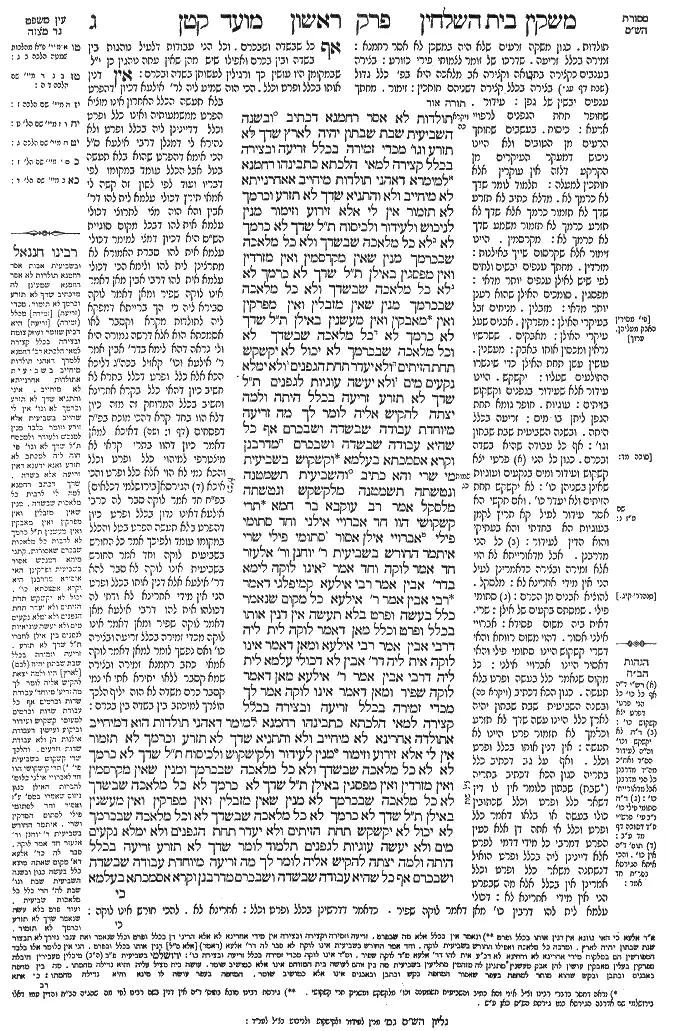
Mo'ed Katan 3a - Guemara
תולדות לא אסר רחמנא דכתיב (ויקרא כה, ד) ובשנה השביעית שבת שבתון יהיה לארץ שדך לא תזרע וגו' מכדי זמירה בכלל זריעה ובצירה בכלל קצירה למאי הלכתא כתבינהו רחמנא למימרא דאהני תולדות מיחייב אאחרנייתא לא מיחייב ולא והתניא שדך לא תזרע וכרמך לא תזמור אין לי אלא זירוע וזימור מנין לניכוש ולעידור ולכיסוח ת"ל שדך לא כרמך לא לא כל מלאכה שבשדך ולא כל מלאכה שבכרמך מנין שאין מקרסמין ואין מזרדין ואין מפסגין באילן ת"ל שדך לא כרמך לא לא כל מלאכה שבשדך ולא כל מלאכה שבכרמך מנין שאין מזבלין ואין מפרקין ואין מאבקין ואין מעשנין באילן ת"ל שדך לא כרמך לא כל מלאכה שבשדך לא וכל מלאכה שבכרמך לא יכול לא יקשקש תחת הזיתים ולא יעדר תחת הגפנים ולא ימלא נקעים מים ולא יעשה עוגיות לגפנים ת"ל שדך לא תזרע זריעה בכלל היתה ולמה יצתה להקיש אליה לומר לך מה זריעה מיוחדת עבודה שבשדה ושבכרם אף כל שהיא עבודה שבשדה ושבכרם מדרבנן וקרא אסמכתא בעלמא וקשקוש בשביעית מי שרי והא כתיב (שמות כג, יא) והשביעית תשמטנה ונטשתה תשמטנה מלקשקש ונטשתה מלסקל אמר רב עוקבא בר חמא תרי קשקושי הוו חד אברויי אילני וחד סתומי פילי אברויי אילן אסור סתומי פילי שרי איתמר החורש בשביעית ר' יוחנן ור' אלעזר חד אמר לוקה וחד אמר אינו לוקה לימא בדר' אבין אמר רבי אילעא קמיפלגי דאמר רבי אבין אמר ר' אילעא כל מקום שנאמר כלל בעשה ופרט בלא תעשה אין דנין אותו בכלל ופרט וכלל מאן דאמר לוקה לית ליה דרבי אבין אמר רבי אילעא ומאן דאמר אינו לוקה אית ליה דר' אבין לא דכולי עלמא לית ליה דרבי אבין אמר ר' אילעא מאן דאמר לוקה שפיר ומאן דאמר אינו לוקה אמר לך מכדי זמירה בכלל זריעה ובצירה בכלל קצירה למאי הלכתא כתבינהו רחמנא למימר דאהני תולדות הוא דמיחייב אתולדה אחרינא לא מיחייב ולא והתניא שדך לא תזרע וכרמך לא תזמור אין לי אלא זירוע וזימור מנין לעידור ולקישקוש ולכיסוח ת"ל שדך לא כרמך לא לא כל מלאכה שבשדך ולא כל מלאכה שבכרמך ומנין שאין מקרסמין ואין מזרדין ואין מפסגין באילן ת"ל שדך לא כרמך לא כל מלאכה שבשדך לא כל מלאכה שבכרמך לא מנין שאין מזבלין ואין מפרקין ואין מעשנין באילן ת"ל שדך לא כרמך לא כל מלאכה שבשדך לא וכל מלאכה שבכרמך לא יכול לא יקשקש תחת הזיתים ולא יעדר תחת הגפנים ולא ימלא נקעים מים ולא יעשה עוגיות לגפנים תלמוד לומר שדך לא תזרע זריעה בכלל היתה ולמה יצתה להקיש אליה לומר לך מה זריעה מיוחדת עבודה שבשדה ושבכרם אף כל שהיא עבודה שבשדה ושבכרם מדרבנן וקרא אסמכתא בעלמא
Comments from Rashi on Masechet Mo'ed Katan Page 3a
תולדות . כגון משקה זרעים שלא היה במשכן לא אסר רחמנא: זמירה בכלל זריעה . שדרכו של זומר לצמוחי פירי כזורע: בצירה בענבים כקצירה בתבואה וקצירה אב מלאכה היא בפ' כלל גדול (שבת דף עג.) בצירה בכלל קצירה דשניהן חותכין: זימור . מחתך ענפים יבשין של גפן: עידור . שחופר תחת הגפנים לרפויי ארעא: כיסוח . בעשבים שחותך הרעים מן הטובים ולא היינו ניכוש דמעקר העיקרים מן הקרקע דלזה אין עוקרין אלא חותכין למעלה: תלמוד לומר שדך לא כרמך לא . מדלא כתיב לא תזרע שדך לא תזמור כרמך אלא שדך לא תזרע כרמך לא תזמור משמע שדך לא כרמך לא: מקרסמין . היינו זימור אלא שקירסום שייך באילנות: מזרדין . מחתך ענפים יבשים ולחים לפי שיש לאילן ענפים יותר מדאי: מפסגין . סומכים האילן שהוא רענן יותר מדאי: מזבלין . מניחים זבל בעיקרי האילן: מפרקין . אבנים שעל עיקרי האילן: מאבקים . ששרשיו נראין ומכסין אותו באבק: מעשנין . עושין עשן תחת האילן כדי שינשרו התולעים שעליו: יקשקש . היינו עידור אלא שעידור בגפנים וקשקוש בזיתים: עוגיות . חופר גומא תחת הגפן ליתן בו מים: לא יקשקש תחת הזיתים ולא יעדר כו' . ואם תקשי הא אסר עידור לעיל קא תריץ לקמן בעוגיות הא בחדתי והא בעתיקי והוא הדין לעידור: זריעה בכלל היתה . ובשנה השביעית שבת שבתון וגו': אף כל עבודה שהיא בשדה ובכרם . כגון כל הני פרטי יצא קשקוש ועידור ומים בנקעים ועוגיות שאינן בשניהן כו': כל הני מדרבנן . אבל מדאורייתא לא הוי אלא זמירה ובצירה כדאמרינן לעיל הני אין מידי אחרינא לא: מלסקל . להוציא אבנים מן הכרם: סתומי פילי . שמסתם בקעים של אילן: שרי . דאית ביה משום פסידא: אברויי אילני אסור . דהוי משום רווחא והאי דשרי קשקוש היינו סתומי פילי והאי דאסיר היינו אברויי אילני: כל מקום שנאמר כלל בעשה ופרט בלא תעשה . כגון הכא דכתיב (ויקרא כה) ובשנה השביעית שבת שבתון יהיה לארץ כלל היינו עשה שדך לא תזרע וכרמך לא תזמור פרט היינו לא תעשה: אין דנין אותו בכלל ופרט וכלל . ואף על גב דכתיב כלל בתריה כגון הכא דכתיב בתריה (שבת) שבתון כלומר אין לו דין דשאר כלל ופרט וכלל שכתובין כולו בעשה או בלאו דאמר כלל ופרט וכלל אי אתה דן אלא כעין הפרט דמרבי כל מידי דדמי לפרט אלא דיינינן ליה בכלל ופרט הואיל דנשתנה משאר כלל ופרט וכלל אמרינן אין בכלל אלא מה שבפרט הני אין מידי אחרינא לא: דכולי עלמא לית להו דרבין כו' מאן דאמר לוקה שפיר . כדאמר דדרשינן בכלל ופרט וכלל: אחרינא לא . להכי חורש אינו לוקה:
Comments from Tosafot - Mo'ed Katan 3a
אף כל שבשדה ושבכרם. וכל הני עבודות דלעיל נוהגות בין בשדה ובין בכרם ואפילו שיש מהן שאין עתה נוהגין כן י"ל שבמקומן היו עושין כך ורגילין לעשותן בשדה ובכרם: אין דנין אותו בכלל ופרט וכלל. הכי הוה שמיע ליה לר' אילעא דכיון דהפרט בלא תעשה הכלל האחרון אינו מוציא הפרט ממשמעותיה ואינו כלל ופרט וכלל דדיינינן ליה בכלל ופרט ולא נהירא לי דמנלן דרבי אילעא ס"ל הכי אימא דהפרט שהוא בלא תעשה בטל אבל הכלל עומד במקומו לפי דבריו ועוד לפי לשון זה קשה לי אמאי תירץ דכולי עלמא לית להו דר' אבין והא הוה מצי לתרוצי דכולי עלמא אית להו. דבכל מקום סוגיית הש"ס היא דכיון דמצי למימר דכולי עלמא אית להו סברת האמורא לא מתרצינן לית להו ולימא הכי דכולי עלמא אית להו דרבי אבין מאן דאמר אינו לוקה שפיר ומאן דאמר לוקה סבירא ליה כי הך ברייתא דמפקא ליה לתולדות מקרא וקסבר לאו אסמכתא הוא אלא דרשה גמורה היא ולי נראה דהא לימא בדר' אבין אמר ר' אילעא וכו' קאזיל בכה"ג דליכא הכא אלא כלל ופרט דכלל בתרא לא חשיב כיון דהאי כלל בקרא אחרינא וחשיב בכלל המרוחק זה מזה כיון דלא הוו בחד קרא דהכי מוכח בפ"ק דפסחים (דף ו: ושם) דאיכא למאן דאמר כיון דהוו בתרי קראי לא מיצטרפי למיהוי כלל ופרט וכלל והכא נמי לא הוי אלא כלל ופרט והכי איכא הגירסא [בירושלמי דכלאים] בפ"ח חד אמר לוקה סבר לה כרבי אילעא דאינו נדון בכלל ופרט כיון דהפרט בלא תעשה הפרט בטל והכלל במקומו עומד ולפיכך אמר כל החורש בשביעית לוקה וחד אמר החורש בשביעית אינו לוקה לא סבר להא דר' אילעא אלא דנין אותו בכלל ופרט הני אין מידי אחרינא לא ודחי לה דכולהו אית להו דרבי אילעא מאן דאמר לוקה שפיר ומאן דאמר אינו לוקה מכדי זמירה בכלל זריעה ובצירה כו' ואם נפשך לומר למאן דאמר לוקה אמאי כתב רחמנא זמירה ובצירה שמא קסבר ללאו יתירא אתי אי נמי קסבר כרם משדה לא הוה יליף הלכך הוצרך למיכתב בין בשדה בין בכרם:
Mo'ed Katan 3a - Mishnah translated into english
whereas the subcategories of labor that are derived from them, e.g., watering, were not prohibited by the Merciful One, i.e., by Torah law, but only by rabbinic law; and in a case of loss the Sages were lenient. The source for this distinction is as it is written: “But in the seventh year shall be a sabbath of solemn rest for the land, a sabbath for the Lord: Your field you shall not sow, and your vineyard you shall not prune. That which grows of its own accord of your harvest you shall not reap, nor gather the grapes of your undressed vines” (Leviticus 25:4–5).
Since pruning is included in the principal category of sowing, as its objective is to encourage the plant’s growth, and picking grapes is included in the principal category of reaping grain, as both involve removal of produce from a plant, for the purpose of teaching what halakha did the Merciful One write them? Why did the Torah explicitly prohibit pruning and picking grapes, rather than sufficing with the general prohibitions against sowing and reaping?
The Gemara answers that these were individually enumerated to say that only for these subcategories of labor is one liable to be flogged, while for other subcategories of labor, i.e., watering a field, one is not liable. Consequently, there are only four types of labor that are prohibited by Torah law during the Sabbatical Year: Sowing and its subcategory of pruning, as well as reaping and its subcategory of grape picking. All other subcategories of labor are prohibited only by rabbinic decree.
The Gemara asks: And is there really no liability for other subcategories of labor? Isn’t it taught in a baraita: “Your field you shall not sow, and your vineyard you shall not prune” (Leviticus 25:4). I have derived from here an explicit prohibition only against sowing and pruning. From where do I derive that weeding, i.e., uprooting weeds, hoeing, and cutting weeds, even without uprooting them, are also prohibited? The verse states: “Your field you shall not sow” and “your vineyard you shall not prune.” This wording indicates that no labor may be performed in your field, and no labor may be performed in your vineyard.
Similarly, from where is it derived that one may not prune trees, and one may not trim dry branches from trees, and one may not cut large branches [mefasegin] from trees? The verse states: “Your field you shall not sow” and “your vineyard you shall not prune,” thereby teaching that no labor may be performed in your field, and no labor may be performed in your vineyard.
Similarly, from where is it derived that one may not fertilize fields and vineyards, and one may not remove stones that surround the base of a tree and impede its growth, and one may not cover exposed roots with dust, and one may not fumigate a tree in order to exterminate worms? The verse states: “Your field you shall not sow” and “your vineyard you shall not prune,” thereby indicating that no labor may be performed in your field, and no labor may be performed in your vineyard.
The apparent conclusion from this is that all labor in a field or a vineyard is prohibited. One might have thought that one may also not hoe lightly under olive trees and one may not hoe under grapevines, and one may not fill cracks in the ground with water, and one may not construct circular ditches around the bases of grapevines in order to collect rainwater. Therefore, the verse states: “Your field you shall not sow.”
The Gemara explains the derivation: Sowing was included in the general prohibition against performing agricultural labors during the Sabbatical Year, as the verse states “But in the seventh year shall be a sabbath of solemn rest for the land” (Leviticus 25:4). Why was sowing singled out and mentioned explicitly? In order to compare other types of labor to it and to say to you: Just as sowing is unique in that it is labor performed both in the field and in the vineyard, so too, any other labor performed both in the field and in the vineyard is prohibited. However, labors performed only in the vineyard but not in the field, i.e., whose objective is merely to sustain the vines from year to year, such as the labors mentioned above, are permitted. In any case, this baraita indicates that many subcategories of labor are prohibited during the seventh year, and not just sowing and pruning, as Rava had stated.
The Gemara rejects this opinion: These labors, with the exceptions of sowing, pruning, grape picking, and reaping, are all prohibited only by rabbinic law, and the verse that is cited as a source from the Torah is a mere support, and not a bona fide source.
Incidental to this discussion, the Gemara asks: Is light hoeing under olive trees in fact permitted during the Sabbatical Year? Isn’t it written: “But the seventh year you shall let it rest and lie fallow” (Exodus 23:11), and it is taught with regard to this verse: “You shall let it rest” from light hoeing, “and lie fallow” from clearing the field of stones. This indicates that light hoeing is indeed prohibited during the Sabbatical Year.
Rav Ukva bar Ḥama said: There are two types of light hoeing, one whose objective is to strengthen the trees, and another that is intended to seal cracks. There is a practical halakhic difference between them: Hoeing performed in order to strengthen the tree is prohibited, as it is similar to plowing in that it enhances the tree’s growth. However, hoeing undertaken in order to seal cracks is permitted, as by doing so one prevents damage to the tree.
§ It was stated that Rabbi Yoḥanan and Rabbi Elazar disagreed with regard to one who plows during the Sabbatical Year. One said: He is flogged for doing so, while the other one said: He is not flogged. The Gemara suggests: Let us say that they disagree with regard to the principle that Rabbi Avin said that Rabbi Ile’a said, and one accepts this principle while the other does not. As, Rabbi Avin said that Rabbi Ile’a said: Wherever a generalization is stated in the Torah as a positive mitzva, and a detail relating to that generalization is stated as a negative mitzva, one does not apply the hermeneutical principle of a generalization, and a detail, and a generalization, according to which the halakha under discussion is expanded to all cases that resemble the detail.
The Gemara explains: The one who said that one who plows during the Sabbatical Year is flogged does not accept the principle that Rabbi Avin said that Rabbi Ile’a said. Accordingly, he expounds the verses as follows: The verse “But in the seventh year shall be a sabbath of solemn rest for the land” (Leviticus 25:4) is a generalization stated as a positive mitzva. The continuation of the verse is “Your field you shall not sow,” which is a detail stated as a negative mitzva. This is followed by another generalization: “For it shall be a year of rest for the land” (Leviticus 25:5). By applying the principle of a generalization, a detail, and a generalization, one can derive that there is a prohibition against performing any agricultural task that is similar to sowing, including plowing.
And the one who said that one is not flogged for plowing holds in accordance with the ruling that Rabbi Avin stated in the name of Rabbi Ile’a. Therefore, the prohibition stated as a detail, i.e., the prohibition against sowing, is not extended to include any other labor. One who plows violates the positive command to let the land rest, but does not transgress a Torah law phrased as a negative mitzva, and therefore he is not flogged.
The Gemara rejects this suggestion: No, one can say that everyone holds that the halakha is not in accordance with the principle that Rabbi Avin said that Rabbi Ile’a said. According to the one who said he is flogged, all is well, as he applies the hermeneutical principle of a generalization, a detail, and a generalization to derive a prohibition for plowing.
And the one who said that he is not flogged could have said to you: Since pruning is included in the primary category of sowing, and grape picking is included in the primary category of reaping, for the purpose of teaching what halakha did the Merciful One write them? They were individually enumerated to say that only for these specific subcategories of labor is one liable to be flogged, but for performing other subcategories of labor one is not liable. According to this opinion, the verse comes to teach that one is not liable to be flogged for performing any labor not explicitly enumerated in the Torah, including plowing.
The Gemara asks: And is there really no liability for other subcategories of labor? Isn’t it taught in a baraita with regard to the verse “Your field you shall not sow, and your vineyard you shall not prune” that I have derived from here an explicit prohibition only against sowing and pruning? From where do I derive that weeding, hoeing, and cutting weeds are also prohibited? The verse states: “Your field you shall not sow and your vineyard you shall not prune” (Leviticus 25:4). By placing the word “not” immediately following the words “field” and “vineyard,” the verse indicates that one may not perform any labor that is generally performed in your field, and one may not perform any labor that is generally performed in your vineyard.
Similarly, from where is it derived that one may not prune trees, and one may not trim dry branches from trees, and one may not cut large branches from trees? The verse states: “Your field you shall not sow and your vineyard you shall not prune,” indicating that any labor that is generally performed in your field may not be performed during the Sabbatical Year, and any labor generally performed in your vineyard may not be performed during the Sabbatical Year.
From where is it derived that one may not fertilize fields and vineyards, and one may not remove stones from around the base of a tree that impede its growth, and one may not fumigate a tree in order to exterminate worms? The verse states: “Your field you shall not sow and your vineyard you shall not prune,” thereby indicating that any labor that is generally performed in your field may not be performed during the Sabbatical Year, and any labor generally performed in your vineyard may not be performed during the Sabbatical Year.
One might have thought that one may also not hoe lightly under olive trees and one may not hoe under grapevines, and one may not fill cracks in the ground with water, and one may not construct circular ditches around the bases of grapevines in order to collect rainwater. Therefore, the verse states: “Your field you shall not sow.”
Sowing was included in the general prohibition against performing agricultural labors during the Sabbatical Year. Why was sowing singled out and mentioned explicitly? In order to compare other types of labor to it and to say to you: Just as sowing is unique in that it is labor performed both in the field and in the vineyard, so too, any other labor performed both in the field and in the vineyard is prohibited. However, labor performed only in the vineyard, but not in the field, i.e., whose objective is merely to sustain the vines from year to year, is permitted. In any case, this baraita indicates that many labors are prohibited during the seventh year, and not just sowing and pruning.
The Gemara rejects this opinion: These labors, with the exceptions of sowing, pruning, grape picking, and reaping, are all prohibited only by rabbinic law, and the verse that is cited as source from the Torah is a mere support, and not a bona fide source.
Traduction : The William Davidson digital edition of the Koren Noé Talmud, with commentary by Rabbi Adin Even-Israel Steinsaltz.
Mo'ed Katan 3a : Significance
Next step
Finished studying Mo'ed Katan 3a? Carry on with the rest of the tractate.
Study Mo'ed Katan 3bFrequently asked questions: Mo'ed Katan 3a
Where is Mo'ed Katan 3a in tractate Mo'ed Katan?
Mo'ed Katan 3a is page 3 of 55 in tractate Mo'ed Katan (Seder Moed).
When is daf 3 of Mo'ed Katan studied in Daf Yomi?
Daf Yomi covers one daf a day, both sides. Daf 3 of Mo'ed Katan will be studied on June 18, 2029.
Is there a video class on Mo'ed Katan 3a?
Yes, by Daf Tube, Rabi Yitzchok Lobenstein, Rabbi Dr. Moshe Weisblum. These classes were published on YouTube by their authors and are gathered on this site.
What is tractate Mo'ed Katan about?
The Masechet Moed Katan is the eleventh tractate of the Seder Moed. The Moed Katan gemara is the study of the laws of the half-holidays that separate the holiday from Passover and Sukot. The Moed Katan tractate is a very short gemara.
Your study is also dedicated to them
- L'ilui Nishmat רינה בת לדיסיה
- L'ilui Nishmat Avraham Ben Simha
- L'ilui Nishmat Yaakov ben Myriam