 Talmud Bavli
The learning on the whole site is dedicated : L'ilui Nishmat יוסף בן מושה
The learning on the whole site is dedicated : L'ilui Nishmat Yaakov ben Myriam
The learning on the whole site is dedicated : L'ilui Nishmat Yechayahou ben Moche
Mo'ed Katan 11a : Youtube
Daf TubeYoutube
3 video classes :
Mo'ed Katan Page 11a
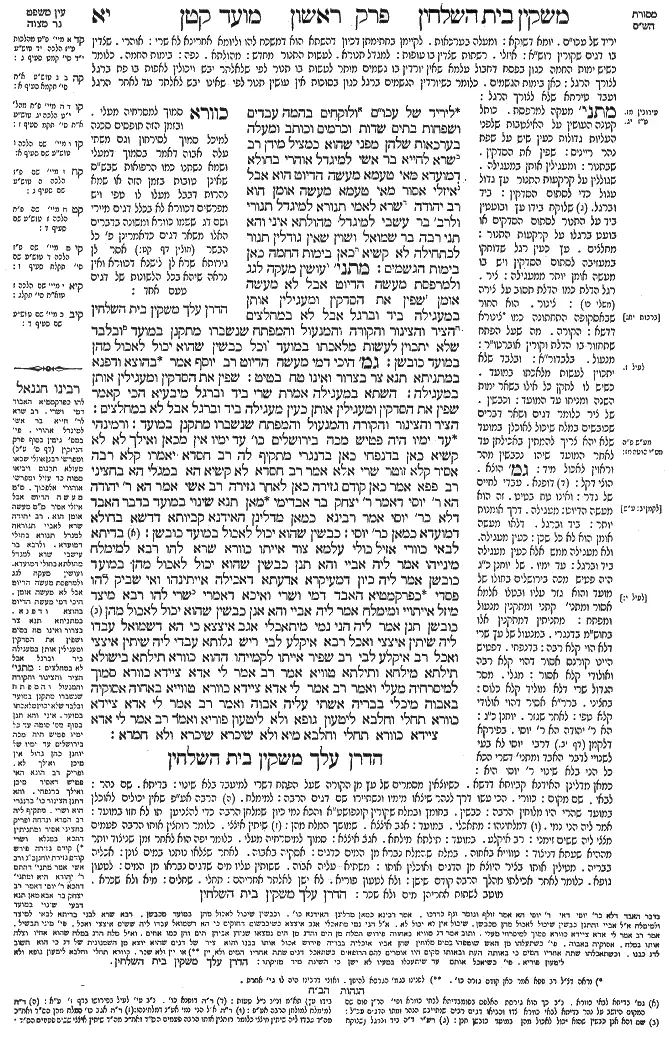
Mo'ed Katan 11a - Guemara
ליריד של עכו"ם ולוקחים בהמה עבדים ושפחות בתים שדות וכרמים וכותב ומעלה בערכאות שלהן מפני שהוא כמציל מידן רב שרא לחייא בר אשי למיגדל אוהרי בחולא דמועדא מאי טעמא מעשה הדיוט הוא אבל איזלי אסור מאי טעמא מעשה אומן הוא רב יהודה שרא לאמי תנורא למיגדל תנורי ולרב' בר עשבי למיגדל מהולתא איני והא תני רבה בר שמואל ושוין שאין גודלין תנור לכתחילה לא קשיא כאן בימות החמה כאן בימות הגשמים:
מתני׳ עושין מעקה לגג ולמרפסת מעשה הדיוט אבל לא מעשה אומן שפין את הסדקין ומעגילין אותן במעגילה ביד וברגל אבל לא במחלצים הציר והצינור והקורה והמנעול והמפתח שנשברו מתקנן במועד ובלבד שלא יתכוין לעשות מלאכתו במועד וכל כבשין שהוא יכול לאכול מהן במועד כובשן:
גמ׳ היכי דמי מעשה הדיוט רב יוסף אמר בהוצא ודפנא במתניתא תנא צר בצרור ואינו טח בטיט:
שפין את הסדקין ומעגילין אותן במעגילה:
השתא במעגילה אמרת שרי ביד וברגל מיבעיא הכי קאמר שפין את הסדקין ומעגילין אותן כעין מעגילה ביד וברגל אבל לא במחלצים:
הציר והצינור והקורה והמנעול והמפתח שנשברו מתקנן במועד:
ורמינהי עד ימיו היה פטיש מכה בירושלים כו' עד ימיו אין מכאן ואילך לא לא קשיא כאן בדנפחי כאן בדנגרי מתקיף לה רב חסדא יאמרו קלא רבה אסיר קלא זוטר שרי אלא אמר רב חסדא לא קשיא הא במגלי הא בחציני רב פפא אמר כאן קודם גזירה כאן לאחר גזירה רב אשי אמר הא ר' יהודה הא ר' יוסי דאמר ר' יצחק בר אבדימי מאן תנא שינוי במועד בדבר האבד דלא כר' יוסי אמר רבינא כמאן מדלינן האידנא קביותא דדשא בחולא דמועדא כמאן כר' יוסי:
כבשין שהוא יכול לאכול במועד כובשן:
בדיתא לבאי כוורי אזיל כולי עלמא צוד אייתו כוורא שרא להו רבא למימלח מינייהו אמר ליה אביי והא תנן כבשין שהוא יכול לאכול מהן במועד כובשן אמר ליה כיון דמעיקרא אדעתא דאכילה אייתינהו ואי שביק להו פסדי כפרקמטיא האבד דמי ושרי ואיכא דאמרי שרי להו רבא מיצד מיזל אייתויי ומימלח אמר ליה אביי והא אנן כבשין שהוא יכול לאכול מהן כובשן תנן אמר ליה הני נמי מיתאכלי אגב איצצא כי הא דשמואל עבדו ליה שיתין איצצי ואכל רבא איקלע לבי ריש גלותא עבדי ליה שיתין איצצי ואכל רב איקלע לבי רב שפיר אייתו לקמייהו ההוא כוורא תילתא בישולא תילתא מילחא ותילתא טוויא אמר רב אמר לי אדא ציידא כוורא סמוך למיסרחיה מעלי ואמר רב אמר לי אדא ציידא כוורא טווייא באחוה אסוקיה באבוה מיכלי בבריה אשתי עליה אבוה ואמר רב אמר לי אדא ציידא כוורא תחלי וחלבא ליטעון גופא ולא ליטעון פוריא ואמר רב אמר לי אדא ציידא כוורא תחלי וחלבא מיא ולא שיכרא שיכרא ולא חמרא:
הדרן עלך משקין:
Comments from Rashi on Masechet Mo'ed Katan Page 11a
יריד של עכו"ם . יומא דשוקא: ומעלה בערכאות . לקיימן בחתימתן דכיון דהשתא הוא דמשכח להו וליומא אחרינא לא שרי: אוהרי . שצדין בו דגים שקורין רוש"א: איזלי . רשתות שצדין בו עופות: למגדל תנורא . לעשות התנור מחדש: מהולתא . נפה: בימות החמה . כלומר כשיש ימות החמה כגון בפסח דחבול עלמא שאין יורדין בו גשמים מותר לעשות בו תנור לפי שלאלתר יבש ויכולין לאפות בו פת ברגל לצורך הרגל: כאן בימות הגשמים . כלומר כשיורדין הגשמים ברגל כגון בסוכות אין עושין תנור לפי שאינו יבש לאלתר עד לאחר הרגל ועבד טירחא שלא לצורך הרגל: מתני' מעקה למרפסת . כותל קטנה העושין על האיצטבות שלפני העליות גדולות כעין שיש על שפת נהר רייניס: שפין את הסדקין . שבתנור: ומעגילין אותן במעגילה . שגוללין על קרקעות התנור עץ גדול עגול כדי לסתום הסדקין: ביד וברגל . שלוקח בידו עץ ובועטין ביד על התנור לסתום הסדקים או בועט ברגלו על קרקעות התנור: מחלצים . עץ כעין רגל שדוחקו במעזיבה לסתום הסדקין ויש בו מעשה אומן יותר ממעגילה: ציר . רגל הדלת כמו הדלת תסוב על צירה (משלי כו): צינור . הוא החור שבאסקופא התחתונה כמו צינורא דדשא: הקורה . מה שעל הפתח שתחזור בו הדלת וקורין אוברטו"ר: מנעול . בלבדור"א: ובלבד שלא יתכוין לעשות מלאכתו במועד . כשיש לו לתקן כל אילו בשאר ימות השנה ומניחו עד המועד: וכבשין . של ציר כלומר דגים ושאר דברים שכובשים במלח שיכול לאוכלן במועד שלא יהא צריך להמתין באכילתן עד לאחר המועד שיהו נכבשין מהר וראויין לאכול מיד: גמ' הוצא . הוצי דקל: דופנא . עבדי לחיים של גדר: ואינו טח בטיט . זה הוא מעשה הדיוט: מעגילה . דרך אומנות יותר: ביד וברגל . דלאו מעשה אומן הוא לא כל שכן: כעין מעגילה . ולא מעגילה ממש אלא כעין מעגילה ביד וברגל: עד ימיו . של יוחנן כ"ג היה פטיש מכה בירושלים בחולו של מועד והוא גזר עליו ובטלו אלמא אסור ומתני' קתני ומתקנין מנעול ומפתח: בדנפחי . דפטיש היינו קורנס אסור דהוי קלא רבה ואולודי קלא אסור: מתניתין דמתקנין אלו בחוש"מ בדנגרי . במנעול של עץ שרי דלא הוי קלא רבה: מגלי . מסר הגדול שרי דלא מוליד קלא כלום: בחציני . ברר"א אסיר דהוי אולודי קלא טפי: לאחר שגזר . יוחנן כ"ג: הא ר' יהודה הא ר' יוסי . בפירקא דלקמן (מועד קטן דף יב.) דרבי יוסי לא בעי לשנויי לדבר האבד ומתני' דשרי הכא כל הני בלא שינוי ר' יוסי היא: כמאן מדלינן האידנא קביותא דדשא . כשיוצאין מסמרים של עץ מן הקורה שעל הפתח דשרי למיעבד בלא שינוי: בדיתא . שם נהר: לבאי . שם מקום: כוורי . הכי עשו דרך לנהר שיצאו מימיו ונשתיירו שם דגים הרבה: למימלח . הרבה אע"פ שאין יכולים לאוכלן במועד שהרי היו מלוחין הרבה: כבשין . בחומץ ובמלח שקורין קונפושט"א והכא נמי כיון שמלחן הרבה כדי להצניען תו לא חזו במועד: אמר ליה הני נמי . דמלחינהו: מתאכלי . במועד: אגב איצצא . שמושך המלח מהן: שיתין איצצי . כלומר רוחצין אותו הרבה פעמים מצצי ליה ששים זימני: רב איקלע . במועד: תילתא מילחא . אגב איצצא: סמוך למיסרחיה מעלי . כלומר יפה הוא לאחר זמן שניצוד יותר מההיא שעתה דניצוד: טוויא באחוה . במלח שהמלח נברא מן המים כדגים: אסקיה באבוה . לאחר שצלאו נותנו במים צונן: אכליה בבריה . מטילין אותו בציר היוצא מן הדגים ואוכלין אותו: משתיא עליה אבוה . ששותין עליו מים שדגים נבראו מן המים: לטעון גופא . כלומר לאחר אכילתו מהלך הרבה קודם שישן: ולא לטעון פוריא . לא ישן לאלתר אחריהם: תחלי . שחלים: מיא ולא שכרא . מוטב לשתות אחריהן מים ולא שכר:
Comments from Tosafot - Mo'ed Katan 11a
כוורא סמוך למסרחיה מעלי. ובזמן הזה תופסים סכנה למיכל סמוך לסירחון וגם משתי עלה אבוה דאמר בסמוך דמעלי ושמא נשתנו כמו הרפואות שבש"ס שאינן טובות בזמן הזה או שמא נהרות דבבל מעלו לו טפי ויש מפרשים דכוורא לא בכלל דגים מיירי ושם דג ששמו כוורא ומשונה בדברים האלו משאר דגים כדאמרינן פ' כל הבשר (חולין דף קט:) אסר לן גירותא שרא לן לישנא דכוורא ואין נראה שיהא בכל הלשונות של דגים טעם אחד:
Mo'ed Katan 11a - Mishnah translated into english
to a fair of pagan gentiles held on a day they have designated for idol worship and buy animals, slaves, maidservants, houses, fields, and vineyards from them. And he may write the necessary deeds and confirm them in their courts [arkaot] by verifying the signatures on the documents to prevent the sellers from appealing and retracting the sale. Although this behavior might be construed as a display of respect for the gentiles and their idols, it is nevertheless permitted because it is as if he were rescuing his property from their hands, as he would not have another opportunity to acquire these items. This indicates that time-sensitive transactions are considered like cases where one might suffer financial loss, and are permitted.
It was related that Rav permitted Ḥiyya bar Ashi to weave simple traps [oharei] on the intermediate days of a Festival. The Gemara explains: What is the reason for this? It is because it is the work of a layman. However, complex nets [izlei] are prohibited. What is the reason? It is the work of a craftsman, which is prohibited on the intermediate days of a Festival.
It was further related that Rav Yehuda permitted Ami the oven maker to construct ovens on the intermediate days of a Festival and Rabba bar Ashabi to craft sieves. The Gemara asks: Is that really so? Didn’t Rabba bar Shmuel teach the following baraita: And they all agree that one may not construct a new oven on the intermediate days of a Festival. The Gemara answers that this is not difficult: Here, where Rav Yehuda permitted constructing an oven, he was referring to the summer, i.e., when the weather is hot and dry, so the oven can dry out and already be fit for use on the Festival; there, where the baraita prohibits constructing an oven, it is referring to the rainy season, i.e., when the weather is such that the oven will not be ready for use on the Festival.
MISHNA: One may construct a railing for a roof or a balcony if it is done in a nonprofessional manner, as the work of a layman, but not if it is done skillfully, as the work of a craftsman. One may plaster the cracks in an oven and roll over them with a roller, a wooden tool used to smooth out clay, with a hand or a foot, but not with a presser, a tool that is specially designed for this task.
With regard to the hinge of a door, and the cylinder of the hinge, and the cross beam that holds the door, and a lock and a key that broke, one may fix them on the intermediate days of a Festival as these items are essential for the Festival and their repair cannot be delayed. This is permitted, provided that he does not intend ahead of time to do his labor on the Festival and delay it until that time.
And with regard to all preserved food from which one can eat on the Festival, since they become ready to be eaten in a short amount of time, he may preserve them on the intermediate days of a Festival.
GEMARA: The Gemara asks: What are the circumstances in which a railing is considered the work of a layman? Rav Yosef said: When it is made with palm branches and the branches of bay trees, which do not create a permanent structure. It was taught in a baraita that he fills in the space with stone but he does not plaster the stones with clay.
It was taught in the mishna: One may plaster the cracks in an oven and roll over them with a roller, with a hand or a foot, but not with a presser. The Gemara asks: Now that you said that it is permitted to roll over the cracks with a roller, is it necessary to say that one may plaster the cracks with a hand or a foot? The Gemara answers that this is what the mishna is saying: One may plaster the cracks in an oven and roll over them as if with a roller, meaning with a hand or a foot, but not with a presser, which is a craftsman’s tool made especially for this.
It was taught in the mishna: With regard to the hinge of a door, and the cylinder of the hinge, and the cross beam that holds the door, and a lock and a key that broke, one may fix them on the intermediate days of a Festival. The Gemara raises a contradiction to this from a different mishna (Ma’aser Sheni 5:15): Until the days of Yoḥanan the High Priest, workmen’s hammers would beat in Jerusalem on the intermediate days of a Festival. One can deduce from this mishna that until his days, yes, the workmen’s hammers would beat, but from then on, no, because Yoḥanan the High Priest banned such work. This seems to contradict the mishna here that permits fixing certain items on the intermediate days of the Festival.
The Gemara answers: This is not difficult: There, when it is prohibited, it is referring to the work of smiths, which generates a great deal of noise; here, where it is permitted, it is referring to the work of carpenters, which is much quieter.
Rav Ḥisda strongly objects to this: If so, people will say that a loud noise is prohibited, but a soft noise is permitted. Rather, Rav Ḥisda said that the apparent contradiction is not difficult for a different reason: This mishna that permits labor is referring to sickles, as sickles emit no noise at all; whereas that mishna that prohibits labor is referring to chisels. Rav Pappa said: Here in the mishna it is referring to the period before the decree of Yoḥanan the High Priest; whereas there in the other mishna it is referring to the period after the decree.
Rav Ashi said: That mishna, which prohibits this labor, was taught in accordance with the opinion of Rabbi Yehuda; while this mishna was taught in accordance with the opinion of Rabbi Yosei. As Rabbi Yitzḥak bar Avdimi said: Who is the tanna who taught that all labor performed on the intermediate days of a Festival must be done with a change, i.e., in an altered manner, even with regard to a matter that will be lost if timely action is not taken? It is not in accordance with the opinion of Rabbi Yosei, as Rabbi Yosei permits doing labor that will prevent financial loss even when it is done in the usual manner.
Ravina said: In accordance with whose opinion do we now lift the lintel above the door in order to drive in the nails that had loosened on the intermediate days of a Festival in the usual manner? In accordance with whose opinion is this done? It is done in accordance with the opinion of Rabbi Yosei, who permits labor that will prevent financial loss even when it is done in the usual manner.
§ It was taught in the mishna: With regard to all preserved food from which he can eat on the Festival, he may preserve them on the intermediate days of a Festival. The Gemara relates that the Bedita River once overflowed, depositing large quantities of fish in small water deposits on the river bank on the intermediate days of a Festival. Everyone went and trapped and brought home fish, and Rava permitted them to salt some of the fish.
Abaye said to him: Didn’t we learn in the mishna: With regard to all preserved food from which he can eat on the Festival, he may preserve them on the intermediate days of a Festival? In this case it was impossible to eat that much fish on the Festival, and therefore preserving them should have been prohibited. Rava said to him: Since they initially brought these fish with the intention of eating them on the Festival, and it only became clear afterward that they had brought too many, and if one would leave them without salting them they would be ruined, they are treated like merchandise that will be lost, and therefore preserving them is permitted.
And some say that it did not happen in this manner, rather, Rava permitted them to trap the fish, to bring them home, and to salt them. Abaye said to him: Didn’t we learn in the mishna: With regard to all preserved food from which he can eat on the Festival, he may preserve them on the intermediate days of a Festival? These fish were heavily salted and consequently could not be eaten until they thoroughly dried out.
Rava said to him: These fish that were just salted can also be eaten now, by pressing out the salt and brine, and therefore, they too are fit to be eaten on the Festival, as in that case of Shmuel, where they prepared recently salted fish for him by pressing it sixty times and he ate the fish. The Gemara relates that Rava happened to come to the house of the Exilarch and they prepared freshly salted fish for him by pressing it sixty times, and he ate it.
Apropos eating fish in various ways, the Gemara relates that Rav once happened to come to the house of Rav Shapir, and they brought before him a certain fish, of which one- third was cooked, one-third was salted and made edible via pressing, and one-third was broiled.
Rav said: Adda the fisherman told me that a fish that has sat for some time and is close to spoiling is at its best. And Rav also said: Adda the fisherman told me: With regard to a fish, broil it with its brother, i.e., with salt, which, like fish, also comes from the sea; place it in its father, i.e., in water; and eat it with its son, i.e., with fish brine which comes from it; and drink after it its father, i.e., water.
And in addition Rav said: Adda the fisherman told me: After eating fish, cress, and milk, let the body carry them and let not the bed carry them, i.e., it is advisable to go for a walk after eating them, rather than immediately going to sleep. And Rav said: Adda the fisherman told me: After eating fish, cress, and milk, it is better to drink water and not beer, and if he has no water, he should drink beer and not wine, in order to avoid harming his body.
Traduction : The William Davidson digital edition of the Koren Noé Talmud, with commentary by Rabbi Adin Even-Israel Steinsaltz.