 Talmud Bavli
Rosh Hashanah 19b : Youtube
Daf TubeYoutube
4 video classes :
Rosh Hashanah Page 19b
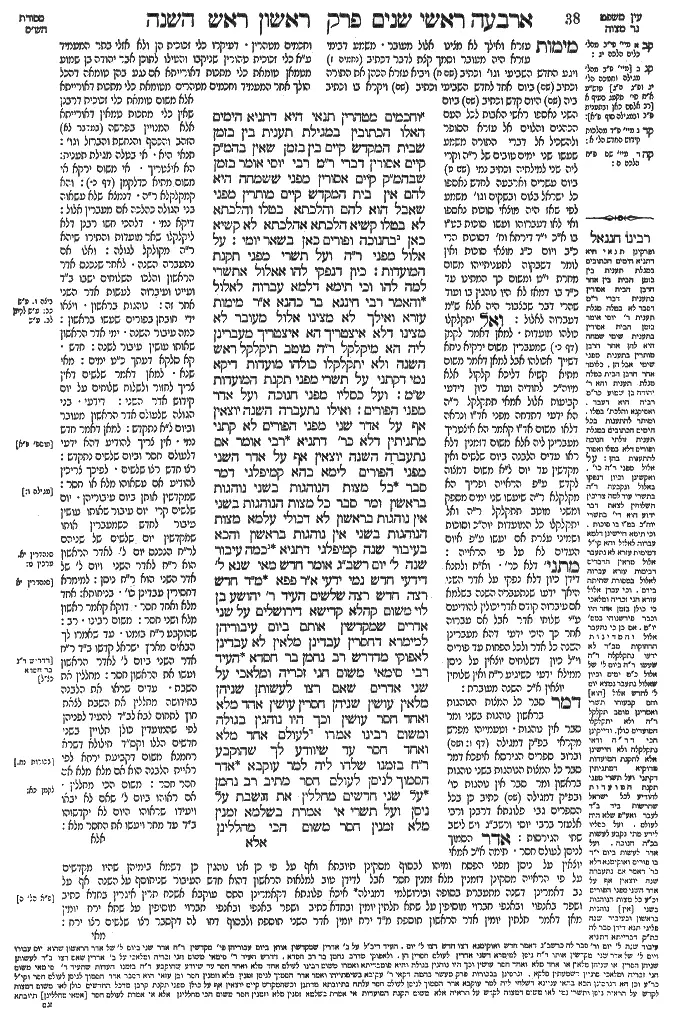
Rosh Hashanah 19b - Guemara
וחכמים מטהרין תנאי היא דתניא הימים האלו הכתובין במגילת תענית בין בזמן שבית המקדש קיים בין בזמן שאין בהמ"ק קיים אסורין דברי ר"מ רבי יוסי אומר בזמן שבהמ"ק קיים אסורין מפני ששמחה היא להם אין בית המקדש קיים מותרין מפני שאבל הוא להם והלכתא בטלו והלכתא לא בטלו קשיא הלכתא אהלכתא לא קשיא כאן בחנוכה ופורים כאן בשאר יומי:
על אלול מפני ר"ה ועל תשרי מפני תקנת המועדות:
כיון דנפקי להו אאלול אתשרי למה להו וכי תימא דלמא עברוה לאלול והאמר רבי חיננא בר כהנא א"ר מימות עזרא ואילך לא מצינו אלול מעובר לא מצינו דלא איצטריך הא איצטריך מעברינן ליה הא מיקלקל ר"ה מוטב תיקלקל ראש השנה ולא יתקלקלו כולהו מועדות דיקא נמי דקתני על תשרי מפני תקנת המועדות ש"מ:
ועל כסליו מפני חנוכה ועל אדר מפני הפורים:
ואילו נתעברה השנה יוצאין אף על אדר שני מפני הפורים לא קתני מתניתין דלא כר' דתניא רבי אומר אם נתעברה השנה יוצאין אף על אדר השני מפני הפורים לימא בהא קמיפלגי דמר סבר כל מצות הנוהגות בשני נוהגות בראשון ומר סבר כל מצות הנוהגות בשני אין נוהגות בראשון לא דכולי עלמא מצות הנוהגות בשני אין נוהגות בראשון והכא בעיבור שנה קמיפלגי דתניא כמה עיבור שנה ל' יום רשב"ג אומר חדש מאי שנא ל' דידעי חדש נמי ידעי א"ר פפא מ"ד חדש רצה חדש רצה שלשים העיד ר' יהושע בן לוי משום קהלא קדישא דירושלים על שני אדרים שמקדשין אותם ביום עיבוריהן למימרא דחסרין עבדינן מלאין לא עבדינן לאפוקי מדדרש רב נחמן בר חסדא העיד רבי סימאי משום חגי זכריה ומלאכי על שני אדרים שאם רצו לעשותן שניהן מלאין עושין שניהן חסרין עושין אחד מלא ואחד חסר עושין וכך היו נוהגין בגולה ומשום רבינו אמרו לעולם אחד מלא ואחד חסר עד שיוודע לך שהוקבע ר"ח בזמנו שלחו ליה למר עוקבא אדר הסמוך לניסן לעולם חסר מתיב רב נחמן על שני חדשים מחללין את השבת על ניסן ועל תשרי אי אמרת בשלמא זמנין מלא זמנין חסר משום הכי מחללינן
Comments from Rashi on Masechet Rosh Hashanah Page 19b
וחכמים מטהרין . דעיקרו כלי זכוכית הן ולא אזלי בתר המעמיד ע"א כלי זכוכית טהורין שניקבו והטילו לתוכן אבר יהודה בן שמוע מטמאן טומאת כלי מתכות דאורייתא אם נגע בהן טומאה דהכל הולך אחר המעמיד וחכמים מטהרים מטומאת כלי מתכות דאורייתא אלא משום טומאת כלי זכוכית דרבנן שאין כלי מתכות טמאין דאורייתא אלא המנויין בפרשה (במדבר לא) הזהב והכסף והנחשת והברזל וגו': תנאי היא . אי בטלה מגילת תענית: הא איצטריך . אי משום ירקא אי משום מתיא כדלקמן (ראש השנה דף כ.): והא קמקלקלא ר"ה . דנמצא שלא עשאוה בני הגולה כהלכה אם מעברין אלול: דיקא נמי . דלהכי חשו רבנן דלא ליקלקלו שאר מועדות והתירו שיהא ר"ה מקולקל לגולה: ואלו אם נתעברה השנה . לאחר שנכנס אדר הראשון והלכו השלוחים ישבו ב"ד ועיינו ועיברוה לעשות אדר השני אחר זה: נוהגות בראשון . ויצאו ידי חובתן בפורים שעשו בראשון: כמה עיבור השנה . ימי אדר הראשון שאותו עושין עיבור לשנה: חדש . קא סלקא דעתך כ"ט ימים: מאי שנא . למאן דאמר שלשים דאין צריך לחזור ולשלוח שלוחים על יום קידוש אדר השני: דידעי . בני הגולה שלעולם אדר הראשון מעובר וביום ל"א נתקדש: למאן דאמר חדש נמי . אין צריך להודיע דהא ידעי דלעולם חסר וביום שלשים נתקדש: רצו חדש רצו שלשים . לפיכך צריכין להודיע אם עשאוהו מלא או חסר: שמקדשין אותן ביום עיבוריהן . יום שלשים קרי יום עיבור שאותו עושין עיבור לחדש כשמעברין אותו שמקדשין יום שלשים של שניהם לר"ח הנכנס יום ל' לאדר הראשון הוא ר"ח לאדר השני ויום ל' של אדר השני הוא ר"ח ניסן: למימרא דחסירין עבדינן כו' . בניחותא: אחד מלא ואחד חסר . דוקא קאמר ראשון מלא ושני חסר: משום רבינו . רב: שהוקבע ר"ח בזמנו . עד שאמרו לך הבאים מארץ ישראל קדשו ב"ד ר"ח אדר השני ביום ל' לאדר הראשון ועשו את הראשון חסר: מחללין את השבת . עדים שראו את הלבנה בחידושה מחללין את השבת לצאת חוץ לתחום לבא לב"ד להעיד לפניהן לפי שהמועדין כולן תלויין בשני חדשים הללו וקס"ד חילולא דשרא רחמנא משום דקביעת ירחא לפי ראיית הלבנה הוא אם מלא מלא אם חסר חסר: משום הכי מחללין . אם ראוהו ביום ל' שאם לא יבאו ויעידו שראוהו היום לא יקדשוהו ב"ד עד מחר ויעשו את החסר מלא:
Comments from Tosafot - Rosh Hashanah 19b
מימות עזרא ואילך לא מצינו אלול מעובר. משמע דבימי עזרא היה מעובר וסמך קצת לדבר דכתיב (נחמיה ז) ויגע החדש השביעי וגו' וכתיב (שם ח) ויביא עזרא הכהן את התורה וכתיב (שם) ביום אחד לחדש השביעי וכתיב (שם) ויקרא בו וכתיב ביה (שם) היום קדש וכתיב (שם) ביום השני נאספו ראשי האבות לכל העם הכהנים והלוים אל עזרא הסופר ולהשכיל אל דברי התורה משמע שעשו שני ימים טובים של ר"ה וקרי ליה שני למילתיה וכתיב נמי (שם ט) ביום עשרים וארבעה לחדש נאספו כל ישראל בצום ובשקים וגו' משמע לפי שאז היה מוצאי סוכות נאספו ואי לאו דעברוהו ועשו סוכות בט"ו בו א"כ י"ד דירחא וח' דסוכות הרי כ"ב ויום כ"ג מוצאי סוכות ואין לומר דשבקוה לתעניתייהו משום מחרת י"ט ומשום כך המתינו עד כ"ד בו דמאז לא היו נוהגין בו ועוד שהרי דבר שבצבור היה אלא ש"מ דעברוה לאלול: ואל יתקלקלו כולהו מועדות. למאן דאמר לקמן (ראש השנה דף כ.) שמעברין משום ירקיא ניחא דשייך אכולהו אבל למאן דאמר משום מתיא קשיא דליכא קלקול אלא מיוה"כ לחודיה ועוד כיון דידעי קביעות אלול אמאי תתקלקל ר"ה הא ידעי דתדחה מפני אד"ו ונראה דלאו משום אד"ו קאמר הא איצטריך מעברינן ליה אלא משום דזמנין דלא ראו עדים הלבנה ביום שלשים ואין מקדשין עד יום ל"א משום דמצוה לקדש ע"פ הראייה ופריך הא מקלקלא ר"ה שיעשו שני ימים מספק ומשני מוטב תתקלקל ר"ה ואל יתקלקלו כל המועדות יוה"כ וסוכות ושמיני עצרת אם יעשו ע"פ איום העדים לא על פי הראייה: מתני' דלא כר'. וא"ת ולתנא דידן כיון דלא נפקי על אדר השני היאך ידעו שנתעברה השנה בשלמא אם עיברוה קודם אדר יכולין להודיעם ע"י שלוחי אדר אבל אם עברוה אחר כך היכי ידעי דהא מעברינן השנה כל אדר ולכל הפחות עד פורים וי"ל כיון דשלוחים יוצאין על ניסן ממילא ידעי כשיגיע ר"ח ואין שלוחין יוצאין א"כ השנה מעוברת: דמר סבר כל המצות הנוהגות בראשון נוהגות בשני ומר סבר אין נוהגות. וטעמייהו מפרש מקראי בפ"ק דמגילה (דף ו: ושם) וברוב ספרים הגירסא איפכא דמר סבר כל המצות הנוהגות בשני נוהגות בראשון ומר סבר אין נוהגות כו' ובפ"ק דמגילה (שם) כתיב כן בכל הספרים גבי פלוגתא דרבנן ורבי אלעזר ברבי יוסי ורשב"ג ויש לישב שתי הגירסות: אדר הסמוך לניסן לעולם חסר. תימה א"כ אמאי יוצאין על ניסן מפני הפסח ומיהו לבסוף מסקינן תיובתא ואף על פי כן אנו נוהגין כן דשמא בימיהן שהיו מקדשים על פי הראייה מסקינן דזמנין מלא זמנין חסר אבל לדידן טוב למלאות הראשון דהוא חדש העיבור שניתוסף על השנה אף על גב דאמרינן דשנה מתעברת בסופה ובירושלמי דמגילה איכא פלוגתא דקאמרינן התם עוקבא אשכח תרין איגרין בחדא כתיב ושפר באנפוי ובאנפי חברוי מוסיפין על שתא תלתין יומין ובחדא כתיב ושפר באנפי ובאנפי חברוי מוסיפין על שתא ירח יומין מאן דאמר תלתין יומין אדר הראשון תוספת מ"ד ירח יומין אדר השני תוספת ולבסוף דחו לה דקסבר רצו שלשים רצו ירח:
Rosh Hashanah 19b - Mishnah translated into english
whereas the Sages declare it pure. According to them, it is still considered a broken utensil. Rabbi Meir himself lived after the destruction of the Second Temple. The festive day commemorating the annulling of the decree of Rome was instituted as a result of an incident involving his student, Rabbi Yehuda ben Shammua. From this, it is clear that Megillat Ta’anit had not yet been nullified.
The Gemara answers: The question whether or not Megillat Ta’anit has been nullified is the subject of a dispute between tanna’im, as it is taught in a baraita: These days, which are written in Megillat Ta’anit, both when the Temple is standing and when the Temple is not standing, are days on which fasting is prohibited; this is the statement of Rabbi Meir. Rabbi Yosei says: When the Temple is standing, these days are prohibited for fasting because these days are a source of joy for Israel. But when the Temple is not standing, these days are permitted for fasting because these days are a source of mourning for them.
The Gemara concludes: And the halakha is that these days were nullified, and the halakha is that they were not nullified. The Gemara asks: This is difficult, as one halakha contradicts the other halakha. The Gemara answers: It is not difficult. Here, it is referring to Hanukkah and Purim. These Festival days were never nullified, and Hanukkah is listed among the Festivals of Megillat Ta’anit. There, the halakha is referring to the rest of the days listed in Megillat Ta’anit, all of which were nullified.
§ The mishna taught: Messengers go out to inform about the sanctification of the New Moon in Elul, due to Rosh HaShana, and in Tishrei, due to the need to establish the correct dates on which to celebrate the Festivals of Tishrei. The Gemara asks: Once the messengers have gone out in the month of Elul to inform the people when the New Moon was declared, why do they need to go out again in Tishrei, as the New Moon of Tishrei always falls on the thirtieth day after the New Moon of Elul?
And if you say that messengers must go out for Tishrei as well, as perhaps the court added another day to the month of Elul, so that Rosh HaShana occurs on the thirty-first day after the New Moon of Elul, there is a difficulty. Didn’t Rabbi Ḥinnana bar Kahana say that Rav said: From the days of Ezra and onward, we have never found that the month of Elul had an additional day. Consequently, it is simple to calculate the days on which the Festivals of Tishrei occur, and there should be no need to send out messengers in Tishrei.
The Gemara answers: When we say: We have not found that the month of Elul ever had an additional day, this does not mean that Elul cannot have an additional day, but only that it never happened because it was not necessary to add a day. But if it had been necessary, they would have added an additional day. Since it is possible that the month of Elul could have had another day added, there is reason to send out messengers for the month of Tishrei, so that all will know when to celebrate the Festivals.
The Gemara asks: But if Elul has an additional day Rosh HaShana will be ruined, because people will celebrate it thirty days after the New Moon of Elul, when its real date is on the thirty-first day. The Gemara answers: Better that Rosh HaShana be ruined, and all the Festivals, i.e., Yom Kippur, Sukkot, and the Eighth Day of Assembly, not be ruined.
The language of the mishna is also precise, as it teaches: Messengers go out in the month of Tishrei due to the need to establish the correct dates on which to celebrate the Festivals of Tishrei. The Gemara summarizes: Indeed, conclude from here that this is the correct understanding.
§ The mishna taught: Messengers go out in Kislev, due to Hanukkah, and in Adar, due to Purim. Whereas, it is not taught: If the year was a leap year, with an additional month of Adar, the messengers go out also in the second Adar due to Purim, which is celebrated in the second Adar. This indicates that the mishna is not in accordance with the opinion of Rabbi Yehuda HaNasi, as it is taught in a baraita: Rabbi Yehuda HaNasi says: If the year was a leap year, the messengers go out also in the second Adar, due to Purim.
The Gemara suggests: Let us say that they disagree about this. One Sage, the author of this mishna, holds that all the mitzvot observed in the second Adar, i.e., the special Torah readings and the mitzvot of Purim, are also observed in the first Adar. If they were observed in the first Adar and not in the second, the people have fulfilled their obligation. Therefore, there is no need to send messengers in the second Adar. And one Sage, Rabbi Yehuda HaNasi, holds that all the mitzvot observed in the second Adar are not observed in the first. It is therefore necessary to send messengers in the second Adar, so that people will know when to keep the mitzvot of Adar.
The Gemara rejects this argument: No, everyone agrees that the mitzvot observed in the second Adar are not observed on the first, and here they disagree about the length of the additional month in the leap year, as it is taught in a baraita: How long is the additional month in a leap year? Thirty days. Rabban Shimon ben Gamliel says: A month. Rabbi Yehuda HaNasi holds in accordance with the opinion of Rabban Shimon ben Gamliel, and since the additional month does not have a fixed number of days, it is necessary to send messengers also for the second Adar, so that people will know when to celebrate Purim. However, according to the first tanna, since the first Adar is always a fixed length, there is no need to send messengers.
The Gemara asks: What is different about thirty days? It is different because people can count thirty days and know when the month ends and when Purim occurs. A month also, people know the length of it. The term month implies that it is a month of twenty-nine days, and based on that they know when to celebrate Purim. Rav Pappa said: The one who said that a month is added does not mean necessarily a month of twenty-nine days. Rather, if the judges of the court wish, they add a month of twenty-nine days; and if it wishes, they add thirty days. Therefore, it is necessary to send messengers also for the second Adar.
Rabbi Yehoshua ben Levi testified in the name of the holy community of Jerusalem about the two months of Adar, that they are sanctified on the day that could have been added to make them a full month, i.e., the thirtieth day after the previous New Moon. That is to say, the thirtieth day after the New Moon of the first Adar is always the New Moon of the second Adar, and thirty days after the New Moon of the second Adar is always the New Moon of Nisan.
The Gemara comments: That is to say that they make the two months of Adar short months, of twenty-nine days, but they do not make them full months, of thirty days. This is to the exclusion of what Rav Naḥman bar Ḥisda taught, as Rav Naḥman bar Ḥisda taught: Rabbi Simai testified in the name of Haggai, Zechariah, and Malachi about two months of Adar in a leap year, that if the members of the court wish to make them both full, they may do so; and if they wish to make them both short, they may do so; and if they wish to make one full and one short, they may do so. And this is what they would do in the Diaspora, when they did not know which day was established as the New Moon. And in the name of our teacher, Rav, they said: The two months of Adar are always observed, one full and one short, unless it is known to you that the New Moon was fixed in its proper time, i.e., the first Adar is also short.
A ruling was sent from Eretz Yisrael to Mar Ukva, the Exilarch in Babylonia: The Adar that immediately precedes Nisan is always short, both in a regular year and in a leap year. But the first Adar in a leap year, which does not immediately precede Nisan, is sometimes full.
Rav Naḥman raised an objection from what was taught in a mishna: Witnesses who saw the new moon may desecrate Shabbat for the fixing of the New Moon of two months, for the month of Nisan and for the month of Tishrei, due to the important Festivals that occur in them. Granted, if you say that the Adar immediately preceding Nisan is sometimes full and sometimes short, due to that reason the witnesses may desecrate Shabbat, as if the witnesses come on the thirtieth, the month will be made short and that day will be declared the New Moon; otherwise, the month will be made full and the next day will be declared the New Moon.
Traduction : The William Davidson digital edition of the Koren Noé Talmud, with commentary by Rabbi Adin Even-Israel Steinsaltz.