 Talmud Bavli
Rosh Hashanah 28a : Youtube
Daf TubeYoutube
2 video classes :
Rosh Hashanah Page 28a
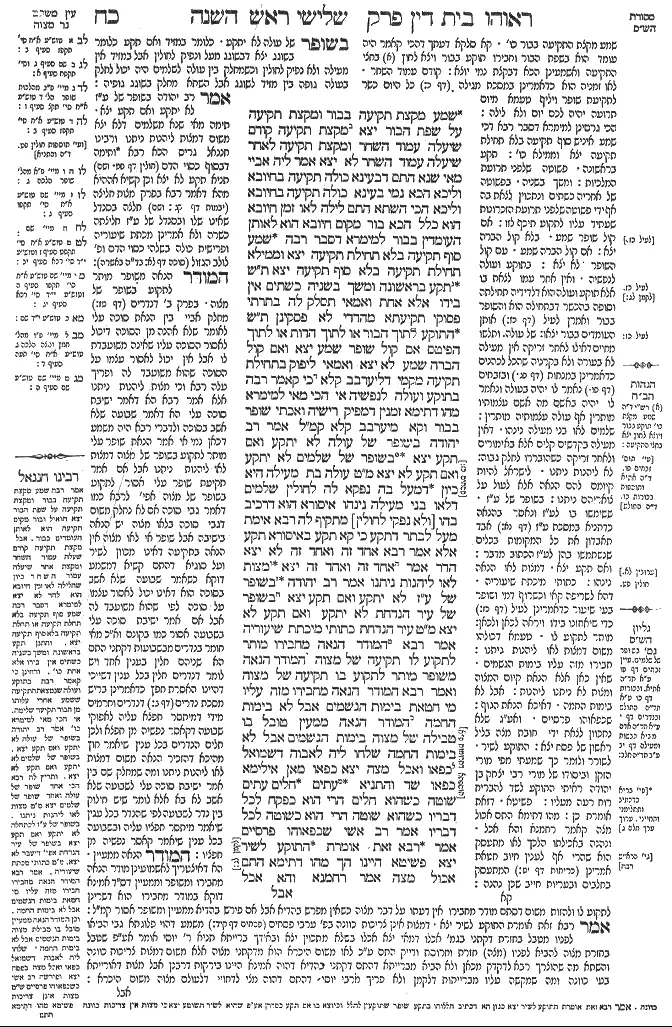
Rosh Hashanah 28a - Guemara
שמע מקצת תקיעה בבור ומקצת תקיעה על שפת הבור יצא מקצת תקיעה קודם שיעלה עמוד השחר ומקצת תקיעה לאחר שיעלה עמוד השחר לא יצא אמר ליה אביי מאי שנא התם דבעינא כולה תקיעה בחיובא וליכא הכא נמי בעינא כולה תקיעה בחיובא וליכא הכי השתא התם לילה לאו זמן חיובא הוא כלל הכא בור מקום חיובא הוא לאותן העומדין בבור למימרא דסבר רבה שמע סוף תקיעה בלא תחילת תקיעה יצא וממילא תחילת תקיעה בלא סוף תקיעה יצא ת"ש תקע בראשונה ומשך בשניה כשתים אין בידו אלא אחת ואמאי תסלק לה בתרתי פסוקי תקיעתא מהדדי לא פסקינן ת"ש התוקע לתוך הבור או לתוך הדות או לתוך הפיטס אם קול שופר שמע יצא ואם קול הברה שמע לא יצא ואמאי ליפוק בתחילת תקיעה מקמי דליערבב קלא כי קאמר רבה בתוקע ועולה לנפשיה אי הכי מאי למימרא מהו דתימא זמנין דמפיק רישיה ואכתי שופר בבור וקא מיערבב קלא קמ"ל אמר רב יהודה בשופר של עולה לא יתקע ואם תקע יצא בשופר של שלמים לא יתקע ואם תקע לא יצא מ"ט עולה בת מעילה היא כיון דמעל בה נפקא לה לחולין שלמים דלאו בני מעילה נינהו איסורא הוא דרכיב בהו [ולא נפקי לחולין] מתקיף לה רבא אימת מעל לבתר דתקע כי קא תקע באיסורא תקע אלא אמר רבא אחד זה ואחד זה לא יצא הדר אמר אחד זה ואחד זה יצא מצות לאו ליהנות ניתנו אמר רב יהודה בשופר של ע"ז לא יתקע ואם תקע יצא בשופר של עיר הנדחת לא יתקע ואם תקע לא יצא מ"ט עיר הנדחת כתותי מיכתת שיעוריה אמר רבא המודר הנאה מחבירו מותר לתקוע לו תקיעה של מצוה המודר הנאה משופר מותר לתקוע בו תקיעה של מצוה ואמר רבא המודר הנאה מחבירו מזה עליו מי חטאת בימות הגשמים אבל לא בימות החמה המודר הנאה ממעין טובל בו טבילה של מצוה בימות הגשמים אבל לא בימות החמה שלחו ליה לאבוה דשמואל כפאו ואכל מצה יצא כפאו מאן אילימא כפאו שד והתניא עתים חלים עתים שוטה כשהוא חלים הרי הוא כפקח לכל דבריו כשהוא שוטה הרי הוא כשוטה לכל דבריו אמר רב אשי שכפאוהו פרסיים אמר רבא זאת אומרת התוקע לשיר יצא פשיטא היינו הך מהו דתימא התם אכול מצה אמר רחמנא והא אכל
Comments from Rashi on Masechet Rosh Hashanah Page 28a
שמע מקצת התקיעה בבור כו' . קא סלקא דעתך דהכי קאמר היה עומד הוא בשפת הבור וחבירו תוקע בבור ויצא לחוץ בחצי התקיעה ואשמעינן הכא דבקצת נמי יוצא: קודם עמוד השחר . לאו זמניה הוא כדאמרינן במסכת מגילה (דף כ:) כל היום כשר לתקיעת שופר ויליף טעמא מיום תרועה יהיה לכם יום ולא לילה: הכי גרסינן למימרא דסבר רבא דכי שמע איניש סוף תקיעה בלא תחילת תקיעה יצא וממילא כו': תקע בראשונה . פשוטה שלפני תרועת המלכיות: ומשך בשניה . בפשוטה של אחריה כשתים ונתכוין לצאת בה אף ידי פשוטה שלפני תרועת הזכרונות שעתיד עליו לתקוע תיכף לזו: אם קול שופר שמע . בלא קול הברה יצא: אם קול הברה שמע . עם קול השופר לא יצא: בתוקע ועולה לנפשיה . ואין אחר עמו לצאת בו אלא תוקע ועולה הוא דלדידיה תחילתה וסופה בהכשר דבתחילה הוא והשופר בבור ואמרן לעיל ((דף כז:) אותן העומדים בבור יצאו: של עולה . ותלשו מחיים דאילו לאחר זריקה אין מעילה לא בעורה ולא בקרניה שהכל לכהנים כדאמרינן במנחות (דף פג.) ובזבחים (דף פו.) נאמר לו יהיה בעולה ונאמר לו יהיה באשם מה אשם עצמותיו מותרין אף עולה עצמותיה מותרין: שלמים לאו בני מעילה נינהו . דאין מעילה בקדשים קלים אלא באימורים ולאחר זריקה כשהובררו לחלק גבוה: לא ליהנות ניתנו . לישראל להיות קיומם להם הנאה אלא לעול על צואריהם ניתנו: בשופר של ע"ז . ששימשו בו לע"ז ונאסר בהנאה כדתניא במסכת ע"ז (דף נא:) אבד תאבדון את כל המקומות בכלים שנשתמשו בהן לע"ז הכתוב מדבר: ואם תקע יצא . דמצות לאו הנאה נינהו: כתותי מיכתת שיעוריה . דהא לשריפה קאי וכשרוף דמי ושופר בעי שיעור כדאמרינן לעיל (ראש השנה דף כז:) כדי שיאחזנו בידו ויראה לכאן ולכאן: מותר לתקוע לו . טעמא דכולהו משום דמצות לאו ליהנות ניתנו: חבירו מזה עליו בימות הגשמים . שאין כאן אלא הנאת קיום המצוה ומצות לא ניתנו ליהנות: אבל לא בימות החמה . דאיכא הנאת הגוף: שכפאוהו פרסיים . ואע"ג שלא נתכוון לצאת ידי חובת מצה בליל ראשון של פסח יצא: התוקע לשיר . לשורר ולזמר כך שמעתי מפי מורי הזקן וביסודו של מורי רבי יצחק בן יהודה ראיתי התוקע לשד להבריח רוח רעה מעליו: פשיטא . דזאת אומרת כן: מהו דתימא התם אכול מצה קאמר רחמנא והא אכל . ונהנה באכילתו הלכך לאו מתעסק הוא שהרי אף לענין חיוב חטאת אמרינן (כריתות דף יט:) המתעסק בחלבים ובעריות חייב שכן נהנה:
Comments from Tosafot - Rosh Hashanah 28a
בשופר של עולה לא יתקע. כלומר במזיד ואם תקע כלומר בשוגג יצא דבשוגג מעל ונפיק לחולין אבל במזיד אין מעילה ולא נפיק לחולין וכשמחלק בין עולה לשלמים היה יכול לחלק בעולה גופה בין מזיד לשוגג אבל השתא מחלק בשוגג גופיה: אמר רב יהודה בשופר של ע"ז לא יתקע ואם תקע יצא. תימה מאי שנא משלמים דלא יצא משום דמצות ליהנות ניתנו ורבינו חננאל גריס הכא רבא ותימה דבסוף כסוי הדם (חולין דף פט. ושם) תניא תקע לא יצא וכן קשיא אההיא מהא דאמר רבא בפרק מצות חליצה (יבמות דף קנ: ושם) חלצה בסנדל שאינו שלו ובסנדל של ע"ז חליצתה כשרה ולא אמרינן מכתת שיעוריה ופרישית כולה בשלהי כסוי הדם ופ' לולב הגזול (סוכה דף לא: בד"ה באשרה): המודר הנאה משופר מותר לתקוע בשופר של מצוה. בפרק ב' דנדרים (דף טז:) מחלק אביי בין הנאת סוכה עלי לאומר שלא אהנה מן הסוכה דיכול לאסור הסוכה עליו שאינה משועבדת לו אבל אין יכול לאסור עצמו על הסוכה שהוא משועבד לה ופריך עלה רבא וכי מצות ליהנות ניתנו אלא אמר רבא הא דאמר ישיבת סוכה עלי הא דאמר שבועה שלא אשב בסוכה ולדברי רבא היה משמע דכאן נמי אי אמר הנאת שופר עלי מותר לתקוע בשופר של מצוה דמצות לאו ליהנות ניתנו אבל אם אמר תקיעת שופר עלי אסור לתקוע בשופר של מצוה אפי' לרבא כמו דאמר גבי סוכה אם לא נחלק משום דגבי סוכה בלאו מצוה יש הנאה בישיבה אבל שופר אי לאו מצוה אין הנאה בתקיעה דאינו מכוון לשיר ועל סוגיא דהתם קשיא דמשמע דוקא כשאמר שבועה שלא אשב בסוכה הוא דאינו יכול לאסור עצמו על סוכה לפי שהוא משועבד לה אבל אם אמר ישיבת סוכה עלי בשבועה אסור כמו בקונם וא"כ מאי חומר בנדרים מבשבועות דקתני התם הא שניהם חלין בענין אחד ויש לומר דנדרים חלין בכל ענין דשייכי דהיינו האסרת חפץ כדאמרינן בריש מסכת נדרים (דף ב:) דנדרים וחרמים מידי דמיתסר חפצא עליה לאפוקי שבועה דקאסר נפשיה מן חפצא ולכן חלים הנדרים בכל ענין שיאמר חוץ מהיכא דהזכיר הנאה משום דמצות לאו ליהנות ניתנו ומה שמחלק שם בין אמר ישיבת סוכה עלי לשבועה שלא אשב לא בא אלא לומר שיש חילוק בין נדר לשבועה לפי שהנדר בכל ענין שיאמר מיתסר חפציו עליה ובשבועה בכל ענין שיאמר קאסר נפשיה מן חפציו: המודר הנאה ממעיין. הא דאיצטריך לאשמועינן מודר הנאה מחבירו ומשופר וממעיין דס"ד אמינא דוקא במודר מחבירו הוא דשרינן לתקוע לו ולהזות משום דסתם מודר מחבירו אין דעתו על דבר מצוה כשאין מפרש בהדיא אבל אם פירש בהדיא ממעיין ומשופר אסור קמ"ל: אמר רבא זאת אומרת התוקע לשיר יצא. דמצות אינן צריכות כוונה בפ' ערבי פסחים (פסחים דף קיד:) משמע דהוי פלוגתא גבי הביאו לפניו מטבל בחזרת דקתני בגמ' אכלו דמאי יצא אכלו בשלא מתכוין יצא ובאידך ברייתא תניא ר' יוסי אומר אע"פ שטבל בחזרת מצוה להביא לפניו (מצה) חזרת וחרוסת ודייק התם ע"כ לאו משום היכרא הוא מדקתני מצוה אלא משום דמצות צריכות כוונה והשתא מה שהוצרך רבא לדקדק מכאן ולא הביא מברייתא דהתם דקתני בהדיא דהוה אמינא היינו בירקות דרבנן אבל מצות דאורייתא בעי כוונה ומה שמקשה עליו מברייתות דלקמן ולא פריך מרבי יוסי דהתם דהוה מצי לדחויי דלעולם מצוה משום היכרא:
Rosh Hashanah 28a - Mishnah translated into english
If one heard part of the blast in the pit and part of the blast at the edge of the pit, he has fulfilled his obligation. But if he heard part of the blast before dawn, when it is not yet time to sound the shofar, and part of the blast after dawn, he has not fulfilled his obligation.
Abaye said to him: What is different there, in the case of one who heard part of the blast before dawn and part of it after dawn? If you say that there the entire blast needs to be heard in a time of obligation, and when he hears part of the blast before dawn and part after dawn it is not all within the same time of obligation, here too, in the case of the pit, the entire blast needs to be in a place where one can fulfill his obligation, and when he hears part of the blast in a pit and part at the edge, it is not all within a place where he can fulfill his obligation.
The Gemara rejects this argument: How can these cases be compared? There, night is not a time of obligation at all, and sounding the shofar then has no meaning whatsoever, but here, a pit is a place of obligation for those standing in the pit. That is to say, the part of the blast that was heard in the pit is not inherently invalid, but merely disqualified due to an external factor, so that it is possible to connect it with the part of the blast that was heard at the edge of the pit.
The Gemara asks: Is this to say that Rabba maintains that if one heard the end of a blast without hearing the beginning of the blast, he has fulfilled his obligation? Because in the case where one heard the beginning of the blast in a pit, he is considered to have heard only the end of the shofar blast, which he heard at the edge of the pit. And it therefore follows that if one heard the beginning of a blast without hearing the end of the blast, he has also fulfilled his obligation.
Come and hear a proof that this is not so, for we learned in the mishna: If one blew the initial tekia of the first set of tekia-terua-tekia, and then drew out the second tekia so that it spans the length of two tekiot, it counts as only one tekia, and is not considered two tekiot, i.e., the concluding tekia of the first set, and the initial tekia of the second set. But why is this so? If we consider part of a blast as a complete one, let it count as two tekiot. The Gemara explains: If one hears only the beginning or the end of a shofar blast, he has indeed fulfilled his obligation, but nevertheless, we do not divide a shofar blast into two.
The Gemara raises another difficulty: Come and hear that which was taught in a mishna: If one sounds a shofar into a pit, or into a cistern, or into a large jug, if he clearly heard the sound of the shofar, he has fulfilled his obligation; but if he heard the sound of an echo, he has not fulfilled his obligation. But why is this so? If indeed half a blast is considered a blast, let him fulfill his obligation with the beginning of the blast, before the sound of the shofar is confused with the echo, since he heard the beginning of the blast clearly.
The Gemara answers: Indeed, half a blast is not considered a blast, and Rabba’s statement must be understood differently. When Rabba spoke, he was speaking not about other people hearing the blast, but about one who was sounding the shofar for himself in a pit and emerged from the pit as he was blowing. He has fulfilled his obligation, because he was located in the same place as the sound of the shofar at all times, and so he heard the entire blast clearly.
The Gemara asks: If so, what is the purpose of Rabba’s statement? The halakha in this case should be obvious, as there is no reason that the blast should be disqualified. The Gemara answers: Lest you say that his head might sometimes emerge from the pit while the shofar itself is still in the pit, and the sound may become confused with its echo, and so he would not fulfill his obligation. Therefore, Rabba teaches us that we are not concerned about this, and the obligation is considered to have been fulfilled.
§ Rav Yehuda said: One should not blow with the shofar of an animal consecrated as a burnt-offering, but if he nevertheless transgressed and blew, he has fulfilled his obligation. One should also not blow with the shofar of an animal consecrated as a peace-offering, and if he nevertheless transgressed and blew, he has not fulfilled his obligation.
The Gemara explains: What is the reason for this distinction? A burnt-offering is subject to misuse of consecrated objects before being offered, and once one misuses it for mundane purposes, it becomes non-sacred, so that the one who blows with its shofar fulfills his obligation. In contrast, peace-offerings are not subject to misuse of consecrated objects before being offered, since in the case of sacrifices of lesser sanctity, misuse is restricted to the fats and other portions that are offered on the altar, and even this applies only after the sprinkling of the blood. Since one is not considered to be misusing peace-offerings when utilizing them for mundane purposes, the prohibition remains intact and they do not become non-sacred. Therefore, one who blows the shofar of an animal consecrated as a peace-offering does not fulfill his obligation.
Rava strongly objects to this argument: When does he commit misuse? After he has sounded it, for only then has he misused the consecrated animal. If so, when he sounds it, he is sounding with something that is still prohibited, even in the case of the animal that was consecrated as a burnt-offering, and so he should not be able to fulfill his obligation with it.
Rather, Rava said: Both this one, the shofar of a burnt-offering, and the other one, the shofar of a peace-offering, are governed by the same halakha: If he sounded them, he has not fulfilled his obligation. Later, Rava retracted his statement and then said the opposite: Both this one, the shofar of a burnt-offering, and the other one, the shofar of a peace-offering, are governed by the same halakha: If he sounded them, he has fulfilled his obligation. The reason for this is that mitzvot were not given for benefit. That is to say, the fulfillment of a mitzva is not in itself considered a benefit, and in the absence of benefit, one is not liable for misuse.
Rav Yehuda said further: One should not sound a shofar that was used for idol worship, but if he nevertheless transgressed and sounded it, he has fulfilled his obligation. One should also not sound a shofar from a city whose residents were incited to idolatry, where the majority of inhabitants committed idolatry, but if he nevertheless transgressed and sounded it, he has not fulfilled his obligation. What is the reason for this last ruling? With regard to any object found in a city whose residents were incited to idolatry, its size as required for the mitzva is seen by halakha as crushed into powder. Since a shofar from a city whose residents were incited to idolatry is destined for burning, it is considered as if it is already burnt, and it therefore lacks the requisite measurement for fulfilling the mitzva.
Rava said: If one is prohibited by vow from deriving benefit from another, i.e., if he took a vow not to receive any benefit whatsoever from a certain person, that other person is nevertheless permitted to sound a blast for him so that he fulfills the mitzva, in accordance with the principle that the fulfillment of a mitzva is not in itself considered a benefit. For the same reason, if one is prohibited by vow from deriving benefit from a particular shofar, he is nevertheless permitted to sound a blast with it so that he may fulfill the mitzva.
And Rava said further: If one is prohibited by vow from deriving benefit from another, that other person may nevertheless sprinkle the waters of purification on him, i.e., water mixed with the ashes of the red heifer, which was used to purify people and objects that had contracted ritual impurity through contact with a corpse, in the rainy season, for at that time the sprinkling is performed only in order to fulfill a mitzva. But he may not do so in the summer season, since then he also benefits from the very fact that water is being sprinkled on him. Similarly, if one is prohibited by vow from deriving benefit from a particular spring, he may nevertheless immerse in it an immersion performed in order to fulfill a mitzva in the rainy season, but not in the summer season, since then he also derives benefit from the very fact that he has immersed in cold water.
§ It is related that the following ruling was sent from Eretz Yisrael to Shmuel’s father: If one was forcibly compelled to eat matza on Passover, he has fulfilled his obligation. The Gemara clarifies the matter: Who compelled him to eat the matza? If we say that a demon forced him, i.e., that he ate it in a moment of insanity, this is difficult. Isn’t it taught in a baraita: With regard to someone who is at times sane and at times insane, at the times when he is sane, he is considered halakhically competent for all purposes and is obligated in all the mitzvot. And when he is insane, he is considered insane for all purposes, and is therefore exempt from the mitzvot. If so, someone who was compelled by a demon to eat matza is not considered obligated to perform the mitzvot at all.
Rav Ashi said: We are dealing with a case where the Persians compelled him to eat. Rava said: That is to say that one who sounds a shofar for the music, having no intent to fulfill the mitzva, fulfills his obligation, since the critical issue is hearing the blast and not the intent of the blower.
The Gemara asks: Isn’t it obvious that this is identical to that which was stated above, that one who was compelled to eat matza fulfills the mitzva even if he had no intention of doing so? The same should apply in the case of the shofar, that one who heard the blast of a shofar fulfills his obligation even if he had no intention of doing so. The Gemara answers: Lest you say that there is a difference between the two cases, there, the Merciful One says: Eat matza, and he indeed ate it, thereby fulfilling the mitzva.
Traduction : The William Davidson digital edition of the Koren Noé Talmud, with commentary by Rabbi Adin Even-Israel Steinsaltz.