 Talmud Bavli
The learning on the whole site is dedicated : L'ilui Nishmat Jacques Isaac Ben Amram Loubaton
The learning on the whole site is dedicated : L'ilui Nishmat יוסף בן מושה
The learning on the whole site is dedicated : L'ilui Nishmat Nissim ben Barukh Malka
Rosh Hashanah 32a : Youtube
Daf TubeYoutube
3 video classes :
Rosh Hashanah Page 32a
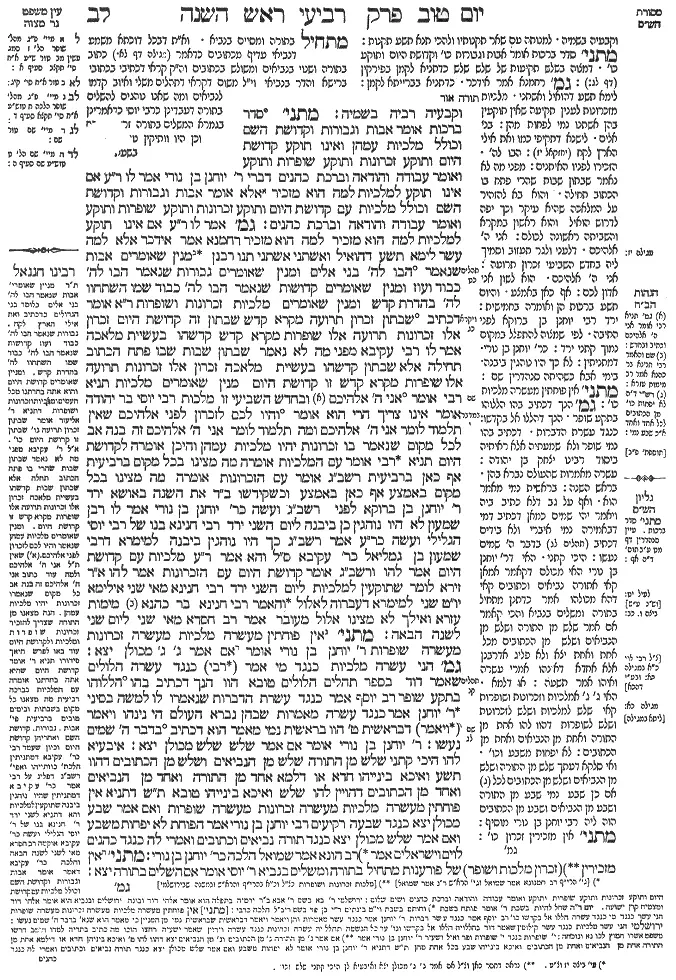
Rosh Hashanah 32a - Guemara
וקבעיה רביה בשמיה:
מתני׳ סדר ברכות אומר אבות וגבורות וקדושת השם וכולל מלכיות עמהן ואינו תוקע קדושת היום ותוקע זכרונות ותוקע שופרות ותוקע ואומר עבודה והודאה וברכת כהנים דברי ר' יוחנן בן נורי אמר לו ר"ע אם אינו תוקע למלכיות למה הוא מזכיר אלא אומר אבות וגבורות וקדושת השם וכולל מלכיות עם קדושת היום ותוקע זכרונות ותוקע שופרות ותוקע ואומר עבודה והודאה וברכת כהנים:
גמ׳ אמר לו ר"ע אם אינו תוקע למלכיות למה הוא מזכיר למה הוא מזכיר רחמנא אמר אידכר אלא למה עשר לימא תשע דהואיל ואשתני אשתני תנו רבנן מנין שאומרים אבות שנאמר (תהלים כט, א) הבו לה' בני אלים ומנין שאומרים גבורות שנאמר הבו לה' כבוד ועוז ומנין שאומרים קדושות שנאמר הבו לה' כבוד שמו השתחוו לה' בהדרת קדש ומנין שאומרים מלכיות זכרונות ושופרות ר"א אומר דכתיב (ויקרא כג, כד) שבתון זכרון תרועה מקרא קדש שבתון זה קדושת היום זכרון אלו זכרונות תרועה אלו שופרות מקרא קדש קדשהו בעשיית מלאכה אמר לו רבי עקיבא מפני מה לא נאמר שבתון שבות שבו פתח הכתוב תחילה אלא שבתון קדשהו בעשיית מלאכה זכרון אלו זכרונות תרועה אלו שופרות מקרא קדש זו קדושת היום מנין שאומרים מלכיות תניא רבי אומר (ויקרא כג, כב) אני ה' אלהיכם ובחדש השביעי זו מלכות רבי יוסי בר יהודה אומר אינו צריך הרי הוא אומר (במדבר י, י) והיו לכם לזכרון לפני אלהיכם שאין תלמוד לומר אני ה' אלהיכם ומה תלמוד לומר אני ה' אלהיכם זה בנה אב לכל מקום שנאמר בו זכרונות יהיו מלכיות עמהן והיכן אומרה לקדושת היום תניא רבי אומר עם המלכיות אומרה מה מצינו בכל מקום ברביעית אף כאן ברביעית רשב"ג אומר עם הזכרונות אומרה מה מצינו בכל מקום באמצע אף כאן באמצע וכשקידשו ב"ד את השנה באושא ירד ר' יוחנן בן ברוקא לפני רשב"ג ועשה כר' יוחנן בן נורי אמר לו רבן שמעון לא היו נוהגין כן ביבנה ליום השני ירד רבי חנינא בנו של רבי יוסי הגלילי ועשה כר"ע אמר רשב"ג כך היו נוהגין ביבנה למימרא דרבי שמעון בן גמליאל כר' עקיבא ס"ל והא אמר ר"ע מלכיות עם קדושת היום אמר להו ורשב"ג אומר קדושת היום עם הזכרונות אמר להו א"ר זירא לומר שתוקעין למלכיות ליום השני ירד רבי חנינא מאי שני אילימא יו"ט שני למימרא דעברוה לאלול והאמר רבי חנינא בר כהנא מימות עזרא ואילך לא מצינו אלול מעובר אמר רב חסדא מאי שני ליום שני לשנה הבאה:
מתני׳ אין פוחתין מעשרה מלכיות מעשרה זכרונות מעשרה שופרות ר' יוחנן בן נורי אומר אם אמר ג' ג' מכולן יצא:
גמ׳ הני עשרה מלכיות כנגד מי אמר (רבי) כנגד עשרה הלולים שאמר דוד בספר תהלים הלולים טובא הוו הנך דכתיב בהו (תהלים קנ, ג) הללוהו בתקע שופר רב יוסף אמר כנגד עשרת הדברות שנאמרו לו למשה בסיני ר' יוחנן אמר כנגד עשרה מאמרות שבהן נברא העולם הי נינהו ויאמר (ויאמר) דבראשית ט' הוו בראשית נמי מאמר הוא דכתיב (תהלים לג, ו) בדבר ה' שמים נעשו:
ר' יוחנן בן נורי אומר אם אמר שלש שלש מכולן יצא:
איבעיא להו היכי קתני שלש מן התורה שלש מן הנביאים ושלש מן הכתובים דהוו תשע ואיכא בינייהו חדא או דלמא אחד מן התורה ואחד מן הנביאים ואחד מן הכתובים דהויין להו שלש ואיכא בינייהו טובא ת"ש דתניא אין פוחתין מעשרה מלכיות מעשרה זכרונות מעשרה שופרות ואם אמר שבע מכולן יצא כנגד שבעה רקיעים רבי יוחנן בן נורי אמר הפוחת לא יפחות משבע ואם אמר שלש מכולן יצא כנגד תורה נביאים וכתובים ואמרי לה כנגד כהנים לוים וישראלים אמר רב הונא אמר שמואל הלכה כר' יוחנן בן נורי:
מתני׳ אין מזכירין (זכרון מלכות ושופר) של פורענות מתחיל בתורה ומשלים בנביא ר' יוסי אומר אם השלים בתורה יצא:
Comments from Rashi on Masechet Rosh Hashanah Page 32a
וקבעיה בשמיה . למנותה עם שאר תקנותיו ולהכי תנא תשע תקנות: מתני' סדר ברכות אומר אבות וגבורות כו' וקדושת היום ותוקע כו' — דמצוה בשלש תקיעות של שלש שלש כדתניא לקמן בפירקין (ראש השנה דף לג:): גמ' רחמנא אמר אידכר . כדתניא בברייתא לקמן: לימא תשע דהואיל ואשתני . מלכיות מזכרונות לענין תקיעה שאין תוקעין בהן אשתנו נמי לפחות מהן: בני אלים . לישנא דתקיפי כמו ואת אילי הארץ לקח (יחזקאל יז): הבו לה' . הזכירו לפניו האיתנים: מפני מה לא נאמר שבתון שבות שהרי פתח בו הכתוב תחילה . והוא בא להזהיר על המלאכה שהיא עיקר וכך יפה לדרוש הואיל והוא ראשון במקרא והשביתה ראשונה לכולם: אני ה' אלהיכם . דלעני ולגר תעזוב וסמיך ליה בחדש השביעי זכרון תרועה: אני ה' אלהיכם . הוא לשון אני אדון לכם: אף כאן באמצע . והיום תשע ברכות הן ואומרה בחמישית: ירד רבי יוחנן בן ברוקא לפני התיבה . לפי שמצוה להתפלל במקום נמוך קתני ירד: כר' יוחנן בן נורי . דמתניתין: לא כך היו נוהגין ביבנה . בימי אבא כשהיתה סנהדרין שם: מתני' אין פוחתין מעשרה מלכיות כו': גמ' הנך דכתיב בהו הללוהו בתקע שופר . הנך דהללו אל בקדשו: כנגד עשרת הדברות . דכתיב בהו נמי שופר ולא שמעתיה אלא ראיתיה ביסוד רבינו יצחק בן יהודה: עשרת מאמרות שהעולם נברא בהן . בראש השנה: בראשית נמי מאמר הוא . ואף על גב דלא כתיב ביה ויאמר יהי שמים כמאן דכתיב דמי דבאמירה נמי איברי ולא בידים דכתיב (תהלים לג) בדבר ה' שמים נעשו: היכי קתני . האי דר' יוחנן בן נורי האי מכולם דקאמר אמאן קאי אתורה נביאים וכתובים קאי דהא מכולהו אמר כדתנן מתחיל בתורה ומשלים בנביא והכי קאמר אם אמר שלש מן התורה ושלש מן הנביאים ושלש מן הכתובים מכל אחת ואחת יצא ולא פליג אדרבנן אלא אחדא דאינהו אמרי עשרה ואיהו אמר תשעה: או דלמא . האי ג' ג' אמלכיות וזכרונות ושופרות קאי שלש למלכיות ושלש לזכרונות ושלש לשופרות דהוו להו אחת מן התורה ואחת מן הנביאים ואחת מן הכתובים: לא יפחות משבע וכו' . ואי סלקא דעתך שלש מן התורה ושלש מן הנביאים ושלש מן הכתובים לכל אם כן שבע נמי שבע מן התורה ושבע מן הנביאים ושבע מן הכתובים הוה ליה רבי יוחנן בן נורי מוסיף: מתני' אין מזכירין זכרון כו':
Comments from Tosafot - Rosh Hashanah 32a
מתחיל בתורה ומסיים בנביא. וא"ת דבכל דוכתא משמע דנביאי עדיף מכתובים כדאמר (מנילה דף לא.) כתוב בתורה ושנוי בנביאים ומשולש בכתובים וה"ק קראי דכתיבי בכתובי ברישא והדר בנביאי וי"ל משום דקראי דתהלים משלי ואיוב קדמו לנביאים ומה שאנו נוהגים להשלים בתורה דעבדינן כרבי יוסי כדאמרינן בגמרא המשלים בתורה זריז ומשובח וכן היו וותיקין עושין:
Rosh Hashanah 32a - Mishnah translated into english
and his teacher established it in his name. Consequently, it is counted as one of Rabban Yoḥanan ben Zakkai’s ordinances.
MISHNA: The order of the blessings of the additional prayer on Rosh HaShana is as follows: One recites the blessing of the Patriarchs, the blessing of God’s Mighty Deeds, and the blessing of the Sanctification of God’s Name, all of which are recited all year long. And one includes the blessing of Kingship, containing many biblical verses on that theme, with them, i.e., in the blessing of the Sanctification of God’s Name, and he does not sound the shofar after it.
Next, one adds a special blessing for the Sanctification of the Day, and sounds the shofar after it; followed by the blessing of Remembrances, which contains many biblical verses addressing that theme, and sounds the shofar after it; and recites the blessing of Shofarot, which includes verses that mention the shofar, and sounds the shofar after it. And he then returns to the regular Amida prayer and recites the blessing of God’s Service and the blessing of Thanksgiving and the Priestly Blessing. This is the statement of Rabbi Yoḥanan ben Nuri.
Rabbi Akiva said to him: If one does not sound the shofar for the blessing of Kingship, why does he mention it? Rather, the order of the blessings is as follows: One recites the blessing of the Patriarchs and that of God’s Mighty Deeds and that of the Sanctification of God’s Name. He subsequently includes the blessing of Kingship in the blessing of the Sanctification of the Day, and sounds the shofar. Next he recites the blessing of Remembrances, and sounds the shofar after it, and the blessing of Shofarot and sounds the shofar after it. He then recites the blessing of God’s Service and the blessing of Thanksgiving and the Priestly Blessing.
GEMARA: The mishna taught that Rabbi Akiva said to him: If one does not sound the shofar for the blessing of Kingship, why does he mention it? The Gemara expresses surprise at this question: Why does he mention it? The Merciful One states that one should mention it. It is a mitzva to recite the blessing of Kingship, regardless of the sounding of the shofar. Rather, this is what Rabbi Akiva meant: Why does one mention ten verses of Kingship, as in the other blessings? Let him recite nine verses or fewer. Since the blessing is different in that it is not followed by shofar blasts, let it also be different with regard to the number of verses it includes.
§ The Sages taught in a baraita: From where is it derived that one recites the blessing of the Patriarchs? As it is stated: “Ascribe to the Lord, O you sons of the mighty” (Psalms 29:1), which is interpreted to mean that one should mention before God the greatness of the mighty, i.e., the righteous Patriarchs. And from where is it derived that one recites the blessing of God’s Mighty Deeds? As it is stated: “Ascribe to the Lord glory and strength” (Psalms 29:1). And from where is it derived that one recites the blessing of the Sanctification of God’s Name? As it is stated: “Ascribe to the Lord the glory due to His name; worship the Lord in the beauty of sanctity” (Psalms 29:2).
And from where is it derived that on Rosh HaShana one recites the blessings of Kingship, Remembrances, and Shofarot? Rabbi Eliezer says: As it is written: “In the seventh month, on the first day of the month, you shall have a solemn rest, a memorial of blasts, a sacred convocation” (Leviticus 23:24). This verse is interpreted as follows: “A solemn rest,” this is referring to the blessing of the Sanctification of the Day; “a memorial,” this is Remembrances; “blasts,” this is Shofarot; “a sacred convocation” this means sanctify it by abstaining from performing prohibited labor.
Rabbi Akiva said to Rabbi Eliezer: For what reason isn’t it stated instead that the phrase “solemn rest” teaches that one must rest by abstaining from prohibited labor, as this is the term with which the verse opened first. It stands to reason that the verse would begin with the main issue, i.e., that this day is a Festival on which performing labor is prohibited. Rather, the verse should be explained as follows: “A solemn rest,” sanctify it by abstaining from performing prohibited labor; “a memorial,” this is Remembrances; “blasts,” this is Shofarot; “a sacred convocation,” this is the Sanctification of the Day.
From where is it derived that that one recites the blessing of Kingship? It is taught in a baraita that Rabbi Yehuda HaNasi says: One verse states: “I am the Lord your God” (Leviticus 23:22), which is referring to God’s Kingship over the world; and two verses later it states: “In the seventh month” (Leviticus 23:24). This teaches that God’s Kingship must be mentioned on Rosh HaShana.
Rabbi Yosei bar Yehuda says: This is not necessary, as the verse states: “Also in the day of your gladness, and in your appointed seasons, and in your New Moons, you shall blow with the trumpets over your burnt-offerings, and over the sacrifices of your peace-offerings; that they may be to you for a remembrance before your God: I am the Lord your God” (Numbers 10:10). As there is no need for the verse to state: “I am the Lord your God,” and therefore what is the meaning when the verse states: “I am the Lord your God”? This is a paradigm that in all places where verses of Remembrances are stated, verses of Kingship should be recited with them.
§ The Gemara returns to the issue discussed in the mishna: And where does one recite the Sanctification of the Day? It is taught in a baraita that Rabbi Yehuda HaNasi says: One recites it with the blessing of Kingship, in the fourth blessing. He explains: Just as we find in all other places that the Sanctification of the Day is mentioned in the fourth blessing of the Amida prayer, so too here, it is recited in the fourth blessing.
Rabban Shimon ben Gamliel says: One recites it together with the blessing of Remembrances, in the fifth blessing. He explains: Just as we find in all other places that the Sanctification of the Day is mentioned in the middle blessing of the Amida prayer, e.g., on Shabbat, when it is the fourth of seven blessings, so too here, it is recited in the middle blessing, which in the case of Rosh HaShana is the fifth blessing, as the Rosh HaShana Amida prayer is comprised of nine blessings.
§ And the baraita relates that when the court sanctified the year in Usha, Rabbi Yoḥanan ben Beroka descended as the prayer leader in the presence of Rabban Shimon ben Gamliel, and he acted in accordance with the opinion of Rabban Yoḥanan ben Nuri by including the blessing of Kingship in the blessing of the Sanctification of God’s Name. Rabban Shimon said to him: They were not accustomed to act in this manner in Yavne. On the second day, Rabbi Ḥanina, son of Rabbi Yosei HaGelili, descended as the prayer leader, and he acted in accordance with the opinion of Rabbi Akiva by including the blessing of Kingship in the blessing of the Sanctification of the Day. Rabban Shimon ben Gamliel said: This is how they were accustomed to act in Yavne.
The Gemara asks a question concerning this baraita: Is that to say that Rabban Shimon ben Gamliel holds in accordance with the opinion of Rabbi Akiva? But didn’t Rabbi Akiva say that one recites the blessing of Kingship with the blessing of the Sanctification of the Day, and Rabban Shimon ben Gamliel says that one recites the blessing of the Sanctification of the Day with the blessing of Remembrances? Why then did Rabban Shimon ben Gamliel indicate his agreement with Rabbi Akiva’s practice? Rabbi Zeira said: Rabban Shimon ben Gamliel merely meant to say that he agrees that one sounds the shofar together with the blessing of Kingship, and that this was how they were accustomed to act in Yavne.
The baraita taught that on the second day Rabbi Ḥanina descended as the prayer leader. The Gemara asks: What is the meaning of: The second day? If we say that this is referring to the second day of the Festival day of Rosh HaShana, is that to say that they rendered Elul a full month, so that the thirtieth day of Elul was the first day of Rosh HaShana and the first day of Tishrei was the second day? But didn’t Rabbi Ḥanina bar Kahana say: From the days of Ezra onward we have not found that the month of Elul was ever rendered full. If so, it is difficult to believe that a case of this kind occurred in the time of the tanna’im. Rav Ḥisda said: What is the meaning of: The second day? It means on the second day, the next time it was Rosh HaShana, i.e., on Rosh HaShana of the following year.
MISHNA: One does not recite fewer than ten verses in the blessing of Kingship, or fewer than ten verses in the blessing of Remembrances, or fewer than ten verses in the blessing of Shofarot. Rabbi Yoḥanan ben Nuri says: If one recited three from each of them, he has fulfilled his obligation.
GEMARA: The Gemara asks: These ten verses of Kingship, to what do they correspond? Rabbi Yehuda HaNasi said: They correspond to the ten praises that David said in the book of Psalms. The Gemara asks: There are many more praises than that in the book of Psalms. The Gemara answers that he means those in which it is written by them: “Praise Him with the blast of the shofar” (Psalms 150:3). In that chapter the phrase “Praise Him” appears ten times.
Rav Yosef said: The ten verses correspond to the Ten Commandments, which were said to Moses at Sinai. Rabbi Yoḥanan said: They correspond to the ten utterances through which the world was created. The Gemara asks: Which are these ten utterances? The Gemara explains: This is referring to the ten times that the phrase “And He said” appears in the story of Creation in the first two chapters of Genesis.
The Gemara asks: Does it refer to the repetition of the phrase: “And He said” in Genesis? There are only nine such phrases, not ten. The Gemara answers that the phrase “In the beginning” is also considered an utterance, as it is written: “By the word of the Lord were the heavens made” (Psalms 33:6), which indicates that all of creation came into existence through a single utterance, after which all matter was formed into separate and distinct entities by means of the other nine utterances.
§ The mishna taught that Rabbi Yoḥanan ben Nuri says: If one recited three from each of them, he has fulfilled his obligation. A dilemma was raised before the Sages: What is he teaching here? Does Rabbi Yoḥanan ben Nuri mean that one must recite three verses from the Torah, three from the Prophets, and three from the Writings, which are nine in total, and if so the practical difference between the opinions of Rabbi Yoḥanan ben Nuri and the first tanna is only one verse? Or perhaps he means that one must recite one verse from the Torah and one from the Prophets and one from the Writings, which are three altogether, and the practical difference between them is a large number of verses, i.e., seven.
The Gemara clarifies this matter: Come and hear a proof, as it is taught in a baraita: One does not recite fewer than ten verses of Kingship, or fewer than ten verses of Remembrances, or fewer than ten verses of Shofarot. And if one recited seven from each of them, he has fulfilled his obligation, as they correspond to the seven firmaments in heaven.
Rabbi Yoḥanan ben Nuri said: One who recites fewer than the requisite ten should not recite fewer than seven, but if he recited three from each of them he has fulfilled his obligation, as they correspond to the Torah, the Prophets, and the Writings. And some say: They correspond to the priests, the Levites, and the Israelites. This indicates that Rabbi Yoḥanan ben Nuri means a total of three verses for each blessing. Rav Huna said that Shmuel said: The halakha is in accordance with the opinion of Rabbi Yoḥanan ben Nuri.
MISHNA: One does not mention verses of Remembrance, Kingship, and Shofar that have a theme of punishment. When reciting the ten verses, one begins with verses from the Torah and concludes with verses from the Prophets. Rabbi Yosei says: If he concluded with a verse from the Torah, he has fulfilled his obligation.
Traduction : The William Davidson digital edition of the Koren Noé Talmud, with commentary by Rabbi Adin Even-Israel Steinsaltz.