 Talmud Bavli
Beitza 21a : Youtube
Daf TubeYoutube
2 video classes :
Beitza Page 21a
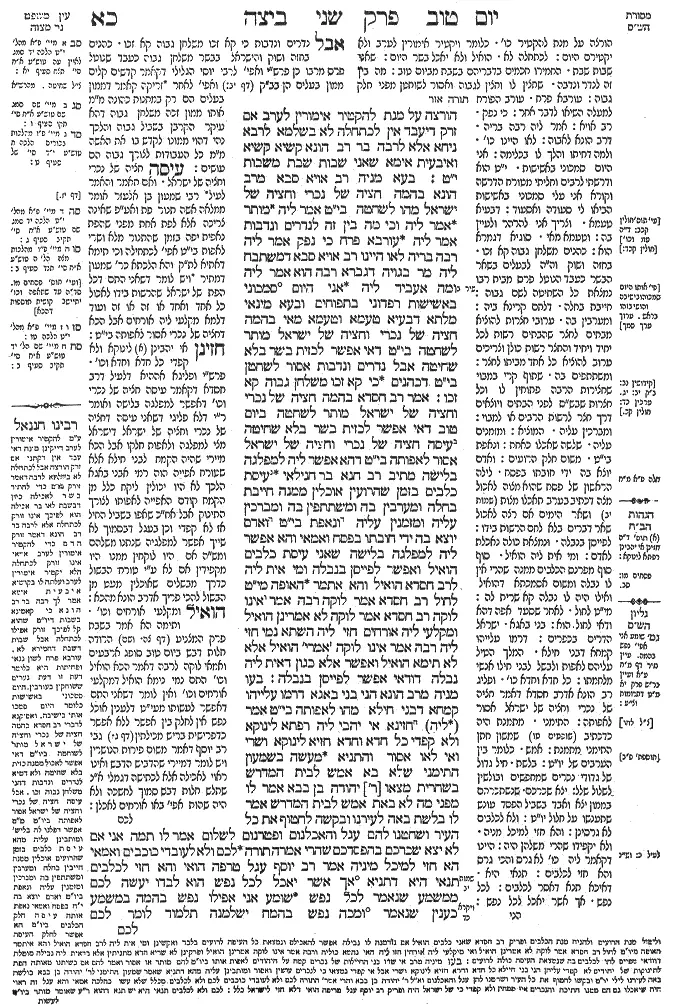
Beitza 21a - Guemara
הורצה על מנת להקטיר אימורין לערב אם זרק דיעבד אין לכתחלה לא בשלמא לרבא ניחא אלא לרבה בר רב הונא קשיא קשיא ואיבעית אימא שאני שבות שבת משבות י"ט:
בעא מניה רב אויא סבא מרב הונא בהמה חציה של נכרי וחציה של ישראל מהו לשחטה בי"ט אמר ליה מותר אמר ליה וכי מה בין זה לנדרים ונדבות אמר ליה עורבא פרח כי נפק אמר ליה רבה בריה לאו היינו רב אויא סבא דמשתבח ליה מר בגויה דגברא רבה הוא אמר ליה ומה אעביד ליה אני היום (שיר השירים ב, ה) סמכוני באשישות רפדוני בתפוחים ובעא מינאי מלתא דבעיא טעמא וטעמא מאי בהמה חציה של נכרי וחציה של ישראל מותר לשחטה בי"ט דאי אפשר לכזית בשר בלא שחיטה אבל נדרים ונדבות אסור לשחטן בי"ט דכהנים כי קא זכו משלחן גבוה קא זכו:
אמר רב חסדא בהמה חציה של נכרי וחציה של ישראל מותר לשחטה ביום טוב דאי אפשר לכזית בשר בלא שחיטה עיסה חציה של נכרי וחציה של ישראל אסור לאפותה בי"ט דהא אפשר ליה למפלגה בלישה מתיב רב חנא בר חנילאי עיסת כלבים בזמן שהרועין אוכלין ממנה חייבת בחלה ומערבין בה ומשתתפין בה ומברכין עליה ומזמנין עליה ונאפת בי"ט ואדם יוצא בה ידי חובתו בפסח ואמאי והא אפשר ליה למפלגה בלישה שאני עיסת כלבים הואיל ואפשר לפייסן בנבלה ומי אית ליה לרב חסדא הואיל והא אתמר האופה מי"ט לחול רב חסדא אמר לוקה רבה אמר אינו לוקה רב חסדא אמר לוקה לא אמרינן הואיל ומקלעי ליה אורחים חזי ליה השתא נמי חזי ליה רבה אמר אינו לוקה אמרי' הואיל אלא לא תימא הואיל ואפשר אלא כגון דאית ליה נבלה דודאי אפשר לפייסן בנבלה:
בעו מניה מרב הונא הני בני באגא דרמו עלייהו קמחא דבני חילא מהו לאפותה בי"ט אמר (ליה) חזינא אי יהבי ליה רפתא לינוקא ולא קפדי כל חדא וחדא חזיא לינוקא ושרי ואי לאו אסור והתניא מעשה בשמעון התימני שלא בא אמש לבית המדרש בשחרית מצאו [ר'] יהודה בן בבא אמר לו מפני מה לא באת אמש לבית המדרש אמר לו בלשת באה לעירנו ובקשה לחטוף את כל העיר ושחטנו להם עגל והאכלנום ופטרנום לשלום אמר לו תמה אני אם לא יצא שכרכם בהפסדכם שהרי אמרה תורה לכם ולא לעובדי כוכבים ואמאי הא חזי למיכל מיניה אמר רב יוסף עגל טרפה הואי והא חזי לכלבים תנאי היא דתניא (שמות יב, טז) אך אשר יאכל לכל נפש הוא לבדו יעשה לכם ממשמע שנאמר לכל נפש שומע אני אפילו נפש בהמה במשמע כענין שנאמר (ויקרא כד, יח) ומכה נפש בהמה ישלמנה תלמוד לומר לכם
Comments from Rashi on Masechet Beitza Page 21a
הורצה על מנת להקטיר כו' . כלומר ויקטיר אימורין לערב ולא יקטירם היום: לכתחלה לא . הואיל ולא יאכל בשר היום: שאני שבות שבת . החמירו חכמים בדבריהם בשבת מביום טוב: מה בין זה לנדר ונדבה . שחצין לו וחצין לגבוה ואסור לשוחטן מפני חלק גבוה: עורבא פרח . עורב הפורח למעלה השיאו לדבר אחר: כי נפק . רב אויא: אמר ליה רבה בריה . דרב הונא לאבוה: לאו היינו כו' . ולמה דחיתו והלך לו בכלימה: אני היום סמכוני באשישות . יו"ט הוא ודרשתי לרבים וחליתי מטורח הדרשה וקורא אני עלי סמכוני באשישות הביאו לי סעודה ואסעוד: דבעיא טעמא . וצריך אני להרהר ולעיין בה: וטעמא מאי . סוגיא דגמרא הוא: כהנים משלחן גבוה קא זכו . בחזה ושוק וה"ה לבעלים בשאר הבשר כעבד הנוטל פרס מבית רבו נמצאת כל השחיטה לשם גבוה: חייבת בחלה . דלחם קרינא ביה: ומערבין בה . ערובי חצרות להוציא מבתים לחצר שהבתים רשות לכל יחיד ויחיד והחצר רשות כולן וצריכים ערוב להוציא כל אחד מביתו לחצר: ומשתתפים בה . שתוף קרי במבוי שחצירות הרבה פתוחין לו וכל חצרות שבש"ס לפני הבתים ויוצאים דרך חצר לרשות הרבים או למבוי: ומברכין עליה . המוציא: ומזמנים עליה . שלשה שאכלו כאחת: ונאפת בי"ט . משום חלק הרועים: ואדם יוצא בה ידי חובתו בפסח . לילה הראשון של פסח שהוא מצוה לאכול מצה דכתיב בערב תאכלו מצות (שמות יב) ושאר הימים אם רצה לאכול שאר דברים בלא לחם הרשות בידו: לפייסן בנבלה . ונמצאת כולה נאכלת לאדם: ומי אית ליה הואיל . סוף סוף מפרנס הכלבים ממנה שהרי אין לו נבלה ומשום אסמכתא דהואיל ואילו היה לו נבלה קא שרית ליה: מיו"ט לחול . לאחר שסעד אפה דהא ודאי לחול הוא: בני באגא . ישראל הדרים בכפרים: דרמו עלייהו קמחא דבני חילא . המלך הטיל עליהם לאפות ולבשל לבני חילו אנשי מלחמתו: כל חדא וחדא כו' . ופליג רב הונא אדרב חסדא דאמר חציה של נכרי וחציה של ישראל אסור לאפותה: התימני . מתמנת היה כדכתיב (שופטים טו) שמשון חתן התימני מתמנת: אמש . כלומר בין הערבים של יו"ט: בלשת . חיל גדול של גדודי נכרים שמחפשים ובולשין לשלול שלל: יצא שכרכם . שנשתכרתם בממון יצא ואבד בשביל הפסד עונש שתענשו על חילול יו"ט: ולא לכלבים לא גרסינן: והא חזי למיכל מניה . ולא יקפידו שהרי משלהן היה: היינו דקאמר ליה כו' לא גרס והכי גרס והא חזי לכלבים: תנאי היא . דאיכא תנא דאסר לכלבים: לכל נפש . אך אשר יאכל לכל נפש:
Comments from Tosafot - Beitza 21a
אב נדרים ונדבות כי קא זכו משלחן גבוה קא זכו. כהנים בחזה ושוק והישראל בבשר משלחן גבוה כעבד שנוטל פרס מרבו כן פרש"י ואפי' לרבי יוסי הגלילי דקאמר קדשים קלים ממון בעלים הן בב"ק (דף יב:) ואפי' לאחר זריקה קאמר דממון בעלים הם רק במתנות כהונה מ"מ אותו ממון זכה משלחן גבוה דהא עיקר הקרבן בשביל גבוה והלכך נהי דהוי ממונו לקדש בו את האשה מ"מ כל העבודות לצורך גבוה הם עושים: עיסה חציה של נכרי וחציה של ישראל. ואם תאמר והאמר לעיל רבי שמעון בן אלעזר אומר ממלאה אשה תנור פת ואע"פ שאינה צריכה אלא לפת אחת מפני שהפת נאפית יפה בזמן שהתנור מלא ושרי לאפות בי"ט אפי' לכתחילה וכי תימא דאתיא לת"ק והא הלכתא כר' שמעון דמתיר ויש לומר דשאני התם דכל הפת של ישראל שהרשות בידו לאכול כל אחד ואחד או זה או זה ועוד דלמא מקלעי ליה אורחים אבל הכא דחציה של נכרי אסור לאפותה בי"ט: הואיל ומקלעי אורחים וכו'. ותימה הא אמר בשבת פרק המצניע (דף צה. ושם) הרודה חלות דבש ביום טוב סופג ארבעים ואמאי לוקה לרבה דאמר הכא הואיל וכו' התם נמי נימא הואיל דמקלעי אורחים וכו' ואין לומר דשאני התם דאפשר לעשותו מעי"ט דלענין אוכל נפש אין לחלק בין אפשר ללא אפשר כדפרישית בריש מכילתין (דף ג.) גבי רב יוסף דאמר משום פירות הנושרין ויש לומר דמיירי שהדביש הדבש ואינו ראוי לאכילה אלא לכתישה דגמלי א"נ שתלש חלות דבש סמוך לחשכה ולא היה שהות אפי' באו אורחים לאכלן: חזינן אי יהבינן לינוקא ולא קפדי כל חדא וחדא וכו'. פרש"י ופליגא אההיא דלעיל דרב חסדא דקאמר עיסה חציה של נכרי וכו' דאפשר למפלגה בלישה ואומר ר"י דלא פליגי דשאני עיסה דחציה של נכרי וחציה של ישראל דישראל מצי למפלגה ולאפות חלקו אבל הכא מיירי שהיה הקמח לבני חילא אלא שטורח אפייה הוה רמי אבני באגא הלכך לא היו יכולין ליקח כלל מן הקמח קודם האפייה לאפותו לצורך התינוק אבל אח"כ שאפו בשביל החיל אז לא קפדי וכן בעגל דבסמוך לא שייך אפשר למפלגיה שנתנו משלהם ומש"ה אם היו לוקחין ממנו היו מקפידין אם לא ע"י טורח הבשול כדרך מבשלים שאוכלין מעט מן הבשול להכי פריך אדרב הונא מהכא:
Beitza 21a - Mishnah translated into english
the offering is accepted on condition that he burn the sacrificial parts that are brought upon the altar in the evening and not during the day. The wording of the baraita indicates that if the meat may not be eaten on that day, then only if he already sprinkled the blood, i.e., after the fact, yes, it is permitted; however, he may not sprinkle it ab initio. Granted, according to the opinion of Rava it works out well, but according to the opinion of Rabba bar Rav Huna, it is difficult. The Gemara comments: Indeed, it is difficult. And if you wish, say instead: A rabbinic decree concerning Shabbat is different from a rabbinic decree concerning a Festival, as the Sages were more stringent with regard to Shabbat than with regard to Festivals.
§ Rav Avya the Elder raised the following dilemma before Rav Huna: If an animal is owned in partnership, half of it belonging to a gentile and half of it to a Jew, what is the halakha with regard to slaughtering it on a Festival? Rav Huna said to him: It is permitted. Rav Avya said to him: And what is the difference between this case and that of vow-offerings and gift-offerings? Vow-offerings and gift-offerings are similar to jointly owned animals, as part of the animal is sacrificed upon the altar while the other part is eaten by the owner and the priest. Why, then, is it not similarly permitted to slaughter them on a Festival? Seeking to distract Rav Avya so that he need not answer his question, Rav Huna said to him: Look, a raven flies in the sky.
When Rav Avya left, Rabba, son of Rav Huna, said to his father: Was this not Rav Avya the Elder, whom Master would recommend to us, saying that he is a great man? If so, why did you treat him in that manner and evade his question? Rav Huna said to him: What should I have done for him? Today I am in a state best described by the verse: “Let me lean against the stout trunks; let me couch among the apple trees” (Song of Songs 2:5), meaning I am worn out and exhausted from all the communal responsibility that has fallen upon me, and he asked me about something that requires reasoning and careful examination, and therefore I could not provide an immediate answer.
The Gemara asks: And what, then, is the reason? The Gemara explains the difference between a jointly owned animal and a vow-offering or gift-offering: A jointly owned animal, half of which belongs to a gentile and half to a Jew, may be slaughtered on a Festival, as it is impossible to obtain an olive-bulk of meat without slaughtering. If a Jew wishes to eat even a small portion of meat, he has no alternative but to slaughter an entire animal, even though he will not use all of it. Therefore, it does not matter if part of the animal belongs to a gentile. However, it is prohibited to slaughter vow-offerings and gift-offerings on a Festival, because in this case there is no real joint ownership of the animal, as the priests, when they receive their portions of the meat of the offering, and similarly, when Israelites partake of the offering, they receive their portions from the table of the Most High. In other words, the entire offering belongs to God, and those who partake of it are considered guests at His table; and as stated above, one may not slaughter an animal on a Festival for the sake of God.
In continuation of the previous discussion, Rav Ḥisda said: A jointly owned animal, half of which belongs to a gentile and half to a Jew, may be slaughtered on a Festival because it is impossible to obtain an olive-bulk of meat without slaughtering. However, with regard to dough, half of which belongs to a gentile and half to a Jew, it is prohibited to bake it on a Festival, as it is possible for him to divide it in half during the kneading and bake only the part that belongs to the Jew.
Rav Ḥana bar Ḥanilai raised an objection from the following mishna: Dough for bread that is meant for dogs, when it is of such quality that even shepherds eat of it, is considered like regular bread. Accordingly, one is obligated to separate ḥalla from such dough, and one may use it to establish an eiruv, i.e., a joining of courtyards and a joining of Shabbat boundaries, and to establish a merging of alleyways, and one recites a blessing before and after eating it, and one invites those with whom he ate to recite Grace after Meals after eating it, and it may be baked on a Festival, like all foods fit for human consumption, and a person fulfills his obligation to eat matza on the first night of Passover with it if it has not leavened.
With regard to the allowance to bake this dough, the Gemara asks: And why may it be baked on a Festival? Isn’t it possible to divide it during the kneading, so that he bakes only the portion to be eaten by people and leaves aside the part given to dogs? The Gemara answers: Dough for bread meant for dogs is different, since it is possible to appease them with a carcass. It is possible that one of his animals will die, and he will feed the carcass to the dogs, in which case all of the dough will be eaten by people.
The Gemara challenges this explanation: Does Rav Ḥisda accept the principle of since, i.e., that since it is possible that the situation may change, the halakha is not determined based on the current circumstances? But wasn’t it stated that the amora’im disagreed about the halakha governing one who intentionally bakes on a Festival day for a weekday? Rav Ḥisda said: He is flogged for desecrating the Festival. Rabba said: He is not flogged.
The Gemara explains the two opinions: Rav Ḥisda said that he is flogged because he holds that we do not say that since, if guests happen to visit him, whatever he bakes will be fit for him on the Festival itself, now too, although guests have not yet arrived, it is considered fit for him. According to that logic, baking would not be considered a full-fledged transgression, and one cannot be forewarned about it and does not receive lashes. Rabba, however, said: He is not flogged, as he holds that we do say the principle of: Since. As Rav Ḥisda himself does not accept the principle of since, how can it be used to resolve a difficulty raised against him?
Rather, the Gemara retracts its previous answer: Do not say that dough for dogs is different, since it is possible that one of his animals will die and he will appease the dogs with the carcass. Rather, the reference here is to a case where he has a carcass ready, so that it is certainly possible to appease them with the carcass. Consequently, when the shepherds bake the dough, it is highly likely that they will consume it all themselves.
§ They raised a dilemma before Rav Huna: With regard to the Jewish residents of a village [baga] upon whom the authorities imposed the obligation to supply flour and bread to the gentile military troops serving in the area, what is the halakha with regard to baking it on a Festival? Rav Huna said to them: We examine the matter: If those villagers can give bread from the soldiers’ quota to a child and the soldiers are not particular about it, then each and every one of the loaves is fit for a Jewish child, and therefore it is permitted to bake them. But if the soldiers do not allow anyone else to partake of their bread, it is prohibited to bake the loaves for them on a Festival.
The Gemara challenges Rav Huna’s lenient ruling: But isn’t it taught in a baraita: There was an incident involving Shimon the Timnite, who did not come on the night of the Festival to the study hall. In the morning, Rabbi Yehuda ben Bava found him and said to him: Why did you not come last night to the study hall? He said to him: A military unit on a search mission [balleshet] came to our city and wanted to pillage the entire city. We slaughtered a calf in order to placate them, and we fed them with it and had them depart in peace.
Rav Yehuda ben Bava said to him: I wonder if your gain, that which you saved by preventing the soldiers from taking your possessions, was not outweighed by your loss, the punishment for your desecration of the Festival. As the Torah states: “Only that which every soul must eat, that alone may be done for you” (Exodus 12:16), which indicates that food may be prepared for you, but not for gentiles. The Gemara asks: But why did Rabbi Yehuda ben Bava say this? Wasn’t some portion of the calf fit to be eaten by them? The conclusion seems to be that even if a Jew may eat from an animal, it may not be slaughtered on a Festival for the sake of a gentile.
Rav Yosef said: In that case it was a calf with a condition that would cause it to die within twelve months [tereifa], which may not be eaten by Jews. The Gemara challenges: But wasn’t it still fit to be eaten by dogs, and it could be argued that it was slaughtered for the sake of dogs belonging to Jews?
The Gemara answers: The question of whether or not one may perform prohibited labor on a Festival for the sake of dogs is a dispute between tanna’im. As it is taught in a baraita: It is written: “Only that which every soul must eat, that alone may be done for you.” By inference, from that which is stated: “Every soul,” I might derive that even the soul of an animal is included, similar to that which is stated: “And he that kills the soul of an animal shall pay it” (Leviticus 24:18), indicating that the life force of an animal is also called a soul. Therefore, the verse states and emphasizes: “For you,”
Traduction : The William Davidson digital edition of the Koren Noé Talmud, with commentary by Rabbi Adin Even-Israel Steinsaltz.