 Talmud Bavli
Beitza 37a : Youtube
Daf TubeYoutube
2 video classes :
Beitza Page 37a
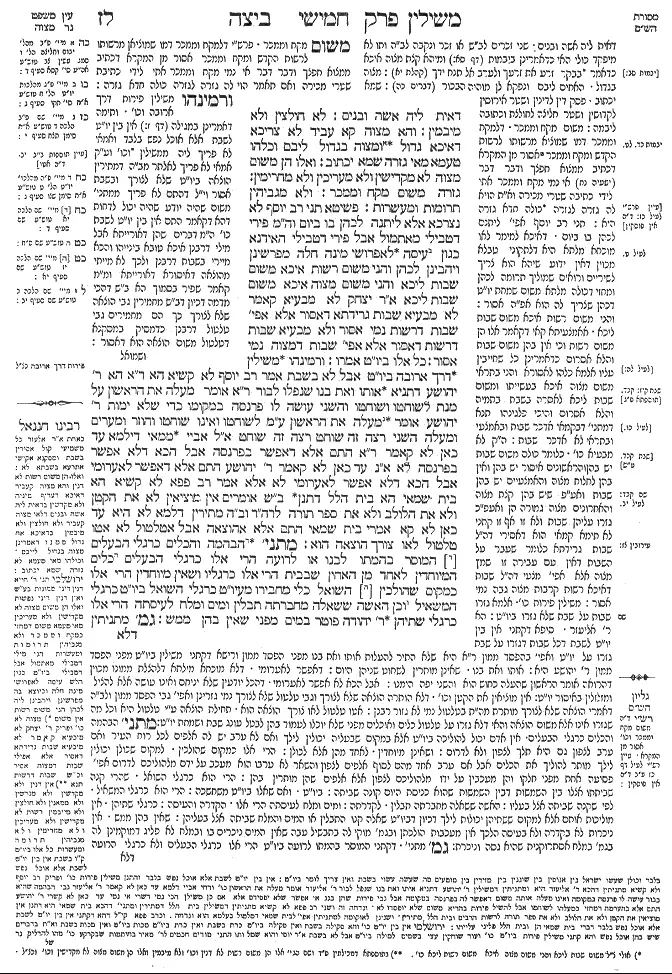
Beitza 37a - Guemara
דאית ליה אשה ובנים:
לא חולצין ולא מיבמין:
והא מצוה קא עביד לא צריכא דאיכא גדול ומצוה בגדול ליבם וכלהו טעמא מאיגזרה שמא יכתוב:
ואלו הן משום מצוה לא מקדישין ולא מעריכין ולא מחרימין:
גזרה משום מקח וממכר:
ולא מגביהין תרומות ומעשרות:
פשיטא תני רב יוסף לא נצרכא אלא ליתנה לכהן בו ביום וה"מ פירי דטבילי מאתמול אבל פירי דטבילי האידנא כגון עיסה לאפרושי מינה חלה מפרשינן ויהבינן לכהן והני משום רשות איכא משום שבות ליכא והני משום מצוה איכא משום שבות ליכא א"ר יצחק לא מבעיא קאמר לא מבעיא שבות גרידתא דאסור אלא אפי' שבות דרשות נמי אסור ולא מבעיא שבות דרשות דאסור אלא אפי' שבות דמצוה נמי אסור:
כל אלו ביו"ט אמרו:
ורמינהו משילין דרך ארובה ביו"ט אבל לא בשבת אמר רב יוסף לא קשיא הא ר"א הא ר' יהושע דתניא אותו ואת בנו שנפלו לבור ר"א אומר מעלה את הראשון על מנת לשוחטו ושוחטו והשני עושה לו פרנסה במקומו כדי שלא ימות ר' יהושע אומר מעלה את הראשון ע"מ לשוחטו ואינו שוחטו וחוזר ומערים ומעלה השני רצה זה שוחט רצה זה שוחט א"ל אביי ממאי דילמא עד כאן לא קאמר ר"א התם אלא דאפשר בפרנסה אבל הכא דלא אפשר בפרנסה לא א"נ עד כאן לא קאמר ר' יהושע התם אלא דאפשר לאערומי אבל הכא דלא אפשר לאערומי לא אלא אמר רב פפא לא קשיא הא בית שמאי הא בית הלל דתנן ב"ש אומרים אין מוציאין לא את הקטן ולא את הלולב ולא את ספר תורה לרה"ר וב"ה מתירין דלמא לא היא עד כאן לא קא אמרי בית שמאי התם אלא אהוצאה אבל אטלטול לא אטו טלטול לאו צורך הוצאה הוא:
מתני׳ הבהמה והכלים כרגלי הבעלים המוסר בהמתו לבנו או לרועה הרי אלו כרגלי הבעלים כלים המיוחדין לאחד מן האחין שבבית הרי אלו כרגליו ושאין מיוחדין הרי אלו כמקום שהולכין השואל כלי מחבירו מעיו"ט כרגלי השואל ביו"ט כרגלי המשאיל וכן האשה ששאלה מחברתה תבלין ומים ומלח לעיסתה הרי אלו כרגלי שתיהן ר' יהודה פוטר במים מפני שאין בהן ממש:
גמ׳ מתניתין
Comments from Rashi on Masechet Beitza Page 37a
דאית ליה אשה ובנים . שני זכרים לב"ש או זכר ונקבה לב"ה ותו לא מיפקד כולי האי כדאמרינן ביבמות (דף סא:) ומיהא קצת מצוה איכא כדאמר בבקר זרע את זרעך ולערב אל תנח ידך (קהלת יא): מצוה בגדול . האחים ליבם ונפקא לן מוהיה הבכור (דברים כה): שמא יכתוב . פסק דין לדינין ושטר אירוסין לקדושין ושטר חליצה לחולצת וכתובה ליבמה: משום מקח וממכר . דלמקח וממכר דמו שמוציא מרשותו לרשות הקדש ומקח וממכר אסור מן המקרא דכתיב ממצוא חפצך ודבר דבר (ישעיהו נח) אי נמי מקח וממכר אתי לידי כתיבה שטרי מכירה וא"ת הויא לה גזרה לגזרה כולה חדא גזרה היא: תני רב יוסף אפי' ליתנם לכהן בו ביום . דאיכא למימר לאו מוכחא מלתא היא דלתקוני טבלא מכוין דאין ידוע שיהא הוא צריך לשיריים ורואים שמוליך תרומה לכהן ומחזי דכולה מלתא משום שמחת יו"ט דכהן שצריך לה הוא אפ"ה אסור: והני משום רשות איכא משום שבות ליכא . אאמצעיתא קאי דקאמר אלו הן משום רשות וכי אין בהן משום שבות והלא אסרום כדאמרינן כל שחייבין עליו אלמא כלהו לאסורא והני בתראי משום מצוה איכא בעשייתו ומשום שבות ליכא לאסרה בשבת בתמיה והלא אסרום והיכי פלגינהו תנא דמתני' דבקמאי אדכר שבות ובאמצעי ובתראי לא אדכר שבות ה"ק לא מבעיא כו' . כלומר כולם משום שבות יש בהן והראשונים איסור יש בהן ואין בהן לחלוח מצוה והאמצעיים יש בהן שבות ואע"פ שיש בהן קצת מצוה והאחרונים מצוה גמורה הן ואעפ"כ גזרו עליהן שבות ולא זו אף זו קתני לא תימא קמאי הוא דאסירי דה"ל שבות גרידתא כלומר שעבר על השבות דאין עם עבירה זו שמץ מצוה אלא אפי' מצעי דה"ל שבות דאיכא רשות קרבות מצוה גבה נמי אסור: משילין פירות כו' . אלמא גזרו שבות על שבת שלא גזרו ביו"ט: הא ר' אליעזר . סיפא דקתני אין בין יו"ט לשבת דכל שבות דגזרו על שבת גזרו על יו"ט ואפי' בהפסד ממון ר"א היא שלא התיר להעלות אותו ואת בנו מפני הפסד ממון ורישא דקתני משילין ביו"ט מפני הפסד ממון ר' יהושע היא: אותו ואת בנו . שאינן מותרין לשחוט שניהן היום: דאפשר לאערומי . דלא מוכחא מילתא דלהצלת ממונו מכוין דהרואה אומר הראשון שהעלה כחוש הוא והשני יפה הימנו: אבל הכא לא אפשר לאערומי . דהכל יודעין שלא יניחם ואינו עושה אלא להציל ומזלזלין באיסור יו"ט: אין מוציאין את הקטן וכו' . דלא הותרה הוצאה שלא לצורך וגבי טלטול שלא לצורך נמי גזרינן ואפילו גבי הפסד ממון ולב"ה דאמרי הוצאה שלא לצורך מותרת מה"ת בטלטול נמי לא גזור רבנן: אטו טלטול לאו צורך הוצאה הוא . תחילת הוצאה ע"י טלטול היא וכל מה שגזרו אינו משום הוצאה והאי דלא גזרו על טלטול כלים ואוכלים מפני שלא יוכלו לעמוד בהן לבטל עונג שבת ושמחת יו"ט: מתני' הבהמה והכלים כרגלי הבעלים . אין אדם יכול להוליכה ביו"ט אלא במקום שבעליה יכולין לילך ואם לא ערב יש לה אלפים לכל רוח העיר ואם ערב לצפון גם היא תלך לצפון ולא לדרום: ושאינן מיוחדין . לאחד מהן אלא לכולן: הרי אלו כמקום שהולכין . למקום שכולן יכולין לילך מותר להוליך את הכלים אבל אם ערב אחד מהם לסוף אלפים לצפון והשאר לא ערבו הוא מעכב על ידם מלהוליכם לדרום אפילו פסיעה אחת מפני חלקו והן מעכבין על ידו מלהוליכם לצפון אלא אלפים שהן מותרין בהן: הרי הוא כרגלי השואל . שהרי קנה שביתתו אצלו בין השמשות דבין השמשות שהוא כניסת היום קונה שביתה: ביו"ט . ואם שאלו ביו"ט משחשכה: הרי הוא כרגלי המשאיל . לפי שקנה שביתה אצל בעליו: האשה ששאלה מחברתה תבלין . לקדרתה: ומים ומלח לעיסתה הרי אלו . הקדרה והעיסה: כרגלי שתיהן . אין מוליכות אותם אלא למקום ששתיהן יכולות לילך דכיון דביו"ט שאלה קנו התבלין או המים והמלח שביתה אצל בעליהן: שאין בהן ממש . אין ניכרות לא בקדרה ולא בעיסה הלכך אין מעכבות הולכתן ובגמ' מוקי לה בתבשיל עבה שאין המים ניכרים בו ובמלח לא פליג דמוקמינן לה בגמ' במלח אסתרוקנית שהיא גסה וניכרת: גמ' מתני' . דקתני המוסר בהמתו לרועה ביו"ט הרי אלו כרגלי הבעלים ולא כרגלי הרועה
Comments from Tosafot - Beitza 37a
משום מקח וממכר. פרש"י דלמקח וממכר דמו שמוציאן מרשותו לרשות הקדש ומקח וממכר אסור מן המקרא דכתיב ממצוא חפצך ודבר דבר אי נמי מקח וממכר אתי לידי כתיבת שטרי מכירה ואם תאמר הוי לה גזרה לגזרה כולה חדא גזרה: ורמינהו משילין פירות דרך ארובה וכו'. ותימה דאמרינן במגילה (דף ז:) אין בין יו"ט לשבת אלא אוכל נפש בלבד ואמאי לא פריך ליה ממשילין. וכו' וע"ק אמאי לא פריך לאלתר מב"ה דמתירין הוצאה ביו"ט שלא לצורך ובשבת אסור וי"ל דהתם לא פריך ממתני' משום שהיה יודע שהיה יכול לדחות דהא דקאמר התם אין בין יו"ט לשבת כו' ה"מ דברים שהן דאורייתא אבל מילי דרבנן איכא טובא בינייהו והכא מיירי בשבות דרבנן ולכך לא מייתי מהוצאה דאיסורא דאורייתא ומ"מ קאמר שפיר בסמוך הא ב"ש דהכי מדמה דכיון דב"ש מחמירין גבי הוצאה שלא לצורך כך הם מחמירים גבי טלטול דרבנן כדמסיק במסקנא דטלטול משום הוצאה הוא דאסור:
Beitza 37a - Mishnah translated into english
because it is dealing with a case in which he already has a wife and children, so that he has already fulfilled the mitzva to be fruitful and multiply, and his betrothal of another woman is only an optional act.
§ Nor perform ḥalitza, nor perform levirate marriage: The Gemara asks: But doesn’t one perform a mitzva through these acts? Why are they categorized as optional? The Gemara answers: No, it is necessary for the mishna to categorize them as optional, as it is speaking of a case when there is an older brother. Since the general principle is that the preferable way to carry out the mitzva is for the oldest brother to perform levirate marriage, the performance of levirate marriage by a younger brother is classified as optional.
The Gemara clarifies the reason for the prohibition against judging, betrothing, etc., on Shabbat and Festivals: And in all these cases, what is the reason they may not be performed? It is a decree lest one write down the proceedings of these acts in a document, such as the verdict of a judgment, the document of betrothal, a document testifying to the ḥalitza, or a marriage contract in the case of levirate marriage.
§ It was taught in the mishna: And the following are notable because of the full-fledged mitzva involved in them, yet are prohibited on Shabbat: One may not consecrate, nor take a valuation vow, nor consecrate objects for use by the priests or the Temple. The Gemara explains: All these cases are prohibited because of a decree due to their similarity to commerce. These acts, which all involve the transfer of ownership to the Temple treasury, resemble commerce, which is prohibited on a Festival.
§ It was taught in the mishna: And one may not separate terumot and tithes. The Gemara asks: Is it not obvious that this is so? In doing so one makes forbidden food usable, a form of repairing, which is a prohibited labor. Rav Yosef taught: It is necessary for the mishna to teach this only to state that it is prohibited even to separate teruma in order to give it to a priest on the same day. One could have thought that since he is separating the produce in order to give it to a priest it should be permitted like any other preparation of food; the mishna therefore states explicitly that it is prohibited.
The Gemara comments: And this applies only to produce that had the status of untithed produce, and therefore was required to be tithed, the day before the Festival. However, produce that became untithed now on the Festival itself, such as dough prepared on the Festival, which becomes untithed and requires ḥalla to be taken from it only after the dough is made: With regard to separating ḥalla from it, one may separate the ḥalla and give it to a priest even on a Festival.
The Gemara asks a question. When the mishna describes those cases as notable because they are optional, is this to say that their prohibition is not because of a rabbinic decree to enhance the character of Shabbat as a day of rest [shevut]? Likewise, with regard to those cases described as notable because they are mitzvot, is this to say that their prohibition is not because of shevut? The mishna, by referring only to the first of its three categories as shevut, implies that the acts listed in the following categories do not involve shevut. But this is not so; as the Gemara stated above, all these acts are prohibited by rabbinic decree to enhance the character of Shabbat and the Festival as days of rest.
Rabbi Yitzḥak said: They are indeed all prohibited as shevut. The mishna lists three types of shevut: Those that involve no mitzva whatsoever, those that have a mitzva aspect to them, and those that constitute a full-fledged mitzva. And the tanna is speaking and arranges his list employing the style of: There is no need, i.e., he arranges the cases in order of increasing notability. First, there is no need to state, i.e., it is most obvious, that plain shevut, which involves no mitzva at all, is prohibited, but even shevut of an optional act, i.e., an act that is a minor mitzva, is also prohibited. And there is no need to state, i.e., it is obvious, that shevut of an optional act is prohibited, but even shevut of a full-fledged mitzva is also prohibited.
§ It was taught in the mishna: The Sages spoke of all these acts being prohibited even with regard to a Festival; all the more so are they prohibited on Shabbat. There is no difference between a Festival and Shabbat except for work involving food. The Gemara raises a contradiction against this from an earlier mishna: One may lower produce from the roof into the house through a skylight to prevent it from being spoiled by the rain on a Festival, but not on Shabbat. This shows that there is another difference between a Festival and Shabbat besides food preparation: Doing a strenuous activity to prevent a loss is permitted on a Festival but prohibited on Shabbat.
Rav Yosef said: This is not difficult, as this mishna here, which does not include the halakha of lowering produce as an example of a difference between Shabbat and a Festival, is in accordance with Rabbi Eliezer, whereas that previous mishna that does cite it as a difference is in accordance with Rabbi Yehoshua.
Rav Yosef elaborates on his statement: As it is taught in a baraita: If a cow and her calf, which may not be slaughtered on the same day because of the biblical prohibition: “You shall not kill it and its offspring both in one day” (Leviticus 22:28), fell into a pit on a Festival, and their owner wishes to take them out, Rabbi Eliezer says: One may raise the first in order to slaughter it and then slaughter it, and as for the second, he provides it sustenance in its place so that it will not die in the pit. It is prohibited to undertake the strenuous task of raising an animal out of a pit except for the purpose of eating it on the Festival. Therefore, since one cannot slaughter both animals on the Festival, only one can be raised, while the other should be sustained in its place until after the Festival.
Rabbi Yehoshua, however, says: One may raise the first with the intent of slaughtering it and then change his mind and not slaughter it. Then he may go back and employ artifice by deciding that he prefers to slaughter the second one, and he raises the second. Having raised both animals, if he so desires he may slaughter this one; if he so desires he may slaughter that one. Rav Yosef understands the argument between the two Sages as follows: Rabbi Yehoshua maintains that it is permitted to perform a strenuous activity on a Festival in order to prevent a loss, and therefore he may raise both animals, lest the one left behind die in the pit. Rabbi Eliezer, on the other hand, holds that one may not perform a strenuous activity to prevent a loss, so the second animal must be left in the pit even though it may die there. It may therefore be posited that the mishna that permits lowering produce on a Festival to prevent loss is in accordance with Rabbi Yehoshua’s opinion. Rabbi Eliezer would disagree with this leniency, and the principle that there is no difference between Shabbat and a Festival other than food preparation would remain intact.
Abaye said to Rav Yosef: From where do you know that this analysis of these Sages’ opinions is correct? Perhaps Rabbi Eliezer stated his opinion that a strenuous activity to prevent monetary loss is prohibited on a Festival only thus far, there in the case of the animals in the pit, where it is possible to sustain the second animal in the pit and keep it from dying. But here, in the case of the produce on the roof, where there is no possibility of preventing the loss through providing sustenance, he would not prohibit lowering the produce to save it from loss.
Alternatively, one can propose an opposite argument: Rabbi Yehoshua stated his opinion that a strenuous activity to prevent loss is permitted only thus far, there in the case of the two animals, because it is possible to employ artifice to raise the second animal, so that an observer might assume that that he was not acting to preserve his property, but wished to eat the first animal and subsequently changed his mind. But here, in the case of the produce on the roof, where it is not possible to employ artifice, as it is clear that he is acting to salvage his produce, Rabbi Yehoshua would not be lenient. Therefore, Rav Yosef’s approach to resolving the contradiction has no support from this baraita.
Rather, Rav Pappa said: This resolution of the contradiction is to be rejected in favor of the following: This is not difficult, as this case is in accordance with Beit Shammai, whereas that case follows the approach of Beit Hillel.
As we learned in a mishna: Beit Shammai say: On a Festival one may not take out a child who cannot walk, nor a lulav, nor a Torah scroll into the public domain, as none of these are required for the preparation of food, and Beit Hillel permit it. It is certainly prohibited to carry out any item into the public domain on Shabbat, yet Beit Hillel permit it on a Festival. Therefore, it may be posited that just as Beit Hillel allow carrying out items on a Festival but not on Shabbat, so would they permit moving the produce off the roof on a Festival but not on Shabbat. According to Beit Shammai, who forbid carrying items out on a Festival and on Shabbat equally, moving the produce from the roof would also be equally prohibited, and the principle that there is no difference between Shabbat and a Festival other than food preparation would remain intact.
The Gemara at first refutes this explanation: Perhaps that is not so, as it is possible that Beit Shammai stated their opinion only thus far, there with regard to the prohibition against transferring objects from one domain to another, but not with regard to moving objects, such as produce, from place to place in the house. The Gemara rejects this claim: Is that to say that moving is not performed for the sake of taking out to the public domain? The decree against moving items unnecessarily, i.e., not for use on Shabbat or a Festival, was enacted due to a concern that one might take objects into the public domain. Rav Pappa’s explanation that it is only Beit Shammai who would prohibit lowering the produce from the roof therefore stands.
MISHNA: The status of animals and vessels on Festivals is as the feet of their owner, meaning that one’s animals and vessels are governed by his own travel limitations on Shabbat and Festivals. In the case of one who delivers his animal to his son or to a shepherd before the Festival to care for it, these are as the feet of the owner, rather than those of the son or the shepherd.
Vessels that have been inherited by several brothers and have not been divided among them but are still owned jointly, if they are designated for the use of one of the brothers in the house and the other brothers have no part in them, these are as his feet, and they are subject to his travel limitations. And as for those that are not designated for any particular brother, these are as a place where they may all go. They are limited by the travel limitations of every one of the brothers, as when one brother made a joining of Shabbat boundaries [eiruv teḥumin] and the others did not.
One who borrows a vessel from another on the eve of a Festival, it is as the feet of the borrower rather than the owner, as when the Festival began the vessel established its place of rest in possession of the borrower. However, if he borrowed it on the Festival itself, it is as the feet of the lender, since at the start of the Festival its place of rest was established in the possession of its owner. And similarly, a woman who borrowed spices from another to put in a dish, or water and salt to put in her dough, these foods, i.e., the dish and the dough, which contain ingredients belonging to both parties, are as the feet of both of them; they are limited by the travel limitations of both parties. Rabbi Yehuda exempts one from travel limitations in the case of water, because it has no substance in the mixture and therefore is not considered connected to the original owner.
GEMARA: The Gemara asserts: The mishna
Traduction : The William Davidson digital edition of the Koren Noé Talmud, with commentary by Rabbi Adin Even-Israel Steinsaltz.