 Talmud Bavli
Beitza 30a : Youtube
Daf TubeYoutube
2 video classes :
Beitza Page 30a
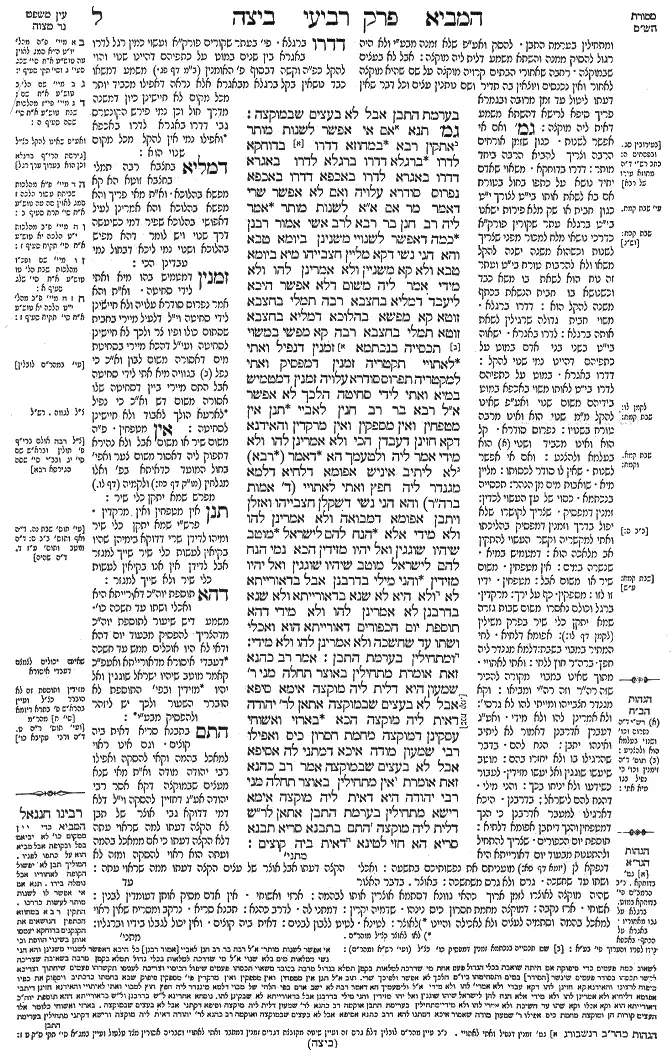
Beitza 30a - Guemara
בערמת התבן אבל לא בעצים שבמוקצה:
גמ׳ תנא אם אי אפשר לשנות מותר אתקין רבא במחוזא דדרו בדוחקא לדרו ברגלא דדרו ברגלא לדרו באגרא דדרו באגרא לדרו באכפא דדרו באכפא נפרוס סודרא עלויה ואם לא אפשר שרי דאמר מר אם א"א לשנות מותר אמר ליה רב חנן בר רבא לרב אשי אמור רבנן כמה דאפשר לשנויי משנינן ביומא טבא והא הני נשי דקא מליין חצבייהו מיא ביומא טבא ולא קא משניין ולא אמרינן להו ולא מידי אמר ליה משום דלא אפשר היכא ליעבד דמליא בחצבא רבה תמלי בחצבא זוטא קא מפשא בהלוכא דמליא בחצבא זוטא תמלי בחצבא רבה קא מפשי במשוי תכסייה בנכתמא זמנין דנפיל ואתי לאתויי תקטריה זמנין דמפסיק ואתי למקטריה תפרוס סודרא עלויה זמנין דמטמיש במיא ואתי לידי סחיטה הלכך לא אפשר א"ל רבא בר רב חנין לאביי תנן אין מטפחין ואין מספקין ואין מרקדין והאידנא דקא חזינן דעבדן הכי ולא אמרינן להו ולא מידי אמר ליה ולטעמך הא דאמר (רבא) לא ליתיב איניש אפומא דלחיא דלמא מגנדר ליה חפץ ואתי לאתויי (ד' אמות ברה"ר) והא הני נשי דשקלן חצבייהו ואזלן ויתבן אפומא דמבואה ולא אמרינן להו ולא מידי אלא הנח להם לישראל מוטב שיהיו שוגגין ואל יהיו מזידין הכא נמי הנח להם לישראל מוטב שיהיו שוגגין ואל יהיו מזידין והני מילי בדרבנן אבל בדאורייתא לא ולא היא לא שנא בדאורייתא ולא שנא בדרבנן לא אמרינן להו ולא מידי דהא תוספת יום הכפורים דאורייתא הוא ואכלי ושתו עד שחשכה ולא אמרינן להו ולא מידי:
ומתחילין בערמת התבן:
אמר רב כהנא זאת אומרת מתחילין באוצר תחלה מני ר' שמעון היא דלית ליה מוקצה אימא סיפא אבל לא בעצים שבמוקצה אתאן לר' יהודה דאית ליה מוקצה הכא בארזי ואשוחי עסקינן דמוקצה מחמת חסרון כיס ואפילו רבי שמעון מודה איכא דמתני לה אסיפא אבל לא בעצים שבמוקצה אמר רב כהנא זאת אומרת אין מתחילין באוצר תחלה מני רבי יהודה היא דאית ליה מוקצה אימא רישא מתחילין בערמת התבן אתאן לר"ש דלית ליה מוקצה התם בתבנא סריא תבנא סריא הא חזי לטינא דאית ביה קוצים:
Comments from Rashi on Masechet Beitza Page 30a
ומתחילין בערמת התבן . להסק ואע"פ שלא זמנה מבע"י ולא היה רגיל להסיק ממנה והשתא משמע דלית ליה מוקצה: אבל לא בעצים שבמוקצה . רחבה שאחורי הבתים קרויה מוקצה על שם שהיא מוקצה לאחור ואין נכנסים ויוצאין בה תדיר ושם נותנין עצים וכל דבר שאין דעתו ליטול עד זמן מרובה ובגמרא פריך סיפא לרישא דהשתא משמע דאית ליה מוקצה: גמ' ואם אי אפשר לשנות . כגון שזמן אורחים הרבה וצריך להביא הרבה ביחד מותר: דדרו בדוחקא . משאוי שאדם יחיד נושא על כתפו בחול בטורח אם בא לשאת אותו בי"ט לצורך י"ט כגון חבית או שק מלא פירות ישאנו בי"ט ברגלא עתר שקורין פורק"א כדרכי נושאי מלח למכור מפני שצריך לשנות וכשהוא משנה ישנה להקל משאו ולא להרבות טורח בי"ט ועתר זה נוח הוא לשאת בו משא כבד וכשנושא בו חבית הנשאת בכתף משנה להקל הוא: דדרו ברגלא . משוי חבית גדולה שרגילין לשאת אותה ברגלא: לדרו באגרא . ישאוה בי"ט בשני בני אדם במוט על כתפיהם דהיינו נמי שנוי להקל: דדרו באגרא . במוט על כתפיהם לדרו בי"ט לאותו משוי באכפא במוט בידיהם משום שנוי ואע"פ שאינו להקל מ"מ שנוי הוא ואינו מרבה טורח בשנויו: נפרוס סודרא . קל הוא ואינו מכביד ושנוי הוא בעלמא ולהצנע: ואם אי אפשר לשנות . שאין לו סודר לכסותו: מליין מיא . שואבות מים מן הנהר: תכסייה בנכתמא . כסוי של עץ העשוי לכדין: זמנין דמפסיק . שצריך לקושרו שלא יפול בדרך וזמנין דמפסיק בהליכתו ואתי למקשריה וקשר העשוי להתקין אב מלאכה הוא: דמטמיש במיא . שנשרה במים: אין מטפחין . משום שיר או משום אבל: מטפחין . ידיו זו לזו: מספקין . כף על ירך: מרקדין . ברגל וכולם נאסרו משום שבות גזרה שמא יתקן כלי שיר בפרק משילין (לקמן ביצה דף לו:): אפומא דלחיא . לחי המתיר במבוי בשבת: דלמא מגנדר ליה חפץ . ברה"ר חוץ ללחי: ואתי לאתויי . מתוך שאינו במבוי מקורה להכיר שזה רה"ר וזה רה"י ומביאו: וקא מגנדר חצבייהו ומייתי להו לא גרסי': ולא אמרינן להו ולא מידי . ואע"ג דעברן אדרבנן דאמור לא ליתיב ואינהו יתבן: הנח להם . בדבר שהרגילו בו ולא יחזרו בהם: מוטב שיעשו שוגגין ואל יעשו מזידין . לעבור כשידעו ולא יניחו בכך: והני מילי . דהנח להם לישראל: בדרבנן . היכא דארגילו למעבר אדרבנן כי הנך דמטפחין והנך דיתבן אפומא דלחיא: תוספת יום הכפורים . שצריך להתחיל ולהתענות מבעוד יום דאורייתא היא דנפקא לן (יומא דף פא:) מועניתם את נפשותיכם בתשעה: ואכלי ושתו עד שחשכה . גרס ולא גרס משחשכה: באוצר . בדבר האצור שהיה מוקצה לאוצרו לזמן ארוך כהאי גוונא דסתמא אוצרין אותו לבהמה: ארזי ואשוחי . אין אדם מסיק אותן דעומדין לבנין: אשוחי . ארז נקבה: דמוקצה מחמת חסרון כיס נינהו . שדמיה יקרין: דמתני לה . לדרב כהנא: תבנא סריא . נרקב ומסריח שאין ראוי למאכל בהמה וסתמיה לעצים ולא לאכילה והיינו לאוצר: לטינא . לטיט ללבון לבנים: דאית ביה קוצים . ואין יכול לגבלו בידיו וברגליו:
Comments from Tosafot - Beitza 30a
דדרו ברגלא. פי' בעתר שקורים פורק"א ועשוי כמין רגל לדרו באגרא בין שנים במוט על כתפיהם דהיינו שנוי והוי להקל כפ"ה וקשה דבסוף פ' האומנין (ב"מ דף פג.) משמע דמשאו כבד נושאין בקל ברגלא מבאגרא אלא נראה דאפילו מכביד יותר מכל מקום לא חיישינן כיון דמשנה מדרך חול וכן נמי פירש הקונטרס גבי דדרו באגרא לדרו באכפא . ואפילו נמי אין להקל מכל מקום שנוי הוא: דמליא בחצבא רבה תמלי בחצבא זוטא הא קא מפשא בהלוכא. וא"ת מאי פריך והא מפשא בהלוכא והא אמרינן לעיל דאפושי בהלוכא שפיר דמי כשיעשה דרך שנוי ויש לומר דהא מפיש בהלוכא ושנוי נמי ליכא דבחול נמי עבדינן הכי: זמנין דמטמיש בהו מיא ואתי לידי סחיטה. וא"ת והא אמר נפרוס סודרא עלויה ולא חיישינן לידי סחיטה וי"ל דלעיל מיירי בחבית שסתום כולו ופיו צר ולכך לא חיישינן לסחיטה ועי"ל דהכא מיירי בסחיטת מים דאסורה משום לבון וא"כ כי נפל בגוויה מיא אתי לידי סחיטה אבל התם מיירי ביין דסחיטה שלו אסורה משום דש וא"כ כי נפיל . לארעא הולך לאבוד ולא חיישינן לסחיטה: תנן אין מטפחין ואין מרקדין. פרש"י שמא יתקן כלי שיר ומיהו לדידן שרי דדוקא בימיהן שהיו בקיאין לעשות כלי שיר שייך למגזר אבל לדידן אין אנו בקיאין לעשות כלי שיר ולא שייך למגזר: אין מטפחין. פ"ה משום שיר או משום אבל ולא נהירא דתפוק ליה דאסור משום צער ואפי' בחול המועד כדאיתא בפ' ואלו מגלחין (מו"ק דף כח:) ולקמיה (דף לו.) מפרש שמא יתקן כלי שיר: דהא תוספת יוה"כ דאורייתא היא ואכלי ושתו עד חשכה כו'. משמע דיש שיעור לתוספת יוה"כ מדהצריך להפסיק מבעוד יום דהא ודאי לא היו אוכלים ממש עד חשכה דעבדי איסורא מדאורייתא ואעפ"כ קאמר מוטב שיהיו ישראל שוגגין ואל יהיו מזידין ובפי' התוספת לא הוברר השעור ולכך יש ליזהר ולהפסיק מבע"י: התם בתבנא סריא דאית ביה קוצים. וגם אינו ראוי למאכל בהמה וקאי להסקה ואפילו רבי יהודה מודה וא"ת מאי שנא מעצים שבמוקצה דקא אסר רבי יהודה אע"ג דחזיין להסקה וי"ל דלא דמי דדוקא גבי אוצר של תבן לא הקצה דעתו למה שראוי עתה דלא הקצה דעתו כי אם ממאכל בהמה ועתה הוא ראוי להסקה ומזה לא הקצה דעתו אבל אוצר של עצים הקצה דעתו ממה שראוי עתה:
Beitza 30a - Mishnah translated into english
from the pile of straw, although he did not designate the pile for this purpose the day before; but one may not begin to take from the wood in the wood storage, a small yard behind the house where people store various items that they do not intend to use in the near future.
GEMARA: A tanna taught in a baraita: If it is impossible to modify the manner in which one carries a vessel, whether due to the vessel or due to time constraints, it is permitted to act in the typical weekday manner.
The Gemara relates that Rava instituted the following in his city, Meḥoza: One who usually carries his burden with difficulty on a weekday should modify his habit on a Festival and carry it on a pitchfork. One who usually carries it on a pitchfork should carry it on a carrying pole held by two people on their shoulders. One who carries it on a carrying pole held by two people on their shoulders should carry it on a carrying pole in his hands, although he is not thereby making it easier for himself. One who carries burdens on a carrying pole in his hands should spread a scarf [sudara] over it. And if it is not possible to make these modifications due to time constraints, it is permitted to proceed in the usual manner, as the Master said above: If it is impossible to modify, it is permitted.
Rav Ḥanan bar Rava said to Rav Ashi: The Sages said: As much as it is possible to modify the weekday manner, one should modify on a Festival. A question was asked of Rav Ashi: But don’t those women fill their jugs with water on a Festival without modifying, and we say nothing to them by way of protest; why do we not instruct them to alter their usual manner?
He said to him: It is because it is not possible for them to fill their jugs any other way. How should they act? She who is accustomed to filling a large jug, should she instead fill a small jug? Won’t this mean that she increases her walking, since she has to make more than one trip to bring home more than one jug, and she will thereby perform unnecessary labor on the Festival?
If one were to suggest the opposite, that one who fills a small jug should fill a large jug, won’t this mean that she increases her load? Furthermore, if one were to suggest that she should cover the jug with a wooden cover, sometimes it falls and she might come to bring it by hand, in the manner of a burden. Should she tie the cover to the jug, the rope might occasionally break, and she might come to tie it, a prohibited labor. Finally, should she spread a scarf over it, it occasionally falls off and becomes soaked in water, and she might come to transgress the prohibition against squeezing. Therefore, it is not possible to make a modification, and those women may act in the regular manner.
Rava bar Rav Ḥanin said to Abaye: We learned in a mishna: The Rabbis decreed that one may not clap, nor strike a hand on his thigh, nor dance on a Festival, lest he come to repair musical instruments. But nowadays we see that women do so, and yet we do not say anything to them.
He said to him: And according to your reasoning, how do you explain that which Rava said: A person should not sit at the entrance to an alleyway, next to the side post that has been placed at the edge of an alleyway in order for it to be considered a private domain, as perhaps an object will roll away from him and he will come to carry it four cubits in the public domain, thereby transgressing a biblical prohibition? But don’t these women take their jugs, and go, and sit at the entrance to an alleyway, and we do not say anything to them?
Rather, the accepted principle is: Leave the Jews alone; it is better that they be unwitting sinners and not be intentional sinners. If people engage in a certain behavior that cannot be corrected, it is better not to reprove them, as they are likely to continue regardless of the reproof, and then they will be sinning intentionally. It is therefore preferable for them to be unaware that they are violating a prohibition and remain merely unwitting sinners. Here, too, with regard to clapping and dancing, leave the Jews alone; it is better that they be unwitting sinners and not be intentional sinners.
The Gemara comments: There were those who understood that this principle applies only to rabbinic prohibitions but not to Torah prohibitions, with regard to which the transgressors must be reprimanded. However, this is not so; it is no different whether the prohibition is by Torah law or whether it is by rabbinic law, we do not say anything to them. For example, on the eve of Yom Kippur, there is an obligation that one begin the fast while it is still day, before sunset, as the extension of Yom Kippur. During this time, one must observe all the halakhot. This mitzva of extending Yom Kippur is by Torah law, and yet people eat and drink until darkness falls but we do not say anything to them, as we know they will pay no attention.
It is taught in the mishna: And one may begin taking straw from the pile of straw. Rav Kahana said: That is to say that one may begin removing items from a storeroom on a Festival ab initio. Although the items in this storeroom are designated for other purposes, it is not assumed that one put them out of his mind. If so, in accordance with whose opinion is this mishna? It is in accordance with the opinion of Rabbi Shimon, who is not of the opinion that there is a prohibition of set-aside [muktze]. According to him, on Shabbat and Festivals it is not prohibited to handle items that one has removed from his mind.
The Gemara challenges: Say the latter clause of the same mishna as follows: But not wood in the wood storage. If so, we have come to the opinion of Rabbi Yehuda, who is of the opinion that there is a prohibition of muktze. The Gemara answers: Here, we are dealing with wood of cedars and firs, which are expensive and used only in the construction of important buildings, not for kindling; the wood storage is therefore considered muktze due to potential monetary loss. With regard to an item that one removes from his mind due to the financial loss he might suffer were he to use it, but not due to any prohibition involved, even Rabbi Shimon concedes that it may not be handled due to the prohibition of muktze.
There are those who taught the statement of Rav Kahana as referring to the latter clause of the mishna, as follows: But not wood from the wood storage area. Rav Kahana said: That is to say that one may not begin removing items from a storeroom ab initio. If so, in accordance with whose opinion is the mishna? It is in accordance with the opinion of Rabbi Yehuda, who maintains that there is a prohibition of muktze. The Gemara challenges: Say the first clause of the mishna, which states that one may begin taking from the pile of straw. If so, we have come to the opinion of Rabbi Shimon, who is not of the opinion that there is a prohibition of muktze. The Gemara answers: There, in the first clause of the mishna, it is dealing with straw that has rotted and become rancid. Since it is no longer fit as animal fodder, even Rabbi Yehuda concedes that it will be used for kindling and is not muktze.
The Gemara asks: Isn’t rancid straw fit for clay in the making of bricks; why can one assume that it will be used as fuel? The Gemara answers: The mishna is referring to straw that has thorns, which cannot be kneaded into clay. It will certainly be used only for kindling.
Traduction : The William Davidson digital edition of the Koren Noé Talmud, with commentary by Rabbi Adin Even-Israel Steinsaltz.