 Talmud Bavli
Beitza 24a : Youtube
Daf TubeYoutube
2 video classes :
Beitza Page 24a
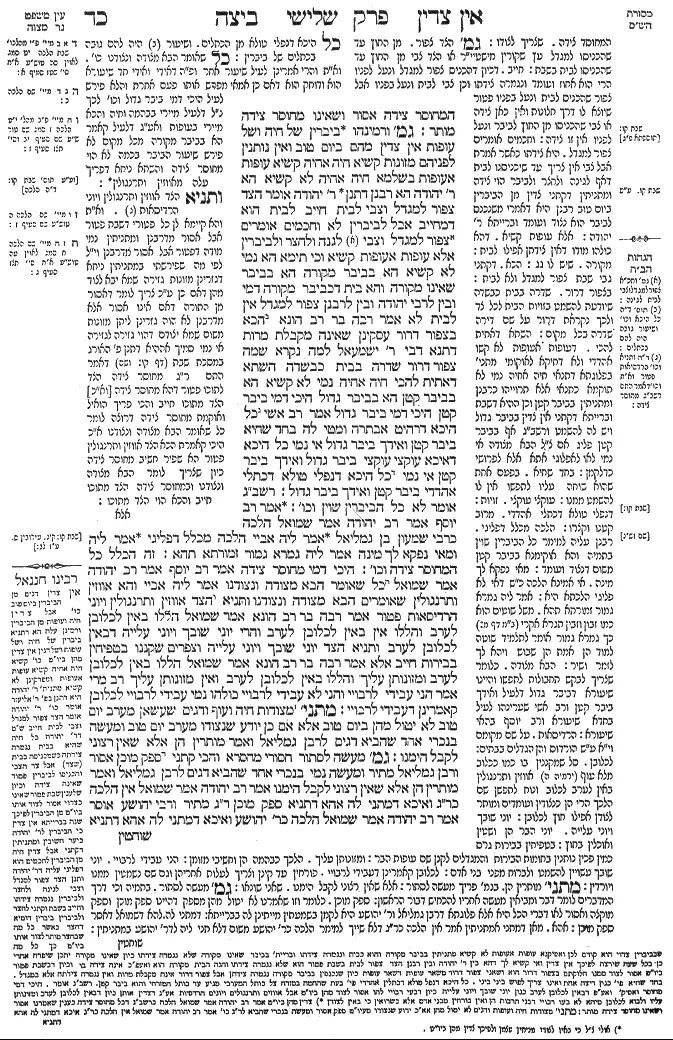
Beitza 24a - Guemara
המחוסר צידה אסור ושאינו מחוסר צידה מותר:
גמ׳ ורמינהו ביברין של חיה ושל עופות אין צדין מהם ביום טוב ואין נותנין לפניהם מזונות קשיא חיה אחיה קשיא עופות אעופות בשלמא חיה אחיה לא קשיא הא ר' יהודה הא רבנן דתנן ר' יהודה אומר הצד צפור למגדל וצבי לבית חייב לבית הוא דמחייב אבל לביברין לא וחכמים אומרים צפור למגדל וצבי לגנה ולחצר ולביברין אלא עופות אעופות קשיא וכי תימא הא נמי לא קשיא הא בביבר מקורה הא בביבר שאינו מקורה והא בית דכביבר מקורה דמי ובין לרבי יהודה ובין לרבנן צפור למגדל אין לבית לא אמר רבה בר רב הונא הכא בצפור דרור עסקינן שאינה מקבלת מרות דתנא דבי ר' ישמעאל למה נקרא שמה צפור דרור שדרה בבית כבשדה השתא דאתית להכי חיה אחיה נמי לא קשיא הא בביבר קטן הא בביבר גדול היכי דמי ביבר קטן היכי דמי ביבר גדול אמר רב אשי כל היכא דרהיט אבתרה ומטי לה בחד שחיא ביבר קטן ואידך ביבר גדול אי נמי כל היכא דאיכא עוקצי עוקצי ביבר גדול ואידך ביבר קטן אי נמי כל היכא דנפלי טולא דכתלי אהדדי ביבר קטן ואידך ביבר גדול:
רשב"ג אומר לא כל הביברין שוין וכו':
אמר רב יוסף אמר רב יהודה אמר שמואל הלכה כרבי שמעון בן גמליאל אמר ליה אביי הלכה מכלל דפליגי אמר ליה ומאי נפקא לך מינה אמר ליה גמרא גמור זמורתא תהא:
זה הכלל כל המחוסר צידה וכו':
היכי דמי מחוסר צידה אמר רב יוסף אמר רב יהודה אמר שמואל כל שאומר הבא מצודה ונצודנו אמר ליה אביי והא אווזין ותרנגולין שאומרים הבא מצודה ונצודנו ותניא הצד אווזין ותרנגולין ויוני הרדיסאות פטור אמר רבה בר רב הונא אמר שמואל הללו באין לכלובן לערב והללו אין באין לכלובן לערב והרי יוני שובך ויוני עלייה דבאין לכלובן לערב ותניא הצד יוני שובך ויוני עלייה וצפרים שקננו בטפיחין בבירות חייב אלא אמר רבה בר רב הונא אמר שמואל הללו באין לכלובן לערב ומזונותן עליך והללו באין לכלובן לערב ואין מזונותן עליך רב מרי אמר הני עבידי לרבויי והני לא עבידי לרבויי כולהו נמי עבידי לרבויי לכלובן קאמרינן דעבידי לרבויי:
מתני׳ מצודות חיה ועוף ודגים שעשאן מערב יום טוב לא יטול מהן ביום טוב אלא אם כן יודע שנצודו מערב יום טוב ומעשה בנכרי אחד שהביא דגים לרבן גמליאל ואמר מותרין הן אלא שאין רצוני לקבל הימנו:
גמ׳ מעשה לסתור חסורי מחסרא והכי קתני ספק מוכן אסור ורבן גמליאל מתיר ומעשה נמי בנכרי אחד שהביא דגים לרבן גמליאל ואמר מותרין הן אלא שאין רצוני לקבל הימנו אמר רב יהודה אמר שמואל אין הלכה כר"ג ואיכא דמתני לה אהא דתניא ספק מוכן ר"ג מתיר ורבי יהושע אוסר אמר רב יהודה אמר שמואל הלכה כר' יהושע ואיכא דמתני לה אהא דתניא
Comments from Rashi on Masechet Beitza Page 24a
המחוסר צידה . שצריך לצודו: גמ' הצד צפור . מן החוץ עד שהכניסו למגדל עץ שקורין מישטיי"ר או הצד צבי מן החוץ עד שהכניסו לבית בשבת: חייב . דכיון דהכניס צפור למגדל ונעל לפניו הרי הוא אחוז ועומד ונגמרה צידתו וכן צבי לבית ונעל בפניו אבל צפור שהכניס לבית ונעל בפניו פטור שיוצא לו דרך חלונות ואין כאן צידה או צבי שהכניסו מן החוץ לביבר ונעל לפניו אין זו צידה: וחכמים אומרים צפור למגדל . היא צידתו כאשר אמרת אבל צבי אין צריך עד שיכניסנו לבית דאף לגינה ולחצר ולביבר הוי צידה ומתניתין דקתני צדין מן הביברין ביום טוב רבנן היא דאמרי משנכנס לביבר הוא נצוד ועומד וברייתא ר' יהודה: אלא עופות קשיא . דהא כולהו מודו דאין צידתן אפילו לבית: מקורה . שיש לו גג: הכא . דקתני גבי שבת צפור למגדל ולא לבית: בצפור דרור . שדרה בבית כבשדה שיודעת להשמט בזויות הבית לכל צד ולכך נקראת דרור על שם דירה שדרה בכל מקום: השתא דאתית להכי . דעופות אעופות לא קשו אהדדי ולא דחיקא לאוקומי מתני' בפלוגתא דתנאי חיה אחיה נמי לא תוקמא כתנאי אלא תרוייהו כרבנן ומתניתין בביבר קטן וכן ההיא דשבת וברייתא דקתני אין צדין בביבר גדול ויש לה להשמט ורשב"ג אף בביבר קטן פליג אם צ"ל הבא מצודה אי נמי לאו לאפלוגי אתא אלא לפרושי כדלקמן: בחד שחיא . בפעם אחת שהוא שוחה עליו לתפשו אין לו להשמט ממנו: עוקצי עוקצי . זויות: דנפלי טולא דכתלי אהדדי . מרוב קטנו וקצרו: הלכה מכלל דפליגי . רבנן עליה למימר כל הביברין שוין בתמיה והא אוקימנא בביבר קטן משום דנצוד ועומד: מאי נפקא לך מינה . אי אמינא הלכה כ"ש דאי לא פליגי הלכתא היא: אמר ליה גמרא גמור זמורתא תהא . משל שוטים הוא כמו זבון וזבין תגרא אקרי (ב"מ דף מ:) כך גמרא גמור אומר לתלמיד שוטה למוד הן אמת הן שבוש ויהא לך לזמר ושיר: הבא מצודה . כלומר שצריך לבקש תחבולות לתפשו והיינו שיעורא דביבר גדול דלעיל ואידך ביבר קטן ורב אשי שערינהו לעיל בחדא שיעורא ורב יוסף בהאי שיעורא: הרדיסאות . על שם מקומם וי"א ע"ש הורדוס והן הגדלים בבתים: לכלובן . סל שמקננין בו כמו ככלוב מלא עוף (ירמיהו ה) אווזין ותרנגולין באין לערב לכלוב ונוח לתפשן שם הלכך הרי הן כנצודין ועומדים ומותר לצודן אפילו חוץ לכלובן: יוני שובך ויוני עלייה . יוני הבר הן ושטין ואוכלין בחוץ: בטפיחין בבירות . גרס כמין פכין נותנין בחומות הבירות והמגדלים לקנן שם עופות הבר: ומזונותן עליך . הלכך כבהמה הן וחשיבי מזומן: הני עבידי לרבויי . יוני שובך עשויין להשמט ולברוח מפני בני אדם: לכלובן קאמרינן דעבידי לרבויי . פורחין עד קינן וצריך לעלות אחריהן וגם שם נשמטין ממנו ויורדין: מתני' מותרין הן . בגמ' פריך מעשה לסתור: אלא שאין רצוני לקבל הימנו . שאני שונאו: גמ' מעשה לסתור . בתמיה וכי דרך המדברים לומר דבר ומביאין מעשה אחריו להכחיש דבור הראשון: ספק מוכן . כלומר וזו שאמרנו לא יטול מהן מספק דהיינו ספק מוכן וספק מוקצה ואסור לאו דברי הכל היא אלא פלוגתא דרבן גמליאל ור' יהושע היא לקמן בשמעתין מייתינן לה בברייתא: דמתני לה . להא דשמואל דאסר ספק מוכן: אהא . מאן דמתני אמתניתין אמר אין הלכה כר"ג דלא שייך למימר הלכה כר' יהושע משום דלא תני ליה לדר' יהושע במתניתין:
Comments from Tosafot - Beitza 24a
כל היכא דנפלי טולא מן הכתלים. ושיעור היה להם גובה בכתלים של ביברין: כל שאומר הבא מצודה ונצודנו כו'. וא"ת והרי אמרינן לעיל שיעור אחר ופ"ה דאידי ואידי חד שיעורא הוא ודוחק הוא דאם כן אמאי מפרש אותו פעם אחרת והלא פירש לעיל היכי דמי ביבר גדול וכו' לכך נ"ל דלעיל מיירי בבהמה וחיה והכא מיירי בעופות ואע"ג דלעיל קאמר הא בביבר מקורה מכל מקום לא פירש שיעור הביבר בכמה לא הוי מחוסר צידה והשתא ניחא דפריך עלה מאווזין ותרנגולין: ותניא הצד אווזין ותרנגולין ויוני הרדיסאות. וא"ת והא קיימא לן כל פטורי דשבת פטור אבל אסור מדרבנן ומתניתין נמי מודה דפטור אבל אסור מדרבנן וי"ל לפי מה שפירשתי במתניתין ניחא דגזרינן מזונות גזירה שמא יבא לצוד מהן דאם כן ע"כ צריך לומר דאסור מן התורה דאם אינו אסור אלא מדרבנן לא הוה גזרינן ליתן מזונות משום שמא יצודם דהוי גזירה לגזירה אי נמי סמיך אההי"א דתנן פ' האורג במסכת שבת (דף קו: ושם) דאמר התם ר"ג מחוסר צידה הצד לתוכו פטור דהא מחוסר צידה [וא"כ] הצד מתוכו חייב והכי פריך הואיל ואוקמת מחוסר צידה דרוצה לומר כל שאומר הבא מצודה ונצודנו א"כ היכי קאמרת הכא הצד אווזין ותרנגולין פטור הא שפיר חשיב מחוסר צידה כיון שצריך לומר הבא מצודה ונצודנו ובמחוסר צידה הצד מתוכו חייב והכא הוי הצד מתוכו:
Beitza 24a - Mishnah translated into english
inside such an enclosure whose trapping is inadequate, meaning that the enclosure is large and contains hiding places so that it is still necessary to pursue and apprehend the animal, it is prohibited for one to catch it; and with regard to any animal whose trapping is not inadequate, as it is possible to seize it immediately without having to engage in further pursuit, it is permitted for one to catch it.
GEMARA: And the Gemara raises a contradiction from what is stated in the Tosefta: From enclosures of animals and of birds, one may not trap animals or birds on a Festival, nor may one place food before them. This is difficult due to a contradiction between the ruling with regard to an animal in the mishna and the ruling with regard to an animal in the Tosefta. This is similarly difficult due to a contradiction between the ruling with regard to birds in the mishna and the ruling with regard to birds in the Tosefta.
The Gemara resolves the first contradiction: Granted, with regard to the contradiction between the ruling concerning an animal in the mishna and the ruling concerning an animal in the Tosefta, it is not difficult, because this, the baraita that prohibits trapping and feeding animals in the enclosures, is in accordance with the opinion of Rabbi Yehuda, who holds that an animal trapped in an enclosure whose trapping is inadequate, i.e., it is still necessary to pursue and apprehend the animal, is not considered trapped, and therefore one may not trap it from the enclosure on a Festival. Whereas that, the mishna that permits trapping and feeding the animals in the enclosures, is in accordance with the opinion of the Rabbis, who maintain that an animal in an enclosure is considered trapped, and therefore removing it from there is not considered an act of hunting.
As we learned in a mishna: Rabbi Yehuda says: One who drives and traps a bird into a closet or a deer into a house is liable. The Gemara infers from this: It is only if he traps the animal into a house that he is liable, but if he traps it into an enclosure, he is not liable. And the Rabbis say: One is liable for trapping a bird into a closet, and for trapping a deer into a garden, or into a courtyard, or into an enclosure. This demonstrates that according to the Rabbis, an animal found inside an enclosure is regarded as already captured, whereas Rabbi Yehuda disagrees. From this it follows that Rabbi Yehuda and the Rabbis similarly disagree about catching an animal inside an enclosure and removing it from there on a Festival.
However, concerning the contradiction between the ruling with regard to birds in the mishna and the ruling with regard to birds in the Tosefta, it is difficult, as all agree that they may not be caught, even in one’s house. And if you say that this contradiction is also not difficult, because this, the mishna that permits trapping, is referring to a roofed enclosure, in which a bird is considered captured, and therefore there is no prohibition against apprehending it on a Festival, and that, the baraita that prohibits trapping, is referring to an unroofed enclosure, in which a bird is not considered trapped and apprehending it is prohibited, that does not resolve the contradiction.
The Gemara explains why the proposed resolution must be rejected: As with regard to a house, which is like a roofed enclosure, there is no dispute. And according to both Rabbi Yehuda and the Rabbis, a bird trapped into a closet, yes, it is considered trapped, while a bird into a house, no, it is not considered trapped.
Rabba bar Rav Huna said: Here, in the mishna, according to which a bird in a house is not considered trapped, we are dealing with a free bird, a sparrow, which does not accept authority. That bird is not intimidated and evades capture even in a house. As the school of Rabbi Yishmael taught: Why is it called a free [dror] bird? Because it dwells [dara] in a house as it does in a field, flittering from place to place. For this reason, it is not considered captured when it is inside a house. Therefore, the distinction between a roofed and an unroofed enclosure resolves the apparent contradiction between the mishna and the Tosefta.
The Gemara comments: Now that you have arrived at this understanding, that the difference between the rulings in the two sources is predicated on different circumstances and not on a tannaitic dispute, the apparent contradiction between the ruling with regard to an animal in the mishna and the ruling with regard to an animal in the Tosefta is also not difficult. This, the ruling in the mishna that permits apprehending the animal, is referring to a small enclosure, in which the animal cannot evade its pursuers and requires no further trapping. That, the ruling in the Tosefta that prohibits apprehending the animal, is referring to a large enclosure, from which the animal cannot escape, but it can still avoid being caught.
The Gemara asks: What are the circumstances of a small enclosure, and what are the circumstances of a large enclosure? Rav Ashi said: Any enclosure where one can run after an animal and reach it in one stoop is a small enclosure. And any other is a large enclosure. Or perhaps, any enclosure that has a series of corners in which the animal could hide and evade capture is a large enclosure, and any other is a small enclosure. Or perhaps, any enclosure where the shadows from the different walls fall upon each other, because the walls are close together, is a small enclosure. And any other, a larger area where the walls are further apart, is a large enclosure.
§ It was taught in the mishna: Rabban Shimon ben Gamliel says: Not all enclosures are identical. If the animal is inadequately trapped in the enclosure, it is prohibited for one to catch it; whereas if it is adequately trapped, he is permitted to do so. Rav Yosef said that Rav Yehuda said that Shmuel said: The halakha is in accordance with the opinion of Rabban Shimon ben Gamliel. Abaye said to Rav Yosef: If one rules that the halakha is in accordance with his opinion, does that mean by inference that the Rabbis disagree, or perhaps there is no dispute and everyone accepts the opinion of Rabban Shimon ben Gamliel?
Rav Yosef said to him: And what difference is there to you whether or not the Rabbis disagree? In either case the halakha is in accordance with the opinion of Rabban Shimon ben Gamliel. Why then does it matter whether or not the issue was in dispute? Abaye said to him, invoking a folk expression with regard to one who learns without reaching understanding: Is it simply learn the lesson; let it be like a song? In other words, is it sufficient to simply parrot the halakhic ruling? Rather, it is necessary to examine the issue to understand it even if it does not yield a practical halakhic difference.
It was further taught in the mishna: This is the principle: Any animal inside such an enclosure whose trapping is inadequate may not be caught and removed from there on a Festival, whereas any animal whose trapping is not inadequate may be apprehended and removed from there. The Gemara asks: What are the circumstances of an animal whose trapping is inadequate? Rav Yosef said that Rav Yehuda said that Shmuel said: Any animal with regard to which one would say: Bring a trap so that we may catch it, as the animal cannot be apprehended without the aid of a trap.
Abaye said to him: But aren’t geese and chickens that are loose in a courtyard creatures with regard to which one would say: Bring a trap so that we may catch it, as they freely roam about and evade capture? And nevertheless, it is taught in a baraita: One who traps geese, chickens, or domestic doves is exempt, as they are considered already trapped.
Rabba bar Rav Huna said that Shmuel said: There is a difference between the two cases: These, the geese and chickens, enter their coop in the evening and use it as their fixed dwelling place and are therefore considered trapped, while these animals in the enclosure do not enter their coop in the evening and therefore flee from those trying to seize them.
The Gemara challenges this argument: But don’t doves of a dovecote and doves of a loft enter their coop in the evening, and yet it is taught in a baraita: One who traps doves of a dovecote, doves of a loft, or birds that are nesting in pitchers in buildings is liable for their capture, although they enter their coop in the evening?
Rather, Rabba bar Rav Huna said that Shmuel said: A distinction can be made as follows: These, the geese and chickens, enter their coop in the evening, and providing them with their feed is your responsibility. They are therefore accustomed to their owners and considered as trapped. Whereas these, the doves of a dovecote and the other birds mentioned in the baraita, admittedly enter their coop in the evening, but feeding them is not your responsibility.
Rav Mari said an alternative distinction: These, the doves of a dovecote, are likely to flee from people, and therefore require trapping, while these, the geese, chickens, and domestic doves, are not likely to flee from them. The Gemara asks: All of them are also likely to flee when being pursued, even chickens. The Gemara answers: We meant to say that they are likely to flee to their coop. In other words, even when they reach their coop they do not remain still but continue in their attempts to escape, and are therefore not considered trapped.
MISHNA: If traps for animals, birds, and fish were set on the eve of a Festival, one may not take anything from them on the Festival, unless he knows that the animals found in the traps had already been caught on the eve of the Festival. And an incident is related where a certain gentile brought fish to Rabban Gamliel, and the latter said: The fish are permitted, but I do not wish to accept them from him, as I despise him.
GEMARA: The Gemara raises a question about the story involving Rabban Gamliel. Was an incident cited above to contradict a previously stated halakha? The mishna first teaches that one may not eat an animal caught on a Festival, and then relates an incident in which Rabban Gamliel ruled that this is permitted. The Gemara answers: The mishna is incomplete; it is missing an important element, and it teaches the following: Even in a case where it is uncertain whether or not the animal was prepared before the Festival, as it is unclear whether it was caught today or on the previous day, it is prohibited; and Rabban Gamliel permits it. And an incident is also related where a certain gentile brought fish to Rabban Gamliel, and the latter said: The fish are permitted, but I do not wish to accept them from him.
Rav Yehuda said that Shmuel said: The halakha is not in accordance with the opinion of Rabban Gamliel. Some teach this halakhic ruling with regard to this baraita, as it is taught: With regard to something about which an uncertainty exists whether or not it was prepared before the Festival, Rabban Gamliel permits it, and Rabbi Yehoshua prohibits it. Rav Yehuda said that Shmuel said: The halakha is in accordance with the opinion of Rabbi Yehoshua. And others teach it in reference to this baraita, as it is taught:
Traduction : The William Davidson digital edition of the Koren Noé Talmud, with commentary by Rabbi Adin Even-Israel Steinsaltz.
Beitza 24a : Significance
Next step
Finished studying Beitza 24a? Carry on with the rest of the tractate.
Study Beitza 24bFrequently asked questions: Beitza 24a
Where is Beitza 24a in tractate Beitza?
Beitza 24a is page 45 of 78 in tractate Beitza (Seder Moed).
When is daf 24 of Beitza studied in Daf Yomi?
Daf Yomi covers one daf a day, both sides. Daf 24 of Beitza will be studied on February 25, 2029.
Is there a video class on Beitza 24a?
Yes, by Daf Tube, Rabbi Dr. Moshe Weisblum. These classes were published on YouTube by their authors and are gathered on this site.
What is tractate Beitza about?
The Masechet Beitsa is the seventh treatise of the Seder Moed. Beitsa gemara is the study of the laws of Yom Tov and eruv Tavchilin. The Beitsa tractate has been named massekhet Yom Tov in the past.
Your study is also dedicated to them
- L'ilui Nishmat Chemouel Eliezer ben Batcheva
- L'ilui Nishmat רינה בת לדיסיה
- L'ilui Nishmat Nissim ben Barukh Malka