 Talmud Bavli
Arachin 33a : Youtube
Rabbi Dr. Moshe WeisblumYoutube
1 video class :
Arachin Page 33a
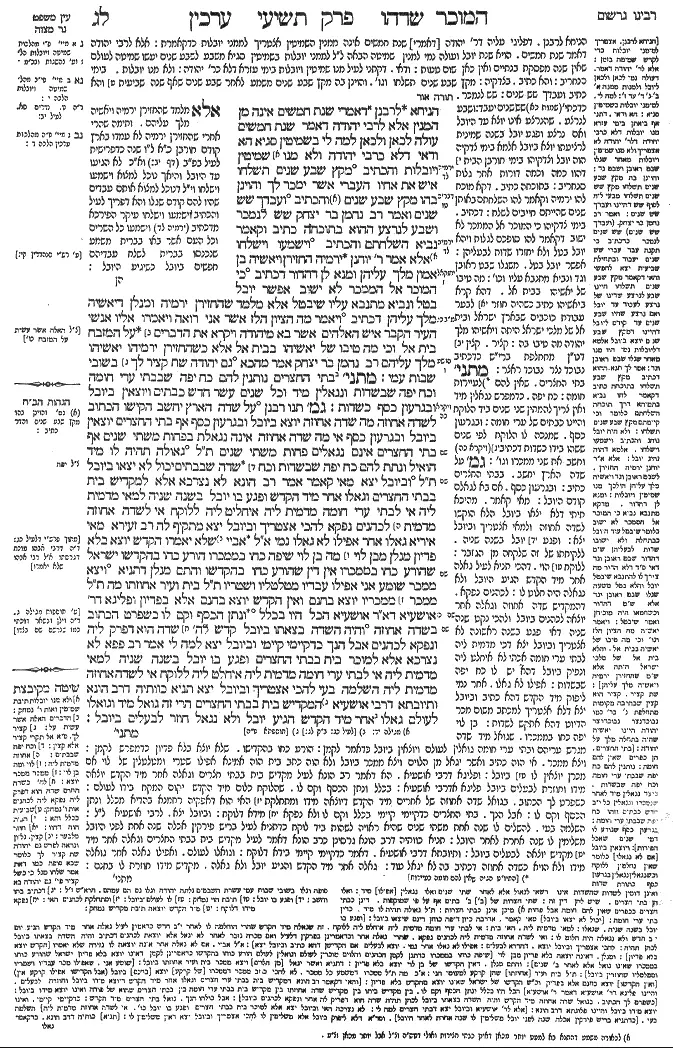
Arachin 33a - Guemara
הניחא לרבנן דאמרי שנת חמשים אינה מן המנין אלא לרבי יהודה דאמר שנת חמשים עולה לכאן ולכאן למה לי בשמיטין סגיא הא ודאי דלא כרבי יהודה ולא מנו שמיטין ויובלות והכתיב (ירמיהו לד, יד) מקץ שבע שנים תשלחו איש את אחיו העברי אשר ימכר לך והוינן בהו מקץ שבע שנים והכתיב (דברים טו, יב) ועבדך שש שנים ואמר רב נחמן בר יצחק שש לנמכר ושבע לנרצע ההוא בתוכחה כתיב וקאמר נביא השלחתם והכתיב (ירמיהו לד, י) וישמעו וישלחו אלא אמר ר' יוחנן ירמיה החזירן ויאשיה בן אמון מלך עליהן ומנא לן דהדור דכתיב (יחזקאל ז, יג) כי המוכר אל הממכר לא ישוב אפשר יובל בטל ונביא מתנבא עליו שיבטל אלא מלמד שהחזירן ירמיה ומנלן דיאשיה מלך עליהן דכתיב (מלכים ב כג, יז) ויאמר מה הציון הלז אשר אני רואה ויאמרו אליו אנשי העיר הקבר איש האלהים אשר בא מיהודה ויקרא את הדברים על המזבח בית אל וכי מה טיבו של יאשיהו בבית אל אלא כשהחזירן ירמיהו יאשיהו מלך עליהם רב נחמן בר יצחק אמר מהכא (הושע ו, יא) גם יהודה שת קציר לך בשובי שבות עמי:
מתני׳ בתי החצרים נותנין להם כח יפה שבבתי ערי חומה וכח יפה שבשדות ונגאלין מיד וכל שנים עשר חדש כבתים ויוצאין ביובל ובגרעון כסף כשדות:
גמ׳ תנו רבנן (ויקרא כה, לא) על שדה הארץ יחשב הקישו הכתוב לשדה אחוזה מה שדה אחוזה יוצא ביובל ובגרעון כסף אף בתי החצרים יוצאין ביובל ובגרעון כסף אי מה שדה אחוזה אינה נגאלת בפחות משתי שנים אף בתי החצרים אינם נגאלים פחות משתי שנים תלמוד לאמר (ויקרא כה, לא) גאולה תהיה לו מיד הואיל ונתת להם כח יפה שבשדות וכח שדה שבבתים יכול לא יצאו ביובל תלמוד לאמר (ויקרא כה, לא) וביובל יצא מאי קאמר אמר רב הונא לא נצרכא אלא למקדיש בית בבתי החצרים וגאלו אחר מיד הקדש ופגע בו יובל בשנה שניה למאי מדמית ליה אי לבתי ערי חומה מדמית ליה איחליט ליה ללוקח אי לשדה אחוזה מדמית לכהנים נפקא להכי אצטריך וביובל יצא מתקיף לה רב זעירא מאי איריא גאלו אחר אפילו לא גאלו נמי אמר ליה אביי שלא יאמרו הקדש יוצא בלא פדיון מנלן מבן לוי מה בן לוי שיפה כחו בממכרו הורע כחו בהקדשו ישראל שהורע כחו בממכרו אין דין שהורע כחו בהקדשו והתם מנלן דתניא (ויקרא כה, לג) ויצא ממכר שומע אני אפילו עבדיו מטלטליו ושטריו תלמוד לאמר בית ועיר אחוזתו מה תלמוד לאמר ממכר ממכריו יוצא בחנם ואין הקדש יוצא בחנם אלא בפדיון ופליגא דר' אושעיא דאמר ר' אושעיא הכל היו בכלל (ויקרא כז, יט) ונתן הכסף וקם לו כשפרט הכתוב בשדה אחוזה (ויקרא כז, כא) והיה השדה בצאתו ביובל קדש לה' שדה הוא דפרק ליה ונפקא לכהנים אבל הנך כדקיימי קיימי וביובל יצא למה לי אמר רב פפא לא נצרכא אלא למוכר בית בבתי החצרים ופגע בו יובל בשנה שניה למאי מדמית ליה אי לבתי ערי חומה מדמית ליה איחלט ליה ללוקח אי לשדה אחוזה מדמית ליה השלמה בעי להכי אצטריך וביובל יצא תניא כוותיה דרב הונא ותיובתא דרבי אושעיא המקדיש בית בבתי החצרים הרי זה גואל מיד וגואלו לעולם גאלו אחר מיד הקדש הגיע יובל ולא נגאל חוזר לבעלים ביובל
Comments from Rashi on Masechet Arachin Page 33a
הניחא לרבנן . דפליגי עליה דר' יהודה [דאמרי] שנת חמשים אינה ממנין השמיטין אצטריך לממני יובלות כדקאמרת: אלא לרבי יהודה דאמר שנת חמשים . הויא שנת יובל ועולה נמי למנין שמיטה הבאה ל"ל לממני יובלות בשמיטין סגיא משבע לשבע שנים יעשו שמיטה לעולם שאין שנה מפסקת בנתיים ואין כאן שום טעות: ודאי . דקתני לעיל מנו שמיטין ויובלות בימי עזרא דלא כר' יהודה: ולא מנו יובלות . בימי סנחריב: והא כתיב . בצדקיה: מקץ שבע שנים תשלחו וגו' והוינן בה מקץ שבע שנים . משמע לאחר שבע שנים שאף שנה שביעית והא כתיב ועבדך שש שנים: שש לנמכר . כדכתי' (שמות כא) שש שנים יעבד: ושבע לנרצע . שהנרצע אינו יוצא עד היובל ואם נרצע ופגע יובל בשנה שמינית לרציעתו יוצא ביובל. אלמא בימי צדקיה הוה יובל וצדקיהו בימי חורבן הבית דהוו כמה וכמה דורות אחר גלות סנחריב: בתוכחה כתיב . דקא מוכח להו ירמיה וקאמר להו השלחתם באותן שנים שהייתם חייבים לשלח: דכתיב . בימי צדקיהו כי המוכר אל הממכר לא ישוב דקאמר להו סופכם לגלות ויהא יובל בטל ולא יחזרו שדות לבעליהן: אפשר יובל בטל . משגלו שבט ראובן וגד ונביא מתנבא עליו וכו': מה טיבו של יאשיהו בבית אל . דהא קרא ביאשיהו כתיב כשהיה חוזר לבער עבודת כוכבים שבארץ ישראל ובית אל של מלכי ישראל היתה ויאשיהו מלך יהודה מה טיבו בה: קציר . קצין דנו"ן מתחלפת ברי"ש כדכתיב נבוכד נצר נבוכד ראצר: מתני' בתי החצרים . שאין להם לעיירות חומה: כח יפה . כדמפרש נגאלין מיד ואין צריך להמתין שני שנים ביד הלוקח והיינו כבתים של ערי חומה: ובגרעון כסף . שמנכה לו הלוקח לפי שנים ששהו בידו כשדות דכתיב (ויקרא כה) וחשב את שני ממכרו וגו': גמ' על שדה הארץ יחשב . בבתי החצרים כתיב: ובגרעון כסף . אם בא לגאלם קודם היובל: מאי קאמר . מהיכא תיתי דלא יצאו ביובל הלא הוקשו לשדה אחוזה ולמאי אצטריך וביובל יצא: ופגע יובל בשנה שניה . ללקיחתו של זה שלקחה מן הגזבר: ללוקח הוי . דהכי תניא לעיל גאלה אחר מיד הקדש הגיע היובל ולא נגאלה היה חלוט לו: לכהנים נפקא . דהמקדיש שדה אחוזה וגאלה אחר יוצאה לכהנים ביובל. ולהכי נקט שנה שניה דאי פגע בשנה ראשונה לא אצטריך וביובל יצא דכי מדמית ליה לבתי ערי חומה אכתי לא איחלט ליה ונפיק ביובל דהא יש לו כח יפה שבשדות: אפילו לא גאלו . אחר נמי ליפוק מיד הקדש דהא כתיב וביובל יצא דלא אצטריך למכתב משום מכר הדיוט דהא אתקש לשדות: בן לוי יפה כחו בממכרו . שגואל מיד שדה מגרש עריהם ובתי ערי חומה גואלין לעולם ויוצאין ביובל כדאמר לקמן: הורע כחו בהקדישו . שלא יוצא בלא פדיון כדמפרש לקמן: ויצא ממכר . אי הוה כתיב ואשר יגאל מן הלוים ויצא ממכר ביובל ולא הוה כתב בית הוה אמינא אפילו שטרי ומטלטלין של לוי אם מכרן יוצאין לו ביובל: ופליגא דרבי אושעיא . הא דאמר רב הונא לעיל מקדיש בית בבתי חצרים וגאלה אחר מיד הקדש יוצאה מידו וחוזרת לבעלים ביובל פליגא אדרבי אושעיא: בכלל ונתן הכסף וקם לו . שהלוקח כלום מיד הקדש יקום המקח בידו לעולם: כשפרט לך הכתוב . בגואל שדה אחוזה של אחרים מיד הקדש דיוצאה מידו ומתחלקת האי הוא דאפקיה רחמנא בהדיא מכלל ונתן הכסף וקם לו: אבל הנך . בתי החצרים כדקיימי קיימי בכלל וקם לו ולא נפקא מידא דלוקח: וביובל יצא . לרבי אושעיא ל"ל: השלמה בעי . להשלים לו שנה אחת משתי שנים שהיא ראויה לשהות ביד לוקח כדתניא לעיל בריש פירקין אכלה שנה אחת לפני היובל משלימין לו שנה אחרת לאחר היובל: תניא כוותיה דרב הונא גרסינן. כרב הונא דאמר לעיל מקדיש בית בבתי החצרים וגאלה אחר מיד מקדיש יוצאה לבעלים ביובל: ותיובתא דרבי אושעיא . דאמר כדקיימי קיימי בידא דלוקח: וגואלו לעולם . ואפילו גאלה אחר גואלה מידו ולא הויא כשדה אחוזה דכתיב בה לא יגאל עוד: גאלה אחר מיד הקדש והגיע יובל ולא גאלה . מקדיש מידו חוזרת לו בחנם:
Comments from Tosafot - Arachin 33a
אלא מלמד שהחזירן ירמיה ויאשיה מלך עליהם . ותימה שהרי אחרי שהחזירן ירמיה לא עמדו בארץ קודם חורבן כ"א ל"ו שנה כדפרישית לעיל בפ"ב (ערכין דף יב:) וא"כ לא הגיעו עד היובל והיאך נוכל למצוא וישמעו וישלחו וי"ל דנוכל למצוא אותם עבדים שהיו להם קודם שגלו והא דפריך לעיל והכתיב וישמעו וישלחו עיקר הפירכא מדכתיב (ירמיהו לד) וישמעו כל השרים וכל העם אשר באו בברית משמע שנכנסו בברית לשלח עבדיהם חפשים ביובל כשיגיע היובל:
Arachin 33a - Mishnah translated into english
The Gemara objects: This works out well according to the Rabbis, who say that the fiftieth year is not included in the counting of the cycle of Sabbatical Years. It was therefore necessary to count the Jubilee Year. But according to Rabbi Yehuda, who says that the fiftieth year is counted for here and for there, i.e., it is both the fiftieth year of the previous cycle and the first year of the subsequent cycle, why do I need for them to count the Jubilee Years? If the Jubilee Year is not in effect, then it is enough to count the Sabbatical Years. The Gemara explains: That baraita is certainly not in accordance with the opinion of Rabbi Yehuda.
The Gemara asks: And did they not count Sabbatical Years and Jubilee Years once the tribes of Reuben and Gad and half the tribe of Manasseh were exiled? But isn’t it written that Jeremiah, who lived many years later, said: “At the end of seven years you shall let go every man his brother that is a Hebrew, that has been sold unto you, and has served you six years, you shall let him go free from you; but your fathers did not listen unto Me, nor inclined their ear” (Jeremiah 34:14)?
The Gemara continues: And we discussed this verse: Why does it state: “At the end of seven years you shall let go every man”? But isn’t it written in the same verse: “And has served you six years”? And Rav Naḥman bar Yitzḥak says: The verse is referring to two separate individuals. The phrase “and has served you six years” is referring to a typical Hebrew slave who was sold, who goes free after six years (see Exodus 21:2), and the phrase “at the end of seven years” is referring to a slave whose ear was pierced with an awl to extend his tenure. Such an individual remains a slave until the Jubilee Year, even if that is the following year, i.e., the end of the seventh year. If so, the verse indicates that the Jubilee Year was in effect in the times of Jeremiah, even though the tribes of Reuben, Gad, and half the tribe of Manasseh were exiled.
The Gemara answers: That verse was not stated by Jeremiah in the form of a command; rather, it is written in the form of reproof. That is, the prophet Jeremiah is saying to the Jewish people: Did you send free the pierced slaves when the Jubilee Year was observed? The Gemara asks: But isn’t it written there: “And they listened and let them go” (Jeremiah 34:10)? Evidently, the entire passage is referring to matters occurring in the present.
Rather, Rabbi Yoḥanan says: Indeed, the Jubilee Year was not in effect once the tribes of Reuben, Gad, and half the tribe of Manasseh were exiled. But Jeremiah brought back all the exiled tribes, and Josiah, son of Amon, ruled over them. And from where do we derive that Jeremiah brought them back? As it is written: “For the seller shall not return to that which he has sold” (Ezekiel 7:13). Ezekiel prophesied that there will come a time when fields will not be returned to the owners in the Jubilee Year. Now, is it possible that the Jubilee Year had already been nullified and yet the prophet is prophesying that it will be annulled in the future? Rather, this teaches that Jeremiah brought back the exiled tribes.
And from where do we derive that Josiah ruled over all the ten tribes exiled by Assyria? As it is written: “And as Josiah turned himself, then he spied the sepulchres…then he said: What monument is that which I see? And the men of the city told him: It is the tomb of the man of God who came from Judah and proclaimed these things that you have done against the altar of Bethel” (II Kings 23:16–17).
Now, what connection does Josiah, king of Judah, have with the altar at Bethel, a city in the kingdom of Israel? Rather, this indicates that when Jeremiah brought back the ten tribes, Josiah ruled over them. Rav Naḥman bar Yitzḥak said: The fact that the tribes returned may be derived from here: “Also, O Judah, there is a harvest appointed for you, when I would return the captivity of My people” (Hosea 6:11). That is, when the ten tribes will return from their captivity, a king of Judah will rule over them.
MISHNA With regard to the houses of the unwalled courtyards mentioned in the Torah (see Leviticus 25:31), i.e., houses in villages that are not surrounded by walls, one accords them the exceptional provisions that apply to houses of walled cities and the exceptional provisions that apply to fields. Therefore, they are redeemed immediately and for the entire twelve months following the sale, like in the sale of houses of walled cities, and not like fields, which may be redeemed only after two years. And they leave the possession of the buyer during the Jubilee Year or with a per annum deduction from the money of the sale price, like the sale of fields. By contrast, houses of walled cities become the possession of the buyer in perpetuity after one year, and if they are redeemed within the year, one pays the full sale price.
GEMARA The Sages taught: The verse states: “But the houses of the courtyards that have no wall round about them shall be reckoned with the fields of the country; they may be redeemed, and they shall go out in the Jubilee” (Leviticus 25:31). The verse juxtaposed houses of unwalled courtyards to an ancestral field: Just as an ancestral field leaves the possession of the buyer in the Jubilee Year or with a per annum deduction from the money of the sale price, so too, houses of the unwalled courtyards leave the possession of the buyer in the Jubilee Year or with the per annum deduction from the money of the sale price.
The baraita continues: If one derives the halakha from an ancestral field, then just as an ancestral field may not be redeemed less than two years after its sale, so too, houses of the unwalled courtyards may not be redeemed less than two years after their sale. Therefore, the verse states: “They may be redeemed,” indicating that they may be redeemed immediately. The baraita continues: Since you have accorded houses of the unwalled courtyards the exceptional provisions that apply to fields and the exceptional provisions that apply to the houses of walled cities, one might have thought that they do not leave the possession of the buyer in the Jubilee Year. Therefore, the verse states: “And they shall go out in the Jubilee.”
The Gemara asks: What is the tanna of the baraita saying in the last clause, i.e., why might one think that such houses do not leave the possession of the buyer in the Jubilee Year? After all, ancestral fields leave the possession of the buyer in the Jubilee Year, and the tanna teaches that the exceptional provisions of an ancestral field apply to houses in unwalled courtyards. Rav Huna said: The verse is necessary only for the case of one who consecrates a house among the houses of the unwalled courtyards, and another redeemed it from the possession of the Temple treasury, and the Jubilee Year arrived in the second year after its redemption.
Rav Huna elaborates: To what will you compare this case? If you compare this house to houses of walled cities that were consecrated and redeemed by another, then the house belongs to the buyer in perpetuity by the end of the first year (see 31b). If you compare it to an ancestral field that was consecrated and redeemed by another, it leaves to the possession of the priests in the Jubilee Year (see 25a). For this reason it was necessary for the verse to state: “And they shall go out in the Jubilee,” to teach that houses in unwalled courtyards which were consecrated and redeemed by another are returned to their owners in the Jubilee Year.
Rav Zeira objects to this: Why is it necessary to interpret this verse as referring specifically to a case where another redeemed the house from the Temple treasury? Even if another did not redeem it, the house should also be returned to its owner in the Jubilee Year, as the verse states simply: “And they shall go out in the Jubilee.” Abaye said to Rav Zeira: An unredeemed house is not returned to its owners in the Jubilee Year, so that people will not say that consecrated property can leave the possession of the Temple treasury without redemption.
The Gemara adds: And from where do we derive that consecrated property does not leave the possession of the Temple treasury without redemption? We derive it from the halakha with regard to a Levite: And what, if with regard to a Levite, whose power is enhanced with regard to his sale, as a Levite may always redeem a field or house that he sold (see mishna in 33b), his power is diminished with regard to his consecration, as a field that he consecrated does not leave the possession of the Temple treasury until he redeems it; then with regard to an Israelite, whose power is diminished with regard to his sale, since if he sells an ancestral field he may not redeem it for the first two years, and he may redeem a house of a walled city only within one year of the sale, is it not logical that his power is diminished with regard to his consecration and that if he consecrated a house of an unwalled courtyard he must redeem it from the Temple treasury before it enters his possession?
The Gemara asks: And there, with regard to a Levite, from where do we derive that his consecrated property does not leave the possession of the Temple treasury without redemption? As it is taught in a baraita with regard to the verse: “And if a man purchases from the Levites, the house that was sold in the city of his possession shall go out during the Jubilee Year” (Leviticus 25:33). From the phrase “that was sold…shall go out” I would derive that any item sold by a Levite returns to him in the Jubilee Year, even his slaves, movable property, and promissory notes. Therefore, the verse states: “House…in the city of his possession,” which teaches that these items do not return to the Levite without redemption.
The baraita continues: What is the meaning when the verse states: “That was sold”? The verse teaches that a house or field that was sold by a Levite leaves the possession of the buyer and enters the Levite’s possession for free in the Jubilee Year, but the consecration of a Levite does not leave for free in the Jubilee Year; rather, it leaves only with redemption.
The Gemara notes: And Rav Huna, who says that a house in an unwalled courtyard that was consecrated and subsequently redeemed by another returns to the original owner in the Jubilee Year, disagrees with Rabbi Oshaya. As Rabbi Oshaya says: All items were included in the command: And he will give the money and it will be assured to him (see Leviticus 27:19), i.e., one who redeems an item from the Temple treasury becomes its owner in all regards.
When the verse specified with regard to an ancestral field: “But the field, when it goes out in the Jubilee, shall be holy unto the Lord, as a field dedicated; his ancestral field shall be for the priest” (Leviticus 27:21), one derives that it is only with regard to a field that one can redeem it and yet it leaves the possession of the Temple treasury to enter the possession of the priests in the Jubilee Year. But with regard to these houses in unwalled courtyards that were consecrated and redeemed by another, they remain in their current state, i.e., in the possession of the one who redeemed them.
The Gemara asks: According to Rabbi Oshaya, why do I need the phrase “and they shall go out in the Jubilee”? Rav Pappa said: It is necessary only for the case of one who sells a house among the houses of the unwalled courtyards and the Jubilee Year arrived in the second year. The verse indicates that the house is nevertheless returned to the seller.
Rav Pappa elaborates: To what will you compare this case? If you compare this case to one of the houses of walled cities that was sold, then the house belongs to the buyer in perpetuity at the end of the first year. And if you compare it to the case of an ancestral field that was sold, then it requires completion of another year after the Jubilee Year, as taught in a baraita cited earlier (29b): If the buyer consumed an ancestral field’s produce for one year before the Jubilee Year, he completes another year after the Jubilee Year. For this reason it was necessary for the verse to state: “And they shall go out in the Jubilee,” to teach that in such a case the house of an unwalled courtyard returns to the possession of the original owner.
The Gemara notes: It is taught in a baraita in accordance with the opinion of Rav Huna, and this baraita is a conclusive refutation of the opinion of Rabbi Oshaya: With regard to one who consecrates a house among the houses of unwalled courtyards, this individual may redeem the house immediately and he may redeem it always. If another individual redeemed it from the possession of the Temple treasury, and the Jubilee Year arrived and it was not redeemed by the original owner, the house returns to the owner in the Jubilee Year.
Traduction : The William Davidson digital edition of the Koren Noé Talmud, with commentary by Rabbi Adin Even-Israel Steinsaltz.