 Talmud Bavli
Arachin 30b : Youtube
Rabbi Dr. Moshe WeisblumYoutube
1 video class :
Arachin Page 30b
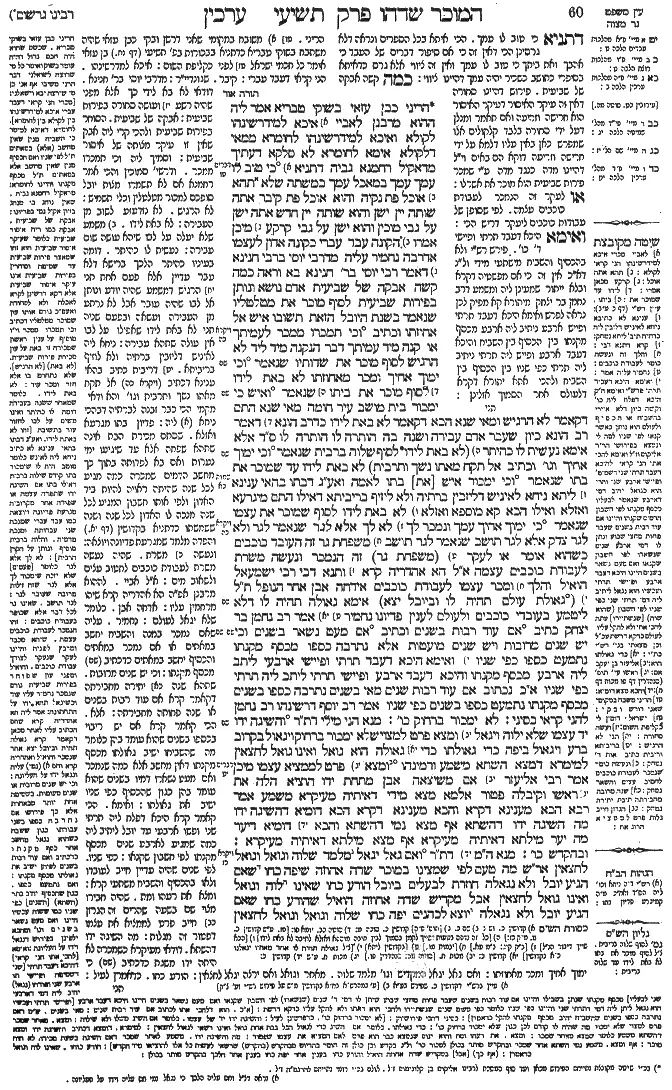
Arachin 30b - Guemara
הריני כבן עזאי בשוקי טבריא אמר ליה ההוא מרבנן לאביי איכא למידרשינהו לקולא ואיכא למידרשינהו לחומרא ממאי דלקולא אימא לחומרא לא סלקא דעתיך מדאקיל רחמנא גביה דתניא (דברים טו, טז) כי טוב לו עמך עמך במאכל עמך במשתה שלא תהא אוכל פת נקיה והוא אוכל פת קיבר אתה שותה יין ישן והוא שותה יין חדש אתה ישן על גבי מוכין והוא ישן על גבי קרקע מיכן אמרו הקונה עבד עברי כקונה אדון לעצמו אדרבה נחמיר עליה מדרבי יוסי ברבי חנינא דאמר רבי יוסי בר' חנינא בא וראה כמה קשה אבקה של שביעית אדם נושא ונותן בפירות שביעית לסוף מוכר את מטלטליו שנאמר בשנת היובל הזאת תשובו איש אל אחוזתו וכתיב (ויקרא כה, יד) וכי תמכרו ממכר לעמיתך או קנה מיד עמיתך דבר הנקנה מיד ליד לא הרגיש לסוף מוכר את שדותיו שנאמר (ויקרא כה, כה) וכי ימוך אחיך ומכר מאחוזתו לא באת לידו לסוף מוכר את ביתו שנאמר (ויקרא כה, כט) ואיש כי ימכור בית מושב עיר חומה מאי שנא התם דקאמר לא הרגיש ומאי שנא הכא דקאמר לא באת לידו כדרב הונא דאמר רב הונא כיון שעבר אדם עבירה ושנה בה הותרה לו הותרה לו ס"ד אלא אימא נעשית לו כהיתר (לא באת לידו לסוף שלוה ברבית שנאמר (ויקרא כה, כה) וכי ימוך אחיך וגו' וכתיב אל תקח מאתו נשך ותרבית) לא באת לידו עד שמוכר את בתו שנאמר (שמות כא, ז) וכי ימכור איש [את] בתו לאמה ואע"ג דבתו בהאי ענינא ליתא ניחא לאיניש דליזבין ברתיה ולא ליזיף בריביתא דאילו התם מיגרעא ואזלא ואילו הכא קא מוספא ואזלא לא באת לידו לסוף שמוכר את עצמו שנאמר (ויקרא כה, לט) כי ימוך אחיך עמך ונמכר לך לא לך אלא לגר שנאמר לגר ולא לגר צדק אלא לגר תושב שנאמר לגר תושב משפחת גר זה העובד כוכבים כשהוא אומר או לעקר (משפחת גר) זה הנמכר ונעשה משרת לעבודת כוכבים עצמה א"ל הא אהדריה קרא ותנא דבי רבי ישמעאל הואיל והלך ומכר עצמו לעבודת כוכבים אידחה אבן אחר הנופל ת"ל ((ויקרא כה, לב) גאולת עולם תהיה לו וביובל יצא) אימא גאולה תהיה לו דלא ליטמע בעובדי כוכבים ולעולם לענין פדיונו נחמיר אמר רב נחמן בר יצחק כתיב (ויקרא כה, נא) אם עוד רבות בשנים וכתיב (ויקרא כה, נב) אם מעט נשאר בשנים וכי יש שנים מרובות ויש שנים מועטות אלא נתרבה כספו מכסף מקנתו נתמעט כספו כפי שניו ואימא היכא דעבד תרתי ופיישי ארבעי ליתב ליה ארבע מכסף מקנתו והיכא דעבד ארבע ופיישי תרתי ליתב ליה תרתי כפי שניו א"כ נכתוב אם עוד רבות שנים מאי בשנים נתרבה כספו בשנים מכסף מקנתו נתמעט כספו בשנים כפי שניו אמר רב יוסף דרשינהו רב נחמן להני קראי כסיני:
לא ימכור ברחוק כו':
מנא הני מילי דת"ר (ויקרא כה, כו) והשיגה ידו יד עצמו שלא ילוה ויגאל ומצא פרט למצוי שלא ימכור ברחוק ויגאול בקרוב ברע ויגאול ביפה כדי גאולתו כדי גאולה הוא גואל ואינו גואל לחצאין למימרא דמצא השתא משמע ורמינהו {דברים יט } ומצא פרט לממציא עצמו מיכן אמר רבי אליעזר אם משיצאה אבן מתחת ידו הוציא הלה את ראשו וקיבלה פטור אלמא מצא מידי דאיתיה מעיקרא משמע אמר רבא הכא מענינא דקרא והכא מענינא דקרא הכא דומיא דהשיגה ידו מה השיגה ידו דהשתא אף מצא נמי דהשתא והכא דומיא דיער מה יער מילתא דאיתיה מעיקרא אף מצא מילתא דאיתיה מעיקרא:
ובהקדש כו':
מנא ה"מ דת"ר (ויקרא כז, יג) ואם גאל יגאל מלמד שלוה וגואל וגואל לחצאין אר"ש מה טעם לפי שמצינו במוכר שדה אחוזה שיפה כחו שאם הגיע יובל ולא נגאלה חוזרת לבעלים ביובל הורע כחו שאינו לוה וגואל ואינו גואל לחצאין אבל מקדיש שדה אחוזה הואיל שהורע כחו שאם הגיע יובל ולא נגאלה יוצא לכהנים יפה כחו שלוה וגואל וגואל לחצאין
Comments from Rashi on Masechet Arachin Page 30b
הריני . משובח במקומי שאני דרשן ובקי כבן עזאי שהיה משתבח בשוקי טבריא כדתניא בבכורות בפ' תשיעי (דף נח.) בן עזאי אומר כל חכמי ישראל לפני כקליפת השום: איכא למדרשינהו . הני קראי דעבד עברי: קיבר . שגונדיי"ר: מדרבי יוסי בר' חנינא . דודאי לא בא לידי כך אלא מפני שהיה רשע ועושה סחורה בפירות שביעית: אבקה של שביעית . הסוחר בפירות שביעית. ולהכי קרי ליה אבק שאין זו עיקר מצותה של איסור שביעית: וסמיך ליה וכי תמכרו ממכר . ודרשי' סמוכין והכי אמר רחמנא אם לא תשמרו מצות יובל סופכם למכור מטלטלין וכלי תשמיש: לא הרגיש . לא נזדעזע לשוב מן העבירה: לא באת לידו . משמע שלא יעלה על לבו שיהא עושה שום עבירה: נעשית לו כהיתר . דומה בעיניו כהיתר. הלכך ברישא דלא עבר עדיין אלא פעם אחת תני הרגיש דמשמע שהיה יודע ונותן אל לבו שהיה עובר אבל לא נרתע מן העבירה ועשאה ובפעם שניה תני לא באת לידו שאפילו על לבו אין עולה שתהא עבירה: ניחא ליה לאיניש דליזבין ברתיה ולא לוזיף בריביתא . דריבית כתיב בהאי ענינא דכתיב (ויקרא כה) אל תקח מאתו נשך ותרבית וגו' והא ודאי מקמי הכי כבר זבנה לברתיה דבהכי ניחא ליה: פדיון בתו מגרעא ואזלא . שסתם מכירת הבת אינה שתהא שפחה אלא עד שיגיעו ימי נערות ואם בא לפדותה בתוך כך מחשב הדמים שמכרה כמה מגיע לכל שנה שהיתה ראויה להיות ביד האדון ולפי אותו חשבון המגיע לכל שנה מנכה לו האדון לכל שנה ושנה ששמשתו כדתניא בקדושין (דף יא.) והפדה מלמד שמגרעת פדיונה ויוצאה: ונעשה משרת . שהיה נעשה משרת לעבודת כוכבים לחטוב עצים ולשאוב מים: א"ל . אביי לההוא מרבנן אפ"ה הא אהדריה קרא שיהו מרחמין עליו: אדחה אבן . כלומר שלא יגאל לעולם: נחמיר . עליה שאם נמכר במנה והשביח יחשב במאתים או אם נמכר במאתים והכסיף יחשב במאתים כדכתיב (שם) מכסף מקנתו: וכי יש שנים מרובות . שתהא שנה יתירה מחבירתה דקאמר קרא אם עוד רבות בשנים או שנה פחותה מחבירתה: אלא . הכי קאמר קרא אם יש ריבוי בכספו בשנים שהוא עומד בהן כלומר מה שהשביחו ישיב גאולתו מכסף מקנתו דאין מחשב אלא כמה שנמכר ואם מעט נשארו דמיו בשנים שהוא עומד בהן כגון שהכסיף כפי שניו ישיב את גאולתו: ואימא . הכי קאמר קרא היכא דפלח ליה תרתי שני ופשו ארבעי עד יובל ליתיב ליה כמה שמגיע לארבע שנים מכסף מקנתו לפי חשבון שקנאו: כפי שניו . לפי שנים שהיה עדיין חייב לעובדו ולאו בהכסיף והשביח משתעי קרא: ומצא את רעהו ומת . שהיה חבירו מצוי שם בשעה שהרים זה הגרזן חייב פרט לממציא את עצמו דפטור זה מגלות: מה השיגה ידו דהשתא . דודאי מעיקרא כשמכרה לא היתה ידו משגת כדכתיב (שם) כי ימוך אחיך ומכר מאחוזתו: ואם גאל יגאל המקדיש וגו' מלמד שלוה . מאחר וגואל ואם ירצה יגאל לחצאין: הורע כחו . כדאמרן לעיל:
Comments from Tosafot - Arachin 30b
דתניא כי טוב לו עמך . הכי איתא בכל הספרים ונראה דלא גרסינן הכי דאין זה כי אם סיפור דברים של העבד כי אהבך ואת ביתך כי טוב לו עמך ואין זה ציווי אלא גרס כדאיתא בסיפרי כתושב כשכיר יהיה עמך דהיינו ציווי: כמה קשה אבקה של שביעית . פירוש דהיינו סחורה דאין זה עיקר האיסור דעיקר האיסור הוא חרישה וזריעה ואם תאמר ומנלן דעל ידי סחורה בלבד קלקולים אלו שמפרש כאן באין עליו דלמא על ידי חרישה וזריעה דוקא הם באים וי"ל דהיינו מדה כנגד מדה ע"י שמכר פירות שביעית הוא מוכר את אשר לו: או לעקר זה הנמכר לעבודת כוכבים עצמה . לפי שסופן של עבודות כוכבים ליעקר דריש הכי: ואימא היכא דעבד תרתי ופיישי ד' כו' . פירש רש"י ולא בהכסיף והשביח מישתעי מידי ול"נ דא"כ אין זה כי אם מפשטיה דקרא ובלא ייתור שמעינן ליה ומשמע דרב נחמן בר יצחק מיתורא קא מפיק לכן נראה לפרש ואימא היכא דעבד תרתי ופייש ארבע ניתיב ליה ארבע מכסף מקנתו בין הכסיף בין השביח והיכא דעבד ארבע ופייש ליה תרתי ניתיב ליה תרתי כפי שניו בין הכסיף בין השביח ולהכי אתא יתורא דקרא דלעולם אחר הסמוך אזלינן:
Arachin 30b - Mishnah translated into english
I am ready to answer any questions put to me like those of the intellectually sharp ben Azzai, who would regularly expound in the markets of Tiberias. One of the Sages said to Abaye: The verses discussing the redemption of a Hebrew slave can be interpreted as a leniency for the slave, and they can also be interpreted as a stringency for him. From where is it derived that the verses should be interpreted as a leniency for the slave? Say that they should be interpreted as a stringency for him.
Abaye explained: Such a possibility should not enter your mind, due to the fact that the Merciful One was explicitly lenient with regard to a slave. As it is taught in a baraita: The verse states with regard to a Hebrew slave: “And it shall be, if he says to you I will not leave you…because he fares well with you” (Deuteronomy 15:16). The term “with you” indicates that the slave must be with you, i.e., treated as your equal, with regard to food, and with you with regard to drink. This means that you should not be eating fine bread while he eats inferior bread [kibbar], bread from coarse flour mixed with bran. Likewise, you should not drink old wine while he drinks inferior new wine. You should not sleep on bedding made from soft sheets while he sleeps on the ground. From here the Sages stated: One who acquires a Hebrew slave is considered like one who acquires a master for himself, as he must ensure that the slave’s living conditions are equal to his own.
That Sage raised an objection to Abaye: On the contrary, let us impose a stringency upon the slave, due to the statement of Rabbi Yosei, son of Rabbi Ḥanina. As Rabbi Yosei, son of Rabbi Ḥanina, says in explanation of the juxtaposition of several passages in the Torah (Leviticus, chapter 25): Come and see how severe is even the hint of violation of the prohibition of the Sabbatical Year, as the prohibition against engaging in commerce with produce of the Sabbatical Year is not one of the primary prohibitions of the Sabbatical Year, and yet its punishment is harsh.
Rabbi Yosei, son of Rabbi Ḥanina, continues: If a person has commercial dealings with produce of the Sabbatical Year or of the Jubilee Year, ultimately he will become so poor that he will be compelled to sell his movable property, as it is stated: “In this Jubilee Year you shall return every man to his possession” (Leviticus 25:13), and it is written in the subsequent verse: “And if you sell something to your neighbor or buy from your neighbor’s hand,” which is referring to an item acquired by passing it from hand to hand. The juxtaposition of the two verses indicates that if one violates the halakhot of the Jubilee Year or the Sabbatical Year, he will eventually have to sell his movable property.
If he does not feel remorse and he does not repent, ultimately he will be compelled to sell his fields, as it is stated in an adjacent verse: “If your brother becomes poor and sells part of his ancestral land” (Leviticus 25:25).
If consciousness of his sins does not come to him, ultimately he will be compelled to sell his house, as it is stated: “And if a man sells a dwelling house in a walled city” (Leviticus 25:29). The Gemara asks: What is different there, in the previous clause, where the tanna says that the sinner does not sense remorse, and what is different here, where he says that consciousness of his sins does not come to him? The Gemara responds: This is in accordance with the statement of Rav Huna, as Rav Huna says: Once a person commits a transgression and repeats it, it is permitted to him.
The Gemara asks: Can it enter your mind to say that it is actually permitted to him because he has transgressed twice? Rather, say that it becomes as though it were permitted to him, that is, after transgressing the prohibition twice he becomes accustomed to this behavior and no longer feels that it is a sin. If one transgresses the prohibition only once, he is apt to feel remorse. Once he repeats his transgression, he loses this sensibility concerning his sins and will no longer feel any remorse.
Rabbi Yosei, son of Rabbi Ḥanina, continues: If consciousness of his sins does not come to him, ultimately he will be compelled to borrow with interest, as it is stated: “And if your brother becomes poor and his means fail with you, then you shall uphold him” (Leviticus 25:35), and it is written in the subsequent verse: “You shall take no interest or increase from him.”
One does not come to borrow with interest until he has already been compelled to sell his daughter, as it is stated: “And when a man sells his daughter as a maidservant” (Exodus 21:7). The Gemara explains: And even though his daughter is not mentioned in that context in Leviticus, nevertheless, a person prefers to sell his daughter and not to borrow money with interest. This is because there, when one sells his daughter, the sum required in order to redeem her continuously decreases, while here, where one borrows with interest, his debt continuously increases. One may therefore assume that if one borrows with interest, he has already sold his daughter.
If consciousness of his sins does not come to him, ultimately he will be compelled to sell himself, as it is stated: “And when your brother becomes poor with you and sells himself to you” (Leviticus 25:39). Not only will he be sold to you, a born Jew; rather, he will even be sold to a stranger, as it is stated: “And sells himself to the stranger” (Leviticus 25:47). And not only to a stranger who is a convert, but even to a gentile who resides in Eretz Yisrael and observes the seven Noahide mitzvot [ger toshav], as it is stated: “And sells himself to a ger toshav with you” (Leviticus 25:47).
When the verse further states: “Or to the offshoot of a stranger’s family,” this is referring to the gentile relatives of a ger toshav, who are idolaters. When it says: “Or to the offshoot [le’eker] of a stranger’s family,” this is referring to one who is sold and becomes a servant to idol worship itself, i.e., he is put to work in a temple dedicated to idolatry. In any event, the baraita teaches that it is only due to an individual’s sins that he reaches such a low point that he must sell himself as a slave. If so, the verses dealing with a Hebrew slave should be interpreted in a stringent manner, so that the slave cannot easily be redeemed.
Abaye said to that Sage: But the verse subsequently restores him, i.e., it requires that one strive to redeem him from slavery. As the tanna of the school of Rabbi Yishmael taught: Since he went and sold himself to a temple dedicated to idol worship, should I throw a stone after the fallen? In other words, perhaps he should be left to his own devices? The verse states: He shall have a perpetual right of redemption, and he shall leave in the Jubilee (see Leviticus 25:31, 48). The Gemara objects: Even so, you can say that he shall have a redemption so that he will not be assimilated among the gentiles, but actually, with regard to his redemption we will be stringent, as it is due only to his sins that he is enslaved.
Rav Naḥman bar Yitzḥak said: Two verses are written with regard to redeeming someone who was sold to a gentile. It is written: “If there are yet many in the years, according to them he shall return the price of his redemption from the money that he was bought for” (Leviticus 25:51). And it is written in the next verse: “And if there remain but few in the years until the Jubilee Year, then he shall reckon with him; according to his years he shall return the price of his redemption.”
Now, are there years with much time and years with little time? Every year is the same length. Rather, this means that if his monetary value appreciated during the years of his service, he is redeemed according to “the money that he was bought for,” which is the lower sum. And if his monetary value depreciated over time, one determines his value “according to his years,” i.e., according to his current value rather than according to his previous worth. The verse indicates that one acts leniently when calculating the redemption payment of a Hebrew slave.
The Gemara asks: But say that the verses should be interpreted as follows: “If there are yet many in the years,” is referring to a case where he served for two years, and four years of servitude remain. In this situation let him return to his master the value of four years of his servitude according to “the money that he was bought for.” And the phrase “if there remain but few in the years” is referring to a case where he served for four years and two years of servitude remain. In this situation let him return to his master the value of two years of his servitude “according to his years.”
The Gemara rejects this suggestion: If so, let the verse write: If there are yet many years. What is the meaning of the phrase “in the years”? Rather, this indicates that if his monetary value appreciated in the years of his service, he is redeemed according to “the money that he was bought for,” which is the lower sum. If his monetary value depreciated in the years, one determines his value “according to his years,” i.e., according to his current value. Upon hearing this explanation, Rav Yosef said: Rav Naḥman bar Yitzḥak interpreted these verses as truly as if the interpretation had been transmitted to Moses from Sinai.
§ The mishna teaches: One may not sell his ancestral field that is located in a distant area and redeem with that money a field that he sold in a nearby area. Likewise, he may not sell a low-quality field and redeem with that money a high-quality field. And he may not borrow money and redeem the field, nor may he redeem the field incrementally, half now and half at a later date. The Gemara asks: From where are these matters derived? As the Sages taught with regard to the verse: “And he prospers and finds sufficient means to redeem it” (Leviticus 25:26), the phrase “and he prospers” teaches that the money he uses to redeem the field must be his own possession, meaning that he may not borrow money and redeem the field.
The baraita continues: “And finds sufficient means”; this excludes the usage of means that were previously available, meaning that one may not sell property that he owned at the time of the sale in order to redeem his field, e.g., he may not sell a field that is located in a distant area and redeem a field that is located in a nearby area, nor may he sell a low-quality field and redeem a high-quality field. “Sufficient means to redeem it”; this indicates that one may redeem his field if he possesses sufficient means to redeem the entire field, but he may not partially redeem his field.
The Gemara asks: Is this to say that the term “finds” indicates that the means were found now and were not previously available? But you can raise a contradiction to this premise from a baraita: The verse states with regard to an unintentional killer: “And one who goes into the forest with another to hew wood, and his hand fetches a stroke with the ax to cut down the tree, and the blade slips off the wood, and finds another person, and he dies, he shall flee to one of these cities and live” (Deuteronomy 19:5). The term “and finds” excludes one who introduces himself into the area of danger. From here Rabbi Eliezer said: If, after the stone departed from one’s hand, the other person stuck his head out and received a blow from it and died, the killer is exempt from exile. Evidently, the term “finds” indicates an item that is there from the outset.
Rava said: Here, “finds” is interpreted according to the context of the verse, and here it is likewise interpreted according to the context of the verse. Here, with regard to redeeming a field, one interprets “finds” in a manner similar to the phrase “he prospers.” Just as “he prospers” is referring to funds that he acquires only now, so too “finds” indicates property that he finds only now, and not property that he owned from the outset. And here, with regard to an unintentional killer, one interprets “finds” in a manner similar to the term “forest.” Just as a forest is something that is there from the outset, so too, “finds” indicates something, i.e., an individual, that is there from the outset. This excludes an individual who was not in the vicinity when the ax slipped.
§ The mishna teaches: But with regard to redeeming a field from the Temple treasury, it is permitted to redeem the field in any of these ways. This is a halakha where greater stringency applies with regard to redeeming a field from an ordinary individual than with regard to redeeming it from the Temple treasury. The Gemara asks: From where are these matters derived? As the Sages taught with regard to a verse dealing with one who consecrates his field: “And if the one who consecrates the field will indeed redeem it” (Leviticus 27:19). The phrase “will indeed redeem” teaches that one may borrow money and redeem his field, and one may partially redeem his field, despite the fact that one may not do so when redeeming a field from an ordinary individual.
Rabbi Shimon said: What is the reason for this leniency in the case of consecrated fields? It is because we find with regard to one who sells his ancestral field, that the Torah enhanced his power, in that if the Jubilee Year arrived and the field was not redeemed, it returns to its original owners in the Jubilee Year. Therefore, his power was diminished with regard to the manner of redemption, in that he cannot borrow money and redeem the field, and he cannot partially redeem it.
But with regard to one who consecrates his ancestral field, since his power was diminished, in that if the Jubilee Year arrived and the field was not redeemed, the field leaves the possession of the Temple treasury and passes to the possession of the priests and does not return to the original owner, the Torah therefore enhanced his power, in that he may borrow money and redeem his field, and he may partially redeem it.
Traduction : The William Davidson digital edition of the Koren Noé Talmud, with commentary by Rabbi Adin Even-Israel Steinsaltz.