 Talmud Bavli
The learning on the whole site is dedicated : For the success of Elyahou ben H'anna & family
The learning on the whole site is dedicated : L'ilui Nishmat Rav Chlomo Ben Jamilla
The learning on the whole site is dedicated : L'ilui Nishmat Margalit bat Ledicia
Horayot 2b : Youtube
Daf TubeYoutube
2 video classes :
Horayot Page 2b
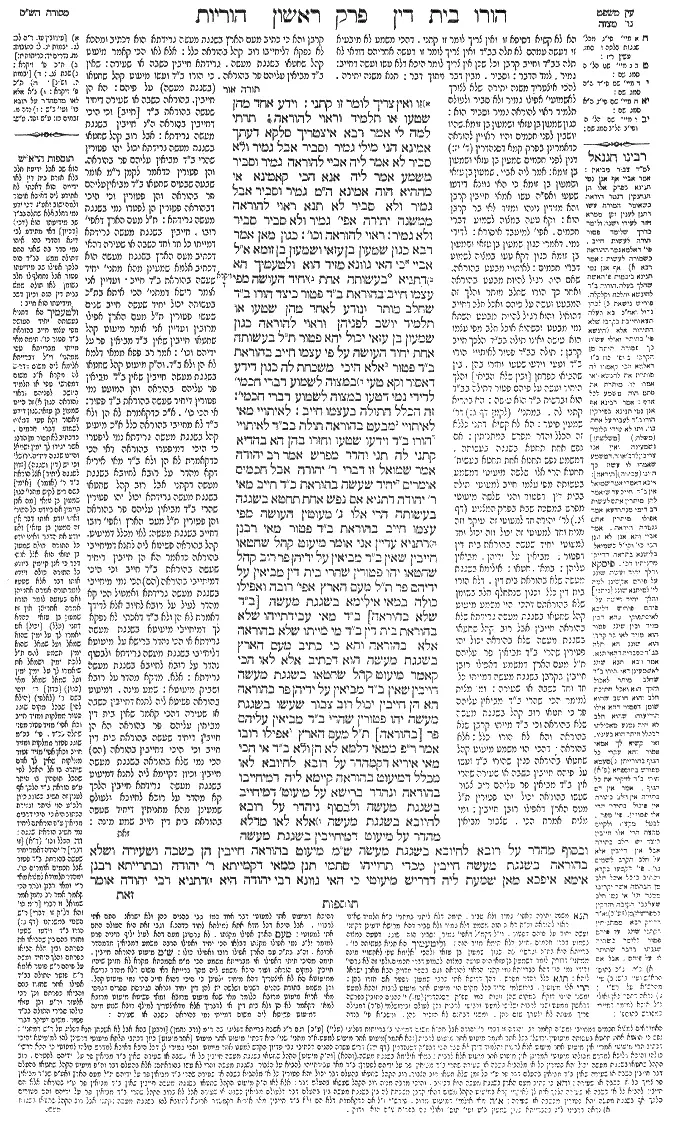
Horayot 2b - Guemara
זו ואין צריך לומר זו קתני:
וידע אחד מהן שטעו או תלמיד וראוי להוראה:
תרתי למה לי אמר רבא איצטריך סלקא דעתך אמינא הני מילי גמיר וסביר אבל גמיר ולא סביר לא אמר ליה אביי להוראה גמיר וסביר משמע אמר ליה אנא הכי קאמינא אי מההיא הוה אמינא ה"מ גמיר וסביר אבל גמיר ולא סביר לא תנא ראוי להוראה ממשנה יתירה אפי' גמיר ולא סביר סביר ולא גמיר:
ראוי להוראה וכו':
כגון מאן אמר רבא כגון שמעון בן עזאי ושמעון בן זומא א"ל אביי כי האי גוונא מזיד הוא ולטעמיך הא דתניא (ויקרא ד, כז) בעשותה אחת יחיד העושה מפי עצמו חייב בהוראת ב"ד פטור כיצד הורו ב"ד שחלב מותר ונודע לאחד מהן שטעו או תלמיד יושב לפניהן וראוי להוראה כגון שמעון בן עזאי יכול יהא פטור ת"ל בעשותה אחת יחיד העושה על פי עצמו חייב בהוראת ב"ד פטור אלא היכי משכחת לה כגון דידע דאסור וקא טעי במצוה לשמוע דברי חכמי' לדידי נמי דטעו במצוה לשמוע דברי חכמי':
זה הכלל התולה בעצמו חייב:
לאיתויי מאי לאיתויי מבעט בהוראה תולה בב"ד לאיתויי הורו ב"ד וידעו שטעו וחזרו בהן הא בהדיא קתני לה תני והדר מפרש אמר רב יהודה אמר שמואל זו דברי ר' יהודה אבל חכמים אומרים יחיד שעשה בהוראת ב"ד חייב מאי ר' יהודה דתניא אם נפש אחת תחטא בשגגה בעשותה הרי אלו ג' מעוטין העושה מפי עצמו חייב בהוראת ב"ד פטור מאי רבנן דתניא עדיין אני אומר מיעוט קהל שחטאו חייבין שאין ב"ד מביאין על ידיהן פר רוב קהל שחטאו יהו פטורין שהרי בית דין מביאין על ידיהם פר ת"ל מעם הארץ אפי' רובה ואפילו כולה במאי אילימא בשגגת מעשה [ב"ד שלא בהוראה] בית דין מאי עבידתייהו שלא בהוראת בית דין ב"ד מי מייתו שלא בהוראה אלא בהוראה והא כי כתיב מעם הארץ בשגגת מעשה הוא דכתיב אלא לאו הכי קאמר מיעוט קהל שחטאו בשגגת מעשה חייבין שאין ב"ד מביאין על ידיהן פר בהוראה הא הן חייבין יכול רוב צבור שעשו בשגגת מעשה יהו פטורין שהרי ב"ד מביאין עליהם פר [בהוראה] ת"ל מעם הארץ אפילו רובו אמר ר"פ ממאי דלמא לא הן ולא ב"ד אי הכי מאי איריא דקמהדר על רובא לחיובא לאו מכלל דמיעוט בהוראה קיימא ליה דמיחייבו בהוראה ונהדר ברישא על מיעוט' דמיחייב בשגגת מעשה ולבסוף ניהדר על רובא לחיובא בשגגת מעשה אלא לאו מדלא מהדר על מיעוט דמיחייבין בשגגת מעשה ובסוף מהדר על רובא לחיובא בשגגת מעשה ש"מ מיעוט בהוראה חייבין הן כשבה ושעירה ושלא בהוראה בשגגת מעשה חייבין מכדי תרוייהו סתמי תנן ממאי דקמייתא ר' יהודה ובתרייתא רבנן אימא איפכא מאן שמעת ליה דדריש מיעוטי כי האי גוונא רבי יהודה היא דתניא רבי יהודה אומר
Comments from Rashi on Masechet Horayot Page 2b
הא לא קשיא דסיפא זו ואין צריך לומר זו קתני . דהכי משמע לא מיבעיא זו דעשה עמהם לא תלה בב"ד ואין צריך לומר זו דעשה אחריהם דודאי לא תלה בב"ד וחייב קרבן וכל שכן אין צריך לומר היכא דלא עשו ועשה דחייב: גמיר . למד הדבר: וסביר . מבין דבר מתוך דבר: תנא משנה יתירה . להכי איצטריך משנה יתירה שלא לצורך לאשמועי' אפילו גמיר ולא סביר ולעולם תלמיד ראוי להוראה גמיר וסביר הוא: כגון שמעון בן עזאי ושמעון בן זומא . שהיו יושבין לפני חכמים והיו ראויין להוראה כדאמרינן בפרק קמא דסנהדרין (ד' יז:) דנין לפני חכמים שמעון בן עזאי ושמעון בן זומא: אמר ליה אביי . שמעון בן עזאי ושמעון בן זומא כי האי גוונא דידעי שטעו ואפ"ה עשו אמאי חייבין קרבן והא מזידין נינהו ומזיד לאו בר קרבן הוא: וקא טעה במצוה לשמוע דברי חכמים . אפי' למיעבד איסורא: לדידי נמי . דאמרי כגון שמעון בן עזאי ושמעון בן זומא כגון דקא טעו במצוה לשמוע דברי חכמים: לאיתויי מבעט בהוראה . שאם היה רגיל להיות מבעט בהוראה ואחר כך הורו שחלב מותר והלך זה המבעט ועשה על פיהם ואכל חלב דחייב דהואיל והוא רגיל להיות מבעט השתא נמי מבעט וכשהוא אוכל חלב מפי עצמו הוא עושה ואינו תולה בב"ד הלכך חייב קרבן: תולה בב"ד פטור לאיתויי הורו ב"ד וטעו וידעו שטעו וחזרו בהן . בין שהביאו כפרתן [ובין שלא הביאו] והלך היחיד ועשה על פיהם פטור דתולה בב"ד הוא וברשות ב"ד הוא עושה: הא בהדיא קתני לה . במתני' (לקמן הוריות דף ג:) דר' שמעון פוטר: הא לא קשיא . דתני כללא זה הכלל והדר מפרש במתניתין: אם נפש אחת תחטא בשגגה בעשותה . דמשמע נפש תחטא אחת תחטא בעשות' תחטא הרי אלו שלשה מיעוטי דמשמע בעשותה מפי עצמו חייב למעוטי תולה בבית דין דפטור והני שלשה מיעוטי מפרש במסכת שבת בפרק המצניע (דף צג.) לר' יהודה חד למעוטי זה עוקר וזה מניח וחד למעוטי זה יכול וזה יכול וחד למעוטי יחיד שעשה בהוראת בית דין דפטור: מביאין על ידיהן . מביאין עליהן: במאי . חטאו: אילימא בשגגת מעשה שלא בהוראת בית דין . דלא הורו בית דין כלל וכגון שנתחלף חלב בשומן שלא בהוראתם דהכי הוי משמע מיעוט קהל שחטאו בשגגת מעשה גרידתא שלא בהוראה חייבין אבל רוב קהל שחטאו בשגגת מעשה שלא בהוראה יכול יהו פטורין שהרי ב"ד מביאין פר עליהם ת"ל מעם הארץ דמשמע דאפילו רובן חייבין בקרבן בשגגת מעשה דמייתו כל חד וחד כשבה או שעירה: ומי מצית למימר הכי שהרי ב"ד מביאין עליהם פר כי חטאו רוב קהל בשגגת מעשה שלא בהוראה וכי ב"ד מייתו קרבן שלא בהוראה והא לא הורו כלל: אלא בהוראה . דהכי הוי משמע מיעוט קהל שחטאו בהוראה כגון שהורו ב"ד ועשו על פיהם חייבין כשבה או שעירה שהרי אין ב"ד מביאין פר עליהם רוב צבור שעשו בהוראה יכול יהו פטורין ת"ל מעם הארץ דאפילו רובן חייבין: ומי מצית אמרת הכי . שצבור מביאין קרבן והא כי כתיב מעם הארץ בשגגת מעשה גרידתא הוא דכתיב ומהכא לא נפקא דליחייבו רוב קהל בהוראה כלל: אלא לאו הכי קאמר מיעוט קהל שחטאו בשגגת מעשה . גרידתא חייבין כשבה או שעירה: שאין ב"ד מביאין עליהם פר בהוראה . כי הורו ב"ד ועשו מיעוט קהל שחטאו (בשגגת מעשה) על פיהם: הא הן חייבין . בהוראה כשבה או שעירה דיחיד שעשה בהוראת ב"ד [חייב] וכי היכי דחייבין בהוראה ה"נ חייבין בשגגת מעשה גרידתא: אבל רוב קהל שחטאו בשגגת מעשה גרידתא יכול יהו פטורין שהרי ב"ד מביאין עליהם פר בהוראה . והן פטורין כדאמר לקמן ר"מ אומר שבעה שבטים שחטאו ב"ד מביאין עליהם פר בהוראה והן פטורין וכי היכי דבהוראה פטורין לפטרו נמי בשגגת מעשה גרידתא: ת"ל מעם הארץ דאפי' רובו . חייבין בשגגת מעשה גרידתא דמייתו כל חד וחד כשבה או שעירה דהאי דכתיב מעם הארץ בשגגת מעשה הוא דכתיב אלמא שמעינן מהא מתני' יחיד שעשה בהוראת ב"ד חייב. ועדיין אני אומר רישא דמתני' הכי איתא בת"כ בעשותה יכול יחיד שעשה חייב שנים שעשו פטורין ת"ל מעם הארץ אפילו מרובין ועדיין אני אומר מיעוט קהל שחטאו חייבין שאין ב"ד מביאין פר על ידיהם וכו': אמר רב פפא ממאי דלמא לא הן ולא ב"ד . וה"ק מיעוט קהל שחטאו בשגגת מעשה חייבין שאין ב"ד מביאין פר עליהם בהוראה והן המועט נמי פטורין דיחיד שעשה בהוראת ב"ד פטור: אי הכי כו' . א"כ כדקאמרת לא הן ולא ב"ד לא מחייבי בהוראה כלל א"כ מיעוט קהל בשגגת מעשה גרידתא נמי ליפטרו כי היכי דמיפטרו בהוראה דאי הכי כדקאמרת לא הן ולא ב"ד מאי איריא דקא מהדר על רובא לחיובא בשגגת מעשה דקתני אבל רוב קהל שחטאו בשגגת מעשה גרידתא יכול יהו פטורין שהרי ב"ד מביאין עליהם פר בהוראה והן פטורין ת"ל מעם הארץ ואפי' רובו דחייב בשגגת מעשה: לאו מכלל דמיעוט . קהל בהוראה פשיטא ליה לתנא דמיחייבי בהוראה כדאמר הא הן חייבין דיחיד שעשה בהוראת ב"ד חייב וכי היכי דמיחייבי בהוראה (שם) הכי נמי מיחייבי בשגגת מעשה גרידתא ואמטול הכי קא מהדר לעיל על רובא לחיוב אלא לדידך דאמרת לא הן ולא ב"ד דאכתי לא נפקא לך דמיחייבי מיעוטא בשגגת מעשה גרידתא אי הכי נהדר ברישא על מיעוטא דליחייבו בשגגת מעשה גרידתא ולבסוף נהדר על רובא לחיובא בשגגת מעשה גרידתא: אלא . מדקא מהדר על רובא ושביק מיעוטא: שמע מינה . דמיעוט בהוראה פשיטא ליה לתנא דחייבין כשבה או שעירה דהכי קאמר שאין בית דין מביאין עליהם פר בהוראה הא הן חייבין דיחיד שעשה בהוראת בית דין חייב וכי היכי דחייבין בהוראה (הם) הכי נמי שלא בהוראה בשגגת מעשה חייבין וכיון דקיימא ליה לתנא דמיעוט בשגגת מעשה גרידתא חייבין הלכך קא מהדר על רובא לחיובא ולעולם שמעינן מהא מתניתין דיחיד שעשה בהוראת בית דין חייב שמע מינה:
Comments from Tosafot - Horayot 2b
תנא. משנה יתירה דאפי' גמיר ולא סביר. תימה דלא ליתני במתני' כ"א תלמיד שאינו ראוי להוראה וכ"ת דא"כ הוה משמע דלא גמיר ולא סביר דהא מרישא ידעינן דקתני ועשה יחיד על פיהם דפטור. וי"ל דקמ"ל דאפי' גמיר וסביר הוה שוגג דטעה במצוה לשמוע דברי חכמים וחייב דלא תימא מזיד הוה: וליטעמיך הא תניא בעשותה כו'. ברייתא היא בת"כ וגרסי' בה כגון שמעון בן עזאי ולהכי אלימא טפי לאקשויי מינה ממתני' דדוחק לומר דשמעון בן עזאי היה טועה במצוה לשמוע דברי חכמים. ולפי זה לא גרסי' ודידי נמי כו' דהא בברייתא נמי קתני הראוי להוראה וגם בספר מדויק הבא מארץ ישראל ליתא: תנא כלל והדר מפרש. דהך דרישא אתי כרבי שמעון דפטר אם חזרו בהן: הרי אלו מעוטין. בירושלמי פריך בכל מקום הוי מיעוט אחר מיעוט לרבות והכא למעט ומשני היינו דוקא במקום שהן זוגות כמו ספ"ק דסנהדרין (טו.) י' כהנים כתובין בפרשה דראשון ממעט ושני לרבות ושלישי למעט ורביעי לרבות וכן לעולם ובירושלמי (פ"ד) דמגילה פריך מעתה לא יצטרך שום כהן. ומשני דבחנם לא הזכיר כהן. ורשב"א פי' בנדה דהיכא דמיעוט אתי למעוטי דבר אחד כמו גבי כהנים כהן ולא ישראל התם אתי לרבויי. אבל היכא דכל חדא אתא למילתא לחוד כדהכא וגבי זאת היא העולה התם אתי למעוטי: מעם הארץ אפילו מקצתו . לא גרסינן מעם דהא לעיל יליף מיניה פרט למומר ול"ג נמי אפילו מקצתו דבלאו הכי יחיד ואפילו הרבה משמע דמביאין מדמהדר ארובא. וה"ג בת"כ עם הארץ אפילו רובו ואפילו כולו: ש"מ מיעוט בהוראה חייבין. תימה מהיכי תיתי דאפילו אי מברייתא משמע הכי מ"מ אסמכתא מקרא לא חזינן שיהיו חייבין במקום הוראה ועוד היכא משמע ליה מהך ברייתא דאי משום דלא מהדר ברישא ממיעוטא הא לא איצטריך דהא מיחיד ילפינן כי היכי דהוא חייב הכי נמי מיעוט קהל. וכן משמע בתורת כהנים דשנים ושלשה יש להן דין יחיד ונראה כגירסת ספרים דגרסי מאי אריא מיעוט מרובא כלומר מאי שנא מיעוט מרובא ומאי פשיטא מיעוט מרובא למאי דקאמר לא הן ולא בית דין אי לדבריך אלא מדאיצטריך למילף רובא שמע מינה דמיעוט פשיטא ליה משום דמייתי נמי בהוראה כשבה או שעירה:
Horayot 2b - Mishnah translated into english
The Gemara answers: In the latter clause, the tanna teaches the mishna employing the style: This, and it is unnecessary to say that, i.e., the cases are arranged with each case more obvious than the one that preceded it.
§ The mishna teaches: And one of the judges knew that they erred, or if he was a student and he is qualified to issue halakhic rulings. The Gemara asks: Why do I need two cases? As a student qualified to issue halakhic rulings is the equivalent of one of the judges, why did the tanna mention both? Rava said: It was necessary to state both, as it may enter your mind to say that this statement that he is liable applies specifically to one who is learned and analytical, but that one who is learned but not analytical, no, he should not be liable to bring an offering. Therefore, the tanna cites both the case of a judge and the case of a student qualified to issue halakhic rulings, to teach that even one who is learned but not analytical is liable in this case.
Abaye challenged this and said to Rava that the term: A student qualified to issue halakhic rulings, indicates that he is both learned and analytical. Rava said to Abaye: This is what I am saying: If the tanna had taught the halakha from that first halakha with regard to one of the judges, I would say that this statement applies only to one who is both learned and analytical, but if he was learned and not analytical, no, he would not be liable. Therefore, the tanna taught the additional case of a student qualified to issue halakhic rulings, and from the extraneous case in the mishna one can infer that the halakha applies even to one who is learned but not analytical or one who is analytical but not yet learned. Since he associates his action with himself, he is liable.
§ The mishna teaches: Qualified to issue halakhic rulings. The Gemara asks: Like whom? Who is an example of one qualified to issue halakhic rulings? Rava said: It is one like Shimon ben Azzai or Shimon ben Zoma, who, although they were among the most outstanding Torah scholars of their generation, were not ordained. Abaye said to Rava: In a case like this, he is an intentional sinner, as a scholar of that caliber would certainly not err. If he ruled that a prohibited action is permitted, it is assumed that he acted with intent, and he is exempt from bringing an offering.
Rava said to Abaye: But according to your reasoning, that which is taught in a baraita that cites the verse: “In performing one” (Leviticus 4:27), from which it is derived that an individual who performs a transgression on his own is liable, while one who performs a transgression based on the ruling of the court is exempt; how so? When does this apply? If the court ruled that forbidden fat is permitted, and it became known to one of the judges that they erred, or if he was a student who was sitting before them and he is qualified to issue halakhic rulings, e.g., Shimon ben Azzai, might one have thought that he would be exempt? To counter this, the verse states: “In performing one,” from which it is derived that an individual who performs a transgression on his own is liable, while one who performs a transgression on the basis of the ruling of the court is exempt.
Rava continues: Rather, the baraita is difficult; how can you find these circumstances where a judge or a prominent Torah scholar would be considered an unwitting sinner? The Gemara answers: It is in a case where the judge or the scholar knew that the action with regard to which the court issued a ruling that it is permitted is in fact prohibited, but he erred with regard to the mitzva of heeding the statements of the Sages. He believed that there is a mitzva to heed the directives of the Sages even when he is certain that they are mistaken. If so, according to my understanding too, the reference is to one like Shimon ben Azzai or Shimon ben Zoma; it is also a case where they erred with regard to the mitzva of heeding the statements of the Sages. Due to that error, they are liable to bring an offering.
§ The mishna teaches: This is the principle: One who associates his action with himself is liable. The Gemara asks: What case that was not already mentioned in the mishna does this principle serve to include? The Gemara answers: It serves to include one who disdains halakhic rulings in general, treating them with contempt and relying only on his own understanding.
The mishna teaches the second part of that principle: And one who associates his action with the ruling of the court is exempt. The Gemara explains: This principle serves to include an additional case that was not yet mentioned in the mishna, namely, where the court issued a ruling and the judges discovered that they erred and reversed their decision. If one was unaware that the court reversed their decision, and acted based on their initial ruling, he is deemed one who associates his action with the ruling of the court and is exempt. The Gemara challenges: The tanna teaches this halakha explicitly in the next mishna (3b), and consequently there is no need for an allusion in this mishna. The Gemara explains: The tanna teaches it ambiguously, and then teaches it explicitly.
§ Rav Yehuda says that Shmuel says: This halakha in the mishna, which states that an individual who performs a transgression on the basis of a ruling issued by the court is exempt from liability to bring an offering, is the statement of Rabbi Yehuda. But the Rabbis say: An individual who performs a transgression on the basis of the ruling of the court is liable. The Gemara asks: What is the opinion of Rabbi Yehuda to which Shmuel refers? It is as it is taught in a baraita: The verse states: “And if one soul from among the common people shall sin unwittingly in performing one of the mitzvot of the Lord” (Leviticus 4:27). These are three exclusionary terms: “One,” “unwittingly,” and “in performing,” and one of these exclusions serves to teach that one who performs a transgression on his own is liable, while one who performs a transgression on the basis of the ruling of the court is exempt.
The Gemara asks: What is the opinion of the Rabbis? It is as it is taught in a baraita: Still I say: Each member of a minority of the congregation that sinned based on the ruling of a court is liable to bring an offering for his unwitting transgression, as the court does not bring a bull for an unwitting communal sin on the basis of the minority’s transgression. One might have thought that each member of a majority of the congregation that sinned based on the ruling of a court would be exempt from liability to bring an offering for his unwitting transgression, as the court brings a bull for an unwitting communal sin on the basis of the majority’s transgression. To counter this, the verse states with regard to a sin-offering brought for an unwitting transgression: “From among the common people,” from which it is derived that even members of the majority of the congregation, and even members of the entire congregation, are not exempt because of the ruling of the court.
The Gemara asks: In what circumstances did the majority of the congregation sin? If we say that the reference is to a transgression with unwitting performance of an action unrelated to a ruling of the court, why does the tanna say: As the court brings a bull for an unwitting communal sin on the basis of the majority’s transgression? Given that this is a case where a court did not issue a ruling, what action did the court perform? Since it was not on the basis of the ruling of the court, does the court bring a bull for an unwitting communal sin that was performed not on the basis of its ruling? Rather, the reference in the baraita must be to a case where the majority of the congregation performed a transgression on the basis of the ruling of the court. If so, the question arises: But when it is written with regard to a sin-offering brought for an unwitting transgression: “From among the common people,” it is with regard to a transgression with unwitting performance of an action that it is written.
Rather, is it not that this is what the tanna is saying: The baraita is incomplete and must be taught in this manner: Each member of a minority of the congregation that sinned with unwitting performance of an action is liable to bring an offering for his unwitting transgression, as the court does not bring a bull for an unwitting communal sin on the basis of the minority’s transgression in a case where the court issued an erroneous ruling. But a minority of the congregation that sinned unwittingly on the basis of the ruling of the court is also liable.
The baraita continues: One might have thought that a majority of the congregation that sinned with unwitting performance of an action would be exempt, as the court brings a bull for an unwitting communal sin on the basis of the majority’s transgression in a case where the court issued an erroneous ruling. Therefore, the verse states: “From among the common people,” from which it is derived that even members of the majority of the congregation are liable. If the unwitting transgression was performed not on the basis of the ruling of the court, there is no difference between a minority and a majority of the people. This is proof that according to the Rabbis both an individual and a minority of the congregation who performed a transgression on the basis of the ruling of the court are liable.
Rav Pappa said: From where do you draw this conclusion? Perhaps in the case where a minority of the congregation performs a transgression on the basis of the ruling of the court, neither do those individuals bring an offering, because they associated their action with the court, nor does the court bring an offering, because it was only a minority of the congregation that performed a transgression on the basis of the ruling of the court.
The Gemara rejects this: If so, why does the tanna specifically seek a source with regard to the majority for liability? Why did the tanna seek to introduce the halakha that even if a majority of the congregation sinned they would be liable to bring an offering? Can one not, by inference, conclude with regard to a minority that acts on the basis of the ruling of the court, that he holds that they are liable even though they acted on the basis of the ruling of the court? According to Rav Pappa’s opinion, let the tanna first seek to cite proof about a minority that each of its members is liable to bring a sin-offering for unwitting performance of an action, and ultimately seek to cite proof about a majority to establish liability for each of its members to bring a sin-offering for unwitting performance of an action, as it has not yet been established with regard to a minority that each of its members is liable to bring a sin-offering for unwitting performance of an action.
Rather, can one not make an inference from the fact that the tanna did not first seek to cite proof about a minority that each of its members is liable to bring a sin-offering for unwitting performance of an action and then seek to cite proof about a majority to establish liability for each of its members to bring a sin-offering for unwitting performance of an action? Accordingly, one can conclude from it that it was clear to the tanna that in a case of a minority that acts on the basis of the ruling of the court, each member of the minority is liable to bring a female lamb or a female goat as a sin-offering, and for unwitting performance of an action not on the basis of the ruling of the court, each member of the minority is similarly liable.
The Gemara asks: Now, we learned both of the baraitot unattributed. From where may it be ascertained that the tanna of the first baraita is Rabbi Yehuda and the tanna of the latter baraita is the Rabbis? Say the opposite. The Gemara answers: Whom did you hear that interprets exclusionary terms in this way? It is Rabbi Yehuda, as it is taught in a baraita that Rabbi Yehuda says:
Traduction : The William Davidson digital edition of the Koren Noé Talmud, with commentary by Rabbi Adin Even-Israel Steinsaltz.