 Talmud Bavli
The learning on the whole site is dedicated : L'ilui Nishmat Amram ben Itshak Loubaton
The learning on the whole site is dedicated : For the success of Elyahou ben H'anna & family
The learning on the whole site is dedicated : L'ilui Nishmat Yaakov ben Myriam
No video class on this page yet.
To add a video to this page please click here.Keritot Page 11b
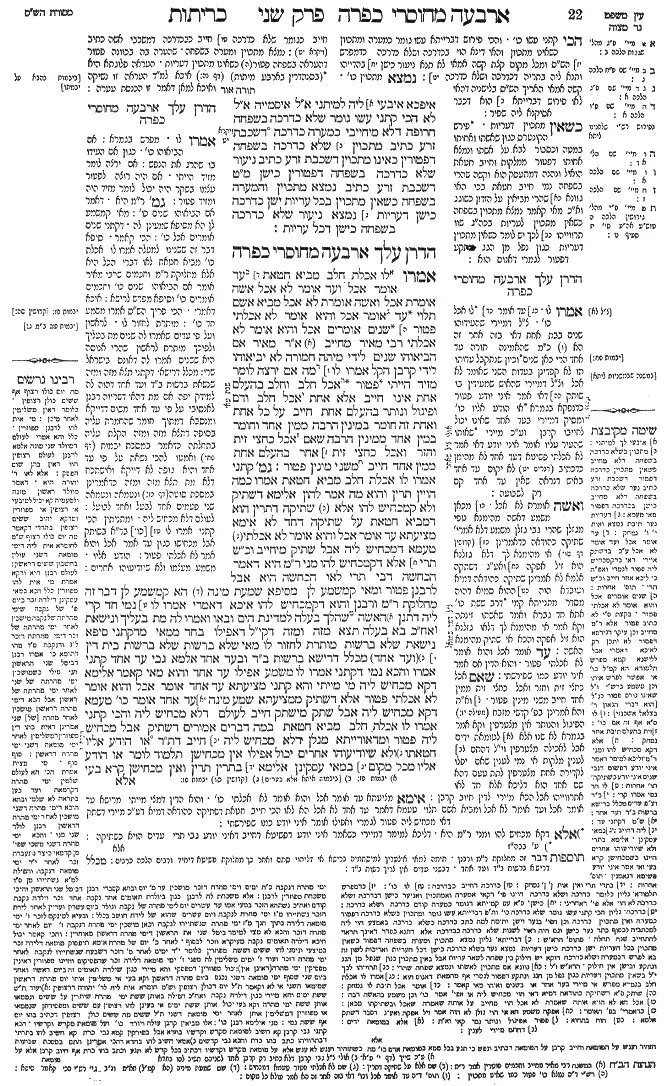
Keritot 11b - Guemara
איפכא איבעי ליה למיתני א"ל איסמייה א"ל לא הכי קתני עשו גומר שלא כדרכה בשפחה חרופה דלא מיחייבי כמערה כדרכה (ויקרא יט, כ) דשכבת זרע כתיב מתכוין שלא כדרכה בשפחה דפטורין כאינו מתכוין דשכבת זרע כתיב ניעור שלא כדרכה בשפחה דפטורין כישן מ"ט דשכבת זרע כתיב נמצא מתכוין והמערה בשפחה כשאין מתכוין בכל עריות ישן כדרכה כישן דעריות נמצא ניעור שלא כדרכה בשפחה כישן דכל עריות:
הדרן עלך ארבעה מחוסרי כפרה
מתני׳ אמרו לו אכלת חלב מביא חטאת עד אומר אכל ועד אומר לא אכל אשה אומרת אכל ואשה אומרת לא אכל מביא אשם תלוי עד אומר אכל והוא אומר לא אכלתי פטור שנים אומרים אכל והוא אומר לא אכלתי רבי מאיר מחייב א"ר מאיר אם הביאוהו שנים לידי מיתה חמורה לא יביאוהו לידי קרבן הקל אמרו לו מה אם ירצה לומר מזיד הייתי פטור אכל חלב וחלב בהעלם אחת אינו חייב אלא אחת אכל חלב ודם ופיגול ונותר בהעלם אחת חייב על כל אחת ואחת זה חומר במינין הרבה ממין אחד וחומר במין אחד ממינין הרבה שאם אכל כחצי זית וחזר ואכל כחצי זית אחר בהעלם אחת ממין אחד חייב משני מינין פטור:
גמ׳ קתני אמרו לו אכלת חלב מביא חטאת אמרו כמה הויין תרין והוא מה אמר להון אלימא דשתיק ולא קמכחיש להו אלא שתיקה דתרין הוא דמביא חטאת על שתיקה דחד לא אימא מציעתא עד אומר אכל והוא אומר לא אכלתי טעמא דמכחיש ליה אבל שתיק מיחייב וכ"ש תרי אלא דקמכחיש להו מני ר"מ היא דאמר הכחשה דבי תרי לאו הכחשה היא אבל לרבנן פטור ומאי קמשמע לן מסיפא שמעת מינה הא קמשמע לן דבר זה מחלוקת ר"מ ורבנן והוא דקמכחיש להו איכא דאמרי אמרו לו נמי חד קרי ליה דתנן האשה שהלך בעלה למדינת הים ובאו ואמרו לה מת בעליך ונישאת ואח"כ בא בעלה תצא מזה ומזה דקי"ל דאפילו בחד ממאי מדקתני סיפא נישאת שלא ברשות מותרת לחזור לו מאי שלא ברשות שלא ברשות בית דין ועד אחד מכלל דרישא ברשות ב"ד ובעד אחד אלמא גבי עד אחד קתני אמרו והכא נמי דקתני אמרו לו משמע אפילו עד אחד והוא מאי קאמר אלימא דקא מכחיש ליה מי מייתי והא קתני מציעתא עד אחד אומר אכל והוא אומר לא אכלתי פטור אלא דשתיק ממציעתא שמע מינה עד אחד אומר כו' טעמא דקא מכחיש ליה אבל שתק מישתק חייב לעולם דלא מכחיש ליה והכי קתני אמרו לו אכלת חלב מביא חטאת במה דברים אמורים דשתיק אבל מכחיש ליה פטור ומדאורייתא מנלן דלא מכחיש ליה חייב דת"ר (ויקרא ד, כג) או הודע אליו חטאתו ולא שיודיעוהו אחרים יכול אפילו אין מכחישן תלמוד לומר או הודע אליו מכל מקום במאי עסקינן אלימא בתרין תרין ואין מכחישן קרא בעי
Comments from Rashi on Masechet Keritot Page 11b
נמצא מתכוין ומערה בשפחה . שהערה בה בכוונה פטור דהעראה בשפחה פטור כשאינו מתכוין דעריות. העראה פלוגתא היא (בסנהדרין בארבע מיתות) (דף נה:) איכא למ"ד העראה זו נשיקה ואיכא למאן דאמר זו הכנסת עטרה: מתני' אמרו לו . מפרש בגמרא: אם הביאוהו כו' . כגון אם העידו בו שהרג את הנפש: אם ירצה לומר מזיד הייתי . אם היה רוצה לפטור עצמו בשקר היה יכול לומר מזיד היה ומזיד פטור: גמ' ר"מ היא . דאמר אם הביאוהו שנים כו': מאי קמשמע לן הא מסיפא שמעינן לה . דקתני שנים אומרים אכל כו': הכי קאמר סיפא דבר זה . ששנינו למעלה אמרו לו אכלת כו' מביא חטאת לאו דברי הכל היא אלא מחלוקת ר"מ וחכמים שרבי מאיר אומר אם הביאוהו שנים כו' וחכמים אומרים כו' וסיפא מפרש לרישא: איכא דאמרי . הכי פריך הש"ס אמרו משמע חד כו': מותרת לחזור לו . לראשון ועל פי עדים שאמרו לה שנים מת בעליך ולפיכך מותרת לראשון שהרי אנוסה היא ששנים אמרו לה דאונס בישראל שרי: מכלל דרישא . דקתני תצא מזה ומזה שנשאת ברשות ב"ד ועד אחד דהוה לה למידק יפה אם מת דהאי דשריוה רבנן לאנסובי על פי עד אחד משום דדייקא ומנסבא דמתוך חומר שהחמרת עליה בסופה דתצא מזה ומזה הקלת עליה בתחלתה כדאמר במסכת יבמות (דף פח.) ואמטו להכי נשאת על פי עד אחד והיא גופה לא דייקא ואישתכח דלא מת תצא מזה ומזה כדאמרינן במסכת סוטה (דף כז:) ונטמאה ונטמאה שני פעמים אחד לבעל ואחד לבועל: לעולם דלא מכחיש ליה . ומתניתין הכי קתני אמרו לו [כו'] בד"א בשותק אבל מכחישו כגון עד אמר אכל והוא אמר לא אכלתי פטור: הודע אליו . משמע מעצמו ולא שיודיעוהו אחרים:
Comments from Tosafot - Keritot 11b
הכי קתני עשו כו' . והכי פירוש דברייתא עשו גומר כמערה ומתכוון כשאינו מתכוון והאי דינא הוי בכדרכה ושלא כדרכה כדמפרש הש"ס ומכל מקום קצת קשה אמאי לא תנא ניעור כישן בהדייהו ותנא ליה בתריה דכדרכה ושלא כדרכה: נמצא מתכוין כו' . קשה אמאי האריך הש"ס בלישניה דהאי לאו פירוש דברייתא הוא דכבר אסיקנא ליה שפיר: כשאין מתכוין דעריות . פירש הקונטרס כגון שאשתו ואחותו במטה וכסבור לבא על אשתו ונמצא אחותו דפטור ממלקות וחייב חטאת הואיל ונהנה דמתעסק הוא וקשה שהרי בשפחה נמי חייב חטאת בכי האי גוונא שהרי מביאין על הזדון כשוגג וא"כ מאי קאמר נמצא מתכוין בשפחה כשאין מתכוין לעריות בכה"ג שוו תרווייהו לכך יש לומר כשאין מתכוין דעריות כגון נפל מן הגג ונתקע דפטור לגמרי דאנוס הוא: מתני' אמרו לו עד אומר לו אכל כו' . צ"ל דמיירי שהעידוהו שנים בבת אחת דאי בזה אחר זה הא כ"מ שהאמינה תורה עד אחד הרי כאן שנים וכיון שנתקבל עדותו תו לא קפדינן בעדות השני שאומר לא אכל וצ"ל דמיירי שהאיש שמעידין בו שותק דאי אמר איני יודע פטור כדנפקא בגמרא או הודע אליו כו' ומסיק דמיירי בעד אחד שאינו יכול לחייבו קרבן וע"כ מיירי שאותו שהעיד עליו אומר איני יודע דאי אמר לא אכלתי פשיטא דעד אחד לא מהימן כדכתיב (דברים יט) לא יקום עד אחד באיש דנראה שאין עד אחד קם רק לשבועה: ואשה אומרת לא אכל . מכאן משמע דאשה מהימנא טפי מגזלן שהרי גבי גזלן משמע דלא אמרי' שתיקה כהודאה כדאמרינן (קדושין דף סו.) אי מהימנא לך דלא גזלנא הוא זיל אפקה ואע"ג דשתקה אלמא לא אמרינן שתיקה כהודאה דמיא ועובדא הוה ההוא סמיא דהוה מסדר מתנייתא קמי דרב ששת כו' אתא חד גברא ואמר שאשתו זינתה וקא אמר אי מהימנא לך דלאו גזלנא הוא זיל אפקה והכא אי שתיק מהימנא האשה: עד אומר אכל והוא אומר לא אכלתי פטור . והוא הדין אם אמר איני יודע כמו שפירשתי: שאם אכל כחצי זית וחזר ואכל כחצי זית ממין אחד חייב משני מינין פטור . וא"ת והא אמרינן בפ' קדשי מזבח (מעילה יז:) הפיגול והנותר אין מצטרפין וקא אמר בגמרא לא שנו אלא לטומאת ידים אבל לאכילה מצטרפין וי"ל דהתם לענין מלקות אי נמי לענין שאם יפלו לקדירה אחת מצטרפין לתת טעם דהא שם אחד הוא דליכא אלא חד לאו אתרווייהו אבל הכא מיירי לדין חיוב קרבן: אימא מציעתא עד אומר אכל והוא אומר לא אכלתי כו' . והוא הדין דמצי מייתי מרישא עד אומר אכל ועד אומר לא אכל ומביא אשם תלוי טעמא דאמר עד אחד לא אכל הא לאו הכי חייב חטאת דשתיקה כהודאה דמיא דע"כ מיירי דשתק דאי מכחיש ליה פטור לגמרי ואפילו אומר איני יודע כמו שפירשתי: אלא דקא מכחיש להו ומני ר"מ היא . דליכא למימר דמיירי כשאמר איני יודע דפשיטא דחייב דאיני יודע גבי תרי עדים הויא כשתיקה:
Keritot 11b - Mishnah translated into english
It should teach the opposite, i.e., it should say: They made one who engages in the initial stage of intercourse like one who completes the act, as it is obvious that one who completes the act is liable.
The tanna said to Rav Sheshet: Should I remove this baraita, as it is apparently corrupted? Rav Sheshet said to him: No; do not remove the baraita, as this is what it is teaching: The Sages rendered one who completes an atypical act of intercourse with an espoused maidservant, for which he is not liable, like one who engages in the initial stage of intercourse with her in the typical manner, for which he is also exempt. They derived this from the fact that it is written: “Lies carnally.”
Similarly, they rendered one who engages intentionally in atypical intercourse with a maidservant, for which they are both exempt, like one who does so in a typical manner unintentionally, as it is written: “Lies carnally.” And they also rendered one who engages in intercourse in an atypical manner with an espoused maidservant while he is awake, for which they are both exempt, like one who does so while sleeping. What is the reason? They derived this from the fact that it is written: “Lies carnally.”
The Gemara concludes: It has been determined that one who engages in intercourse intentionally or engages in the initial stage of intercourse with an espoused maidservant is like one who does so unintentionally with all those with whom relations are forbidden, meaning that he is exempt. Similarly, one who engages in intercourse with an espoused maidservant in a typical manner while sleeping is like one who does so, while sleeping, with all those others with whom relations are forbidden, and he is likewise exempt. Furthermore, it has also been determined that one who engages in atypical intercourse with an espoused maidservant while awake is like one who does so with all those with whom relations are forbidden, while sleeping, and he is also exempt.
MISHNA: If witnesses said to a person: We saw that you ate forbidden fat, he is liable to bring a sin offering if he did so unwittingly. If a witness says: He ate forbidden fat, and a witness says: He did not eat forbidden fat, or if a woman says: He ate forbidden fat, and a woman says: He did not eat forbidden fat, he is liable to bring a provisional guilt offering, brought by one who is uncertain as to whether he committed a sin that requires a sin offering. If a witness says: He ate forbidden fat, and the person himself says: I did not eat forbidden fat, he is exempt.
If two witnesses say: He ate forbidden fat, and the person himself says: I did not eat forbidden fat, Rabbi Meir deems him liable to bring a sin offering. Rabbi Meir said: This conclusion can be derived a fortiori: If two witnesses could have brought him liability to receive the severe punishment of death, can they not bring him liability to sacrifice an offering, which is relatively lenient? The Rabbis said to him: Witnesses are unable to render another person liable to bring an offering contrary to his statement, as what if he wishes to say: I did so intentionally, in which case he would be exempt from bringing an offering?
If one unwittingly ate an olive-bulk of forbidden fat and then ate another olive-bulk of forbidden fat during one lapse of awareness, i.e., in a case where he did not discover in the interim that fat is forbidden, or that the food he is eating is forbidden fat, he is liable to bring only one sin offering. If one ate forbidden fat, and blood, and piggul, and notar in one lapse of awareness, he is liable to bring a sin offering for each and every one of them. This is a stringency that applies to one who eats several types of forbidden food and does not apply to one who eats one type of forbidden food.
And a stringency that applies to one who eats one type of forbidden food and not to one who eats several types of forbidden food is that if one ate half an olive-bulk and then ate another half an olive-bulk during one lapse of awareness, in a case where they were both from one type of forbidden food, he is liable to bring a sin offering. If they were from two types, he is exempt, because he did not eat an olive-bulk of any specific forbidden food.
GEMARA: The mishna teaches: If witnesses said to him: You ate forbidden fat, he is liable to bring a sin offering. The Gemara analyzes the first clause of the mishna: Since the mishna employs the plural form of the word said, how many witnesses are involved in the case? There must be at least two witnesses. And what does he say to them in response? If we say that he is silent and does not contradict them, then it may be inferred that it is only when he responds with silence in response to the claim of two witnesses that he brings a sin offering, but for silence in response to the claim of one witness, he does not bring a sin offering.
But say the middle clause: If a witness says that he ate forbidden fat, and the person himself says: I did not eat it, he is exempt. The Gemara infers: The reason that he is exempt is that he contradicts him. But if he is silent, he is liable, and all the more so if he is silent when two witnesses claim that he ate forbidden fat. This contradicts the inference from the first clause that silence in response to one witness does not render one liable to bring a sin offering.
Rather, the first clause is referring to a case where he contradicts the claim of the two witnesses. Whose opinion is this? It is that of Rabbi Meir, who says in the continuation of the mishna that the person’s contradiction of the testimony of two witnesses is not considered a contradiction, and he is liable to bring a sin offering. But according to the opinion of the Rabbis, he is exempt.
The Gemara asks: And according to this answer, what does the tanna teach us in the first clause? From the latter clause you already learn that according to Rabbi Meir, one is liable to bring a sin offering as a result of the testimony of two witnesses, even if he contradicts them. The Gemara answers: The latter clause is clarifying the first clause, and this is what it teaches us: This matter that was stated in the first clause is actually the subject of a dispute between Rabbi Meir and the Rabbis, and that dispute pertains to a case where he contradicts their testimony.
Some say a different explanation of the first clause: The case is where only one witness asserts that the individual ate forbidden fat, and occasionally the plural verb form in the expression: Witnesses said to him, can also be used to refer to one witness. As we learned in a mishna (Yevamot 87b): With regard to a woman whose husband went overseas, and witnesses came and said to her: Your husband died, and she married another man on the basis of this testimony, and afterward her husband came back, she must leave both this man, her first husband, and that one, whom she married subsequently. This mishna indicates that the plural expression can be used in the case of a single witness, as we maintain that this mishna is referring even to a case where one witness testified that her husband died.
From where is this inferred? It is inferred from the fact that the latter clause of that mishna teaches: If she married without consent and then her first husband returned, she is permitted to return to him. What does the mishna mean when it states that she remarried without consent? It means she remarried without the consent of the court, which would be granted based on the testimony of one witness. Rather, two witnesses testified that her husband had died. Since that is full-fledged halakhic testimony, she is permitted to remarry independently, even without the explicit consent of the court.
By inference, one may conclude that the first clause is referring to a case where she married with the consent of the court and on the basis of the testimony of one witness. Evidently, that mishna teaches the plural form of the word: Said, when it is referring to one witness, and here, too, in this mishna where it teaches the phrase: Witnesses said to him, it indicates that even one witness renders one liable to bring a sin offering.
The Gemara asks: And what does he say in response to the witness? If we say that he contradicts the witness, does he bring an offering? But doesn’t the middle clause teach: If a witness says: He ate forbidden fat, and the person himself says: I did not eat forbidden fat, he is exempt?
Rather, if it is referring to a case where he is silent, the clause is unnecessary, as one can learn this halakha from the middle clause, which states: If a witness says: He ate forbidden fat, and the person himself says: I did not eat forbidden fat, he is exempt from bringing a sin offering. This indicates that the reason he is exempt is that he contradicts the witness, but if he was silent, he is liable to bring a sin offering.
The Gemara rejects this reasoning: Actually, the first clause of the mishna is referring to a case where he does not contradict the witness but remains silent. And this is what the mishna is teaching: If they, i.e., even one witness, said to him: You ate forbidden fat, he is liable to bring a sin offering. The middle clause then clarifies: In what case is this statement said? It is said where he was silent in response to this accusation, but if he contradicts the witness, he is exempt.
The Gemara asks: And from where do we derive that by Torah law that if he does not contradict the witness, he is liable to bring a sin offering? It is as the Sages taught in a baraita with regard to a verse that deals with a sin offering: “Or if his sin is known to him” (Leviticus 4:28), that this is referring to a case where he found out himself but not a case where others informed him of his sin. One might have thought he is exempt even if he does not contradict the claim of the witness. Therefore, the verse states: “Or if his sin is known to him,” which teaches that in any case where he knows that he sinned, even if others informed him of it, he is liable. He is exempt only if he denies it.
The Gemara asks: What are we dealing with, in the case where he is informed by others? If we say that it is referring to two witnesses who inform him, in a case where two witnesses testify and he does not contradict them does one need a verse to render him liable?
Traduction : The William Davidson digital edition of the Koren Noé Talmud, with commentary by Rabbi Adin Even-Israel Steinsaltz.