 Talmud Bavli
Ketubot 27b : Youtube
Daf TubeYoutube
1 video class :
Ketubot Page 27b
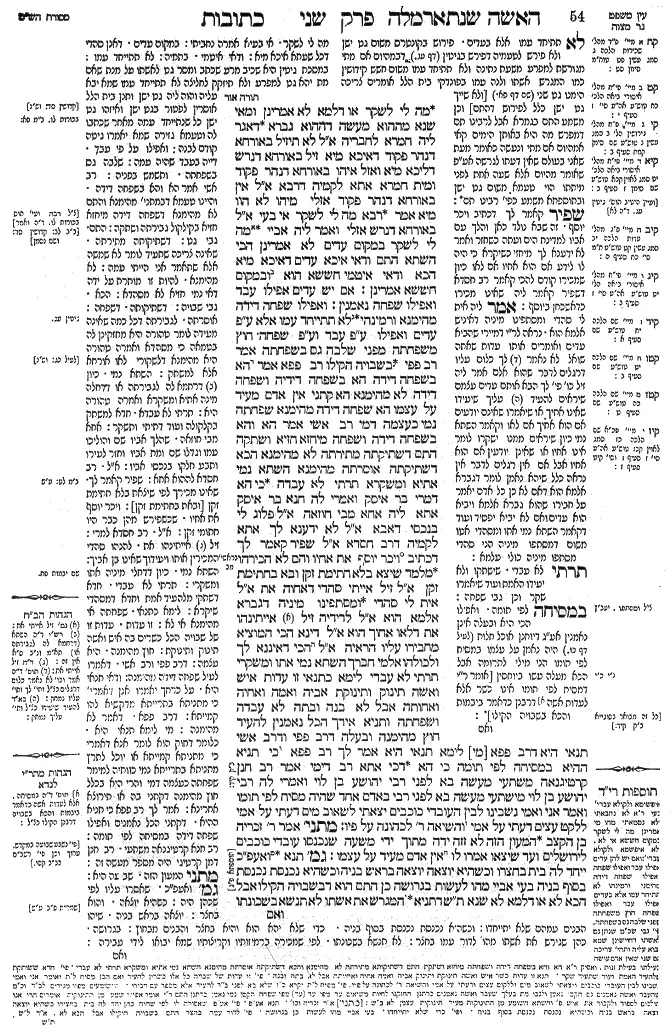
Ketubot 27b - Guemara
מה לי לשקר או דלמא לא אמרינן ומאי שנא מההוא מעשה דההוא גברא דאגר ליה חמרא לחבריה א"ל לא תיזיל באורחא דנהר פקוד דאיכא מיא זיל באורחא דנרש דליכא מיא ואזל איהו באורחא דנהר פקוד ומית חמרא אתא לקמיה דרבא א"ל אין באורחא דנהר פקוד אזלי מיהו לא הוו מיא אמר רבא מה לי לשקר אי בעי א"ל באורחא דנרש אזלי ואמר ליה אביי מה לי לשקר במקום עדים לא אמרינן הכי השתא התם ודאי איכא עדים דאיכא מיא הכא ודאי איטמי חששא הוא ובמקום חששא אמרינן:
אם יש עדים אפילו עבד ואפילו שפחה נאמנין:
ואפילו שפחה דידה מהימנא ורמינהי לא תתייחד עמו אלא ע"פ עדים ואפילו ע"פ עבד וע"פ שפחה חוץ משפחתה מפני שלבה גס בשפחתה אמר רב פפי בשבויה הקילו רב פפא אמר הא בשפחה דידה הא בשפחה דידיה ושפחה דידה לא מהימנא הא קתני אין אדם מעיד על עצמו הא שפחה דידה מהימנא שפחתה נמי כעצמה דמי רב אשי אמר הא והא בשפחה דידה ושפחה מיחזא חזיא ושתקה התם דשתיקתה מתירתה לא מהימנא הכא דשתיקתה אוסרתה מהימנא השתא נמי אתיא ומשקרא תרתי לא עבדה כי הא דמרי בר איסק ואמרי לה חנא בר איסק אתא ליה אחא מבי חוזאה א"ל פלוג לי בנכסי דאבא א"ל לא ידענא לך אתא לקמיה דרב חסדא א"ל שפיר קאמר לך דכתיב (בראשית מב, ח) ויכר יוסף את אחיו והם לא הכירהו מלמד שיצא בלא חתימת זקן ובא בחתימת זקן א"ל זיל אייתי סהדי דאחוה את א"ל אית לי סהדי ומסתפינו מיניה דגברא אלמא הוא א"ל לדידיה זיל אייתינהו את דלאו אחוך הוא א"ל דינא הכי המוציא מחבירו עליו הראיה א"ל הכי דאיננא לך ולכולהו אלמי חברך השתא נמי אתו ומשקרי תרתי לא עבדי לימא כתנאי זו עדות איש ואשה תינוק ותינוקת אביה ואמה ואחיה ואחותה אבל לא בנה ובתה לא עבדה ושפחתה ותניא אידך הכל נאמנין להעיד חוץ מהימנה ובעלה דרב פפי ודרב אשי תנאי היא דרב פפא מי לימא תנאי היא אמר לך רב פפא כי תניא ההיא במסיחה לפי תומה כי הא דכי אתא רב דימי אמר רב חנן קרטיגנאה משתעי מעשה בא לפני רבי יהושע בן לוי ואמרי לה רבי יהושע בן לוי מישתעי מעשה בא לפני רבי באדם אחד שהיה מסיח לפי תומו ואמר אני ואמי נשבינו לבין העובדי כוכבים יצאתי לשאוב מים דעתי על אמי ללקט עצים דעתי על אמי והשיאה ר' לכהונה על פיו:
מתני׳ אמר ר' זכריה בן הקצב המעון הזה לא זזה ידה מתוך ידי משעה שנכנסו עובדי כוכבים לירושלים ועד שיצאו אמרו לו אין אדם מעיד על עצמו:
גמ׳ תנא ואעפ"כ ייחד לה בית בחצרו וכשהיא יוצאה יוצאה בראש בניה וכשהיא נכנסת נכנסת בסוף בניה בעי אביי מהו לעשות בגרושה כן התם הוא דבשבויה הקילו אבל הכא לא או דלמא לא שנא ת"ש דתניא המגרש את אשתו לא תנשא בשכונתו
Comments from Rashi on Masechet Ketubot Page 27b
מה לי לשקר . אי בעיא אמרה נחביתי: במקום עדים . דאנן סהדי דכל שעתא איכא מיא: ודאי איטמי . בתמיה: לא תתייחד עמו . במסכת גיטין היא שכיב מרע שכתב ומסר גט לאשתו על מנת שאם מת יהא גט למפרע ולא תיזקק לחליצה לא תתייחד עמו שמא יבא עליה והוה ליה גט ישן ותנן בית הלל אוסרין לפטור בגט ישן ואיזהו גט ישן כל שנתייחד עמה מאחר שכתבו לה וטעמא גזירה שמא יאמרו גיטה קודם לבנה: ואפילו על פי עבד . דייה בעבד שהיה עמה: שלבה גס בשפחתה . ותשמש בפניה: רב אשי אמר הא והא בשפחה דידה . והיינו טעמא דבמתני' מהימנא והתם לא מהימנא דשפחה דידה מיחזא חזיא בקילקול גבירתה ושתקה: התם . גבי גט: דשתיקותה מתירתה . שאינה צריכה שתעיד לומר לא שמשה אלא שתאמר אני הייתי עמה: לא מהימנא . להיות זו מותרת על ידה דאי נמי חזיא לא מסהדא: הכא . גבי שבויה: דשתיקותה . דשפחה: אוסרתה . לגבירתה דכל כמה שאינה מעידה לומר טהורה היא מחזקינן לה בטמאה כי מסהדא ואמרה טהורה היא מהימנא דלשקורי לאו אורחא אלא למשתק: השתא נמי . כיון דרחמא לה לגבירתה או דדחלה מינה אתיא ומשקרא ואמרה טהורה היא: תרתי לא עבדא . חדא למשתק בקלקולה ועוד דתיתי ותשקר: אחא מבי חוזאה . שהלך אביו שם והוליכו עמו וגדלו שם ומת אביו וחזר לעירו ותבע חלקו בנכסי אביו: תרתי לא עבדא . חדא למשתק בקלקולה ועוד דתיתי ותשקר: א"ל . רב חסדא לההוא אחא: שפיר קאמר לך . שאינו מכירך לפי שיצאת בלא חתימת זקן [ובאת בחתימת זקן]: ויכר יוסף את אחיו . שכשפירש מהן כבר היו חתומי זקן: א"ל . רב חסדא למרי: א"ל . רב חסדא למרי: זיל אייתינהו את . להנהו סהדי המכירין אותו ויעידוך שאינו בן אביך: השתא נמי . כיון דדחלי מיניה אתו ומשקרי: תרתי לא עבדי . חדא דשתקי מלהעיד אמת וחדא דמסהדי שיקרא: לימא כתנאי . שפחתה אי מהימנא אי לא: זו עדות . עדות זו של שבויה הכל כשרים בה איש ואשה תינוק ותינוקת: חוץ מהימנה . היא עצמה: דרב פפי ורב אשי . דאמרו לעיל שפחה דידה מהימנה: ודאי תנאי היא . על כרחך יאמרו אנן דאמרי' כי מתניתא בתרייתא מדקשיא להו קמייתא: דרב פפא . דאמר לא מהימנה: מי לימא תנאי היא . כלומר דחוק הוא לומר אנא דאמרי כי מתניתא קמייתא או יוכל לתרץ מתניתא בתרייתא נמי כוותיה למימר שפחתה כעצמה דמי והרי היא בכלל חוץ מהימנה דקתני בה או תירוצא אחרינא: אמר לך רב פפא כי תניא ההיא . דקתני הכל נאמנים ואפילו שפחה דידה במסיחה לפי תומה: רב חנא קרטיגנאה משתעי . רב חנן דמן קרטיגי היה מספר מעשה זה: מתני' המעון הזה . שבועה היא: גמ' ואעפ"כ . שאסרו עליו לפי שכהן היה: כשהיא יוצאה . והוא בחצר: יוצאה בראש בניה . שיהו הבנים עמהם שלא יתייחדו: וכשהיא נכנסת נכנסת בסוף בניה . כדי שלא יהא הוא והיא בחצר והבנים מבחוץ: בגרושה . כהן שגירש את אשתו מהו לדור עמו בחצר: לא תנשא בשכונתו . לפי שמכירה ברמיזותיו וקריצותיו שמא יבואו לידי עבירה:
Comments from Tosafot - Ketubot 27b
לא תתיחד עמו אלא בעדים . פירוש בקונטרס משום גט ישן ולא פירש לטעמיה דפירש בגיטין (דף עג.) דבמהיום אם מתי מגורשת למפרע משעת נתינה ולא תתיחד עמו משום חשש קידושין כמו המגרש אשתו ולנה עמו בפונדקי בית הלל אומרים צריכה הימנו גט שני (שם דף פא.) [ולא שייך גט ישן כלל לפירוש דהתם] וכן משמע התם בגמרא אבל לרבינו תם דמפרש מה היא באותן הימים קאי אמהיום אם מתי ונעשה כאומר מעת שאני בעולם שאין דעתו לגרשה אע"פ שאומר מהיום אלא שעה אחת לפני מיתתו הוי טעמא משום גט ישן ובתוספתא משמע כפי' רבינו תם: בגרה יום אחד ונתקדשה כו' . וא"ת ומתני' דקתני דמשתבעה נותנין לה י"ב חודש היכי משכחת לה כיון דאין נותנין לעולם אלא ל' יום בבגרות דמסתמא איירי בנתקדשה כשהיא נערה כמו שדרך בני אדם דאסור לקדש את בתו קטנה ואין פוסקין נמי על הקטנה להשיאה וי"ל דדוקא בבגרה ואח"כ נתקדשה קאמר רב הונא דאין לה אלא ל' יום אבל נתקדשה קודם בגרות יש לה י"ב חודש משעת תביעה וטעמא דכשבגרה קודם שנתקדשה אין לה י"ב חודש דמסתמא הכינה כל תכשיטיה שאם ימצא לה בעל יהא הכל מוכן אבל נתקדשה קודם בגרות אינה מקפדת שכבר היא מקודשת: שפיר קאמר לך דכתיב ויכר יוסף . זה שבא נולד כאן והלך עם אביו למדינת הים ועתה כשחזר ואמר לא ידענא לך מיחזי כשיקרא כי היה לו לידע אם הוא אחיו אם לאו כיון שמכירו קודם להכי קאמר רב חסדא דשפיר קאמר ליה שאינו מכירו כדאשכחן ביוסף: אמר ליה אית לי סהדי ומסתפינו מיניה דאיניש אלמא הוא . נראה לר"י דמיירי שהביא עדים ואומרים אותו עדות שאתה שואל לא נאמר לך כלום עליו דרגלים לדבר שהוא אלם אמר ליה זיל כו' פי' לך הבא אותם עדים עצמם שיראים להעיד עליך שיעידו שאינו אחיך או שיאמרו שאינם יודעים אם הוא אחיך אם לאו וקאמר השתא נמי כיון שיראים ממנו ישקרו לומר אינו אחיו או שאינן יודעין אם הוא אחיו אבל אם אין רגלים לדבר אין נראה כלל שיהא נאמן לומר דגברא אלמא הוא דאם לא כן כל אדם יאמר על חבירו שהוא גברא אלמא ויביא הוא עדים ואם לא יביא יפסיד ועוד דקאמר השתא נמי אתו ומסהדי אטו משום דמסתפו מיניה הני סהדי מסתפו מיניה כולי עלמא: תרתי לא עבדי . שישתקו ולא יעידו האמת ועוד שיאמרו שקר וכן גבי שפחה: במסיחה לפי תומה . ואפילו הכי היא ובעלה אינן נאמנין אע"ג דיוחנן אוכל חלות (לעיל כתובות דף כו.) היה נאמן על עצמו במסיח לפי תומו הני מילי לתרומה אבל הכא מעלה עשו ביוחסין [ואומר ר"י דמסיח לפי תומו אינו כשר דמסיח לפי תומו אינו כשר אלא לעדות אשה דרבנן כדאמר ביבמות והכא בשבויה הקילו]:
Ketubot 27b - Mishnah translated into english
Why would I lie in so ineffectual a manner, and deem her credible? Had she wanted to lie, she could have claimed that she hid, which is a more effective claim. Or perhaps we do not say that principle.
The Gemara asks: And in what way is this different from that incident where a certain man who rented a donkey to his colleague said to the renter: Do not go on the path of the Pekod River, where there is water, and the donkey is likely to drown. Go on the path of Neresh, where there is no water. And he went on the path along the Pekod River and the donkey died.
The renter came before Rava and said to him: Yes, I went on the path along the Pekod River; however, there was no water there. The donkey’s death was caused by other factors. Rava said: His claim is accepted based on the principle: Why would I lie. If he wanted to lie, he could have said to him, I went on the path of Neresh. And Abaye said to Rava: We do not say the principle: Why would I lie, in a situation where there are witnesses. This principle, which is a form of miggo, is effective only when his claim does not contradict established facts. In this case, since it is known to all that there is water on the path along the Pekod River, his claim is not accepted. Similarly, as it is an established fact that the women taken captive were certainly raped, her claim is not accepted even though it is based on a miggo.
The Gemara asks: How can these cases be compared? There, in the case of the donkey, there are certainly witnesses capable of confirming that there is water along that path. Here, in the case of the women, is it clearly established that she was definitely defiled? It is merely a concern, and in a situation where there is merely a concern and not an established fact we say the principle: Why would I lie, and her claim is accepted.
§ We learned in the mishna: If they have witnesses, even if the witness is a slave and even if the witness is a maidservant, they are deemed credible. The Gemara asks: And is even her personal maidservant deemed credible? The Gemara raises a contradiction from a mishna (Gittin 73a): With regard to one who divorced his wife conditionally, and the condition was not yet fulfilled, the woman may enter into seclusion with him only on the basis of the presence of witnesses, due to the concern that they will engage in intercourse. If between the drafting of a bill of divorce and its taking effect the husband and wife enter into seclusion together, the bill of divorce must be discarded and a new document drafted in its place.
And she may enter into seclusion even on the basis of the presence of a slave and on the basis of the presence of a maidservant, except for her personal maidservant, due to the fact that she is accustomed to her maidservant, and her presence will not serve as an impediment that would prevent her from engaging in intercourse. Therefore, with regard to the woman taken captive as well, the testimony of the maidservant is not accepted to establish that she was not defiled. Rav Pappi resolved the contradiction and said: With regard to a captive woman, the Sages ruled leniently. Because the prohibition against intercourse with a captive woman is based on the concern that she was violated, the Sages relied on the testimony of her personal maidservant.
Rav Pappa resolved the contradiction and said: This halakha in the case of conditional divorce is stated with regard to her maidservant, who is not deemed credible even in the case of a captive woman. That halakha in the case of the captive woman, where they said even the testimony of the maidservant is accepted, is stated with regard to his maidservant to whom the woman is not so accustomed, and therefore her presence serves as an impediment.
The Gemara asks: And is her maidservant not deemed credible? But isn’t it taught in the mishna: A person is not deemed credible to establish his status by his own testimony? From that statement it may be inferred that the woman is not deemed credible to testify about herself, but her maidservant is deemed credible. The Gemara answers: The legal status of her maidservant is like her own status. Neither is deemed credible.
Rav Ashi resolved the contradiction and said: Both halakhot are stated with regard to her maidservant, but there is a distinction between the cases. A maidservant sees what transpires and is silent, but does not testify falsely. Therefore, there, in the case of conditional divorce, where the maidservant’s silence with regard to whether her mistress engaged in intercourse renders the woman permitted, as it is sufficient for the maidservant to say merely: I was there, she is not deemed credible due to the concern lest she witnessed them engaging in intercourse and remained silent. However, here, in the case of the captive woman, where the maidservant’s silence would render her mistress forbidden, as a captive woman is presumed to have been violated and the only way to render her permitted is by saying: She was not defiled, she is deemed credible.
The Gemara asks: Here too there should be concern that she will come and lie for the benefit of her mistress. The Gemara answers: She would not perform two acts of dishonesty. Although there is suspicion that she will refrain from telling the truth, there is no suspicion that she will lie as well. Therefore, if she relates that her mistress was not defiled, she is deemed credible.
Proof that one is not suspected of both concealing the truth and lying is cited, as in that case of Mari bar Isak, and some say it was Ḥana bar Isak, where someone claiming to be his brother came to him from Bei Ḥoza’a, a district located far from the Jewish population centers in Babylonia. This brother said to him: Apportion me a share in my father’s property. Mari said to him: I do not know you. The brother came before Rav Ḥisda seeking a legal remedy. Rav Ḥisda said to him: Your brother is speaking well and his response is well founded, as it is written: “And Joseph recognized his brothers but they recognized him not” (Genesis 42:8). This teaches that Joseph left the land of Canaan without the trace of a beard and came to meet his brothers with the trace of a beard.
Rav Ḥisda said to him: Go bring witnesses that you are his brother. He said to Rav Ḥisda: I have witnesses, but they are afraid of Mari, who is a violent man, and will not testify. Rav Ḥisda said to Mari: Go bring witnesses that he is not your brother. Mari said to him: Is that the halakha? Isn’t the guiding principle in cases of this sort: The burden of proof rests upon the claimant? Let the man claiming part of my inheritance bring proof supporting his claim. Rav Ḥisda said to him: This is how I render judgment for you and for all your fellow violent men; I place the burden of proof upon them. The Gemara asks: Now too, witnesses will come and lie in fear of Mari, and what is accomplished by requiring Mari to bring the witnesses? Apparently, one is not suspected of performing two acts of dishonesty, to both conceal the truth and to lie.
The Gemara suggests: Let us say that the opinions of the amora’im with regard to the testimony of her maidservant are subject to this dispute between tanna’im. It is taught in one baraita: This testimony that a captive woman was not defiled with regard to which a man and a woman, a male child or a female child, the woman’s father, and her mother, and her brother, and her sister are deemed credible, but not her son and her daughter, and not her slave or maidservant. And it is taught in another baraita: All are deemed credible to testify with regard a captive woman, except for her and her husband.
The Gemara notes: The opinion of Rav Pappi and the opinion of Rav Ashi are certainly subject to the dispute between tanna’im, as they hold that her maidservant is deemed credible contrary to the first baraita cited. However, with regard to the opinion of Rav Pappa, who distinguishes between her maidservant, who is not deemed credible, and his maidservant, who is, do we say that it is subject to the dispute between tanna’im? Perhaps the tanna in each baraita holds that her maidservant is not deemed credible, and the baraita that deems everyone credible except for the woman and her husband could be explained in another manner, e.g., the legal status of her maidservant is like her own status.
The Gemara says: There is no proof that Rav Pappa’s opinion is contingent upon the tannaitic dispute, as Rav Pappa could have said to you: When that baraita that deems everyone credible except for the woman and her husband is taught, it is taught in a case where she is making an unconsidered, incidental remark in the context of a conversation about an unrelated matter. However, direct testimony of her maidservant is not accepted.
As in that case when Rav Dimi came from Eretz Yisrael to Babylonia; he said that Rav Ḥanan of Carthage relates: An incident came before Rabbi Yehoshua ben Levi for judgment; and some say that Rabbi Yehoshua ben Levi relates: An incident came before Rabbi Yehuda HaNasi, with regard to a person who was making an unconsidered, incidental remark, and said: My mother and I were taken captive among the gentiles. When I went out to draw water, my thoughts were about my mother; to gather wood, my thoughts were about my mother. We were never separated. And Rabbi Yehuda HaNasi deemed her fit to marry into the priesthood on the basis of those remarks, even though with regard to testimony about his mother, a son is disqualified as a witness. The same is true of the woman’s maidservant.
MISHNA: Rabbi Zekharya ben HaKatzav said: I swear by this abode of the Divine Presence that my wife’s hand did not move from my hand from the time that the gentiles entered Jerusalem until they left, and I know for a fact that she was not defiled. The Sages said to him: A person cannot testify about himself. The legal status of one’s wife is like his own status in this regard. Therefore, your testimony is not accepted, and your wife is forbidden to you.
GEMARA: The tanna taught in the Tosefta: And even so, despite the fact that the Sages ruled his wife forbidden to him because he was a priest, he did not divorce her. He designated a house in his courtyard for her, but did not enter into seclusion with her, and when she would go out of the courtyard she would go out before her sons so that she would not be alone in the courtyard with her husband, and when she would enter the house, she would enter after her sons, for the same reason.
Abaye raises a dilemma: What is the halakha regarding whether we have to do likewise with a divorcée? Can a priest who divorces his wife designate a house for her in the courtyard and rely on the children to ensure that the couple will not enter into seclusion? Is it specifically there, in the case of Rabbi Zekharya ben HaKatzav because with regard to a captive woman the Sages ruled leniently, since the prohibition is based on suspicion and not certainty; however here, in the case of a divorcée, where there is a certain Torah prohibition, no, he may not designate a residence for her in the courtyard? Or perhaps, the case of a divorcée is no different.
The Gemara cites proof to resolve the dilemma: Come and hear proof as it is taught in a baraita: With regard to one who divorces his wife, she may not marry and live in his immediate vicinity, i.e., his courtyard, due to the concern that because of the intimacy they once shared, her living there will lead to transgression.
Traduction : The William Davidson digital edition of the Koren Noé Talmud, with commentary by Rabbi Adin Even-Israel Steinsaltz.
Ketubot 27b : Significance
Next step
Finished studying Ketubot 27b? Carry on with the rest of the tractate.
Study Ketubot 28aFrequently asked questions: Ketubot 27b
Where is Ketubot 27b in tractate Ketubot?
Ketubot 27b is page 52 of 222 in tractate Ketubot (Seder Nashim).
When is daf 27 of Ketubot studied in Daf Yomi?
Daf Yomi covers one daf a day, both sides. Daf 27 of Ketubot will be studied on January 3, 2030.
Is there a video class on Ketubot 27b?
Yes, by Daf Tube. These classes were published on YouTube by their authors and are gathered on this site.
What is tractate Ketubot about?
The Masechet Ketubot is the second tractate of the Seder Nashim. The gemara Ketubot is the study of the different marital responsibilities, especially those concerning the marriage contract, in Hebrew ketubah. The Ketubot tractate is a gemara which contains 13 chapters.
Your study is also dedicated to them
- L'ilui Nishmat Jacques Isaac Ben Amram Loubaton
- L'ilui Nishmat Avraham Ben Simha
- L'ilui Nishmat Rav Chlomo Ben Jamilla