 Talmud Bavli
Hagigah 11b : Youtube
Rabbi Dr. Moshe WeisblumYoutube
1 video class :
Hagigah Page 11b
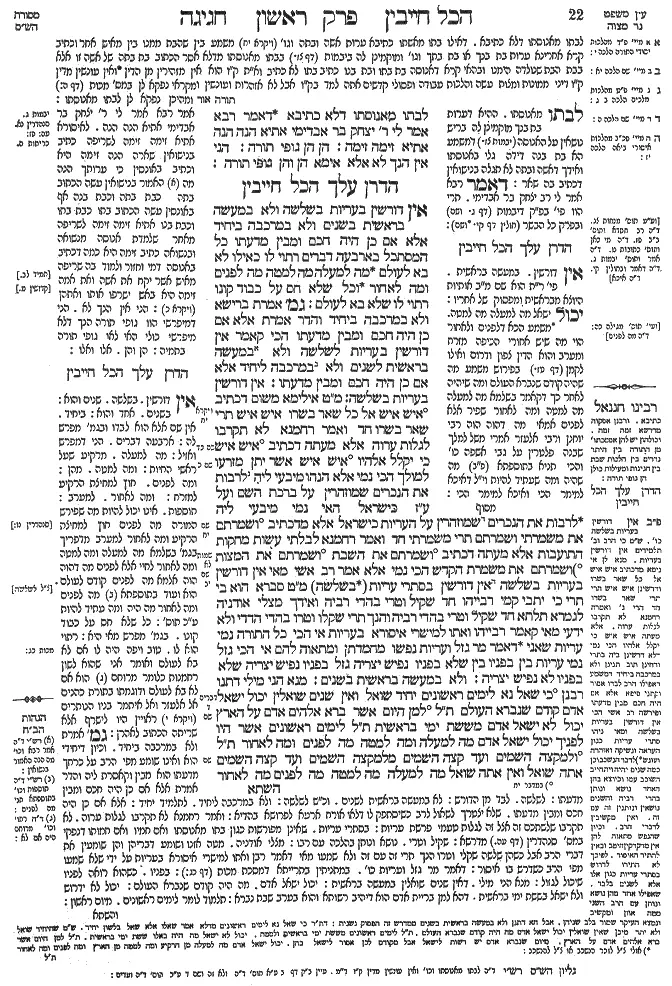
Hagigah 11b - Guemara
לבתו מאנוסתו דלא כתיבא דאמר רבא אמר לי ר' יצחק בר אבדימי אתיא הנה הנה אתיא זימה זימה:
הן הן גופי תורה:
הני אין הנך לא אלא אימא הן והן גופי תורה:
הדרן עלך הכל חייבין:
מתני׳ אין דורשין בעריות בשלשה ולא במעשה בראשית בשנים ולא במרכבה ביחיד אלא אם כן היה חכם ומבין מדעתו כל המסתכל בארבעה דברים ראוי לו כאילו לא בא לעולם מה למעלה מה למטה מה לפנים ומה לאחור וכל שלא חס על כבוד קונו ראוי לו שלא בא לעולם:
גמ׳ אמרת ברישא ולא במרכבה ביחיד והדר אמרת אלא אם כן היה חכם ומבין מדעתו הכי קאמר אין דורשין בעריות לשלשה ולא במעשה בראשית לשנים ולא במרכבה ליחיד אלא אם כן היה חכם ומבין מדעתו:
אין דורשין בעריות בשלשה:
מ"ט אילימא משום דכתיב (ויקרא יח, ו) איש איש אל כל שאר בשרו איש איש תרי שאר בשרו חד ואמר רחמנא לא תקרבו לגלות ערוה אלא מעתה דכתיב (ויקרא כד, טו) איש איש כי יקלל אלהיו (ויקרא כ, ט) איש איש אשר יתן מזרעו למולך הכי נמי אלא הנהו מיבעי ליה לרבות את הנכרים שמוזהרין על ברכת השם ועל ע"ז כישראל האי נמי מיבעי ליה לרבות את הנכרים שמוזהרין על העריות כישראל אלא מדכתיב (ויקרא יח, ל) ושמרתם את משמרתי ושמרתם תרי משמרתי חד ואמר רחמנא לבלתי עשות מחקות התועבות אלא מעתה דכתיב (שמות לא, יד) ושמרתם את השבת (שמות יב, יז) ושמרתם את המצות (במדבר יח, ה) ושמרתם את משמרת הקדש הכי נמי אלא אמר רב אשי מאי אין דורשין בעריות בשלשה אין דורשין בסתרי עריות (בשלשה) מ"ט סברא הוא בי תרי כי יתבי קמי רבייהו חד שקיל וטרי בהדי רביה ואידך מצלי אודניה לגמרא תלתא חד שקיל וטרי בהדי רביה והנך תרי שקלו וטרו בהדי הדדי ולא ידעי מאי קאמר רבייהו ואתו למישרי איסורא בעריות אי הכי כל התורה נמי עריות שאני דאמר מר גזל ועריות נפשו מחמדתן ומתאוה להם אי הכי גזל נמי עריות בין בפניו בין שלא בפניו נפיש יצריה גזל בפניו נפיש יצריה שלא בפניו לא נפיש יצריה:
ולא במעשה בראשית בשנים:
מנא הני מילי דתנו רבנן (דברים ד, לב) כי שאל נא לימים ראשונים יחיד שואל ואין שנים שואלין יכול ישאל אדם קודם שנברא העולם ת"ל (דברים ד, לב) למן היום אשר ברא אלהים אדם על הארץ יכול לא ישאל אדם מששת ימי בראשית ת"ל לימים ראשונים אשר היו לפניך יכול ישאל אדם מה למעלה ומה למטה מה לפנים ומה לאחור ת"ל (דברים ד, לב) ולמקצה השמים ועד קצה השמים מלמקצה השמים ועד קצה השמים אתה שואל ואין אתה שואל מה למעלה מה למטה מה לפנים מה לאחור
Comments from Rashi on Masechet Hagigah Page 11b
לבתו מאנוסתו דלא כתיבא . דאילו בתו מאשתו כתיבא ערות אשה ובתה וגו' (ויקרא יח) משמע בין שהבת ממנו בין מאיש אחר וכתיב קרא אחרינא ערות בת בנך או בת בתך וגו' ומוקמינן לה ביבמות (דף צז.) בבתו מאנוסתו מדלא אסר הכתוב בת בתה של אשה זו אלא בבת הבת שנולדה הימנו ובהאי קרא דאנוסה בת בתו ובת בנו כתיב בתו לא כתיב וא"ת ק"ו הוא אין מזהירין מן הדין ואין עונשין מדין ק"ו דיני ממונות ומצות עשה והלכות עבודה ופסולי קדשים אתה למד בק"ו אבל לא אזהרות ועונשין ומקראי נפקא לן במס' מכות (דף ה:) ומהיכן נפקא לן לבתו מאנוסתו: אמר רבא אמר לי ר' יצחק בר אבדימי אתיא הנה הנה . לאיסורא אתיא זימה זימה לשריפה כתיב בנישואין שארה הנה זימה היא וכתיב באונסין כי ערותך הנה מה האמור בנשואין עשה הכתוב בתה כבת בתה וכבת בנה אף באונסין עשה הכתוב בתו כבת בתו וכבת בנו אתיא זימה זימה לשריפה מאחר שלמדת אנוסה מנשואה ובנשואה כתיב זימה היא כמה דכתיב באנוסה דמי וחזור ולמוד בה שריפה מאיש אשר יקח את אשה ואת אמה זימה היא באש ישרפו אותו ואתהן (ויקרא כ): הני אין הנך לא . הני דמיפרשי הוו גופי תורה הנך דלא מיפרשי כולי האי לאו גופי תורה בתמיה: הן והן . אלו ואלו: מתני' אין דורשין . בשלשה. שנים והוא: בשנים . אחד והוא: ביחיד . אין שם אלא הוא לבדו ובגמ' מפרש לה: ארבעה דברים . הני דמפרש ואזיל: מה למעלה . מרקיע שעל ראשי החיות: ומה למטה . מהן: ומה לפנים . חוץ למחיצת הרקיע למזרח: ומה לאחור . למערב: תוספות . אינו יכול להיות מה שפירש המורה מה לפנים חוץ למחיצת הרקיע ומה לאחור למערב מדפריך בגמ' בשלמא מה למעלה ומה למטה ומה לאחור לחיי אלא לפנים מה דהוה הוה אלמא מה לפנים קודם לעולם הוא ועוד בתוספתא מה לפנים ומה לאחור מה היה ומה עתיד להיות ע"כ תוס': כל שלא חס על כבוד קונו . בגמ' מפרש מאי היא: רתוי הוא לו . טוב ויפה היה לו אם לא בא לעולם ואומר אני שהוא לשון רחמנות כלומר מרוחם הוא אם לא בא לעולם ודוגמתו בתורת כהנים אל אלעזר ואל איתמר בניו הנותרים (ויקרא י) ראויין היו לישרף אלא שריתה הכתוב לאהרן: גמ' אמרת ולא במרכבה ביחיד . וכיון דיחידי הוא ואינו שומע מפי הרב על כרחך מדעתו הוא מבין וקאסרת ליה והדר אמרת אלא אם כן היה חכם ומבין מדעתו: לשלשה . לבד מן הדורש: לא במעשה בראשית לשנים . וכ"ש לשלשה: ולא במרכבה ליחיד . לתלמיד יחיד: אלא אם כן היה חכם ומבין מדעתו . שלא יצטרך לשאול לרב כשיסתפק לו דלאו אורח ארעא לפרושא בהדיא: ואמר רחמנא לא תקרבו לגלות ערוה . לא תקרבו שלשתכם זה אצל זה לגלות טעמי פרשת עריות: בסתרי עריות . שאינן מפורשות כגון בתו מאנוסתו ואם חמיו ואם חמותו דנפקי במס' סנהדרין (דף עה.) מדרשא: שקיל וטרי . נושא ונותן בהלכה עם רבו: מצלי אודניה . מטה אזנו ושומע דבריהן והן שומעין את דברי הרב אבל כשהן שלשה שקלי וטרו הנך תרי זה עם זה ולא שמעו מאי דאמר רבן ואתו למישרי איסורא בעריות על ידי שלא שמעו מפי הרב כשדרש בו איסור: דאמר מר גזל ועריות כו' . במתניתין בתרייתא דמסכת מכות (דף כג:): בפניו . כשהוא רואה לפניו שיכול לגזול: מנא הני מילי . דאין שנים שואלין במעשה בראשית: יכול ישאל אדם . מה היה קודם שנברא העולם: יכול לא ידרוש ולא ישאל בששת ימי בראשית . דהא למן בריית אדם הוא דיהיב רשותא והוא בערב שבת נברא: תלמוד לומר לימים ראשונים . מיום ראשון:
Comments from Tosafot - Hagigah 11b
לבתו מאנוסתו. ההיא דערות בת בנך מוקמינן לה בריש נושאין על האנוסה (יבמות צז.) דמשמע הא בת בנה דידה גלי באנוסתו ואידך דאשה ובתה לא תגלה בנישואין דכתיב בה שאר: דאמר רבא אמר לי רב יצחק בר אבדימי. תרי הוו פי' בפ"ק דיבמות (דף ג. ושם) ובפרק כל הבשר (חולין דף קי. ושם): מתני' אין דורשין. במעשה בראשית. פי' ר"ת הוא שם מ"ב אותיות היוצא מבראשית ומפסוק של אחריו: יכול ישאל מה למעלה מה למטה. משמע הכא דלפנים ולאחור הוי מה שיש אחורי הכיפה מזרח ומערב והוא הדין צפון ודרום ואילו לקמן (חגיגה דף טז.) בפירוש משמע מה שהיה קודם שנברא העולם ומה שיהיה לאחר כך דקאמר בשלמא מה למעלה מה למטה ומה לאחור שפיר אלא לפנים אמאי מה דהוה הוה רבי יוחנן ורבי אלעזר אמרי משל למלך שבנה פלטרין על גבי אשפה כו' והכי תניא בתוספתא (פ"ב) מה שהיה ומה שעתיד להיות וי"ל דאיכא למימר הכי ואיכא למימר הכי:
Hagigah 11b - Mishnah translated into english
with regard to his daughter born from the woman he raped, which is not written explicitly in the Torah. It is forbidden for this man to have sexual relations with this daughter, despite the fact that she is not the daughter of his wife, as he did not marry her mother.
As Rava said: Rabbi Yitzḥak bar Avdimi said to me that this halakha is derived by means of a verbal analogy between the term they [hena], an unusual form of this word, written in one context, and the same term, they, written elsewhere. As it is written: “The nakedness of a woman and her daughter…you shall not take…they [hena] are near kinswomen; it is lewdness” (Leviticus 18:17). And it is written: “The nakedness of your son’s daughter, or of your daughter’s daughter, even their nakedness you shall not uncover; for they [hena] are your own nakedness” (Leviticus 18:10). This indicates that every daughter, even from the rape of a woman who is not one’s wife, is forbidden, just like one’s daughter from his wife.
Furthermore, the punishment for this transgression is derived from a verbal analogy between: “It is lewdness [zima]” (Leviticus 18:17), which is written with regard to a woman and her daughter, and the same term “lewdness” that appears elsewhere, as it is stated: “And if a man take with his wife also her mother, it is lewdness [zima]: They shall be burnt with fire, both he and they” (Leviticus 20:14).
§ The mishna taught: These [hen hen] are the essential parts of the Torah. The Gemara asks: These, the topics mentioned in the mishna, which are not written explicitly but for which there is ample basis in the Torah, yes, they are the essential parts of Torah, whereas those other categories listed in the mishna that are written explicitly, no, they are not essential? Rather, one must say that both these and those [hen vehen] are the essential parts of the Torah. Every part of the Torah is essential, whether or not it is written explicitly.
We shall return to you, [chapter of] "All of obligated..."
MISHNA: One may not expound the topic of forbidden sexual relations before three or more individuals; nor may one expound the act of Creation and the secrets of the beginning of the world before two or more individuals; nor may one expound by oneself the Design of the Divine Chariot, a mystical teaching with regard to the ways God conducts the world, unless he is wise and understands most matters on his own.
The mishna continues in the same vein: Whoever looks at four matters, it would have been better for him had he never entered the world: Anyone who reflects upon what is above the firmament and what is below the earth, what was before Creation, and what will be after the end of the world. And anyone who has no concern for the honor of his Maker, who inquires into and deals with matters not permitted to him, deserves to have never come to the world.
GEMARA: The Gemara poses a question: You said in the first clause of the mishna: Nor may one expound the Design of the Divine Chariot by oneself, which indicates that the topic may not be learned at all, and yet you subsequently said: Unless he is wise and understands most things on his own, which indicates that an individual is permitted to study the Design of the Divine Chariot.
The Gemara explains: This is what the mishna is saying: One may not expound the topic of forbidden sexual relations before three students, nor the act of Creation before two, nor may one teach the Divine Chariot to one, unless that student was wise and understands on his own.
§ The Gemara continues to clarify the mishna, which reads: One may not expound the topic of forbidden sexual relations before three individuals. What is the reason for this? If we say it is because it is written: “None of you [ish, ish] shall approach any near of kin to uncover their nakedness” (Leviticus 18:6). Ish, ish, literally means: Man, man. It is understood as an allusion to the number of students permitted to study the topic. This is as it is explained immediately: “Man, man” equals two; “any near of kin to him” is one; and the Merciful One states: “You shall not approach to uncover their nakedness,” which indicates that one may not expound the halakhot of forbidden sexual relations in the presence of three individuals.
They ask: If that is so, then what of this verse: “Any man [ish, ish] who curses his God” (Leviticus 24:15), or “Any man [ish, ish] who gives of his seed to the Molekh” (Leviticus 20:2), which is a form of idol worship? In both cases the double expression implies the number two. So too there, will you say that it is prohibited to teach these halakhot before two individuals?
The Gemara answers: Rather, those instances of the double expression: Man, man, are required for him, the tanna, in order to include gentiles, who are commanded with regard to blessing, a euphemism for cursing, God, and with regard to idol worship just as Jews are commanded.
But if so, this mention of “man, man” in the case of forbidden relations is also required for him to include gentiles, who are commanded with regard to forbidden sexual relations, as Jews are.
Rather, the Gemara rejects the previous explanation, and suggests that the prohibition against teaching three is derived from the following verse stated with regard to forbidden sexual relations: “And you shall observe My charge” (Leviticus 18:30), which is explained as follows: “And you shall observe [ushmartem],” in the plural, indicates at least two; “My charge” is one; and the Merciful One states at the conclusion of this verse: “That you do not perform any of these abominable customs” (Leviticus 18:30), indicating that this topic may not be taught to three.
The Gemara asks: However, if that is so, then what of that which is written: “And you shall observe the Shabbat” (Exodus 31:14), and “And you shall observe the festival of matzot” (Exodus 12:17), and “And you shall observe the charge of the sacred things” (Numbers 18:5); so too, will you say that none of these subjects may be taught to three?
Rather, Rav Ashi said: These scriptural allusions are all unacceptable. What is the meaning of: One may not expound the topic of forbidden sexual relations before three? It means: One may not expound the concealed laws of forbidden sexual relations before three. The prohibition against teaching before three applies to halakhot of forbidden sexual relations that are not explicitly stated in the Torah but are derived by expounding the verses or through analogy.
What is the reason? It is due not to a biblical allusion, but rather it is based on logical reasoning: When two students sit before their teacher, one of them is typically involved in a discussion of halakha with his teacher, while the other lends his ear to listen to the teaching. However, if there are three students, one of them is involved in a discussion with his teacher while the other two are engaged in a discussion with one another, and they do not know what their teacher is saying, and may come to render permitted a forbidden relation by following their own reasoning rather than the explanation provided by their teacher.
The Gemara raises a difficulty: If so, the entire Torah should likewise be taught only to two individuals, to prevent similar errors.
The Gemara answers: The halakha of forbidden sexual relations is different, for the Master said: Robbery and forbidden sexual relations are sins that one’s soul covets and lusts after. Therefore, we are concerned that one who has not properly studied these matters with his teacher will rule leniently for himself.
The Gemara asks: If so, robbery should also not be taught to more than two, for this very reason. The Gemara responds: There is a difference between the lust for forbidden sexual relations and the lust for robbery. In the case of those with whom relations are forbidden, his evil inclination is strong whether or not the objects of desire are before him. With regard to robbery, however, if the object presents a direct temptation before him his inclination is strong, but when it is not before him his inclination is not strong, and we are therefore less concerned.
§ It is taught in the mishna: “Nor the act of Creation before two.” The Gemara poses a question: From where are these matters derived? The Gemara explains: As the Sages taught that the verse states: “For ask now of the days past, which were before you” (Deuteronomy 4:32); since this verse is stated in the singular, it teaches that an individual may ask questions with regard to Creation, i.e., “the days past,” but two may not ask, which indicates that one may teach such matters to only one student.
One might have thought that a person may ask questions with regard to matters preceding the creation of the world. Therefore, the continuation of the verse states: “Since the day that God created man upon the earth,” but not earlier.
One might have thought that a person may not ask questions with regard to matters that occurred during the six days of Creation before the creation of man. Therefore, the verse states: “For ask now of the days past, which were before you,” indicating that one may inquire about the days preceding the creation of man.
One might have thought that a person may ask questions with regard to what is above, what is below, what was before, and what is after the world. Therefore, the same verse states: “From one end of the heavens to the other” (Deuteronomy 4:32), which is explained as follows: With regard to that which is from one end of the heavens to the other, within the boundaries of the world, you may ask, but you may not ask what is above, what is below, what was before, or what is after.
Traduction : The William Davidson digital edition of the Koren Noé Talmud, with commentary by Rabbi Adin Even-Israel Steinsaltz.