 Talmud Bavli
The learning on the whole site is dedicated : L'ilui Nishmat Amram ben Itshak Loubaton
The learning on the whole site is dedicated : L'ilui Nishmat Nissim ben Barukh Malka
The learning on the whole site is dedicated : L'ilui Nishmat רינה בת לדיסיה
Sanhedrin 85b : Youtube
Daf TubeYoutube
2 video classes :
Sanhedrin Page 85b
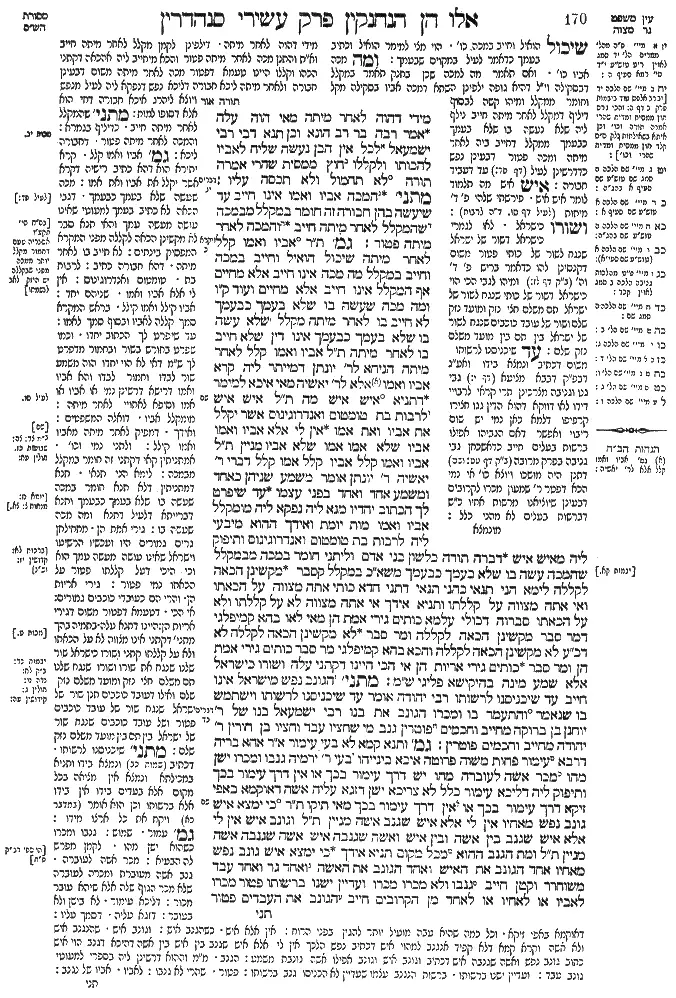
Sanhedrin 85b - Guemara
מידי דהוה לאחר מיתה מאי הוה עלה אמר רבה בר רב הונא וכן תנא דבי רבי ישמעאל לכל אין הבן נעשה שליח לאביו להכותו ולקללו חוץ ממסית שהרי אמרה תורה (דברים יג, ט) לא תחמול ולא תכסה עליו:
מתני׳ המכה אביו ואמו אינו חייב עד שיעשה בהן חבורה זה חומר במקלל מבמכה שהמקלל לאחר מיתה חייב והמכה לאחר מיתה פטור:
גמ' ת"ר (ויקרא כ, ט) אביו ואמו קלל לאחר מיתה שיכול הואיל וחייב במכה וחייב במקלל מה מכה אינו חייב אלא מחיים אף המקלל אינו חייב אלא מחיים ועוד ק"ו ומה מכה שעשה בו שלא בעמך כבעמך לא חייב בו לאחר מיתה מקלל שלא עשה בו שלא בעמך כבעמך אינו דין שלא חייב בו לאחר מיתה ת"ל אביו ואמו קלל לאחר מיתה הניחא לר' יונתן דמייתר ליה קרא אביו ואמו אלא לר' יאשיה מאי איכא למימר דתניא (ויקרא כ, ב) איש איש מה ת"ל איש איש לרבות בת טומטום ואנדרוגינוס אשר יקלל את אביו ואת אמו אין לי אלא אביו ואמו אביו שלא אמו אמו שלא אביו מניין ת"ל אביו ואמו קלל אביו קלל אמו קלל דברי ר' יאשיה ר' יונתן אומר משמע שניהן כאחד ומשמע אחד ואחד בפני עצמו עד שיפרט לך הכתוב יחדיו מנא ליה נפקא ליה מומקלל אביו ואמו מות יומת ואידך ההוא מיבעי ליה לרבות בת טומטום ואנדרוגינוס ותיפוק ליה מאיש איש דברה תורה כלשון בני אדם וליתני חומר במכה מבמקלל שהמכה עשה בו שלא בעמך כבעמך משא"כ במקלל קסבר מקשינן הכאה לקללה לימא הני תנאי כהני תנאי דתני חדא כותי אתה מצווה על הכאתו ואי אתה מצווה על קללתו ותניא אידך אי אתה מצווה לא על קללתו ולא על הכאתו סברוה דכולי עלמא כותים גירי אמת הן מאי לאו בהא קמיפלגי דמר סבר מקשינן הכאה לקללה ומר סבר לא מקשינן הכאה לקללה לא דכ"ע לא מקשינן הכאה לקללה והכא בהא קמיפלגי מר סבר כותים גירי אמת הן ומר סבר כותים גירי אריות הן אי הכי היינו דקתני עלה ושורו כישראל אלא שמע מינה בהיקישא פליגי ש"מ:
מתני' הגונב נפש מישראל אינו חייב עד שיכניסנו לרשותו רבי יהודה אומר עד שיכניסנו לרשותו וישתמש בו שנאמר (דברים כד, ז) והתעמר בו ומכרו הגונב את בנו רבי ישמעאל בנו של ר' יוחנן בן ברוקה מחייב וחכמים פוטרין גנב מי שחציו עבד וחציו בן חורין ר' יהודה מחייב וחכמים פוטרין:
גמ׳ ותנא קמא לא בעי עימור א"ר אחא בריה דרבא עימור פחות משוה פרוטה איכא בינייהו בעי ר' ירמיה גנבו ומכרו ישן מהו מכר אשה לעוברה מהו יש דרך עימור בכך או אין דרך עימור בכך ותיפוק ליה דליכא עימור כלל לא צריכא ישן דזגא עליה אשה דאוקמא באפי זיקא דרך עימור בכך או אין דרך עימור בכך מאי תיקו ת"ר (דברים כד, ז) כי ימצא איש גונב נפש מאחיו אין לי אלא איש שגנב אשה מניין ת"ל וגונב איש אין לי אלא איש שגנב בין אשה ובין איש ואשה שגנבה איש אשה שגנבה אשה מניין ת"ל ומת הגנב ההוא מכל מקום תניא אידך כי ימצא איש גונב נפש מאחיו אחד הגונב את האיש ואחד הגונב את האשה ואחד גר ואחד עבד משוחרר וקטן חייב גנבו ולא מכרו מכרו ועדיין ישנו ברשותו פטור מכרו לאביו או לאחיו או לאחד מן הקרובים חייב הגונב את העבדים פטור
Comments from Rashi on Masechet Sanhedrin Page 85b
מידי דהוה לאחר מיתה . דילפינן לקמן מקלל לאחר מיתה חייב וא"ת והתנן מכה לאחר מיתה פטור והכא מיחייב ליה אהכאה דקתני הכהו וקללו היינו טעמא דפטור מכה לאחר מיתה משום דבעינן חבורה ולאחר מיתה ליכא חבורה דליכא נפש דנפקא ליה לעיל מנפש ויוצא ליהרג איכא חבורה דחי הוא אלא דסופו למות: מתני' שהמקלל לאחר מיתה חייב . כדליף בגמרא: והמכה לאחר מיתה פטור . דחבורה ליכא: גמ' אביו ואמו קלל . קרא יתירא הוא דהא כתיב רישיה דקרא אשר יקלל את אביו ואת אמו: מכה שעשה שלא בעמך כבעמך . דגבי הכאה לא כתיב בעמך למעוטי שאינו עושה מעשה עמך והאי תנא סבר לא מקשינן הכאה לקללה מפני המקרא המפסיק בינתים: לא חייב בו לאחר מיתה . דהא חבורה כתיב: לרבות בת . טומטום ואנדרוגינוס: אין לי אלא אביו ואמו . שניהם יחד: אביו קילל ואמו קילל . בראש המקרא סמך קללה לאביו ובסוף סמך לאמו: עד שיפרט לך הכתוב יחדיו . וכמו שפרט בחורש בשור ובחמור מדפרט לך ש"מ דאי לא הוי יחדו הוה משמע שור לבדו וחמור לבדו והא אביו ואמו דרישא דרשינן נמי או אביו או אמו וסיפא לאתויי לאחר מיתה: מומקלל אביו . דואלה המשפטים: ואידך . דמפיק לאחר מיתה מאביו ואמו קילל: ולתני נמי וכו' . אמתניתין קאי דקתני זה חומר במקלל מבמכה: לימא הני תנאי . תנא דמתניתין דלא תנא חומר במכה שעשה בו שלא בעמך כבעמך ותנא דברייתא דלעיל דתנא ומה מכה שעשה בו: גירי אמת הן . מתחילתן גרים גמורים היו ועכשיו הרשיעו וישראל שאינו עושה מעשה עמך הוא וכי היכי דעל קללתו פטור על הכאתו נמי פטור: גירי אריות הן . והרי הם כעובדי כוכבים גמורים: אי הכי . דטעמא דפטור משום דגירי אריות הן: היינו דתנא עלה . בתמיה בהך מתני' דקתני אינו מצווה לא על הכאתו ולא על קללתו קתני ושורו כישראל שור שלנו שנגח את שורו ושורו שנגח שלנו תם משלם חצי נזק ומועד משלם נזק שלם ואילו דעובד כוכבים תנן שור של ישראל שנגח שור של עובד כוכבים פטור ושל עובד כוכבים שנגח שור. של ישראל בין תם בין מועד משלם נזק שלם: מתני' שיכניסנו לרשותו . דכתיב (שמות כב) ונמצא בידו ותניא במכילתא ונמצא אין מציאה בכל מקום אלא בעדים בידו אין בידו אלא ברשותו וכן הוא אומר (במדבר כא) ויקח את כל ארצו מידו: גמ' עמור . שמוש: גנבו ומכרו כשהוא ישן מהו . לקמן מפרש לה הבעיא: מכר אשה לעוברה . גנב אשה מעוברת ומכרה לעוברה שלא מכר הגוף שלה אלא שיהא עובר מכור: דליכא עימור . לא בישן ולא בעובר: דזגא עליה . דסמך עליו: דאוקמא באפי זיקא . וכל כמה שהיא עבה מועיל יותר להגין בפני הרוח: אין אלא איש . כשהגנב איש: וגונב איש . שהנגנב איש ולא אשה וקרא קמא דלא קפיד אנגנב למהוי איש דכתיב נפש הלכך אין לי אלא איש שגנב בין איש בין אשה דהיכא דגנב הוי איש כתוב גונב נפש ואשה שגנבה איש דכתיב וגונב איש וגונב אפילו אשה גונבת משמע: הגנב . מ"מ וההוא דרשינן ליה בספרי למעוטי גונב עבד: ועדיין ישנו ברשותו . ברשות הנגנב עצמו שעדיין לא הכניסו גנב ברשותו: פטור . שהרי לא גנבו: לאביו . אביו של נגנב:
Comments from Tosafot - Sanhedrin 85b
שיכול הואיל וחייב במכה כו' . הוי מצי למימר הואיל וכתיב בעמך כדאמר לעיל במקוים שבעמך: ומה מכה אביו כו' . ואם תאמר מה למכה שכן בחנק תאמר במקלל דבסקילה וי"ל דהיא גופה ילפינן השתא דמכה אביו בסקילה מקל וחומר ממקלל ומיהו קשה לבסוף דיליף דמקלל לאחר מיתה חייב נילף ליה שלא נעשה בו שלא בעמך כבעמך ממקלל דחייב ביה לאחר מיתה ומכה פטור דבעינן נפש כדדרשינן לעיל (סנהדרין דף פד:) עד דעביד חבורה: איש איש מה תלמוד לומר איש איש . פירשתי שלהי פ' ד' מיתות (לעיל סנהדרין דף סו. ד"ה לרבות): ושורו כישראל . לאו לגמרי כישראל דשור של ישראל שנגח לשור של כותי פטור משום דקנסינן להו כדאמר בריש פ' ד' וה' (ב"ק דף לז:) ומיהו לגבי הכי הוי כישראל דשור של כותי שנגח לשור של ישראל תם משלם חצי נזק ומועד נזק שלם ושור של עובד כוכבים שנגח לשור של ישראל בין תם בין מועד משלם נזק שלם: עד שיכניסנו לרשותו . משום דכתיב ונמצא בידו ואע"ג דבפ"ק דבבא מציעא (דף י:) גבי גט וגניבה מצרכינן תרי קראי לרבויי דידו לאו דווקא דהוא הדין גגו חצירו קרפיפו דלמא כאן נמי יש שום ריבוי ואפשר דאם הגביהו אפילו ברשות בעלים חייב כדאשכחן גבי גניבה בפרק מרובה (ב"ק דף עט: ושם) דתנן היה מושכו ויוצא כו' אי נמי הכא דפטר ר' שמעון מכרו לקרובים דבעינן שיוציאנו מרשות אחיו כ"ש דברשות בעלים לא מהני כלל:
Sanhedrin 85b - Mishnah translated into english
The Gemara answers: The halakha here is just as it is after the death of his father, and the son is liable for cursing his father even after his death. Therefore, he is also liable when his father’s death is imminent.
Despite several attempts to cite proof contradicting his opinion, there is no conclusive refutation of the statement of Rav Sheshet that a son may serve as an agent of the court to punish his father. The Gemara asks: What halakhic conclusion was reached about this matter? Rabba bar Rav Huna says, and likewise the school of Rabbi Yishmael taught: With regard to all cases a son is not designated as an agent to strike his father or to curse him, except in a case where his father incites others to worship idols, as the Torah states: “Neither shall you spare, nor shall you conceal him” (Deuteronomy 13:9).
MISHNA: One who strikes his father or his mother is not liable to be executed unless he wounds one of them. This is a stringency with regard to one who curses his father that is more severe than the halakha with regard to one who strikes his father, as one who curses his father or his mother after his or her death is liable, but one who strikes one of them after his or her death is exempt, as he did not cause a wound.
GEMARA: The Sages taught in a baraita that it is written: “For any man who curses his father and his mother shall die; he has cursed his father and his mother; his blood shall be upon him” (Leviticus 20:9). This is referring to one who curses his parents even after their death, as one might have thought: Since one is liable for striking and one is liable for cursing, just as one who strikes is liable only when his father or mother are alive, so too, one who curses is liable only when they are alive.
Furthermore, one may draw an a fortiori inference: If, with regard to one who strikes another, where the Torah deemed the status of striking one who performs actions not of your people, i.e., a sinner, like that of striking one who performs actions that are of your people, yet the Torah did not deem him liable for striking another after death, then with regard to one who curses, where the Torah deemed the status of cursing one who performs actions not of your people like that of cursing one who performs actions that are of your people, is it not right that the Torah did not deem him liable for cursing another after their death?
Therefore, the verse states the extraneous phrase: “He has cursed his father and his mother,” to include even one who curses his father or mother after that parent’s death.
The Gemara asks: This works out well according to the opinion of Rabbi Yonatan, for whom the phrase “his father and his mother” is extraneous. But according to the opinion of Rabbi Yoshiya, who disagrees with him, what is there to say?
This is as it is taught in a baraita that it is written: “For any man [ish ish] who curses his father and his mother shall be put to death, he has cursed his father and his mother; his blood shall be upon him.” What is the meaning when the verse states redundantly: “Ish ish”? It serves to include not only a son, but also a daughter, one whose sexual organs are indeterminate [tumtum], and a hermaphrodite who curse their parent. When the verse states: “Who curses his father and his mother,” I have derived only liability for cursing both his father and his mother. From where is liability derived for one who cursed his father but who did not curse his mother, or one who cursed his mother but who did not curse his father? The verse states: “He has cursed his father and his mother,” from which it is derived that the halakha is as if the verse states: He cursed his father or he cursed his mother. This is the statement of Rabbi Yoshiya.
Rabbi Yonatan says: In verses of this kind when two subjects are joined with a prefix of the letter vav, that prefix indicates the conjunction “and,” meaning both subjects together, and it also indicates the conjunction “or,” meaning each one by itself, unless the verse specifies with the word: “Together,” in which case the meaning is both together. Therefore, the phrase “he has cursed his father and his mother” is extraneous.
Since according to the opinion of Rabbi Yoshiya, the phrase is not redundant, from where does he derive that one is liable for cursing his father after his death? The Gemara answers: He derives it from that which is written: “And one who curses his father or his mother shall be put to death” (Exodus 21:17).
The Gemara asks: And the other tanna, Rabbi Yonatan, what does he derive from that verse? The Gemara answers: He requires the other verse to include a daughter, a tumtum, and a hermaphrodite in the prohibition against cursing a parent.
The Gemara challenges: But let him derive that halakha from the redundant use of “ish ish,” as Rabbi Yoshiya does. The Gemara responds: Rabbi Yonatan holds that the Torah spoke in the language of people. The repetition of the term ish is merely a rhetorical flourish commonly employed in speech, and no additional halakhot can be derived from it.
§ The Gemara asks with regard to the mishna: And let the tanna teach a second stringency in the mishna: This is a stringency with regard to one who strikes his father that is more severe than the halakha with regard to one who curses his father, that with regard to one who strikes a parent the Torah deemed the status of striking one who performs actions not of your people to be like that of striking one who performs actions of your people, which is not so with regard to one who curses a parent. The Gemara responds: The tanna of the mishna disagrees and holds that we liken striking to cursing based on the juxtaposition of the verses.
The Gemara suggests: Let us say that the opinions of these following tanna’im are parallel to the opinions of those following tanna’im, as it is taught in one baraita: With regard to a Samaritan, you are commanded to refrain from striking him, but you are not commanded to refrain from cursing him. And it is taught in another baraita: You are commanded neither to refrain from cursing him nor to refrain from striking him.
It is assumed that everyone, i.e., the tanna of each baraita, agrees that Samaritans are true converts. Since their conversion was sincere, their status is that of a Jew who sinned. Based on that assumption, the Gemara suggests: What, is it not that they disagree about this: That one Sage, the tanna of the second baraita, holds that we liken striking to cursing and the halakha is the same with regard to both, and therefore it is neither prohibited to strike a Samaritan, nor is it prohibited to curse him; and one Sage, the tanna of the first baraita, holds that we do not liken striking to cursing, and there is no prohibition against cursing a sinner, but there is a prohibition against striking him?
The Gemara rejects the parallel between the two tannaitic disputes. No, everyone, i.e., the tanna’im in each baraita, agrees that we do not liken striking to cursing, and here they disagree about this: One Sage, the tanna of the first baraita, holds that Samaritans are true converts and their status is that of a Jew who sinned. Therefore, there is no prohibition against cursing him, but there is a prohibition against striking him. And one Sage, the tanna of the second baraita, holds that Samaritans are converts who converted under duress due to the threat of lions (see II Kings, chapter 17) and their conversion was never valid. Therefore, their legal status is that of a gentile and it is neither prohibited to strike a Samaritan nor to curse him.
The Gemara asks: If so, is that consistent with that which is taught with regard to the second baraita: And in terms of damage caused to his ox his status is like that of a Jew? Apparently, even the tanna of the second baraita holds that the conversion of the Samaritans was sincere. Rather, learn from it that the two tanna’im disagree with regard to the juxtaposition of the two prohibitions, as initially suggested; their dispute is not with regard to the status of a Samaritan. The Gemara affirms: Conclude from it that this is the crux of their dispute.
MISHNA: One who abducts a Jewish person is not liable to be executed unless he brings the abductee into his domain. Rabbi Yehuda says: He is not liable unless he brings him into his domain and exploits him, as it is stated: “If a man shall be found abducting a person of his brethren from the children of Israel, and he exploited him and sold him, then that abductor shall die” (Deuteronomy 24:7). The phrase “exploited him” indicates using him for labor. With regard to one who abducts his own son and sells him, Rabbi Yishmael, son of Rabbi Yoḥanan ben Beroka, deems him liable, and the Rabbis deem him exempt. If one abducted one who is a half-slave half-freeman, i.e., a Canaanite slave who belonged to two owners and was emancipated by one of them, Rabbi Yehuda deems him liable, and the Rabbis deem him exempt.
GEMARA: The Gemara asks: And does the first tanna not require exploitation as a condition for liability? The Torah states it explicitly in the verse in Deuteronomy. Rabbi Aḥa, son of Rava, says: The difference between them is in a case of exploitation worth less than the value of one peruta. The first tanna holds that one is liable for any exploitation and there is no minimum value in order to establish liability. Rabbi Yehuda holds that one is liable only if one derives benefit equal to at least one peruta from his exploitation.
Rabbi Yirmeya raises a dilemma: If one abducted another and sold him while he was asleep, what is the halakha? If one abducted and sold a pregnant woman solely for benefit from her fetus, what is the halakha? Is that a manner of exploitation for which one is liable to be executed or is that not a manner of exploitation for which one is liable to be executed?
The Gemara asks with regard to the dilemmas raised by Rabbi Yirmeya: But let him derive that the abductor is not liable, as there is no exploitation at all of a sleeping individual or a fetus. The Gemara answers: No, it is necessary to raise the dilemma only with regard to the sleeping individual in a case where one reclines on him, and with regard to the pregnant woman where one stands her in the face of the wind to protect himself from the wind. In those cases, is that a manner of exploitation for which one is liable to be executed or is that not a manner of exploitation for which one is liable to be executed? What is the halakha? The Gemara concludes: The dilemma shall stand [teiku] unresolved.
The Sages taught in a baraita that it is written: “If a man shall be found abducting a person of his brethren from the children of Israel, and he exploited him and sold him, then that abductor shall die” (Deuteronomy 24:7). I have derived only that a man who abducted another is liable. From where is it derived that a woman who abducts another is liable as well? It is derived from the verse that states: And one who abducts a man, and sells him, if he be found in his hand, he shall be put to death” (Exodus 21:16), where the sex of the abductor is not specified.
I have derived only that a man who abducted another, whether a man or a woman, is liable, as it is written: “If a man shall be found abducting a person”; the abductor is male but the sex of the abductee is not specified. And I derived that a woman who abducted a man is liable, as it is written: “And one who abducts a man”; the sex of the abductor is not specified but the abductee is male. From where is it derived that a woman who abducted a woman is liable as well? It is derived from the verse that states: “Then that abductor shall die” (Deuteronomy 24:7); the abductor shall die in any case, regardless of the sex of the one who was abducted.
It is taught in another baraita that it is written: “If a man is found abducting a person of his brethren,” from which it is derived that whether he abducts a man, or whether he abducts a woman, or whether he abducts a convert, or whether he abducts an emancipated slave or a minor, he is liable. If he abducted another but did not sell him, or if he sold him but he remains in his domain, the abductor is exempt. If he sold him to the father of the abductee, or to his brother, or to one of his other relatives, the abductor is liable. One who abducts slaves is exempt.
Traduction : The William Davidson digital edition of the Koren Noé Talmud, with commentary by Rabbi Adin Even-Israel Steinsaltz.