 Talmud Bavli
Yevamot 79b : Youtube
Daf TubeYoutube
2 video classes :
Yevamot Page 79b
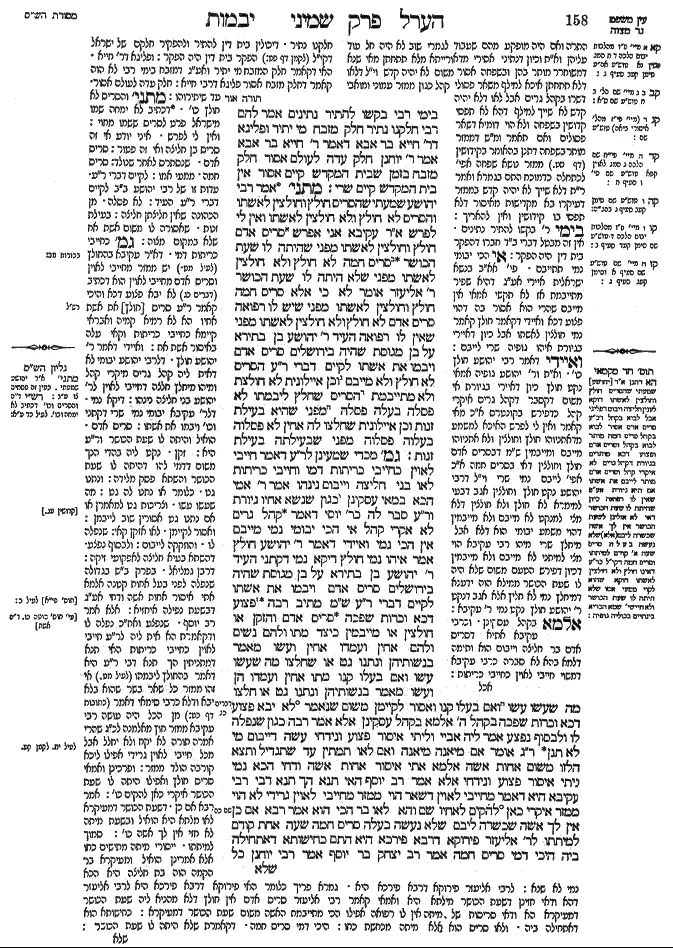
Yevamot 79b - Guemara
בימי רבי בקשו להתיר נתינים אמר להם רבי חלקנו נתיר חלק מזבח מי יתיר ופליגא דר' חייא בר אבא דאמר ר' חייא בר אבא אמר ר' יוחנן חלק עדה לעולם אסור חלק מזבח בזמן שבית המקדש קיים אסור אין בית המקדש קיים שרי:
מתני׳ אמר רבי יהושע שמעתי שהסריס חולץ וחולצין לאשתו והסריס לא חולץ ולא חולצין לאשתו ואין לי לפרש א"ר עקיבא אני אפרש סריס אדם חולץ וחולצין לאשתו מפני שהיתה לו שעת הכושר סריס חמה לא חולץ ולא חולצין לאשתו מפני שלא היתה לו שעת הכושר ר' אליעזר אומר לא כי אלא סריס חמה חולץ וחולצין לאשתו מפני שיש לו רפואה סריס אדם לא חולץ ולא חולצין לאשתו מפני שאין לו רפואה העיד ר' יהושע בן בתירא על בן מגוסת שהיה בירושלים סריס אדם ויבמו את אשתו לקיים דברי ר"ע הסריס לא חולץ ולא מייבם וכן איילונית לא חולצת ולא מתייבמת הסריס שחלץ ליבמתו לא פסלה בעלה פסלה מפני שהיא בעילת זנות וכן איילונית שחלצו לה אחין לא פסלוה בעלוה פסלוה מפני שבעילתה בעילת זנות:
גמ׳ מכדי שמעינן לר"ע דאמר חייבי לאוין כחייבי כריתות דמו וחייבי כריתות לאו בני חליצה וייבום נינהו אמר ר' אמי הכא במאי עסקינן כגון שנשא אחיו גיורת ור"ע סבר לה כר' יוסי דאמר קהל גרים לא אקרי קהל אי הכי יבומי נמי מייבם אין הכי נמי ואיידי דאמר ר' יהושע חולץ אמר איהו נמי חולץ דיקא נמי דקתני העיד ר' יהושע בן בתירא על בן מגוסת שהיה בירושלים סריס אדם ויבמו את אשתו לקיים דברי ר"ע ש"מ מתיב רבה פצוע דכא וכרות שפכה סריס אדם והזקן או חולצין או מייבמין כיצד מתו ולהם נשים ולהם אחין ועמדו אחין ועשו מאמר בנשותיהן ונתנו גט או שחלצו מה שעשו עשו ואם בעלו קנו מתו אחין ועמדו הן ועשו מאמר בנשותיהן ונתנו גט או חלצו מה שעשו עשו ואם בעלו קנו ואסור לקיימן משום שנאמר (דברים כג, ב) לא יבא פצוע דכא וכרות שפכה בקהל ה' אלמא בקהל עסקינן אלא אמר רבה כגון שנפלה לו ולבסוף נפצע אמר ליה אביי וליתי איסור פצוע ונידחי עשה דייבום מי לא תנן ר"ג אומר אם מיאנה מיאנה ואם לאו תמתין עד שתגדיל ותצא הלזו משום אחות אשה אלמא אתי איסור אחות אשה ודחי הכא נמי ניתי איסור פצוע ונידחי אלא אמר רב יוסף האי תנא הך תנא דבי רבי עקיבא היא דאמר מחייבי לאוין דשאר הוי ממזר מחייבי לאוין גרידי לא הוי ממזר איקרי כאן (דברים כה, ז) להקים לאחיו שם והא לאו בר הכי הוא אמר רבא אם כן אין לך אשה שכשרה ליבם שלא נעשה בעלה סריס חמה שעה אחת קודם למיתתו לר' אליעזר פירוקא דרבא פירכא היא התם כחישותא דאתחילה ביה היכי דמי סריס חמה אמר רב יצחק בר יוסף אמר רבי יוחנן כל
Comments from Rashi on Masechet Yevamot Page 79b
חלקנו נתיר . דיכולין בית דין להתיר ולהפקיר חלקם של ישראל דקי"ל (לקמן יבמות דף פט:) הפקר בית דין היה הפקר: ופליגא דר' חייא . האי דקאמר חלק המזבח מי יתיר ואע"ג דמזבח בימי רבי לא הוה קאמר דחלק מזבח אסור פליגא דרבי חייא: חלק עדה לעולם אסור . עד שיתירוהו: מתני' והסריס לא חולץ כו' . דכתיב לא ימחה שמו מישראל פרט לסריס ששמו מחוי: ואין לי לפרש . איני יודע אי זה סריס בן חליצה ואי זה פטור: סריס אדם . שנסתרס לאחר שנולד: סריס חמה . ממעי אמו: לקיים דברי ר"ע . עדות זו של רבי יהושע ב"ב לקיים דברי ר"ע העיד: לא פסלה . מן הכהונה שאין חליצתן חליצה: בעילת זנות . שאסורה לו משום אשת אח שלא במקום מצוה: גמ' כחייבי כריתות דמי . דא"ר עקיבא בהחולץ (לעיל יבמות מט.) יש ממזר מחייבי לאוין וסריס אדם מחייבי לאוין הוא דכתיב (דברים כג) לא יבא פצוע דכא והיכי קאמר ר"ע סריס [חולץ] את אשת אחיו הא לא רמיא קמיה ואבראי קיימא כחייבי כריתות וקאי עלה באיסור אשת אח: ואיידי דאמר ר' יהושע חולץ . דלרבי יהושע יבומי לא דאית ליה קהל גרים מיקרי קהל ומיהו מיחלץ חלצה דחייבי לאוין לר' יהושע בני חליצה נינהו: דיקא נמי . דלר' עקיבא יבומי נמי שרי דקתני וכו' ויבמו את אשתו: סריס אדם . הואיל והיתה לו שעת הכושר ור"ע היא: זקן . נקט ליה בהדי הנך משום דדמי להו דהיתה לו שעת הכושר והשתא פסק מלידה: ונתנו גט . כלומר או נתנו לה גט: מה שעשו עשו . וצריכות גט למאמרן או אם נתנו גט אסורין שוב לייבמן: ואסור לקיימן . לאו אזקן קאי: שנפלה לו . והוזקקה לייבום: ולבסוף נפצע . דהשתא בעיא חליצה לאפקועי זיקה: דרבן גמליאל בפרק ב"ש בגדולה שנפלה לפני בעל אחות קטנה. אלמא אתי איסור אחות אשה ודחי אע"ג דבשעת נפילה איחזיא: אלא אמר רב יוסף . שנפצע ואח"כ נפלה לו ודקאמרת הא אית ליה לר"ע חייבי לאוין כחייבי כריתות האי תנא דמתניתין הך תנא דבי ר"ע הוא דאמר בהחולץ ליבמתו (לעיל יבמות מט.) אי זהו ממזר כל שאר בשר שהוא בלא יבא ודלא כרבי סימאי דאמר (כתובות דף כט:) מן הכל היה עושה רבי עקיבא ממזר חוץ מאלמנה לכ"ג שהרי אמרה תורה לא יקח ולא יחלל אבל מכל חייבי לאוין גרידי אפילו ליכא קורבה הולד ממזר: ופרכינן ואמאי סריס חולץ ואפילו היתה לו שעת הכושר איקרי כאן להקים כו': אמר רבא אם כן . דשעת הכושר דמעיקרא לאו מלתא היא הואיל ובשעת מיתה לא חזי אין לך אשה כו': סמוך למיתתו . ייסורי מיתה מתישים כחו. אלא אמרינן הואיל ומעיקרא בר הקמה הוה בת חליצה היא הכא נמי לא שנא: לרבי אליעזר פירוקא דרבא פירכא היא . גמרא פריך. כלומר האי פירוקא דרבא פירכא היא לרבי אליעזר דהא ודאי חזינן דשעת הכושר מילתא היא ואמאי קאמר רבי אליעזר סריס אדם אין חולץ דלא מהניא ליה שעת הכושר דמעיקרא הא ודאי סריסות של מיתה אין לו רפואה אפילו הכי מתייבמת האשה משום שעת הכושר דמעיקרא: כחישותא הוא דאתחילה ביה . ולאו סריס הוא אלא מיתה מכחשת כחו: היכי דמי סריס חמה . דקאמרת שלא היתה לו שעת הכושר:
Comments from Tosafot - Yevamot 79b
בימי ר' בקשו להתיר נתינים . אין זה מבטל דברי ב"ד חברו דהפקר בית דין היה הפקר: אי הכי יבומי נמי תתייבם . פי' אא"ב בנשא ישראלית איירי אע"ג דהיא שפיר מתייבמת אז לא תקשי אמאי אין מייבם שהרי הוא אסור בה דהוי פצוע דכא ואיידי דקאמר חולץ קאמר נמי חולצין לאשתו אבל כיון דאיירי בגיורת איהו גופיה שרי לייבם: ואיידי דאמר רבי יהושע חולץ כו' . וא"ת ור' יהושע גופיה אמאי נקט חולץ כיון דאיירי בגיורת אי משום דקסבר דקהל גרים איקרי קהל כדפירש בקונטרס א"כ מאי קאמר ואין לי לפרש האיכא למשמע מדאתניוהו חולץ וחולצין ולא אתניוהו מייבם ומייבמין ש"מ דבסריס אדם חולץ וחולצין דאי בסריס חמה א"כ אפי' לייבם נמי שרי וי"ל דרבי יהושע נקט חולץ וחולצין אגב דבעי למימרא לא חולץ ולא חולצין דלא מצי למנקט לא מייבם ולא מייבמין דהוי משמע יבומי הוא דלא אבל מיחלץ שרי מיהו רבי עקיבא הוי מצי למיתני לא מייבם ולא מייבמין דכיון דפירש הטעם משום שלא היה לו שעת הכושר ממילא הוה ידענא דמיחלץ נמי לא חליץ אלא אגב דנקט ר' יהושע חולץ נקט נמי ר' עקיבא: אלמא בקהל עסקינן . וכרבי עקיבא אתיא דסריס אדם בר חליצה וייבום הוא ותימה דלמא בהא לא סברה כרבי עקיבא דמשוי חייבי לאוין כחייבי כריתות:
Yevamot 79b - Mishnah translated into english
It is related that in the days of Rabbi Yehuda HaNasi the Sages sought to permit the Gibeonites and treat them like Jews in all regards, thereby allowing them to enter into the congregation. Rabbi Yehuda HaNasi said to them: Even if we permit our share and say that the court nullifies the Jewish people’s right to enslave the Gibeonites, and so they should be treated like emancipated slaves, who can permit the altar’s share? Do they not belong to the Temple and the altar as well?
The Gemara comments: And Rabbi Yehuda HaNasi disagrees with the teaching of Rabbi Ḥiyya bar Abba. As Rabbi Ḥiyya bar Abba said that Rabbi Yoḥanan said: The share in the enslavement of the Gibeonites that belongs to the congregation of Israel is forbidden forever and can never be permitted. However, with regard to the share belonging to the altar, when the Temple is standing it is forbidden, but when the Temple is not standing it is permitted.
MISHNA: Rabbi Yehoshua said: I heard two rulings from my teachers. One ruling is that a eunuch performs ḥalitza with his yevama, and his brothers perform ḥalitza with his wife, and the other ruling is that a eunuch does not perform ḥalitza with his yevama, and his brothers do not perform ḥalitza with his wife. And I cannot explain these two rulings, as I do not remember the circumstances to which each ruling applies.
Rabbi Akiva said: I will explain. A eunuch caused by man, i.e., one who became emasculated after birth, performs ḥalitza with his yevama and his brothers perform ḥalitza with his wife, because he had an hour of fitness, a time when he was fertile. On the other hand, a eunuch by natural causes, i.e., who was entirely lacking in sexual capacity from birth, does not perform ḥalitza with his yevama and his brothers do not perform ḥalitza with his wife, because he did not have an hour of fitness, as he never had the potential to father children.
Rabbi Eliezer says: No; rather, the opposite is the case: A eunuch by natural causes performs ḥalitza with his yevama and his brothers perform ḥalitza with his wife because he can be cured, whereas a eunuch caused by man does not perform ḥalitza with his yevama and his brothers do not perform ḥalitza with his wife because he cannot be cured.
Rabbi Yehoshua ben Beteira testified about a man named ben Megusat, who lived in Jerusalem and was a eunuch caused by man, that his brothers nevertheless entered into levirate marriage with his wife, in order to fulfill and confirm the statement of Rabbi Akiva.
A sexually underdeveloped man does not perform ḥalitza or enter into levirate marriage with his yevama. And similarly, a sexually underdeveloped woman [aylonit], who is incapable of bearing children, does not perform ḥalitza or enter into levirate marriage with her yavam.
If a sexually underdeveloped man performed ḥalitza with his yevama, he has not thereby disqualified her from marrying into the priesthood, as his ḥalitza is invalid. However, if he had intercourse with her, he has disqualified her. This is because it is considered licentious sexual intercourse, since such intercourse does not fulfill the mitzva of levirate marriage and is therefore categorized as forbidden relations with one’s sister-in-law. And similarly, with regard to a sexually underdeveloped woman, if one of the brothers performed ḥalitza with her he has not thereby disqualified her from marrying into the priesthood. However, if he had intercourse with her, he has disqualified her because the intercourse is considered licentious sexual intercourse.
GEMARA: Now, we learned that Rabbi Akiva said: Those liable for violating a prohibition are like those liable to receive karet with regard to the validity of their marriage and all its ramifications, and those liable to receive karet are not eligible to perform ḥalitza or levirate marriage. A eunuch caused by man has the status of a man with crushed testicles, and is therefore prohibited by a standard negative mitzva from marrying a Jewish woman. If he violated the prohibition and married her, his marriage is invalid according to Rabbi Akiva, just as if he had married a woman who is forbidden to him by a prohibition punishable by karet. Why, then, should his ḥalitza be valid?
Rabbi Ami said: With what are we dealing here? We are dealing with a case where the eunuch’s brother had married a convert, and Rabbi Akiva holds in accordance with the opinion of Rabbi Yosei, who said that the congregation of converts is not called a congregation of the Lord. Consequently, it is permitted even for those for whom it is prohibited to enter into the congregation, e.g., a eunuch, to marry converts.
The Gemara raises a difficulty: If so, the eunuch should also be able to perform levirate marriage with the convert. The Gemara answers: Yes, it is indeed so, but since Rabbi Yehoshua said that a eunuch performs ḥalitza with his yevama, Rabbi Akiva as well said that he performs ḥalitza with her, while in fact he may enter into levirate marriage with her if he so chooses.
The Gemara adds: The language of the mishna is also precise in this regard, as it teaches: Rabbi Yehoshua ben Beteira testified about a man named ben Megusat, who lived in Jerusalem and was a eunuch caused by man, that his brothers entered into levirate marriage with his wife, to fulfill the statement of Rabbi Akiva. This indicates that according to Rabbi Akiva, not only ḥalitza but even levirate marriage is permitted. The Gemara concludes: Learn from this that this is the correct understanding of the mishna.
Rabba raised an objection from the following baraita: A man with crushed testicles, and one whose penis has been severed, and a eunuch caused by man, and an elderly man who is no longer capable of fathering children, may either perform ḥalitza or enter into levirate marriage. The baraita clarifies the matter: How so? If these men died and they had wives and they also had brothers, and the brothers proceeded to perform levirate betrothal with their wives, or gave them a bill of divorce, or performed ḥalitza with them, what they did is done, i.e., it is a valid act. And if the brothers had intercourse with the wives, they acquired them in levirate marriage, like any other yevama.
If the brothers of these sexually impaired men died, and the sexually impaired men proceeded to perform levirate betrothal with their brothers’ wives, or gave them a bill of divorce, or performed ḥalitza with them, what they did is done, i.e., it is a valid act. And if they had intercourse with their brothers’ wives they acquired them in levirate marriage, but they are prohibited from maintaining them as their wives because it is stated: “A man with crushed testicles or a severed penis shall not enter into the congregation of the Lord” (Deuteronomy 23:2). Apparently, we are dealing with a case where the eunuch’s brother had married a woman who is in the congregation of the Lord, i.e., a Jew from birth who is governed by this prohibition, and not a convert.
Rather, Rabba said that the case here is one where one’s brother died and his yevama happened before him for levirate marriage, and he was injured only afterward. Since the mitzva of levirate marriage had initially applied to him, he performs ḥalitza with her.
Abaye said to him: If so, let the prohibition applying to a man with crushed testicles come and override the positive mitzva of levirate marriage. Didn’t we learn in a mishna (109a) as follows: With regard to a case of two brothers who were married to two sisters, one of whom was a minor married off by her brothers in a marriage valid only by rabbinic decree, and the brother who was married to the adult sister passed away, Rabban Gamliel says: If the minor sister refuses her husband, declaring that she does not desire the marriage, she has refused him. Since the marriage is valid only by rabbinic decree, the girl may terminate it before she reaches the age of twelve by declaring that she does not wish to remain in the marriage, and no bill of divorce is required. In such a case the marriage is nullified retroactively, and so her former husband, the yavam, may perform levirate marriage with her sister.
The mishna continues: But if she does not refuse him, the minor must wait and her husband must not have relations with her until she reaches adulthood and their marriage is valid by Torah law, since in the meantime she is forbidden to him as the sister of a woman awaiting levirate marriage with him. At that point, when the minor reaches adulthood, this one, the adult sister, goes out free from the yavam without levirate marriage or ḥalitza as his wife’s sister. Apparently, the prohibition with regard to a wife’s sister comes and overrides the mitzva of levirate marriage that had previously been in effect. Here too, then, let the prohibition applying to a man with crushed testicles come and override the positive mitzva of levirate marriage.
Rather, Rav Yosef said: This tanna of our mishna is the tanna of the school of Rabbi Akiva, who said that only the child born of a union between those who are liable for violating prohibitions involving incestuous relationships is a mamzer, but the child born of a union between people who are liable for violating ordinary prohibitions is not a mamzer. The prohibition applying to a man with crushed testicles falls into the latter category, and therefore his marriage is valid and he may perform ḥalitza.
The Gemara asks: Why does the mitzva of levirate marriage apply at all to a eunuch? Read here the verse with regard to levirate marriage: “To establish a name for his brother in Israel” (Deuteronomy 25:7), and this one is no longer capable of this, even if previously he had an hour of fitness when he was fertile earlier in his life.
Rava said: If it is so that anyone who cannot presently father children is exempt from levirate marriage even if he had previously been capable of doing so, there is no instance of a woman who is fit for the yavam, as even if her husband died of natural causes it is impossible that he did not become like a eunuch by natural causes an hour before his death. He had certainly lost his fertility before dying, and therefore he has the status of a eunuch, which means that the mitzva of levirate marriage should not apply in his case at all. Rather, it must be that a man who had previously been capable of fathering children is considered fit for the purposes of levirate marriage.
The Gemara comments: According to the opinion of Rabbi Eliezer in the mishna that a eunuch caused by man does not perform ḥalitza and his marriage is invalid even though he had an hour of fitness when he was fertile, Rava’s answer, his proof from the fact that all men on their deathbeds lack sexual capacity, is undoubtedly a refutation.
The Gemara answers: Rabbi Eliezer maintains that a man who is about to die cannot be compared to a eunuch, as there, he can no longer father children due to the general weakness that begins to take over his body as death approaches, which prevents him from engaging in relations with a woman, but his basic ability to father children remains unimpaired.
The Gemara raises a practical question: What are the circumstances of a eunuch by natural causes? Rav Yitzḥak bar Yosef said that Rabbi Yoḥanan said: Anyone
Traduction : The William Davidson digital edition of the Koren Noé Talmud, with commentary by Rabbi Adin Even-Israel Steinsaltz.