 Talmud Bavli
Ketubot 51b : Youtube
Daf TubeYoutube
1 video class :
Ketubot Page 51b
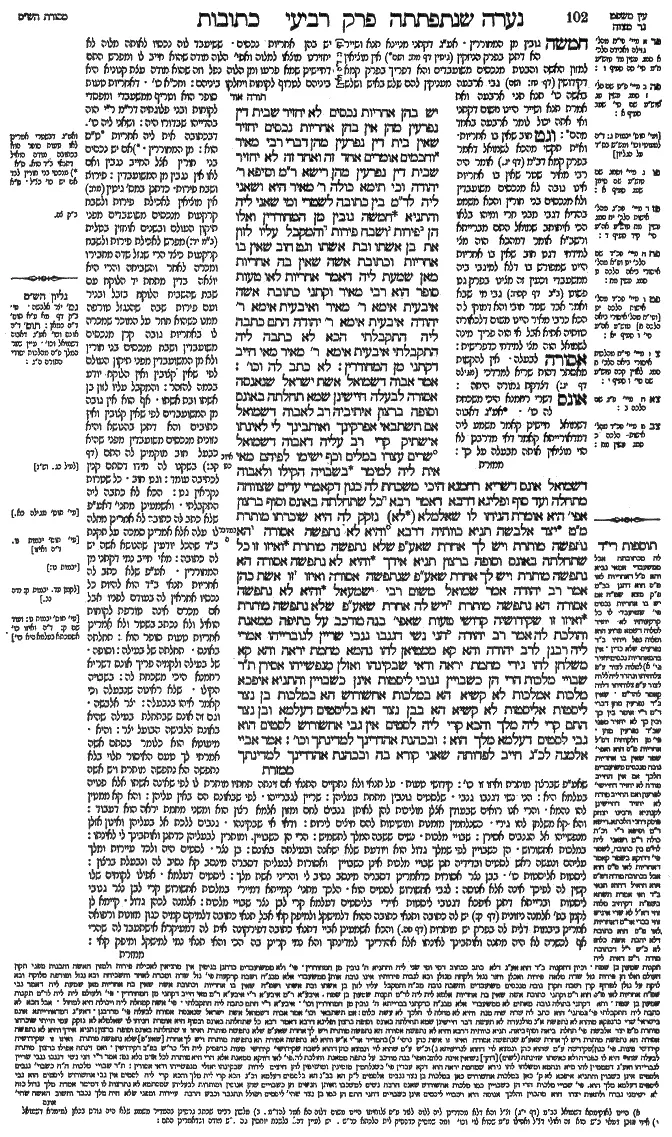
Ketubot 51b - Guemara
יש בהן אחריות נכסים לא יחזיר שבית דין נפרעין מהן אין בהן אחריות נכסים יחזיר שאין בית דין נפרעין מהן דברי רבי מאיר וחכמים אומרים אחד זה ואחד זה לא יחזיר שבית דין נפרעין מהן רישא ר"מ וסיפא ר' יהודה וכי תימא כולה ר' מאיר היא ושאני ליה לר"מ בין כתובה לשטרי ומי שאני ליה והתניא חמשה גובין מן המחוררין ואלו הן פירות ושבח פירות והמקבל עליו לזון את בן אשתו ובת אשתו וגט חוב שאין בו אחריות וכתובת אשה שאין בה אחריות מאן שמעת ליה דאמר אחריות לאו טעות סופר הוא רבי מאיר וקתני כתובת אשה איבעית אימא ר' מאיר ואיבעית אימא ר' יהודה איבעית אימא ר' יהודה התם כתבה ליה התקבלתי הכא לא כתבה ליה התקבלתי איבעית אימא ר' מאיר מאי חייב דקתני מן המחוררין:
לא כתב לה וכו':
אמר אבוה דשמואל אשת ישראל שנאנסה אסורה לבעלה חיישינן שמא תחלתה באונס וסופה ברצון איתיביה רב לאבוה דשמואל אם תשתבאי אפרקינך ואותבינך לי לאינתו אישתיק קרי רב עליה דאבוה דשמואל (איוב כט, ט) שרים עצרו במלים וכף ישימו לפיהם מאי אית ליה למימר בשבויה הקילו ולאבוה דשמואל אונס דשריא רחמנא היכי משכחת לה כגון דקאמרי עדים שצווחה מתחלה ועד סוף ופליגא דרבא דאמר רבא כל שתחלתה באונס וסוף ברצון אפי' היא אומרת הניחו לו שאלמלא (לא) נזקק לה היא שוכרתו מותרת מ"ט יצר אלבשה תניא כוותיה דרבא (במדבר ה, יג) והיא לא נתפשה אסורה הא נתפשה מותרת ויש לך אחרת שאע"פ שלא נתפשה מותרת ואיזו זו כל שתחלתה באונס וסופה ברצון תניא אידך והיא לא נתפשה אסורה הא נתפשה מותרת ויש לך אחרת שאע"פ שנתפשה אסורה ואיזו זו אשת כהן אמר רב יהודה אמר שמואל משום רבי ישמעאל והיא לא נתפשה אסורה הא נתפשה מותרת ויש לה אחרת שאע"פ שלא נתפשה מותרת ואיזו זו שקידושיה קדושי טעות שאפי' בנה מורכב על כתיפה ממאנת והולכת לה אמר רב יהודה הני נשי דגנבו גנבי שריין לגוברייהו אמרי ליה רבנן לרב יהודה והא קא ממטיאן להו נהמא מחמת יראה והא קא משלחן להו גירי מחמת יראה ודאי שבקינהו ואזלן מנפשייהו אסירן ת"ר שבויי מלכות הרי הן כשבויין גנובי ליסטות אינן כשבויין והתניא איפכא מלכות אמלכות לא קשיא הא במלכות אחשורוש הא במלכות בן נצר ליסטות אליסטות לא קשיא הא בבן נצר הא בליסטים דעלמא ובן נצר התם קרי ליה מלך והכא קרי ליה לסטים אין גבי אחשורוש לסטים הוא גבי לסטים דעלמא מלך הוא:
ובכהנת אהדרינך למדינתך וכו':
אמר אביי אלמנה לכ"ג חייב לפדותה שאני קורא בה ובכהנת אהדרינך למדינתך
Comments from Rashi on Masechet Ketubot Page 51b
יש בהן אחריות נכסים . ששיעבד לוה נכסיו לאותה מלוה לא יחזירנו מוצאו למלוה ואפי' הלוה מודה שהוא חייב לו ומפרש התם דחיישינן שמא פרעו ומן הלוה נפל וזה שהוא מודה עצת קנוניא היא ביניהם לטרוף לקוחות ויחלקו ביניהם: וחכ"א כו' . דאחריות ט"ס הוא וטריף ממשעבדי ומפסדי לקוחות ובני פלוגתיה דר"מ ר"י הוה בהדייהו שבדורו היה: ושאני ליה כו' . דבכתובה אית ליה אחריות ט"ס הוא: מן המחוררין . אם יש נכסים בני חורין אצל החייב נגבין ואם לאו אין נגבין מן המשועבדין: פירות ושבח פירות . כדתנן במס' גיטין (מח:) אין מוציאין לאכילת פירות ולשבח קרקעות מנכסים משועבדים מפני תיקון העולם ובשנים אוחזין בטלית (ב"מ יד:) מפרש לאכילת פירות ולשבח קרקעות כיצד הרי שגזל שדה מחבירו ומכרה לאחר והשביחה והרי היא יוצאה בדין מתחת יד הלוקח עם שבח שהשביח הלוקח בזבל ובניר ועם פירות שבה שהנגזל טורפה ממנו כשהוא חוזר על המוכר שמכרה לו באחריות גובה קרן מנכסים משועבדין ושבח מנכסים בני חורין ולא מן המשועבדין מפני תיקון העולם לפי שאין קצובין ואין הלוקח יודע בכמה להזהר: והמקבל עליו לזון בן אשתו ובת אשתו . אף הוא אין גובה מן המשועבדים לפי שאין קצובין ואין כתובים והא דתנן בהנושא והיא נזונית מנכסים משועבדין מפני שהיא כבעל חוב מוקמינן לה התם (דף קב:) בשקנו לה מידו דסתם קנין לכתיבה עומד: וגט חוב . כל שטרות נקראין גט: הכא לא כתבה ליה התקבלתי . ואשמעינן מתני' דאע"פ שלא כתב לה כתובה לא אמרינן מחלה לו עלה אלא אמרינן סמכה על תקנת ב"ד שהכל יודעין שהנושא אשה יש לה כתובה: מאי חייב נמי דקתני מן המחוררין . אע"פ שלא כתב לה אחריות תנאי ב"ד הוא להיות כל נכסיו אחראין לה בעודם לפניו אבל אם מכרם אינה טורפת לקוחות הואיל ולא נכתב בשטר ולא אמרינן אחריות טעות סופר הוא: תחלתה באונס . תחלתה של בעילה: וסופה . של בעילה ולקמיה פריך אונס דשריא רחמנא היכי משכחת לה: בשבויה הקילו . שלא ראינוה שנבעלה וכי קאמר איהו בנבעלה: יצר אלבשה . וגם זה אונס שבתחלת בעילה שהיא באונס הלבישה הבועל יצר: והיא . מיעוטא הוא כלומר בסתם אשה אמרתי לך טעם האיסור תלוי בלא נתפשה הא נתפשה מותרת ויש אשה שאע"פ שברצון מותרת ואיזו זו כו': קידושי טעות . על תנאי ולא נתקיים התנאי אם זינתה תחתיו מותרת לו לפי שאינה אשתו אלא פנויה בעלמא היא: הני נשי דגנבו גנבי . שלסטים גונבין מתחת בעליהן: שריין לגברייהו . לפי שבאונס הם באין עליהן: והא קא ממטין להו נהמא . והרי אנו רואים שבעודן אצלן מוליכות להן לאותן גנבים לחם ומזון אלמא רצון הוא ומשני מחמת יראה הוא דעבוד: והא קא משלחן להו גירי . כשנלחמין מזמנות ומושיטות להם חיצים לירות: ודאי אי שבקינהו . גנבים ללכת אל בעליהן ואינון אזלן מנפשייהו אל הגנבים אסירן: שבויי מלכות . נשים ששבה המלך לתשמיש: הרי הן כשבויין . ומותרין לבעליהן כדתנן ואותבינך לי לאינתו: במלכות אחשורוש . הן כשבויין לפי שמלך גדול הוא ויודעת שלא ישאנה ובעילתה באונס: בן נצר . לסטים היה ולכד עיירות ומלך עליהם ונעשה ראש לסטים ובדידיה תנן שבויי מלכות אינן כשבויין ואסורות לבעליהן דסברה מינסב קא נסיב לה ונבעלת ברצון: ליסטות אליסטות כו' . בבן נצר אסורות כדאמרינן דסברה מינסב נסיב לי והריני אשת מלך: ליסטים דעלמא . אפילו לקוחים שלו קשין לה לפיכך אינה אלא אנוסה: לגבי אחשורוש לסטים הוא . הלכך מתני' קמייתא דמיירי במלכות אחשורוש קרי לבן נצר גנובי ליסטות וברייתא דתנן איפכא דגנובי ליסטות איירי בליסטים דעלמא קרי לבן נצר שבויי מלכות: אלמנה לכהן גדול . קיימא לן לקמן בפ' אלמנה ניזונית (כתובות דף ק:) יש לה כתובה ותנאי כתובה ההוא דלמישקל ולמיפק קאי אבל תנאי כתובה דלמיקם קמיה כגון מזונות ורפואה אמרינן ביבמות דלית לה בפרק יש מותרות (דף פה.) והכא אשמעינן אביי דתנאי כתובה דפירקונה אית לה דמעיקרא אישתעבד לה שהרי אף לכשרה לא היה מתנה ואותבינך לאינתו אלא אהדרינך למדינתך והא נמי קרינן בה הכי והאי תנאי נמי למישקל ומיפק קאי:
Comments from Tosafot - Ketubot 51b
ממקרקעי ולא ממטלטלי בין למזונות בין לפרנסה . וא"ת קשיא דרבא אדרבא דבפרק מציאת האשה (לקמן כתובות דף סח.) פסיק רבא הלכה כר"י דאמר ינתן לשניה כדרך שנתן לראשונה ואמרינן התם דשמואל כר"י ס"ל אלמא סבר רבא דשמין באב וא"כ גביא ממטלטלי כדאמרינן בשמעתין וליכא למימר דהתם רבא משמיה דרב חסדא קאמר לה וליה לא ס"ל דהא התם בההיא סוגיא פריך מינה אמילתיה דרבא גופיה ולא קא משני הכי וי"ל דהא דאמר רבא הכא ממקרקעי ולא ממטלטלי היינו בדלא אמידניה והא דסבר רבא התם כרבי יהודה ושמואל בדאמידניה שדעתו שתגבה ממטלטלי וכה"ג מפליג הש"ס התם ונראה דבזמן הזה דכולהו גבי ממטלטלי כתובה ומזונות מתקנת הגאונים ופרנסה נמי אנן סהדי שכל בני אדם רגילים להשיא בנותיהם ממטלטלי וחשיב כמו באמידניה דפסיק רבא כר"י: חמשה גובין מן המחוררין . אע"ג דקתני מניינא תנא ושייר הא דתנן בפרק הניזקין (גיטין דף מח: ושם) אין מוציאין למזון האשה והבנות מנכסים משועבדים והא דפריך בפרק קמא דקידושין (דף טז: ושם) גבי ארבעה מעניקין להם שלש באיש ושלש באשה כו' תנא תני ארבעה ואת אמרת תנא ושייר היינו משום דקתני ואי אתה יכול לומר ארבעה באחד מהם: וגט חוב שאין בו אחריות . וא"ת תקשי מהכא לשמואל דאמר בפרק קמא דב"מ (דף יג.) אומר היה רבי מאיר שטר שאין בו אחריות אינו גובה לא מנכסים משועבדין ולא מנכסים בני חורין והכא משמע בהדיא דגבי מבני חרי ומיהו בלאו הכי איתותב שמואל התם מברייתא ורשב"א אומר דמהכא הוה מצי למידחי דגט חוב שאין בו אחריות היינו שמפורש בו דלא למיגבי ביה ממשעבדי וכעין זה מצינו בפרק גט פשוט (ב"ב דף קסח:) גבי מי שבא ואמר אבד שטר חובי והא דמוקי לה הכא כרבי מאיר היינו משום דלכאורה כוותיה אתיא אבל אי הוה פריך מינה לשמואל הוה מצי למידחי כדפרישית: אסורה לבעלה . אין להקשות מאסתר דהות שריא למרדכי (מגילה דף יג:) דצדקת גמורה היתה: אונס דשרי רחמנא היכי משכחת לה כו' . אע"ג דאבוה דשמואל חיישינן קאמר משמע ליה דמדאורייתא קאמר דאי מדרבנן לא הוי מוציאין אותה מבעלה על כך:
Ketubot 51b - Mishnah translated into english
they include a property guarantee he may not return them to the lender, as he does not know who lost them. It is possible that the debt has already been paid and the documents were returned to the borrower, and he lost them. He may not give them back to the lender even if the borrower admits that he still owes the money, as the court collects the debt from purchasers of the borrower’s property. There is a concern that the borrower has repaid the loan and he is saying that he did not yet repay it because he has conspired with the lender to convince the court to confiscate liened property that the borrower sold, and the lender and borrower will divide the proceeds.
If, however, the documents were of the kind that do not include a property guarantee he returns them, as in this case the court does not collect from purchasers of the borrower’s property. This is the statement of Rabbi Meir. And the Rabbis say: In both this case and that one, he may not return the promissory notes, as the court collects from purchasers of the borrower’s property regardless, as it is assumed that the omission of the property guarantee from a document is merely a scribal error.
If so, the first clause of the mishna here is in accordance with the opinion of Rabbi Meir, and the latter clause is in accordance with the opinion of Rabbi Yehuda. And if you would say that the entire mishna is in accordance with the opinion of Rabbi Meir, and there is a difference for Rabbi Meir between a marriage contract and other documents, i.e., the guarantee of a marriage contract applies even if it is omitted but the property guarantee in other contracts does not, is there really a difference for him between the two types of documents?
Isn’t it taught in a baraita: Five claims may be collected only from free assets, and they are as follows: Produce, and enhancement to the produce. And likewise, in the case of one who accepts upon himself the duty to sustain his wife’s son or his wife’s daughter and then dies, they receive their support only from the estate’s free assets. And other claims that may be collected only from free assets are a document of debt that does not include the clause of property guarantee, and the marriage contract of a wife that does not include the clause of property guarantee.
The Gemara reasons: Whom have you heard say that omission of the property guarantee from a document is not a scribal error? Rabbi Meir, and yet the baraita teaches that the same applies to the marriage contract of a wife. This proves that according to Rabbi Meir, there is no difference between a marriage contract and other documents.
The Gemara answers: If you wish, say that the mishna here is in accordance with the opinion of Rabbi Meir, and if you wish, say that it is in accordance with the opinion of Rabbi Yehuda. The Gemara elaborates: If you wish, say that the mishna is in accordance with the opinion of Rabbi Yehuda, and there, in the other mishna (54b), the case is where she wrote to him: I have received it, thereby waiving her right to part of the marriage contract. In contrast, here, she did not write to him: I have received it, and therefore she collects the entire sum from him even if he did not write a marriage contract.
Conversely, if you wish, say that the mishna is in accordance with the opinion of Rabbi Meir. According to this interpretation, what is the meaning of the phrase: He is obligated, which is taught in the latter clause of the mishna with regard to the case where the marriage contract did not specify that the husband’s property will serve as a guarantee of his obligations toward his wife? It means that the wife’s claims may be collected only from the husband’s free assets, i.e., she does not have a lien on his property.
§ The mishna taught that if the husband did not write for her that he would redeem her from captivity and restore her to him, he is nevertheless obligated to do so, as this is a stipulation of the court. Shmuel’s father said: The wife of an Israelite who was raped is forbidden to her husband, as we are concerned that perhaps her ordeal started as rape and ended willingly, i.e., during the act she may have acquiesced, and a married woman who willingly had relations with another man is forbidden to her husband.
Rav raised an objection to the opinion of Shmuel’s father from the mishna, which states that one of the stipulations of the marriage contract reads: If you are taken captive I will redeem you and restore you to me as a wife. This indicates that despite the possibility that she might have been raped during captivity, she remains permitted to her husband if he is not a priest, and there is no concern that she might have ultimately agreed to the act. Shmuel’s father was silent and did not respond.
Rav recited the following verse about Shmuel’s father: “The princes refrained from talking and laid a hand upon their mouths” (Job 29:9). The Gemara comments: The application of this verse to Shmuel’s father indicates that he refrained from responding despite the fact that an answer was available. But what is there for him to say in reply? The Gemara answers: He could have said that in the case of a captive woman they were lenient. Since it is uncertain whether she was in fact raped during her captivity, the Sages were lenient. However, it is possible that they were more stringent in the case of a woman who was definitely raped.
The Gemara further asks: According to Shmuel’s father, how can you find a case of rape where the Merciful One permits the victim to remain married to her husband? It is always possible that she might have ultimately acquiesced. The Gemara answers: For example, where witnesses say that she screamed continuously from beginning to end.
The Gemara comments: And Shmuel’s father disagrees with the opinion of Rava. As Rava said: With regard to any case that starts as rape and ends willingly, even if she ultimately says: Leave him, and she further states that if he had not forcibly initiated intercourse with her, she would have hired him for intercourse, she is nevertheless permitted to her husband. What is the reason for this? The evil inclination took hold of her during the act, and therefore she is still considered to have engaged in intercourse against her will.
It is taught in a baraita in accordance with the opinion of Rava: The verse states with regard to a sota: “And a man lies with her…and she was not taken” (Numbers 5:13). This is referring to a woman who had intercourse but was not taken forcefully, i.e., raped, and therefore she is forbidden to her husband. It may be inferred from this that if she was taken forcefully, she is permitted to him. And the word “she” teaches that you have a case of another woman, where even though she was not taken forcefully she is permitted. And which case is this? This is any case that starts as rape and ends willingly. Although at the conclusion of the act she was not taken forcefully, she is nevertheless permitted to her husband, as stated by Rava.
A different inference from the same verse is taught in another baraita: “And she was not taken”; in this case, the woman is forbidden to her husband. It may be inferred that if she was taken forcefully, she is permitted to her husband. And you have another case where, even though she was taken forcefully, she is forbidden to her husband. And which case is this? This is the case of the wife of a priest, who is forbidden to her husband even if she is the victim of a rape.
Rav Yehuda said another exposition of this same verse that Shmuel said in the name of Rabbi Yishmael: “And she was not taken”; in this case she is forbidden to her husband. It may be inferred that if she was taken forcefully she is permitted to her husband. And there is a case of another woman where, even though she was not taken forcefully, she nevertheless remains permitted. And which case is this? This is referring to one whose betrothal was a mistaken betrothal, as, even if her son from this marriage is riding on her shoulders she may refuse to remain with her husband and go off as pleases her. Since she was not really married to begin with, an act of intercourse with another man does not render her forbidden to the man with whom she performed a mistaken betrothal.
Rav Yehuda said: Those women stolen by kidnappers are permitted to their husbands, as, even if they had intercourse with their captors it is considered rape. The Rabbis said to Rav Yehuda: But while they are captives they bring their kidnappers bread. This indicates that they are not acting under duress. He replied: They do so due to fear. The Rabbis further inquired: But they send them arrows. Rav Yehuda again replied: This too is due to fear. However, I certainly agree that if the kidnappers leave them alone, and they go back to them of their own accord, they are forbidden to their husbands, as it is clear that they are no longer acting out of fear.
The Sages taught: With regard to women captured by the monarchy for the purpose of having intercourse with the king, they are considered to be like captives, i.e., they are assumed to have been raped but not to have consented to intercourse. However, those stolen by bandits are not considered to be like captives, as there is a concern that they might have consented to their captors, thinking that they will marry them. The Gemara raises a difficulty: But isn’t it taught in a baraita that the reverse is the case, i.e., women taken by the monarchy are not classified as captives, whereas this status does apply to those abducted by bandits?
The Gemara answers: The apparent contradiction between the ruling of one baraita with regard to those captured by the monarchy and the ruling of the other baraita with regard to those captured by the monarchy is not difficult: This first baraita is referring to the monarchy of Ahasuerus, i.e., a powerful king, as the woman is aware that he is merely using her to satisfy his lust and will certainly not marry her, whereas that other baraita is dealing with the monarchy of ben Netzer, a man who established for himself a minor kingdom through robbery and small-scale conquests. It is possible for a woman to suppose that a king like ben Netzer will eventually marry her.
Similarly, the apparent contradiction between the ruling of one baraita with regard to those kidnapped by bandits and the ruling of the other baraita with regard to those kidnapped by bandits is not difficult: This first baraita is referring to the banditry of ben Netzer, as she might agree to his advances, hoping to become the wife of a king. Conversely, that other baraita is dealing with regular bandits [listim], as it can be assumed that the woman did not acquiesce to having intercourse, as, even if he wanted to marry her she would not agree. The Gemara asks: And this ben Netzer, how can it be that there he is called a king and here he is called a bandit? The Gemara answers: Yes, when considered alongside Ahasuerus he is merely a bandit, but when considered alongside a regular bandit he is deemed a king.
§ The mishna taught: And in the case of a priestess, i.e., the wife of a priest, even if her husband did not write: If you are taken captive I will redeem you and return you to your native province, he is obligated to do so. Abaye said: In the case of a widow who was married to a High Priest, although the marriage is prohibited by Torah law, if she is taken captive he is obligated to redeem her, as I apply to her the clause: And in the case of a priestess: I will return you to your native province. Her husband can, and therefore must, fulfill this clause just as he could if he had married a woman who is permitted to him.
Traduction : The William Davidson digital edition of the Koren Noé Talmud, with commentary by Rabbi Adin Even-Israel Steinsaltz.