 Talmud Bavli
Gittin 83a : Youtube
Daf TubeYoutube
2 video classes :
Gittin Page 83a
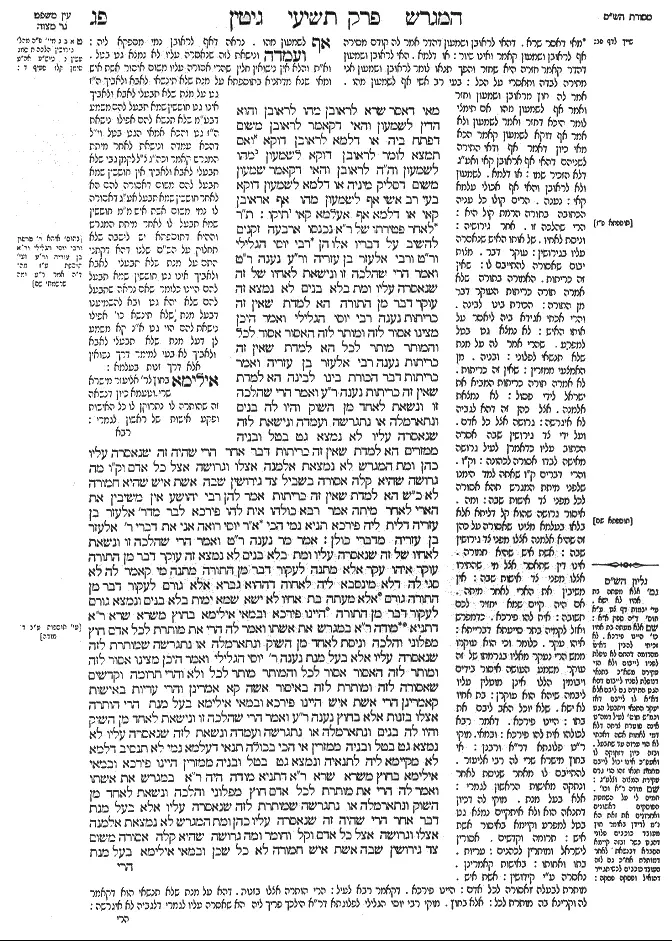
Gittin 83a - Guemara
מאי דאסר שרא לראובן מהו לראובן והוא הדין לשמעון והאי דקאמר לראובן משום דפתח ביה או דלמא לראובן דוקא ואם תמצא לומר לראובן דוקא לשמעון מהו לשמעון וה"ה לראובן והאי דקאמר שמעון משום דסליק מיניה או דלמא לשמעון דוקא בעי רב אשי אף לשמעון מהו אף אראובן קאי או דלמא אף אעלמא קאי תיקו:
ת"ר לאחר פטירתו של ר"א נכנסו ארבעה זקנים להשיב על דבריו אלו הן רבי יוסי הגלילי ור"ט ורבי אלעזר בן עזריה ור"ע נענה ר"ט ואמר הרי שהלכה זו ונישאת לאחיו של זה שנאסרה עליו ומת בלא בנים לא נמצא זה עוקר דבר מן התורה הא למדת שאין זה כריתות נענה רבי יוסי הגלילי ואמר היכן מצינו אסור לזה ומותר לזה האסור אסור לכל והמותר מותר לכל הא למדת שאין זה כריתות נענה רבי אלעזר בן עזריה ואמר כריתות דבר הכורת בינו לבינה הא למדת שאין זה כריתות נענה ר"ע ואמר הרי שהלכה זו ונשאת לאחד מן השוק והיו לה בנים ונתארמלה או נתגרשה ועמדה ונישאת לזה שנאסרה עליו לא נמצא גט בטל ובניה ממזרים הא למדת שאין זה כריתות דבר אחר הרי שהיה זה שנאסרה עליו כהן ומת המגרש לא נמצאת אלמנה אצלו וגרושה אצל כל אדם וק"ו מה גרושה שהיא קלה אסורה בשביל צד גירושין שבה אשת איש שהיא חמורה לא כ"ש הא למדת שאין זה כריתות אמר להן רבי יהושע אין משיבין את הארי לאחר מיתה אמר רבא כולהו אית להו פירכא לבר מדר' אלעזר בן עזריה דלית ליה פירכא תניא נמי הכי א"ר יוסי רואה אני את דברי ר' אלעזר בן עזריה מדברי כולן:
אמר מר נענה ר"ט ואמר הרי שהלכה זו ונשאת לאחיו של זה שנאסרה עליו ומת בלא בנים לא נמצא זה עוקר דבר מן התורה עוקר איהו עקר אלא מתנה לעקור דבר מן התורה מתנה מי קאמר לה לא סגי לה דלא מינסבא ליה לאחוה דההוא גברא אלא גורם לעקור דבר מן התורה גורם אלא מעתה בת אחיו לא ישא שמא ימות בלא בנים ונמצא גורם לעקור דבר מן התורה היינו פירכא ובמאי אילימא בחוץ משרא שרא ר"א דתניא מודה ר"א במגרש את אשתו ואמר לה הרי את מותרת לכל אדם חוץ מפלוני והלכה וניסת לאחד מן השוק ונתארמלה או נתגרשה שמותרת לזה שנאסרה עליו אלא בעל מנת נענה ר' יוסי הגלילי ואמר היכן מצינו אסור לזה ומותר לזה האסור אסור לכל והמותר מותר לכל ולא והרי תרומה וקדשים שאסורה לזה ומותרת לזה באיסור אשה קא אמרינן והרי עריות באישות קאמרינן הרי אשת איש היינו פירכא ובמאי אילימא בעל מנת הרי הותרה אצלו בזנות אלא בחוץ נענה ר"ע ואמר הרי שהלכה זו ונישאת לאחד מן השוק והיו לה בנים ונתארמלה או נתגרשה ועמדה ונשאת לזה שנאסרה עליו לא נמצא גט בטל ובניה ממזרין אי הכי בכולה תנאי דעלמא נמי לא תנסיב דלמא לא מקיימא ליה לתנאיה ונמצא גט בטל ובניה ממזרין היינו פירכא ובמאי אילימא בחוץ משרא שרא ר"א דתניא מודה היה ר"א במגרש את אשתו ואמר לה הרי את מותרת לכל אדם חוץ מפלוני והלכה ונשאת לאחד מן השוק ונתארמלה או נתגרשה שמותרת לזה שנאסרה עליו אלא בעל מנת דבר אחר הרי שהיה זה שנאסרה עליו כהן ומת המגרש לא נמצאת אלמנה אצלו וגרושה אצל כל אדם וקל וחומר ומה גרושה שהיא קלה אסורה משום צד גירושין שבה אשת איש חמורה לא כל שכן ובמאי אילימא בעל מנת
Comments from Rashi on Masechet Gittin Page 83a
או דלמא . האי לראובן ושמעון דהדר קאמר חזרה היא שחזר והפך תנאו לומר לראובן ושמעון אני מתירה לבדה ותאסרי על הכל: בעי רב אשי אף לשמעון מהו . אמר לה חוץ מראובן ושמעון וחזר ואמר אף לשמעון מהו אם תימצי לומר היכא דחזר ואמר לשמעון ולא אמר אף דוקא לשמעון קאמר הכא מאי כיון דאמר אף ודאי התירה לשניהם דהאי אף אראובן קאי ואע"ג דלא הזכיר שמו: או דלמא . לשמעון ולא לראובן והאי אף אכולי עלמא קאי: נענה . הרים קולו כל עניה הכתובה בתורה הרמת קול היא: הרי שהלכה זו . אחר גירושיה: וניסת לאחיו . של אותו האיש שנאסרה עליו בגירושין: עוקר דבר . מצות יבום שאסורה להתייבם לו: שאין זה כריתות . האמורה בתורה שלא אמרה תורה כריתות העוקר דבר מן התורה: הכורת בינו לבינה . והרי אכתי אגידא ביה ליאסר על אותו האיש: לא נמצא גט בטל למפרע . שהרי אמר לה על מנת שלא תנשאי לפלוני: ובניה . מן האמצעי ממזרין: שאין זה כריתות . לא אמרה תורה כריתות המביא את ישראל לידי פסול: לא נמצאת אלמנה . אצל כהן זה דהא לגביה לא איגרשה: גרושה אצל כל אדם . ועל ידי צד גירושין שבה אסרה הכתוב עליו כדאמרן לעיל גרושה מאישה לבדו אסורה לכהונה: וק"ו . והרי דברים ק"ו שאתה למד הימנו שלפני מיתת המגרש תהא אסורה לכל מפני צד אישות שבה: ומה . איסור גרושה שהוא קל דליתא אלא בלאו בעלמא מצינו שאסורה על כהן זה שהיא אלמנה אצלו מפני צד גירושין שבה: אשת איש שהיא חמורה . אינו דין שתאסר אצל מי שהתירו אצלו מפני צד אישות שבה: אין משיבין את הארי לאחר מיתה . אם היה קיים שמא יחזיר לכם תשובה: אית להו פירכא . כדמפרש ואזל לקמיה בתר סייעתא דברייתא: איהו עקר . כלומר וכי הוא עוקרו ממש הרי נעקר מאליו בגרמתו של זה עוקר משמע העושה איסור בידים ויבומין הללו אינן מוטלין עליו ליבמה שיהא הוא עוקרן: בת אחיו לא ישא . שלא יוכל האב ליבם את בתו: היינו פירכא . דאמר רבא לכולהו אית להו פירכא: ובמאי . מוקי ר"ט פלוגתא דר"א ורבנן: אי בחוץ מישרא שרי לה רבי אליעזר . להתייבם לו מאחר שניסת לאחר ונתקה מאישות הראשון לגמרי: אלא בעל מנת . מוקי לה דכיון דתנאה הוא ולא איתקיים נמצא גט בטל למפרע וקיימא באיסור אשת איש: תרומה וקדשים . אסורין לישראל ומותרין לכהנים: עריות . בתו ואחותו: באישות קאמרינן . נאסרה ע"י קידושין: אשת איש . מותרת לבעלה ואסורה לכל אדם: היינו פירכא . דקאמר רבא לעיל: הרי הותרה אצלו בזנות . דהא על מנת שלא תנשאי הוא דקאמר לה וקרינא בה מותרת לכל: אלא בחוץ . מוקי רבי יוסי הגלילי לפלוגתא דר"א הילכך פריך ליה הא שאסרה עליו לגמרי דלגביה לא איגרשה:
Comments from Tosafot - Gittin 83a
אף לשמעון מהו . נראה דאף לראובן נמי מספקא ליה: ועמדה ונישאת לזה שנאסרה עליו לא נמצא גט בטל . וא"ת והלא אין נישואין חלין שהרי אסורה עליו משום איסור אשת איש ומאי שנא מדתניא בתוספתא על מנת שלא תינשאי לאבא ולאביך ה"ז גט על מנת שלא תבעלי לאבא ולאביך אינו גט חוששין שמא תבעל להם משמע דבע"מ שלא תנשא להם אפילו נישאת ה"ז גט והכא אמאי הגט בטל וי"ל דהכא עמדה ונישאת לאחר מיתת המגרש קאמר וכה"ג צ"ל לקמן גבי שלא תבעלי לאבא ולאביך אין חוששין שמא תבעל להם משום דאסורה להם הא לאחר חוששין שמא תבעל אע"ג דאסורה לו נמי משום אשת איש מ"מ חוששין שמא תבעל לו לאחר מיתת המגרש וההיא דתוספתא יש לישבה שלא תחלוק על הש"ס שלנו דהא דקתני התם על מנת שלא תבעלי לאבא ולאביך אינו גט חוששין שמא תבעל להם היינו כלומר שאם נראה שתבעל להם שלא יהא גט ובא להשמיענו דבעל מנת שלא תינשא כו' אפילו נישאת להם הוי גט א"נ קא משמע לן דעל מנת שלא תבעלי לאבא ולאביך לא בעי למימר דרך נשואין אלא דרך זנות בעלמא: מודה ר"א במגרש כו' . תימה למאן מודה דלרבנן דפליגי עליה לא הויא גט ואינה מותרת לשום אדם: אילימא בחוץ לר' אליעזר מישרא שרי . וטעמא כיון דנשאה זה שהותרה לו נתרוקן לו כל האישות ופקע אישות של ראשון לגמרי:
Gittin 83a - Mishnah translated into english
that what he initially forbade he then permitted, enabling her to marry anyone she wishes, what is the halakha if he said the second time that she is permitted to marry Reuven? Did he mean that she is permitted to marry Reuven and the same is true with regard to Shimon, i.e., she is permitted to marry him as well? Is the fact that he mentioned only that she is permitted to marry Reuven because he opened his prior qualification by mentioning him before he mentioned Shimon, but he intended to permit her to marry Shimon as well? Or did he, perhaps, specifically intend to permit her to marry Reuven?
And if you say that he intended to permit her to marry specifically Reuven and not Shimon, what is the halakha if he said that she is permitted to marry Shimon? Did he mean that she is permitted to marry Shimon and the same is true with regard to Reuven, and the fact that he mentioned only Shimon is because he ended his initial previous statement by mentioning him? Or perhaps he was specifically referring only to Shimon?
Rav Ashi raises another dilemma with regard to the same case: If he said to her the second time: You are also permitted to marry Shimon, what is the halakha? Is the word also referring to Reuven, i.e., she is permitted to marry Shimon in addition to Reuven, or perhaps it is also referring to everyone, i.e., she is permitted to marry Shimon in addition to all men, but not Reuven? The dilemma shall stand unresolved.
§ The Sages taught (Tosefta 9:1): After the death of Rabbi Eliezer, four Sages entered the discussion to refute his statement. They were: Rabbi Yosei HaGelili, Rabbi Tarfon, Rabbi Elazar ben Azarya, and Rabbi Akiva.
Rabbi Tarfon responded to Rabbi Eliezer’s opinion, saying: If after the husband stipulated that the wife not marry a certain man she went and married the brother of the one to whom she was prohibited from marrying, and this husband died without children, she cannot perform levirate marriage with her husband’s brother, because he is forbidden to her due to the stipulation of her first husband. Is the first husband not found to be uprooting a matter of Torah law through his stipulation? You have therefore derived that this is not an act of severance. The divorce is not valid, as the Torah would not sanction a manner of divorce that can cause a mitzva to be nullified.
Rabbi Yosei also responded to Rabbi Eliezer’s opinion, saying: Where do we find an example of something that is forbidden to this person and permitted to that other person? What is forbidden is forbidden to everyone, and what is permitted is permitted to everyone. This contradicts Rabbi Eliezer’s opinion that a divorcée can be prohibited from marrying a certain man and permitted to marry all other men. You have therefore derived that this is not an act of severance.
Rabbi Elazar ben Azarya responded, saying: What is the meaning of the expression: “Scroll of severance,” which is used in the Torah for a bill of divorce? It means something that severs the bond between him and her entirely. This woman, by contrast, is still bound to her husband after their divorce, as his stipulation prevents her from marrying a certain man. You have therefore derived that this is not an act of severance.
Rabbi Akiva responded, saying: If after the husband stipulated that the wife not marry a certain man she went and married a man from the general public, and she had children with him, and she was subsequently widowed or divorced from the second husband, and she then arose and married the one to whom she was forbidden by her first husband’s condition, isn’t the bill of divorce thereby found to be nullified? And would this not render her children from her second marriage as born from an adulterous relationship [mamzerim], as she is retroactively considered her first husband’s wife? You have therefore derived that this is not an act of severance, as the Torah would not enable a divorce that could lead to such a situation.
Rabbi Akiva continued to offer an alternative refutation of Rabbi Eliezer’s opinion: If the one to whom she was forbidden was a priest, and her ex-husband who divorced her died, is she not thereby found to be a widow with regard to him, as she was considered a married woman with regard to this priest even after her divorce, and a divorcée with regard to any other man? Nevertheless, she is forbidden to him too, just as she is forbidden to any other priest.
And it is therefore an a fortiori inference that just as the prohibition for a divorcée to marry a priest (see Leviticus 21:14) is a relatively minor prohibition, yet she is forbidden to this priest due to the element of divorce that applies to her, even though with regard to him she is not a divorcée but a widow, all the more so is it not clear that the prohibition against sexual intercourse with a married woman, which is a major prohibition, should apply to every man during the lifetime of the ex-husband, due to the fact that she is considered a married woman with regard to this one man? You have therefore derived that this is not an act of severance, as this divorce does not permit her to marry any man.
Rabbi Yehoshua said to them: Even though your objections are valid, one does not refute the opinion of a lion after his death. After a Sage has passed away one cannot reject his opinion based on a difficulty with it, as he possibly would have provided an answer had it been presented to him while he was still alive.
Rava said: All of the previously mentioned responses have refutations that can be raised against them except for the response of Rabbi Elazar ben Azarya, which does not have a refutation. The Gemara notes that this is also taught in a baraita, as Rabbi Yosei said: I see the statement of Rabbi Elazar ben Azarya as preferable to the statements of all the other Sages.
The Gemara commences discussion of the baraita: The Master said that Rabbi Tarfon responded, saying: If she went and married the brother of the one to whom she was prohibited from marrying, and he died without children, is the first husband not thereby found to be uprooting a matter of Torah law? The Gemara asks: What is the meaning of the question: Is the first husband not uprooting a matter of Torah law? Is it he who is uprooting the mitzva? Rather, Rabbi Tarfon means that the husband is stipulating to uproot a matter of Torah law.
The Gemara questions this assertion as well: Is the husband stipulating to uproot a mitzva? Did he say to her that it is not sufficient if she does not marry the brother of that man, who he rendered forbidden to her? Since he did not stipulate this, he did not uproot the mitzva; it is the woman who uprooted the mitzva by marrying specifically that man’s brother. Rather, Rabbi Tarfon means that the husband is causing a matter of Torah law to be uprooted.
The Gemara asks: He is causing of matter of Torah law to be uprooted? But if that is so, one should not marry his brother’s daughter lest he die without children, and he will thereby be found to be causing a matter of Torah law to be uprooted in that his brother will not be able to perform levirate marriage with his own daughter, and the Sages laud one who marries his brother’s daughter. The Gemara responds: This is the refutation against Rabbi Tarfon’s response that Rava was referring to.
The Gemara asks: And with regard to what case did Rabbi Tarfon refute Rabbi Eliezer’s opinion? If we say that it was with regard to a case in which the husband said that his wife is permitted to marry any man except for so-and-so, the refutation is irrelevant, as Rabbi Eliezer permits the woman to marry this man after she married another man.
As it is taught in a baraita (Tosefta 9:1): With regard to a case where a man divorces his wife and said to her while handing her the bill of divorce: You are hereby permitted to marry any man except for so-and-so, and she went and married someone from the general public and was subsequently widowed or divorced from him, Rabbi Eliezer concedes that she is now permitted to marry the man whom she was initially prohibited from marrying by the qualification of her first husband.
Rather, Rabbi Tarfon’s refutation was clearly stated with regard to a case where the woman was divorced on the condition that she would not marry so-and-so. A condition still applies after the woman remarries and its violation nullifies the divorce retroactively.
The baraita states that Rabbi Yosei HaGelili responded, saying: Where do we find an example of something that is forbidden to this person and permitted to that other person? What is forbidden is forbidden to everyone and what is permitted is permitted to everyone. The Gemara asks: Is there not such an example? Aren’t teruma, the portion of the produce designated for the priest, and sacrificial meat forbidden to this group, i.e., non-priests (see Leviticus 22:10), and permitted to that group, i.e., priests? The Gemara answers: We are referring to a forbidden woman.
The Gemara asks: Aren’t those women with whom relations are prohibited due to familial ties forbidden to some men, i.e., their relatives, and permitted to others? The Gemara answers: We are referring to a woman who is forbidden due to marriage.
The Gemara asks: Isn’t a married woman forbidden to all men but permitted to her husband? The Gemara responds: This is the refutation against Rabbi Yosei HaGelili’s response that Rava was referring to.
The Gemara clarifies: And with regard to what case did Rabbi Yosei HaGelili raise this objection? If we say that it was with regard to a case in which the divorce was granted on the condition that she not marry a certain man, she is not entirely forbidden to him, as she is permitted to engage in licentiousness with him; the condition was with regard to marriage, not licentiousness. Rather, he clearly raised the objection with regard to a case where the husband told his wife that she is permitted to marry any man except for so-and-so, rendering her entirely forbidden to that man.
The baraita states that Rabbi Akiva responded, saying: If she went and married a man from the general public, and she had children with him, and she was subsequently widowed or divorced from this second husband, and she then arose and married the one to whom she was forbidden, isn’t the bill of divorce thereby nullified? And would this not render her children mamzerim?
The Gemara asks: If that is so, and there is a concern that she will eventually violate the condition, in a case of any typical condition that the husband attaches to the divorce she should not remarry either, lest she not fulfill his condition and the bill of divorce be found to be nullified and her children be rendered mamzerim. The Gemara responds: This is the refutation against Rabbi Akiva’s response that Rava was referring to.
The Gemara asks: And with regard to what case did Rabbi Akiva raise this objection? If we say that it was with regard to a case in which the husband said that his wife is permitted to marry any man except for so-and-so, the objection is irrelevant, as Rabbi Eliezer permits the woman to marry so-and-so after she marries another man.
As it is taught in a baraita: With regard to a case where a man divorces his wife and said to her: You are hereby permitted to marry any man except for so-and-so, and she went and married someone from the general public, and was subsequently widowed or divorced from him, Rabbi Eliezer concedes that she is now permitted to marry the man whom she was initially prohibited from marrying. Rather, Rabbi Akiva’s objection was clearly with regard to a case of a condition that she would not marry so-and-so.
The baraita states that Rabbi Akiva added an alternative response: If the one to whom she was forbidden was a priest, and her ex-husband who divorced her died, is she not found to be a widow with regard to him and a divorcée with regard to any other man? And it is therefore an a fortiori inference that just as the prohibition against a divorcée marrying a priest is minor, and yet she is forbidden to this priest due to the element of divorce that applies to her, all the more so is it not clear that the prohibition against relations with a married woman, which is major, should apply to every man during the lifetime of the ex-husband, due to the fact that she is considered a married woman with regard to this one man? Therefore, the divorce does not take effect.
The Gemara asks: And with regard to what case was this objection raised? If we say that it was with regard to a case of a condition,
Traduction : The William Davidson digital edition of the Koren Noé Talmud, with commentary by Rabbi Adin Even-Israel Steinsaltz.