 Talmud Bavli
Ta'anit 25b : Youtube
Daf TubeYoutube
4 video classes :
Ta'anit Page 25b
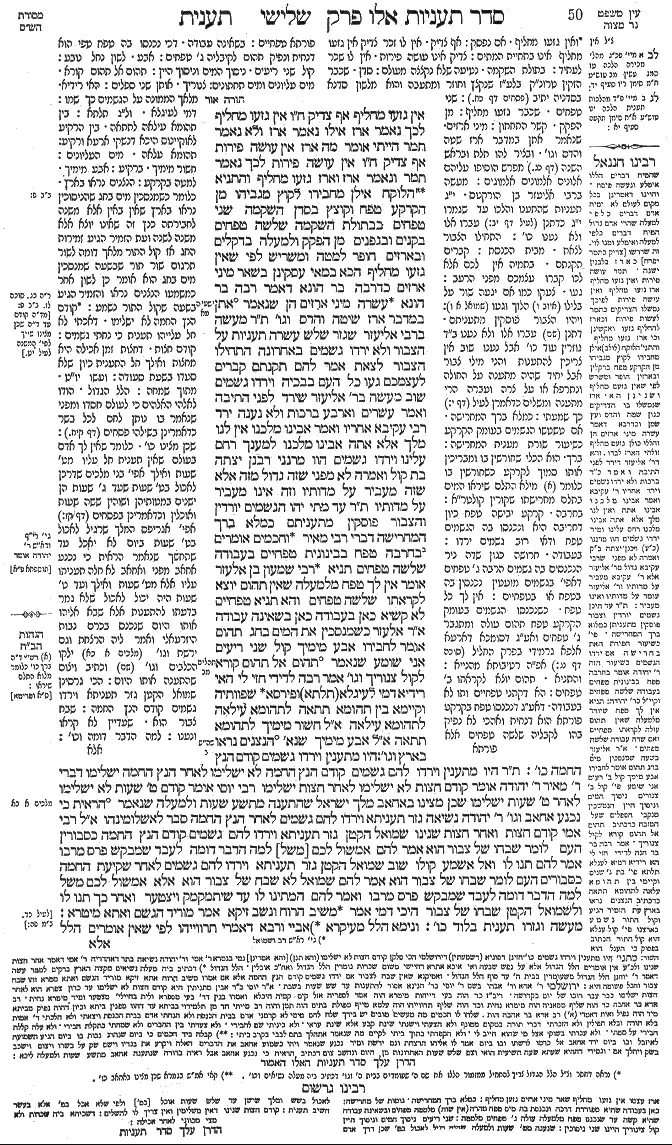
Ta'anit 25b - Guemara
אין גזעו מחליף אף צדיק ח"ו אין גזעו מחליף לכך נאמר ארז אילו נאמר ארז ולא נאמר תמר הייתי אומר מה ארז אין עושה פירות אף צדיק ח"ו אין עושה פירות לכך נאמר תמר ונאמר ארז וארז גזעו מחליף והתניא הלוקח אילן מחבירו לקוץ מגביהו מן הקרקע טפח וקוצץ בסדן השקמה שני טפחים בבתולת השקמה שלשה טפחים בקנים ובגפנים מן הפקק ולמעלה בדקלים ובארזים חופר למטה ומשריש לפי שאין גזעו מחליף הכא במאי עסקינן בשאר מיני ארזים כדרבה בר הונא דאמר רבה בר הונא עשרה מיני ארזים הן שנאמר (ישעיהו מא, יט) אתן במדבר ארז שיטה והדס וגו' ת"ר מעשה ברבי אליעזר שגזר שלש עשרה תעניות על הצבור ולא ירדו גשמים באחרונה התחילו הצבור לצאת אמר להם תקנתם קברים לעצמכם געו כל העם בבכיה וירדו גשמים שוב מעשה בר' אליעזר שירד לפני התיבה ואמר עשרים וארבע ברכות ולא נענה ירד רבי עקיבא אחריו ואמר אבינו מלכנו אין לנו מלך אלא אתה אבינו מלכנו למענך רחם עלינו וירדו גשמים הוו מרנני רבנן יצתה בת קול ואמרה לא מפני שזה גדול מזה אלא שזה מעביר על מדותיו וזה אינו מעביר על מדותיו ת"ר עד מתי יהו הגשמים יורדין והצבור פוסקין מתעניתם כמלא ברך המחרישה דברי רבי מאיר וחכמים אומרים בחרבה טפח בבינונית טפחיים בעבודה שלשה טפחים תניא רבי שמעון בן אלעזר אומר אין לך טפח מלמעלה שאין תהום יוצא לקראתו שלשה טפחים והא תניא טפחיים לא קשיא כאן בעבודה כאן בשאינה עבודה א"ר אלעזר כשמנסכין את המים בחג תהום אומר לחבירו אבע מימיך קול שני ריעים אני שומע שנאמר (תהלים מב, ח) תהום אל תהום קורא לקול צנוריך וגו' אמר רבה לדידי חזי לי האי רידיא דמי לעיגלא (תלתא) ופירסא שפוותיה וקיימא בין תהומא תתאה לתהומא עילאה לתהומא עילאה א"ל חשור מימיך לתהומא תתאה א"ל אבע מימיך שנא' (שיר השירים ב, יב) הנצנים נראו בארץ וגו':
היו מתענין וירדו גשמים קודם הנץ החמה כו':
ת"ר היו מתענין וירדו להם גשמים קודם הנץ החמה לא ישלימו לאחר הנץ החמה ישלימו דברי ר' מאיר ר' יהודה אומר קודם חצות לא ישלימו לאחר חצות ישלימו רבי יוסי אומר קודם ט' שעות לא ישלימו לאחר ט' שעות ישלימו שכן מצינו באחאב מלך ישראל שהתענה מתשע שעות ולמעלה שנאמר (מלכים א כא, כט) הראית כי נכנע אחאב וגו' ר' יהודה נשיאה גזר תעניתא וירדו להם גשמים לאחר הנץ החמה סבר לאשלומינהו א"ל רבי אמי קודם חצות ואחר חצות שנינו שמואל הקטן גזר תעניתא וירדו להם גשמים קודם הנץ החמה כסבורין העם לומר שבחו של צבור הוא אמר להם אמשול לכם [משל] למה הדבר דומה לעבד שמבקש פרס מרבו אמר להם תנו לו ואל אשמע קולו שוב שמואל הקטן גזר תעניתא וירדו להם גשמים לאחר שקיעת החמה כסבורים העם לומר שבחו של צבור הוא אמר להם שמואל לא שבח של צבור הוא אלא אמשול לכם משל למה הדבר דומה לעבד שמבקש פרס מרבו ואמר להם המתינו לו עד שיתמקמק ויצטער ואחר כך תנו לו ולשמואל הקטן שבחו של צבור היכי דמי אמר משיב הרוח ונשב זיקא אמר מוריד הגשם ואתא מיטרא:
מעשה וגזרו תענית בלוד כו':
ונימא הלל מעיקרא אביי ורבא דאמרי תרווייהו לפי שאין אומרים הלל
Comments from Rashi on Masechet Ta'anit Page 25b
ואין גזעו מחליף . אם נפסק: אף צדיק . אין לו זכר צדיק אין גזעו מחליף אינו בתחיית המתים: צדיק אינו עושה פירות . אין לו שכר לעתיד: בתולת השקמה . נטיעה שלא נקצצה מעולם: סדן . שכבר הזקין טרונ"ק בלע"ז שנקצץ וחוזר ומתעבה והוא מלשון סדנא בסדניה יתיב (פסחים דף כח.): שני טפחים . שכבר גזעו מחליף: מן הפקק . קשר התחתון: מיני ארזים . שנאמר אתן במדבר ארז שטה והדס וגו'. ובציר להו תלת ובראש השנה (דף כג.) מפרש הוסיפו עליהם אלונים אלמונים אלמוגים: מעשה ברבי אליעזר בן הורקנוס . י"ג תעניות שהתענו והלכו עד שגמרו י"ג כדתנן (לעיל תענית דף יב:) עברו אלו ולא נענו כו': התחילו הצבור לצאת . מבית הכנסת: קברים תקנתם . בתמיה אין לכם אלא לכו קברו עצמכם מפני הרעב: געו . צעקו כמו אם יגעה שור על בלילו (איוב ו) הלוך וגעו (שמואל א ו): ויהיו הצבור פוסקין מתעניתם . דתנן (שם) עברו אלו ולא נענו ב"ד גוזרין עוד כו' אבל נענו שוב אין צריכין להתענות והני מילי צבור אבל יחיד שהיה מתענה על החולה ונתרפא או על צרה ועברה הרי מתענה ומשלים כדאמרן לעיל (תענית דף י:) כך שמעתי: כמלא ברך המחרישה . אם טשטשו הגשמים בעומק הקרקע כשיעור שורת מענית המחרישה: ברך . הוא הכלי שחורשין בו ומבריכין אותו סמוך לקרקע כשחורשין בו כלומר מילא התלם שיראו המים בתלם מחרישתו שקורין קולטר"א: בחרבה . קרקע יבישה טפח כיון דחריבה היא ונכנסו בה הגשמים טפח ודאי רוב גשמים ירדו: בעבודה . חרושה כגון שדה ניר הנכנסים בה גשמים הרבה ג' טפחים דאפי' בגשמים מועטין נכנסין בה בטפח או בטפחיים: אין לך כל טפח . כשנכנסו הגשמים בעומק הקרקע טפח תהום עולה ומתגבר ג' טפחים ואע"ג דסומכא דארעא אלפא גרמידי בפרק החליל (סוכה דף נג:) אפ"ה רטיבותא מהנייא: והתניא . תהום יוצא לקראתו ב' טפחים: הא דקתני טפחיים ותו לא בעבודה . דאע"ג דנכנסו טפח בקרקע פורתא הוא דנחית ואהכי לא נפיק בהו לקבליה שלשה טפחים אלא פורתא טפחיים: בשאינה עבודה . דכי נכנסו בה טפח טפי הוא דנחית ונפיק תהום לקיבליה ג' טפחים: אבע . לשון נחל נובע: קול שני ריעים . ניסוך המים וניסוך היין: תהום אל תהום קורא . מים עליונים ומים תחתונים: צנוריך . אותן שני ספלים: האי רידיא . מלאך הממונה על הגשמים כך שמו: דמי לעיגלא . ול"ג תלתא: בין תהומא עילאה לתתאה . בין הרקיע לאוקיינוס היכא דנשקי ארעא ורקיע: תהומא עלאה . מים העליונים: חשור מימיך . ברקיע: אבע מימיך . למטה בקרקע: הנצנים נראו בארץ . כלומר כשמנסכין מים בחג שהניסוכין נראו בארץ שאין באין אלא משנה לחבירתה כנץ זה שאינו יוצא אלא משנה לשנה ועת הזמיר הגיע זמירות החג אז קול התור מלאך דומה לשור תרגום שור תור שבשעה שמנסכין מים בחג הוא אומר כן לשון אחר כמשמעו הנצנים נראו והזמיר הגיע בשעה שקול התור נשמע: קודם חצות . דחצות זמן אכילה היא מחצות ואילך חל התענית כיון שלא סעדו בשעת סעודה: שכן מצינו כו' . כלומר שאין לך אדם בעולם שאין תענית חל עליו מט' שעות ואילך אפי' בני מלכים שדרכן לאכול בט' שעות שעד ג' שעות הן ישנים במטותיהן ושוהין ששה שעות ואוכלין וכדאמרינן בפסחים (דף קז:) אפי' אגריפס המלך שרגיל לאכול בט' שעות ביום לא יאכל עד שתחשך שנאמר הראית כי נכנע אחאב מפני ואחאב לא חלה תעניתו עליו אלא מט' שעות ואילך ועד ט' שעות היה יכול לאכול שלא גמר בדעתו להתענות אלא שבא אליהו אותו היום שנכנס בכרם נבות היזרעאלי ואמר ליה הרצחת וגם ירשת וגו' (מלכים א כא) ילקו הכלבים וגו' (שם) וכתיב ויצום שהתענה אותו היום: הכי גרסינן שמואל הקטן גזר תעניתא וירדו גשמים קודם הנץ החמה: שבח צבור הוא . שעדיין לא קראו ונענו: למה הדבר דומה וכו':
Ta'anit 25b - Mishnah translated into english
its shoots do not replenish themselves when its stump is cut down, so too, Heaven forbid, with regard to a righteous person, his shoots will not replenish themselves, i.e., he will be unable to recover from misfortune. Therefore, it is stated “cedar” in the verse. Just as the cedar grows new shoots after its stump is cut down, so too, a righteous individual will thrive again. Conversely, were it stated “cedar” and were it not stated “palm tree,” I would say that just as in the case of a cedar, it does not produce fruit, so too, a righteous man, God forbid, does not produce fruit, i.e., he will have no reward in the World-to-Come. Therefore, it is stated “palm tree” and it is also stated “cedar.”
§ The Gemara asks: And do a cedar’s shoots really replenish themselves? But isn’t it taught in a baraita: With regard to one who bought a tree from another to chop it down for wood, without acquiring total ownership of the tree, he must lift his ax a handbreadth and chop there, so as to allow the tree to grow back? However, in a case where he purchased a large sycamore, he must leave two handbreadths. In the case of an untrimmed sycamore, he must leave three handbreadths. In a situation where one bought reeds or grapevines, he may chop only from the first knot and above. In the case of palms or cedars, one may dig down and uproot it, as its shoots will not replenish themselves. This baraita indicates that cedars will not grow new shoots after they have been cut down.
The Gemara answers: With what are we dealing here? With other species of cedars. This is in accordance with the opinion of Rabba bar Huna, as Rabba bar Huna said: There are ten species of cedars, as it is stated: “I will plant in the wilderness the cedar, the acacia tree and myrtle and the oil tree; I will set in the desert cypress, the plane tree and the larch together” (Isaiah 41:19). The seven species mentioned in this verse are all called cedars, as are three additional species.
The Sages taught: An incident occurred involving Rabbi Eliezer, who decreed a complete cycle of thirteen fasts upon the congregation, but rain did not fall. At the end of the last fast, the congregation began to exit the synagogue. He said to them: Have you prepared graves for yourselves? If rain does not fall, we will all die of hunger. All the people burst into tears, and rain fell.
There was another incident involving Rabbi Eliezer, who descended to serve as prayer leader before the ark on a fast day. And he recited twenty-four blessings, but he was not answered. Rabbi Akiva descended before the ark after him and said: Our Father, our King, we have no king other than You. Our Father, our King, for Your sake, have mercy on us. And rain immediately fell. The Sages were whispering among themselves that Rabbi Akiva was answered while his teacher, Rabbi Eliezer, was not. A Divine Voice emerged and said: It is not because this Sage, Rabbi Akiva, is greater than that one, Rabbi Eliezer, but that this one is forgiving, and that one is not forgiving. God responded to Rabbi Akiva’s forgiving nature in kind by sending rain.
§ The Sages taught in a baraita: How much rain must fall for the community to cease their fast for rain? If the rain penetrates the soil by the full depth of the blade of a plow until the spot where it bends, they may cease fasting; this is the statement of Rabbi Meir. And the Rabbis say a different measurement: If the earth is completely dry, the soil must become moist to the depth of a single handbreadth. For average soil, they must wait until the moisture reaches a depth of two handbreadths. If it is worked soil, i.e., soil that has been plowed, the moisture must reach to a depth of three handbreadths.
It is taught in a baraita that Rabbi Shimon ben Elazar says: There is no handbreadth of rain from above toward which the water of the deep does not rise three handbreadths. The Gemara raises an objection: But isn’t it taught in another baraita that the water of the deep rises two handbreadths? The Gemara explains: This is not difficult. Here, in first baraita, it is referring to worked land, which water penetrates faster, whereas there, in the second baraita, it is referring to unworked land, which water does not penetrate as easily, and therefore the water of the deep rises only two handbreadths.
Rabbi Elazar said: When the water libation was poured during the festival of Sukkot, these waters of the deep say to the other waters of the deep: Let your water flow, as I hear the voices of two of our friends, the wine libation and the water libation, which are both poured on the altar. As it is stated: “Deep calls to deep at the sound of your channels, all Your waves and Your billows are gone over me” (Psalms 42:8), i.e., the upper waters of the deep call to the lower waters of the deep when they hear the sound of the libations.
Rabba said: I have seen this angel in charge of water, Ridya, in the form of a calf whose lips were parted, standing between the lower waters of the deep and the upper waters of the deep. To the upper waters of the deep, he said: Distill your water and let it rain. To the lower waters of the deep, he said: Let your water flow from below, as it is stated: “The flowers appear on the earth; the time of the singing has come, and the voice of the turtledove [tur] is heard in our land” (Song of Songs 2:12). The appearance of flowers in this verse alludes to the libations, as both the blooming of flowers and pouring of these libations are annual events. The time of the singing is referring to the singing of the Festival. Finally, the term tur in Aramaic can also mean an ox; in this context, it is interpreted as a reference to the angel Ridya.
§ The mishna teaches: If they were fasting for rain and rain fell for them before sunrise, they need not complete their fast until the evening. The Sages taught: If they were fasting for rain and rain fell for them before sunrise, they need not complete their fast, as the obligation to fast does not come into effect until sunrise. However, if rain fell after sunrise, they must complete their fast. This is the statement of Rabbi Meir. Rabbi Yehuda says: If rain fell before midday, they need not complete their fast; however, if it rains after midday, they must complete their fast.
Rabbi Yosei says: If rain falls before the ninth hour, three hours into the afternoon, they need not complete their fast; if it rains after the ninth hour of the day, they must complete their fast, as we found with regard to Ahab, king of Israel, who fasted from the ninth hour and onward, as it is stated: “And it came to pass, when Ahab heard these words, that he rent his clothes, and put sackcloth upon his flesh, and fasted, and lay in sackcloth, and went softly. And the word of the Lord came to Elijah the Tishbite saying: Do you see how Ahab humbles himself before Me?” (I Kings 21:27–29). According to tradition, this occurred in the ninth hour.
Rabbi Yehuda Nesia decreed a fast, and rain fell for them after sunrise. He thought to complete the fast, but Rabbi Ami said to him that we learned: Before noon and after noon, i.e., the halakha is in accordance with the opinion of Rabbi Yehuda. Shmuel HaKatan decreed a fast, and rain fell for them before sunrise. The people thought to say: This is a sign of the praiseworthiness of the community, as we merited rainfall even before we prayed.
He said to them: I will tell you a parable. To what is this matter comparable? To a situation where there is a slave who requests a reward from his master, either food or livelihood, and the master says to his ministers: Give him what he asks for and let me not hear his voice, as I would rather not have to listen to him. Here, too, evidently God has no desire to hear our prayers.
Again, on another occasion, Shmuel HaKatan decreed a fast, and rain fell for them after sunset. Based on his previous response, the people thought to say: This is a sign of the praiseworthiness of the community, as God listened to our prayers all day. Shmuel HaKatan said to them: It is not a sign of the praiseworthiness of the community. Rather, I will tell you a parable. To what is this matter comparable? To a situation where there is a slave who requests a reward from his master, and the master says to his ministers: Wait until he pines away and suffers, and afterward give it to him. Here too, the delay is not to the congregation’s credit.
The Gemara asks: But if so, according to the opinion of Shmuel HaKatan, what is considered the praiseworthiness of the community; what are the circumstances in which approval is shown from Heaven? The Gemara explains: When the prayer leader recites: He Who makes the wind blow, and the wind blows; and when he recites: And the rain fall, and rain falls.
The mishna teaches: An incident occurred in which the court decreed a fast in Lod, and when rain fell they ate and drank, and afterward they recited hallel. The Gemara asks: And let us recite hallel at the outset, without delay. Why did they first go home and eat? Abaye and Rava both said: Because one recites hallel
Traduction : The William Davidson digital edition of the Koren Noé Talmud, with commentary by Rabbi Adin Even-Israel Steinsaltz.