 Talmud Bavli
Pesahim 78b : Youtube
Daf TubeYoutube
3 video classes :
Pesahim Page 78b
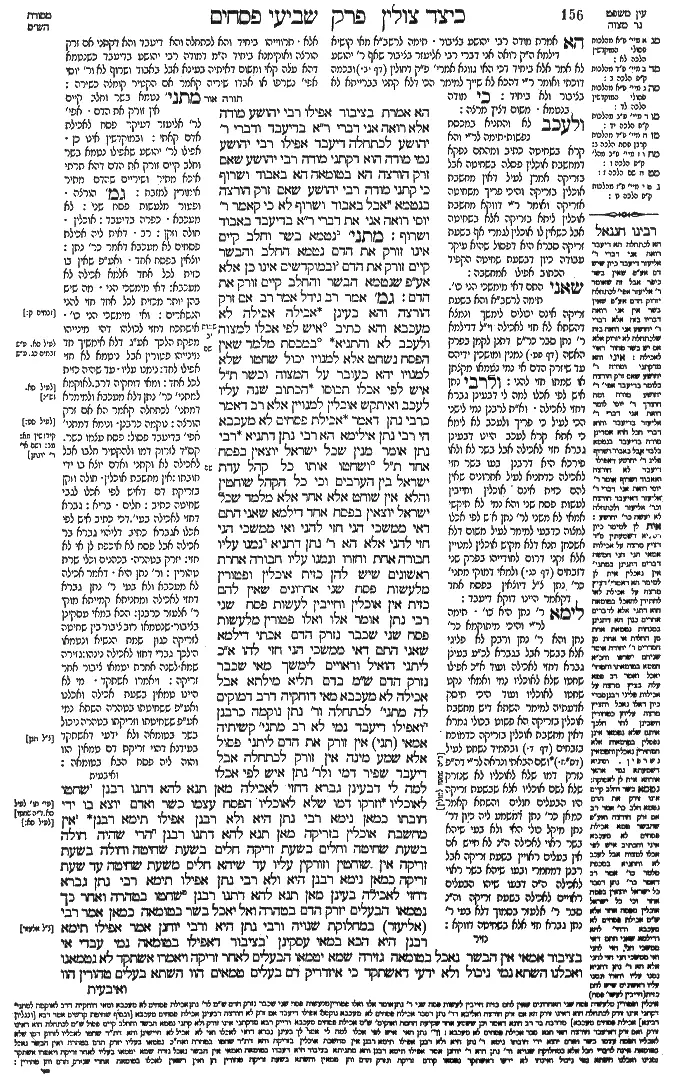
Pesahim 78b - Guemara
הא אמרת בציבור אפילו רבי יהושע מודה אלא רואה אני דברי ר"א בדיעבד ודברי ר' יהושע לכתחלה דיעבד אפילו רבי יהושע נמי מודה הוא דקתני מודה רבי יהושע שאם זרק הורצה הא בטומאה הא באבוד ושרוף כי קתני מודה רבי יהושע שאם זרק הורצה בנטמא אבל באבוד ושרוף לא כי קאמר ר' יוסי רואה אני את דברי ר"א בדיעבד באבוד ושרוף:
מתני׳ נטמא בשר וחלב קיים אינו זורק את הדם נטמא החלב והבשר קיים זורק את הדם ובמוקדשים אינו כן אלא אע"פ שנטמא הבשר והחלב קיים זורק את הדם:
גמ׳ אמר רב גידל אמר רב אם זרק הורצה והא בעינן אכילה אכילה לא מעכבא והא כתיב (שמות יב, ד) איש לפי אכלו למצוה ולעכב לא והתניא (שמות יב, ד) במכסת מלמד שאין הפסח נשחט אלא למנויו יכול שחטו שלא למנויו יהא כעובר על המצוה וכשר ת"ל איש לפי אכלו תכוסו הכתוב שנה עליו לעכב ואיתקש אוכלין למנויין אלא רב דאמר כרבי נתן דאמר אכילת פסחים לא מעכבא הי רבי נתן אילימא הא רבי נתן דתניא רבי נתן אומר מנין שכל ישראל יוצאין בפסח אחד ת"ל (שמות יב, ו) ושחטו אותו כל קהל עדת ישראל בין הערבים וכי כל הקהל שוחטין והלא אין שוחט אלא אחד אלא מלמד שכל ישראל יוצאין בפסח אחד דילמא שאני התם דאי ממשכי הני חזי להני ואי ממשכי הני חזי להני אלא הא ר' נתן דתניא נמנו עליו חבורה אחת וחזרו ונמנו עליו חבורה אחרת ראשונים שיש להן כזית אוכלין ופטורין מלעשות פסח שני אחרונים שאין להם כזית אין אוכלין וחייבין לעשות פסח שני רבי נתן אומר אלו ואלו פטורין מלעשות פסח שני שכבר נזרק הדם אכתי דילמא שאני התם דאי ממשכי הני חזי להו א"כ ליתני הואיל וראויים לימשך מאי שכבר נזרק הדם ש"מ בדם תליא מילתא אבל אכילה לא מעכבא מאי דוחקיה דרב דמוקים לה מתני' לכתחלה ור' נתן נוקמה כרבנן ואפילו דיעבד נמי לא רב מתני' קשיתיה אמאי (תני) אין זורק את הדם ליתני פסול אלא שמע מינה אין זורק לכתחלה אבל דיעבד שפיר דמי ולר' נתן איש לפי אכלו למה לי דבעינן גברא דחזי לאכילה מאן תנא להא דתנו רבנן שחטו לאוכליו וזרקו דמו שלא לאוכליו הפסח עצמו כשר ואדם יוצא בו ידי חובתו כמאן נימא רבי נתן היא ולא רבנן אפילו תימא רבנן אין מחשבת אוכלין בזריקה מאן תנא להא דתנו רבנן הרי שהיה חולה בשעת שחיטה וחלים בשעת זריקה חלים בשעת שחיטה וחולה בשעת זריקה אין שוחטין וזורקין עליו עד שיהא חלים משעת שחיטה עד שעת זריקה כמאן נימא רבנן היא ולא רבי נתן אפילו תימא רבי נתן גברא דחזי לאכילה בעינן מאן תנא להא דתנו רבנן שחטו בטהרה ואחר כך נטמאו הבעלים יזרק הדם בטהרה ואל יאכל בשר בטומאה כמאן אמר רבי (אליעזר) במחלוקת שנויה ורבי נתן היא ורבי יוחנן אמר אפילו תימא רבנן היא הכא במאי עסקינן בציבור דאפילו בטומאה נמי עבדי אי בציבור אמאי אין הבשר נאכל בטומאה גזירה שמא יטמאו הבעלים לאחר זריקה ויאמרו אשתקד לא נטמאנו ואכלנו השתא נמי ניכול ולא ידעי דאשתקד כי איזדריק דם בעלים טמאים הוו השתא בעלים טהורין הוו
Comments from Rashi on Masechet Pesahim Page 78b
אלא . תרווייהו ביחיד והא לכתחלה והא דיעבד והא דקתני אם זרק הורצה ואוקימנא ביחיד ה"מ דמודה רבי יהושע בדיעבד כשנטמא דהא עלה קאי ומשום דאיתיה בעינא אבל באבוד ושרוף לא ור' יוסי אפילו נשרפו או אבדו שיריה קאמר אם הקטיר קומצה כשירה: מתני' נטמא בשר וחלב קיים אין זורק את הדם . אפי' לר' אליעזר דעיקר פסח לאכילת אדם קאתי: ובמוקדשין אינו כן . אפילו לר' יהושע שאפילו נטמא בשר וחלב קיים זורק את הדם דהא תרתי איכא מתיר ושיריים שהדם מתיר אימורין למזבח: גמ' הורצה . ופטור מלעשות פסח שני לא מעכבא . כפרה בדיעבד: אוכלין . חולה וזקן: רב . דאית ליה אכילת פסחים לא מעכבא דאמר כר' נתן: יוצאין בפסח אחד . ואע"פ שאין בו כזית לכל אחד אלמא אכילה לא מעכבא: דאי מימשכי הני . מה שיש בהן יותר מכזית לכל אחד חזי להני הנשארים: ואי מימשכי הני כו' . אישתכח דחזי לכולהו דהי מינייהו מפקת הלכך אע"ג דלא אימשיך חד מינייהו פטורין אבל ניטמא לא חזי אפילו לחד: נימנו עליו . עד שהיה כזית לכל אחד: ומאי דוחקיה דרב . לאוקמא למתני' כר' נתן דלא מעכבא ולמימרא דמתני' לכתחילה קאמר הא אם זרק הורצה: נוקמה כרבנן . ונימא דמתני' אפי' בדיעבד פסול: פסח עצמו כשר . קס"ד לזרוק דמו ולהקטיר חלבו אבל לאכילה לא וקתני ואדם יוצא בו ידי חובתו: ור' נתן היא . דאמר אכילה לא מעכבא ולא בעי ר' נתן גברא דחזי לאכילה ומתניתא קמייתא מוקי ר' אלעזר כרבנן: אין מחשבת אוכלין . חולה וזקן בזריקת דם דאיש לפי אכלו לגבי שחיטה כתיב: חלים . בריא: גברא דחזי לאכילה בעי' . דכי כתיב איש לפי אכלו אגברא כתיב דליהוי גברא בר אכילה אבל פסח לא איכפת לן אי לא חזי: יזרק בטהרה . בכהנים וכלי שרת טהורין: ור' נתן היא . דאמר אכילה לא מעכבא ולא בעי ר' נתן גברא דחזי לאכילה ומתניתא קמייתא מוקי ר' אלעזר כרבנן: הכא במאי עסקינן בציבור . שנטמאו רוב ציבור בין שחיטה לזריקה כגון שמת הנשיא ונטמאו הילכך גברי דחזו לאכילה נינהו: גזירה שמא . לשנה אחרת יטמאו ציבור אחר זריקה: ויאמרו אשתקד . מי לא היינו טמאין בשעת אכילה ואכלנו ואע"פ ששחיטתו בטהרה השתא נמי אע"פ ששחיטתו וזריקתו בטהרה ניכול בשר בטומאה ולא ידעי דאשתקד בעידנא דהוי זריקת הדם טמאין הוו והוה ליה פסח הבא בטומאה:
Comments from Tosafot - Pesahim 78b
הא אמרת מודה רבי יהושע בציבור . תימה לרשב"א מאי קושיא דילמא ה"ק רואה אני דברי רבי אליעזר בציבור שאף ר' יהושע לא אמר אלא ביחיד דכי האי גוונא אמרי' פ"ק דחולין (דף יב.) ובכמה דוכתי ואומר ר"י דהכא לא שייך למימר הכי דלא קתני בברייתא לא בציבור ולא ביחיד: כי מודה בנטמא . משום דציץ מרצה: ולעכב לא והתניא במכסת נפשות . תימה לר"י והא קרא בשחיטה כתיב ומהתם נפקא דמחשבת אוכלין פסלה בשחיטה אבל בזריקה אמרן לעיל דאין מחשבת אוכלין בזריקה והיכי פריך משחיטה אזריקה ואומר ר"י דווקא מחשבת אוכלין ליתא בזריקה אלא בשחיטה אבל כשאין לו אוכלין לגמרי אף בשעת זריקה סברא היא דפסול שהיא עיקר עבודה כיון דבשעת שחיטה הקפיד הכתוב אפילו אמחשבה: שאני התם דאי מימשכי הני כו' . תימה לרשב"א והא בשעת זריקה אינם יכולים לימשך ונמצא דהשתא לא חזי לאכילה וי"ל דדילמא ר' נתן סבר כר"ש דתנן לקמן בפרק האשה (פסחים דף פט.) נמנין ומושכין ידיהם עד שיזרק הדם אי נמי נטמאו מקצתן או שמתו חזי להני: ולרבי נתן איש לפי אכלו למה לי דבעינן גברא דחזי לאכילה . וא"ת לרבנן נמי לישני הכי לעיל כי פריך ולעכב לא לימא כי אתא קרא לעכב היינו דבעינן גברא חזי לאכילה אבל בשר לא ולאו פירכא היא דרבנן בעו בשר חזי לאכילה כדתניא לעיל אחרונים שאין להם כזית אינם אוכלין וחייבין לעשות פסח שני והא נמי לא תיקשי אמאי לא משני לר' נתן איש לפי אכלו למצוה כדבעי למימר לעיל משום דלא אשכחן תנא דלא מקיש אוכלין למנויין אלא זקני דרום לחודייהו בפרק שני דזבחים (דף כג.) ולמאי דמוקי מתני' כר' נתן צ"ל דיוצאין בפסח אחד דקאמר היינו דוקא דיעבד: לימא ר' נתן היא כו' . תימה לר"י והיכי מיתוקמא כר' נתן והא ר' נתן ורבנן לא פליגי אלא בבשר אבל בגברא לכ"ע בעינן גברא דחזי לאכילה ועוד א"כ אפילו שחטו שלא לאוכליו נמי ואמאי נקט שחטו לאוכליו ועוד היכי תיסק אדעתיה למימר השתא דיש מחשבת אוכלין בזריקה הא פשוט בכולי גמרא דאין מחשבת אוכלין בזריקה כדמוכח בזבחים (דף ד.) ובתמיד נשחט לעיל (דס"ח.) ושם הבאתי ונראה לר"י דה"פ נזרק דמו שלא לאוכליו לא שנזרק שלא לשם אוכליו אלא שבשעת זריקה היו הבעלים חולים והשתא קאמר כמאן כר' נתן דמשמע ליה כיון דר' נתן מיקל כולי האי ולא בעי שיהא בשר ראוי לאכילה ה"נ לא חייש אם אין בעלים ראויין בשעת זריקה אבל רבנן דמחמרי ובעו שיהא בשר ראוי לאכילה ה"ה דבעו שיהו הבעלים ראויים לאכילה בשעת זריקה וה"נ סבר ר' אלעזר בסמוך דלא בעי ר' נתן גברא חזי אלא בשחיטה דווקא:
Pesahim 78b - Mishnah translated into english
Didn’t you say that with regard to an offering involving the public, even Rabbi Yehoshua concedes that ritual impurity is permitted?
Rather, Rabbi Yosei’s statement should be understood differently. When he said: I see as correct the statement of Rabbi Eliezer, he was referring to after the fact. When he said: I see as correct the statement of Rabbi Yehoshua, he meant ab initio. The Gemara asks: After the fact Rabbi Yehoshua also concedes, as it teaches: Rabbi Yehoshua concedes that if one sprinkled the blood, it was accepted and the offering is valid.
The Gemara responds: This case is with regard to ritual impurity, and that case is with regard to an offering that was lost or burned. The Gemara explains: When it teaches that Rabbi Yehoshua concedes that if one sprinkled the blood it is accepted, that is with regard to a case in which the meat of the offering became impure; but with regard to a case where the meat of the offering was lost or burned, he does not agree, even after the fact. When Rabbi Yosei said: I see as correct the opinion of Rabbi Eliezer after the fact, that was with regard to cases in which the meat was lost or burned, with regard to which Rabbi Yehoshua did not concede to Rabbi Eliezer.
MISHNA: If the meat of the Paschal lamb became ritually impure, and the fat remains pure and may be burned on the altar, one may not sprinkle the blood. On the other hand, if the fat became impure and the meat remains pure, one may sprinkle the blood because the meat remains fit to be eaten. This is the halakha with regard to a Paschal lamb, whose primary purpose is to be eaten by those who have registered for it. However, with regard to other offerings it is not so. Rather, although the meat has become impure and the fat remains pure, one may sprinkle the blood, because part of the offering still remains valid.
GEMARA: Rav Giddel said that Rav said: If one sprinkled the blood despite the fact that the meat was ritually impure, it was nonetheless accepted; one is not obligated to observe the second Pesaḥ. The Gemara asks: Don’t we require that the Paschal lamb be eaten, which could not occur in this case? The Gemara answers: Failure to engage in eating the offering does not preclude it from being accepted.
The Gemara asks: Isn’t it written: “And if the household be too little for a lamb, then he and his neighbor who is close to his house shall take one according to the number of the souls; according to every man’s eating you shall make your count for the lamb” (Exodus 12:4)? This indicates that the Torah requires one to eat the Paschal lamb. The Gemara responds: This verse is stated as a mitzva only. It should be fulfilled, but it does not preclude acceptance of the offering.
The Gemara asks: And was it not stated to preclude acceptance of the offering if it cannot be eaten? Wasn’t it taught in a baraita: “According to the number of the souls”; this teaches that the Paschal lamb is slaughtered only for those who have registered for it and have thereby included themselves in advance in the number of the souls? I might have thought that if one slaughtered it for those who have not registered for it, he is merely like one who violates a mitzva, but the offering is still valid after the fact. Therefore, the verse states: “According to every man’s eating you shall make your count”; the verse repeated that the Paschal lamb is eaten only by those registered in order to underscore that failure to register precludes the offering from being valid.
And those who are able to eat the offering, as opposed to the sick or elderly who are unable to eat it, are juxtaposed in the verse to those who registered. Therefore, just as a Paschal lamb is disqualified if it is slaughtered for those who did not register for it, it is disqualified if it cannot be eaten. This poses a difficulty for the opinion of Rav.
The Gemara answers: Rather, Rav said his statement in accordance with the opinion of Rabbi Natan, who said that failure to engage in eating the Paschal lamb does not preclude one from fulfilling one’s obligation to bring the offering, as the eating is a separate mitzva.
The Gemara asks: Which statement of Rabbi Natan is this referring to? If we say it is this statement of Rabbi Natan, as it was taught in a baraita that Rabbi Natan says: From where is it derived that all Jews may fulfill their obligation after the fact with one Paschal lamb? The verse states: “And the whole assembly of the congregation of Israel shall slaughter it in the afternoon” (Exodus 12:6). He asked: And does the entire assembly slaughter it? Is it a mitzva for each individual to slaughter his own Paschal lamb? Is it not true that only one person slaughters for the entire group? Rather, this formulation of the verse teaches that all Jews may fulfill their obligation with one Paschal lamb. It is considered as though they all slaughtered it and fulfilled their obligation, although they cannot all eat an olive-bulk of the offering.
The Gemara responds that this is not comparable to the case at hand: Perhaps it is different there, as, if these withdraw from the offering, it is fit for those, and if those withdraw it is fit for these. Although it is impossible for all Jews to partake of the same offering, the offering is fit for each individual, who could eat an olive-bulk of it if enough other people would withdraw.
Rather, it is this statement of Rabbi Natan, as it was taught in a baraita: If one group registered for a Paschal lamb and then another group registered for it, and there was not enough meat to allow each person to eat an olive-bulk, the first ones, who have an olive-bulk of the Paschal lamb for each person, eat and are exempt from performing the ritual of the Paschal lamb on the second Pesaḥ; the latter ones, who do not have an olive-bulk available from the Paschal lamb for each person, do not eat and are obligated to perform the ritual of the Paschal lamb on the second Pesaḥ.
Rabbi Natan says: Both these and those are exempt from performing the ritual of the Paschal lamb on the second Pesaḥ, as the blood has already been sprinkled. Therefore, they have all fulfilled their obligation. This indicates that, according to the opinion of Rabbi Natan, eating is not essential.
The Gemara responds that one can still ask: Perhaps it is different there, as, if these members of the first group withdraw, it is fit for the members of the second group. The Gemara rejects the question: If so, let it teach that the second group is exempt from the second Pesaḥ since the members of the first group are fit to withdraw. What is the reason for the statement of the baraita that the blood has already been sprinkled? Learn from this that the matter depends on the blood, but failure to engage in eating the Paschal lamb does not preclude one from fulfilling his obligation.
The Gemara asks: What compelled Rav to establish the mishna as teaching that the blood may not be sprinkled on the altar ab initio, in accordance with the opinion of Rabbi Natan? Let us establish the mishna in accordance with the view of the Rabbis and say that even after the fact, no, one does not fulfill his obligation. The Gemara answers: Rav had difficulty with the mishna: Why does it teach that one may not sprinkle the blood? It should teach that the offering is disqualified. Rather, learn from this use of language that one may not sprinkle the blood on the altar ab initio, but after the fact it seems well.
The Gemara asks: And according to the opinion of Rabbi Natan, why do I need the phrase “according to every man’s eating,” if it does not teach that the eating is essential? The Gemara answers: It is necessary, even according to the opinion of Rabbi Natan, to teach that we require a person who is fit for eating. Although it is possible to fulfill one’s obligation without actually eating the Paschal lamb, if one is physically unable to eat some of it, e.g., one who is sick or elderly, he does not fulfill his obligation.
The Gemara raises a discussion based on the views cited above. Who is the tanna that taught this baraita? As the Sages taught: If one slaughtered it for individuals who are able to eat it and sprinkled its blood for individuals who cannot eat it, the Paschal lamb itself is valid, and one fulfills his obligation with it. In accordance with whose opinion is this baraita? Let us say it is in accordance with the opinion of Rabbi Natan, who holds that eating is not essential, and not in accordance with the opinion of the Rabbis?
The Gemara rejects this suggestion: The baraita can be understood even if you say it is in accordance with the opinion of the Rabbis. Everyone agrees that improper intent pertaining to those who will eat the offering disqualifies the offering only if it occurs during the slaughter; it does not disqualify the offering if it occurs during the sprinkling of the blood.
The Gemara asks: Who is the tanna that taught this baraita? As the Sages taught: With regard to one who was sick and not able to eat meat at the time of the slaughter and was healthy at the time of the sprinkling of the blood, or one who was healthy at the time of the slaughter and sick at the time of the sprinkling of the blood, one may not slaughter or sprinkle blood for him until he is healthy from the time of slaughter until the time of the sprinkling of the blood. In accordance with whose opinion is this? Let us say it is in accordance with the opinion of the Rabbis, who hold that eating the Paschal lamb is essential, and not in accordance with the opinion of Rabbi Natan. The Gemara rejects this suggestion: The baraita can be understood even if you say it is in accordance with the opinion of Rabbi Natan, because even Rabbi Natan holds that we require a person who is fit for eating.
The Gemara records a further discussion: Who is the tanna that taught this baraita? As the Sages taught: If one slaughtered the Paschal lamb in ritual purity, and after that the owners became ritually impure, the blood should be sprinkled in purity and the meat should not be eaten in impurity. In accordance with whose opinion is this baraita?
Rabbi Eliezer said: This halakha is subject to dispute, and it is taught in this baraita in accordance with the opinion of Rabbi Natan, who holds that eating is not essential, and not in accordance with the opinion of the Rabbis. And Rabbi Yoḥanan said: The baraita can be understood even if you say that it is in accordance with the opinion of the Rabbis. With what are we dealing here? With a situation in which the majority of the public is ritually impure, in which case everyone agrees that they perform the ritual of the Paschal lamb even in a state of impurity.
The Gemara asks: If it is in a case involving the public, why is the meat not eaten in a state of impurity? When the majority of the public is impure, they may sacrifice and even consume the Paschal lamb. The Gemara answers that this prohibition is due to a rabbinic decree lest the owners become impure after the sprinkling of the blood, and they will say: Last year, didn’t we become impure, and nevertheless we ate the Paschal lamb? Now too, we will eat. And they will not know that last year, when the blood was sprinkled the owners were already impure, and therefore the offering could be consumed in a state of impurity. Now, the owners were pure when the blood was sprinkled and became impure only afterward, and a Paschal lamb sacrificed in a state of purity cannot be eaten in a state of impurity, even if everyone is impure.
Traduction : The William Davidson digital edition of the Koren Noé Talmud, with commentary by Rabbi Adin Even-Israel Steinsaltz.