 Talmud Bavli
Mo'ed Katan 20b : Youtube
Daf TubeYoutube
2 video classes :
Mo'ed Katan Page 20b
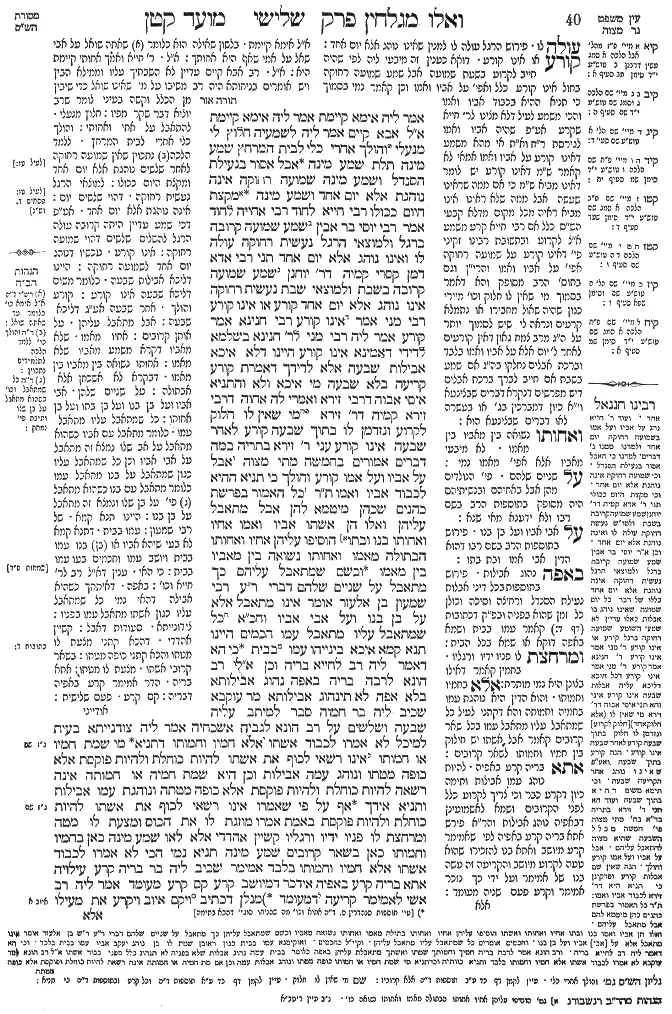
Mo'ed Katan 20b - Guemara
אמר ליה אימא קיימת אמר ליה אימא קיימת א"ל אבא קיים אמר ליה לשמעיה חלוץ לי מנעלי והולך אחרי כלי לבית המרחץ שמע מינה תלת שמע מינה אבל אסור בנעילת הסנדל ושמע מינה שמועה רחוקה אינה נוהגת אלא יום אחד ושמע מינה מקצת היום ככולו רבי חייא לחוד רבי אחייה לחוד אמר רבי יוסי בר אבין שמע שמועה קרובה ברגל ולמוצאי הרגל נעשית רחוקה עולה לו ואינו נוהג אלא יום אחד תני רבי אדא דמן קסרי קמיה דר' יוחנן שמע שמועה קרובה בשבת ולמוצאי שבת נעשית רחוקה אינו נוהג אלא יום אחד קורע או אינו קורע רבי מני אמר אינו קורע רבי חנינא אמר קורע אמר ליה רבי מני לר' חנינא בשלמא לדידי דאמינא אינו קורע היינו דלא איכא אבילות שבעה אלא לדידך דאמרת קורע קריעה בלא שבעה מי איכא ולא והתניא איסי אבוה דרבי זירא ואמרי לה אחוה דרבי זירא קמיה דר' זירא מי שאין לו חלוק לקרוע ונזדמן לו בתוך שבעה קורע לאחר שבעה אינו קורע עני ר' זירא בתריה במה דברים אמורים בחמשה מתי מצוה אבל על אביו ועל אמו קורע והולך כי תניא ההיא לכבוד אביו ואמו ת"ר כל האמור בפרשת כהנים שכהן מיטמא להן אבל מתאבל עליהן ואלו הן אשתו אביו ואמו אחיו ואחותו בנו ובתו הוסיפו עליהן אחיו ואחותו הבתולה מאמו ואחותו נשואה בין מאביו בין מאמו וכשם שמתאבל עליהם כך מתאבל על שניים שלהם דברי ר"ע רבי שמעון בן אלעזר אומר אינו מתאבל אלא על בן בנו ועל אבי אביו וחכ"א כל שמתאבל עליו מתאבל עמו חכמים היינו תנא קמא איכא בינייהו עמו בבית כי הא דאמר ליה רב לחייא בריה וכן א"ל רב הונא לרבה בריה באפה נהוג אבילותא בלא אפה לא תינהוג אבילותא מר עוקבא שכיב ליה בר חמוה סבר למיתב עליה שבעה ושלשים על רב הונא לגביה אשכחיה אמר ליה צודנייתא בעית למיכל לא אמרו לכבוד אשתו אלא חמיו וחמותו דתניא מי שמת חמיו או חמותו אינו רשאי לכוף את אשתו להיות כוחלת ולהיות פוקסת אלא כופה מטתו ונוהג עמה אבילות וכן היא שמת חמיה או חמותה אינה רשאה להיות כוחלת ולהיות פוקסת אלא כופה מטתה ונוהגת עמו אבילות ותניא אידך אף על פי שאמרו אינו רשאי לכוף את אשתו להיות כוחלת ולהיות פוקסת באמת אמרו מוזגת לו את הכוס ומצעת לו מטה ומרחצת לו פניו ידיו ורגליו קשיין אהדדי אלא לאו שמע מינה כאן בחמיו וחמותו כאן בשאר קרובים שמע מינה תניא נמי הכי לא אמרו לכבוד אשתו אלא חמיו וחמותו בלבד אמימר שכיב ליה בר בריה קרע עילויה אתא בריה קרע באפיה אידכר דמיושב קרע קם קרע מעומד אמר ליה רב אשי לאמימר קריעה דמעומד מנלן דכתיב (איוב א, כ) ויקם איוב ויקרע את מעילו
Comments from Rashi on Masechet Mo'ed Katan Page 20b
א"ל אימא קיימת . בלשון שאילה הוא כלומר שאתה שואל על אבי שאל על אמי שאף היא אחותך: א"ל . ר' חייא ואמך אחותי קיימת היא: א"ל . רב אבא קיים עדיין לא השבתיך עליו וממילא הבין ויש אומרים בניחותא היה רב משיבו על מי שאינו שואל כדי שיבין מן הכלל וקשה בעיני לומר שרב יוציא דבר שקר מפיו: חלוץ מנעלי . להתאבל על אחי ואחותי: והולך כלי אחרי לבית המרחץ . ללמד הלכה נתכוין שאין שמועה רחוקה לאחר שלשים נוהגת אלא יום אחד ומקצת היום ככולו: למוצאי הרגל נעשית רחוקה . דהוי שלשים יום: אינה נוהגת אלא יום אחד . אע"פ דכי שמע עדיין היתה קרובה עולה הרגל להשלים שלשים דהוי שמועה רחוקה: אינו קורע . עכשיו דנוהג יום אחד לשמועה רחוקה: היינו דליכא אבילות שבעה . כלומר משום דליכא שבעה אינו קורע: קורע והולך . אחר שבעה אע"ג דליכא שבעה: אבל מתאבל עליהן . על אותן קרובים: אחיו מאמו . שלא מאביו דקרא משמע מאביו שלא מאמו: אחותו נשואה בין מאביו בין מאמו . דבקרא לא אשכחן אלא אבתולה: על שניים שלהן . אבי אביו ועל בן בנו ועל בן בתו ועל בן אחותו: כל שמתאבל עליו מתאבל עמו . כלומר מתאבל עם אביו כשהוא מתאבל על אב שלו נמצא זה מתאבל על אבי אביו וכן כל שמתאבל עליו כגון שמתאבל על בנו מתאבל עמו כלומר מתאבל עם בנו כשהוא מתאבל פי' על בן שלו ונמצא זה מתאבל על בן בנו: היינו תנא קמא . של רבי שמעון: עמו בבית . דתנא קמא לא בעי שיהא אביו או (בן) בנו עמו בבית ויושב עמו וחכמים בעו עמו בבית: כי האי . ענין דא"ל רב לר' חייא וכו': באפה . דאיתתך כשהיא אבילה דהאי נמי כל שמתאבל עליו כגון אשתו מתאבל עמו בפניו: צידונייתא . סעודות דאבל: קשיין אהדדי . דהכא קתני מצעת לו מטתו והכא קתני כופה מטתו: בשאר קרובי אשתו . מצעת לו מטתו: אתא בריה . הדר אמימר קרע באפיה דבריה: קם קרע . פעם שלישית:
Comments from Tosafot - Mo'ed Katan 20b
עולה לו. פירוש הרגל עולה לו למנין שאינו נוהג אלא יום אחד: קורע או אינו קורע. דוקא כענין זה מיבעי ליה לפי שהיה חייב לקרוע בשעת שמועה אבל שמע שמועה רחוקה בחול אינו קורע כלל ואפי' על אביו ואמו וכן קאמר נמי בסמוך כי תניא ההיא בכבוד אביו ואמו והכי משמע לעיל דלא מצינו לר' חייא שקרע אע"פ שהיה אביו ואמו לגירסת ר"ח וא"ת אי מהא משמע דאינו קורע על אביו ואמו אמאי לא. קאמר ש"מ דאינו קורע יש לומר דאינו מביא ש"מ כי אם ממה שראינו שעשה אבל ממה שלא ראינו אינו מביא ראיה מכל מקום מדלא קבעי הש"ס כלל אם רבי חייא קרע משמע א"צ לקרוע ובתשובת רבינו זקיני פי' דאינו קורע על שמועה רחוקה אפי' על אביו ואמו והרי"ן וגם בתוס' הרב מסופק והא דאמר בסמוך מי שאין לו חלוק וכו' מיירי כגון שהיה שאול מחבירו או נתמלא קרעים ונראה לי שיש לסמוך יותר על ה"ג מרב צמח גאון דאין קורעים לאחר ל' יום אלא על אביו ואמו בלבד וברכת אבלים נחלקו בה"ג אם שמע בשבת אם חייב לברך ברכת אבלים דיש מפרשים דנקרא דברים שבצינעא וי"א כיון דמברכין בג' או בעשרה לאו דברים שבצינעא הוא: ואחותו נשואה בין מאביו בין מאמו. לא מיבעי מאביו אלא אפי' מאמו נמי: על שניים שלהם. פי' הנולדים מהן אבל באחיהם ובנשותיהם היה מסופק בתוספות הרב בשם רבו ולא ידענא מאי שנא: על אבי אביו ועל בן בנו. פירוש בתוספות הרב בשם רבו דהוא הדין אבי אמו ובת בתו: באפה נהוג אבילות. פירוש בתוספות בכל דיני אבלות נעילת הסנדל ורחיצה וסיכה וכולן כל זמן שהוא בפניה ובפ"ק דכתובות (דף ד:) קאמר עמו בבית ושמא באפה דוקא או שמא בכל הבית: ומרחצת לו פניו ידיו ורגליו. בחמין קאמר דאילו בצונן היא נמי מותרת: אלא בחמיו וחמותו. והוא הדין היא נוהגת עמו בחמיה וחמותה והא דקתני לעיל כל שמתאבל עליו מתאבל עמו בכל שאר קרובים קאמר אבל אשתו יש חילוק בין חמיו וחמותו לשאר קרובים: אתא בריה קרע באפיה. להיות נוהג עמו אבילות ותימה כיון דקרע כבר וכי צריך לקרוע כלל לפני הקרובים ושמא לאשמועינן דבאפיה נוהג אבילות והר"א פירש אתא בריה קרע באפיה לפי שאמימר קרע מיושב ואתא בנו להזכירו שהוא טעה לקרוע מיושב והקריעה זה עשה בנו של אמימר ועל ידי כך נזכר אמימר וקרע פעם שניה מעומד:
Mo'ed Katan 20b - Mishnah translated into english
Not wishing to deliver unfortunate news, Rav said to him: Is my mother still alive? In other words, why do you not ask me about my mother, who is your sister, whether she is still among the living? Rabbi Ḥiyya said to him: Is your mother still alive? Rav said to him: Is my father still alive? Rabbi Ḥiyya understood from Rav’s failure to provide him with straight answers that both his brother and his sister had passed away. Rabbi Ḥiyya immediately said to his servant: Remove my shoes as a sign of mourning, and afterward carry my clothes behind me, as I am going to the bathhouse.
The Gemara comments: Learn three halakhot from this incident with Rabbi Ḥiyya. Learn from this that a mourner is prohibited from wearing shoes, and therefore Rabbi Ḥiyya removed his shoes upon hearing of the deaths of his brother and sister. And learn from this that in the case of distant tidings of a relative’s death, the mourning rites apply for only one day and no more. And learn from this that the legal status of part of the day is like that of an entire day, as immediately following the removal of his shoes, Rabbi Ḥiyya went to the bathhouse.
In any case, Rabbi Ḥiyya observed only one day of mourning after receiving a belated report of his siblings’ passing, in contrast to Rabbi Aḥiyya, who observed seven and thirty days. The Gemara’s question assumes that Rabbi Ḥiyya and Rabbi Aḥiyya are the same person. The Gemara answers: This is not difficult, for Rabbi Ḥiyya is a discrete person and Rabbi Aḥiyya is a discrete person; despite the similarity between their names, these are two different people.
§ Rabbi Yosei bar Avin said: If one received recent tidings of a relative’s death during a Festival, when it is prohibited to mourn, and after the Festival they became distant tidings, as after the Festival thirty days had already elapsed since the relative’s passing, the Festival counts for him toward the number of days that make it a belated report. And, consequently, after the Festival he observes only one day of mourning. Similarly, Rabbi Adda of Caesarea taught a baraita before Rabbi Yoḥanan: If one received recent tidings of a relative’s passing on Shabbat, and at the conclusion of Shabbat it became distant tidings, he observes only one day of mourning.
§ The Gemara asks: Upon receiving a belated report of a close relative’s passing, does one rend his garment or does he not rend it? Rabbi Mani said: He does not rend it, whereas Rabbi Ḥanina said: He does rend it. Rabbi Mani said to Rabbi Ḥanina: Granted, it makes sense that according to my position this is consistent, as I say that he does not rend his garment, and this is because there is no seven-day period of mourning. But according to you, who says that he does rend his garment, is there rending without a seven-day period of mourning afterward?
The Gemara asks: Is there not? But isn’t it taught in a baraita reported by Isi, father of Rabbi Zeira, and some say it was taught by the brother of Rabbi Zeira before Rabbi Zeira: If at first one did not have his own garment to rend, and he acquired one during the seven-day period of mourning, he should rend it then. But if he acquired it only after the seven-day period of mourning, he does not rend it.
Rabbi Zeira explained the baraita after him, filling in a missing element: In what case is this statement that one does not rend his garment after the seven-day period of mourning said? In the case of the other five close relatives over whose death it is a mitzva to mourn, i.e., son, daughter, brother, sister, and spouse. But for one’s father or mother, one continues to be obligated to rend his garment if he receives the garment after the seven-day mourning period as well. This apparently contradicts Rabbi Mani’s statement that there is no rending without seven days of mourning.
The Gemara answers: When that baraita is taught, it is referring to a symbolic act meant to honor his father or mother. It is for one’s father or mother that he must rend his garment, even if it becomes available only after the seven-day period of mourning. Essentially, however, the obligation to rend one’s garments applies only when it is followed by a seven-day period of mourning.
§ The Sages taught: With regard to all of the relatives mentioned in the Torah in the passage referring to priests, for which a priest becomes impure, a mourner must mourn for them. And they are: His wife, his father, and his mother, his brother and his unmarried sister from the same father, his son, and his daughter. The Sages added other relatives to this list: His maternal brother and his unmarried sister from the same mother, and his married sister, whether from the same father or from the same mother. One mourns for these relatives, although a priest would not become impure for them.
Just as one mourns for them, so too he mourns for their relatives’ relatives, who are his second-degree relatives. That is to say, just as one is required to mourn over his close relatives, so too he is required to mourn over his relatives’ close relatives, which are known as second-degree relatives. For example, if his father’s father, his son’s son, his brother’s son, or the like passed away, he must join his relatives in their mourning; this is the statement of Rabbi Akiva. Rabbi Shimon ben Elazar says: He mourns only over his son’s son and his father’s father, but not over the other relatives of his relatives. And the Rabbis say: Any relative over whom one would mourn if that person died, one mourns with him when he is in mourning.
The Gemara asks: The statement of the Rabbis is identical to the statement of the first tanna, Rabbi Akiva. What does their statement add? The Gemara answers: The practical difference between them is with regard to whether one mourn with him only in the same house. According to the Rabbis, one is required to mourn with his relative only while he is with him in the same house, whereas according to Rabbi Akiva, he is required to observe mourning even when he is not with him. This is like what Rav said to his son, Ḥiyya, and it is similarly like what Rav Huna said to his son Rabba, when the latter’s wife was in mourning: In her presence practice mourning, but out of her presence do not practice mourning.
It is related that the son of Mar Ukva’s father-in-law, i.e., Mar Ukva’s brother-in-law, died, and Mar Ukva thought to sit in mourning over him for the seven- and thirty-day periods of mourning. Rav Huna went into his house, found him observing the rites of mourning, and said to him: Do you desire to eat mourners’ food [tzudaniyyata]? The Sages said that one should observe mourning in honor of his wife only when she is in mourning over the death of his father-in-law or his mother-in-law.
As it is taught in a baraita: One whose father-in-law or mother-in-law died may not force his wife to paint [koḥelet] her eyelids or put rouge [pokeset] on her face while she is in mourning. Rather, he should overturn his bed, and observe the rites of mourning with her. And similarly, when her father-in-law or mother-in-law dies, she may not paint her eyelids or put rouge on her face. Rather, she should overturn her bed and practice the rites of mourning with him.
And it was taught in another baraita: Even though the Sages said that a husband may not force his wife to paint her eyelids or put rouge on her face when she is in mourning, i.e., that she may not treat her mourning lightly, actually, they said that she may pour his cup of wine, make his bed, and wash his face, hands, and feet, as these activities are expressions of affection between husband and wife rather than unnecessary adornment or a belittlement of the mourning. These two baraitot contradict each other: The first baraita indicates that the husband must practice the rites of mourning together with his wife, whereas the second one bars him only from forcing her to treat her own mourning lightly.
Rather, must one not conclude from this as follows: Here, where one is required to observe the halakhot of mourning together with his wife, the baraita is referring to the death of his father-in-law or mother-in-law. There, where one is not required to mourn, the baraita is referring to the death of his wife’s other relatives for whom she is required to mourn. The Gemara summarizes: Conclude from this that this is the case. This is also taught in a baraita: The Sages said that one is required to observe the rites of mourning in honor of his wife only when she is in mourning over his father-in-law or his mother-in-law.
It was further related that the son of Ameimar’s son died, and Ameimar rent his garment over him. His son came before him, and he rent his garments again in the presence of his son, as an expression of empathy with his son’s pain and grief. Later, he remembered that when he rent his garments in his son’s presence he rent them while sitting, and therefore he stood up and rent his garment again while standing.
With regard to this issue, the Gemara reports that Rav Ashi said to Ameimar: From where do we derive that rending must be done while standing? He responded: As it is written about the deaths of Job’s sons: “Then Job arose, and rent his coat” (Job 1:20).
Traduction : The William Davidson digital edition of the Koren Noé Talmud, with commentary by Rabbi Adin Even-Israel Steinsaltz.