 Talmud Bavli
Hagigah 7a : Youtube
Rabbi Dr. Moshe WeisblumYoutube
1 video class :
Hagigah Page 7a
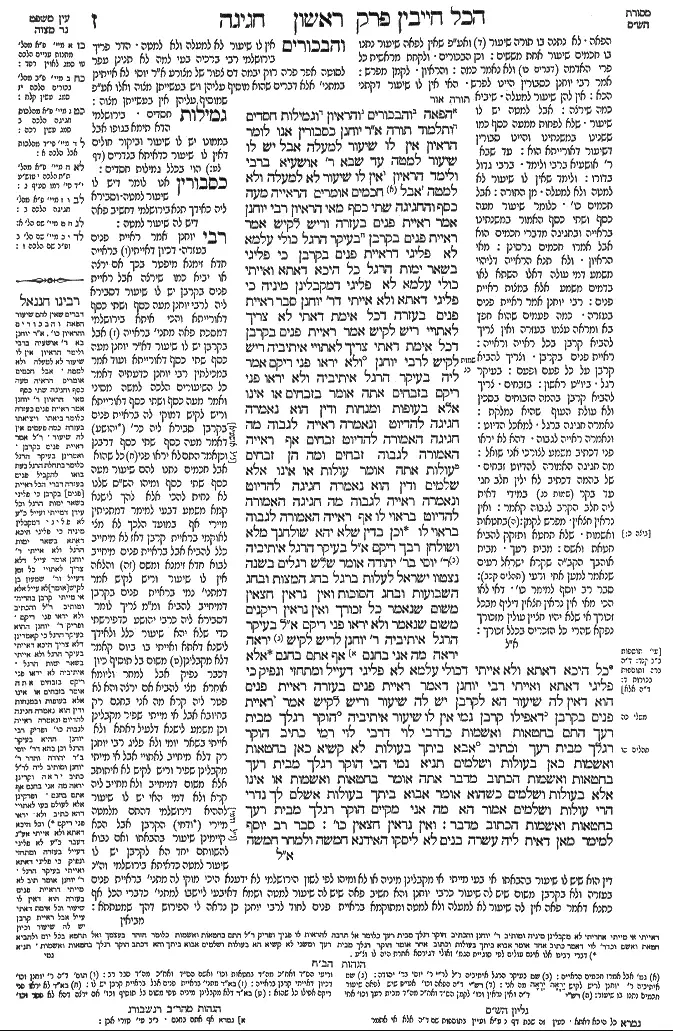
Hagigah 7a - Guemara
הפאה והבכורים והראיון וגמילות חסדים ותלמוד תורה א"ר יוחנן כסבורין אנו לומר הראיון אין לו שיעור למעלה אבל יש לו שיעור למטה עד שבא ר' אושעיא ברבי ולימד הראיון אין לו שיעור לא למעלה ולא למטה אבל חכמים אומרים הראייה מעה כסף והחגיגה שתי כסף מאי הראיון רבי יוחנן אמר ראיית פנים בעזרה וריש לקיש אמר ראיית פנים בקרבן בעיקר הרגל כולי עלמא לא פליגי דראיית פנים בקרבן כי פליגי בשאר ימות הרגל כל היכא דאתא ואייתי כולי עלמא לא פליגי דמקבלינן מיניה כי פליגי דאתא ולא אייתי דר' יוחנן סבר ראיית פנים בעזרה דכל אימת דאתי לא צריך לאתויי ריש לקיש אמר ראיית פנים בקרבן דכל אימת דאתי צריך לאתויי איתיביה ריש לקיש לרבי יוחנן (שמות כג, טו) ולא יראו פני ריקם אמר ליה בעיקר הרגל איתיביה ולא יראו פני ריקם בזבחים אתה אומר בזבחים או אינו אלא בעופות ומנחות ודין הוא נאמרה חגיגה להדיוט ונאמרה ראייה לגבוה מה חגיגה האמורה להדיוט זבחים אף ראייה האמורה לגבוה זבחים ומה הן זבחים עולות אתה אומר עולות או אינו אלא שלמים ודין הוא נאמרה חגיגה להדיוט ונאמרה ראייה לגבוה מה חגיגה האמורה להדיוט בראוי לו אף ראייה האמורה לגבוה בראוי לו וכן בדין שלא יהא שולחנך מלא ושולחן רבך ריקם א"ל בעיקר הרגל איתיביה ר' יוסי בר' יהודה אומר שלש רגלים בשנה נצטוו ישראל לעלות ברגל בחג המצות ובחג השבועות ובחג הסוכות ואין נראין חצאין משום שנאמר כל זכורך ואין נראין ריקנים משום שנאמר ולא יראו פני ריקם א"ל בעיקר הרגל איתיביה ר' יוחנן לריש לקיש יראה יראה מה אני בחנם אף אתם בחנם אלא כל היכא דאתא ולא אייתי דכולי עלמא לא פליגי דעייל ומתחזי ונפיק כי פליגי דאתא ואייתי רבי יוחנן דאמר ראיית פנים בעזרה ראיית פנים הוא דאין לה שיעור הא לקרבן יש לה שיעור וריש לקיש אמר ראיית פנים בקרבן דאפילו קרבן נמי אין לו שיעור איתיביה (משלי כה, יז) הוקר רגלך מבית רעך התם בחטאות ואשמות כדרבי לוי דרבי לוי רמי כתיב הוקר רגלך מבית רעך וכתיב (תהלים סו, יג) אבא ביתך בעולות לא קשיא כאן בחטאות ואשמות כאן בעולות ושלמים תניא נמי הכי הוקר רגלך מבית רעך בחטאות ואשמות הכתוב מדבר אתה אומר בחטאות ואשמות או אינו אלא בעולות ושלמים כשהוא אומר אבוא ביתך בעולות אשלם לך נדרי הרי עולות ושלמים אמור הא מה אני מקיים הוקר רגלך מבית רעך בחטאות ואשמות הכתוב מדבר:
ואין נראין חצאין כו':
סבר רב יוסף למימר מאן דאית ליה עשרה בנים לא ליסקו האידנא חמשה ולמחר חמשה
Comments from Rashi on Masechet Hagigah Page 7a
הפאה . לא נתנה בו תורה שיעור ואע"פ שאין לפאה שיעור נתנו בו חכמים שיעור אחת מששים: וכן הבכורים . ולקחת מראשית כל פרי האדמה (דברים כו) ולא נאמר כמה: והראיון . לקמן מפרש: אמר רבי יוחנן כסבורין היינו לפרש . האי אין לו שיעור דקתני הכא: אין להן שיעור למעלה . שיביא כמה שירצה: אבל למטה יש לו שיעור . שלא לפחות ממעה כסף כמו ששנינו במשנתינו והיינו סבורין דשיעור דאורייתא הוא: עד שבא ר' אושעיא ברבי ולימד . ברבי גדול בדורו: ולימד שאין לו שיעור לא למטה ולא למעלה . מן התורה: אבל חכמים כו' . כלומר שיעור מעה כסף ושתי כסף האמור במשנתינו בראייה ובחגיגה מדברי חכמים הוא אבל אמרו חכמים גרסינן: מאי הראיון . ולא תנא הראייה דליהוי משמע דמי עולה דאלו השתא לאו בדמים משמע אלא במצות ראיית פנים: רבי יוחנן אמר ראיית פנים בעזרה . כמה פעמים שהוא חפץ בא ומראה עצמו בעזרה ואין צריך להביא קרבן בכל ראייה וראייה: ראיית פנים בקרבן . וצריך להביא קרבן על כל פעם ופעם: בעיקר רגל . ביו"ט ראשון: בזבחים . צריך להביא קרבן בהמה הזבוחים בסכין ולא עולת העוף שהיא נמלקת: נאמרה חגיגה ברגל . למאכל הדיוט: ונאמרה ראייה לגבוה . דהא לא יראו פני דכתיב משמע לצורכי אני שואל: מה חגיגה האמורה להדיוט זבחים . של בהמה דכתיב לא ילין חלב חגי עד בקר (שמות כג) במידי דאית ליה חלב הקרב לגבוה קאמר: ואין נראין חצאין . מפרש לקמן: בחטאות ואשמות . שלא תחטא ותזקק להביא חטאת ואשם: מבית רעך . מבית אוהבך הקב"ה שקרא ישראל רעים שנאמר למען אחי ורעי (תהלים קכב): סבר רב יוסף למימר כו' . דאי לאו הכי מאי אין נראין חצאין דיליף מבכל זכורך אי שלא יהיו חציין עולין מזכורך נפקא שהרי כל הזכרים בכלל זכורך:
Comments from Tosafot - Hagigah 7a
והבכורים אין לו שיעור לא למעלה ולא למטה. הדר פריך בירושלמי רבי ברכיה בעי למה לא תנינן עפר לסוטה אפר פרה רוק יבמה דם צפור של מצורע א"ר יוסי לא אייתינן במתני' אלא דברים שהוא מוסיף עליהן ויש בעשייתן מצוה ואלו אע"פ שמוסיף עליהן אין בעשייתן מצוה: גמילות חסדים. בירושלמי הדא תימא בגופו אבל בממונו יש לו שיעור וביקור חולים דאין לו שיעור כדאיתא בנדרים (דף לט:) הוי בכלל גמילות חסדים: כסבורין אנו לומר דיש לו שיעור למטה. וסבירא ליה כאידך תנא בירושלמי דחשיב פאה דיש לה שיעור למטה: רבי יוחנן אמר ראיית פנים בעזרה. דכיון דאייתי בראייה חדא זימנא מיפטר בכך אם ירצה או יביא כמו שירצה אבל ראיית פנים בקרבן יש לו שיעור דסבירא ליה לרבי יוחנן מעה כסף ושתי כסף דאורייתא והכי איתא בירושלמי דמסכת פאה מתני' בראייה אבל בקרבן יש לו שיעור דא"ר יוחנן מעה כסף שתי כסף דאורייתא ועוד אמר במכילתין רבי יוחנן כדעתיה דאמר כל השיעורים הלכה למשה מסיני ואמר מעה כסף ושתי כסף דאורייתא וריש לקיש דמוקי לה בראיית פנים בקרבן סבירא ליה כר' (יהושע) דאמר מעה כסף שתי כסף דרבנן וכן אמר התם לא יראו פני כל שהוא אבל חכמים נתנו להם שיעור מעה כסף שתי כסף ומיהו הש"ס שלנו לא נחית להכי אלא להך לישנא קמא משמע דבעי למימר דמתניתין מיירי אף במועד הלכך לא מצי לאוקמי בראיית קרבן דאז לא מיחייב כלל להביא אבל בראיית פנים מיחייב לבוא חדא זימנא ומשם (זה) והלאה אין לו שיעור וריש לקיש אמר דמתני' נמי בראיית פנים בקרבן דמיחייב להביא ומ"מ צריך לומר דסבירא ליה כרבי יהושע כדפירשתי כדי שלא יהא שיעור כלל ולאידך לישנא דאתא ואייתי בו ביום קאמר דלא מקבלינן משום בל תוסיף כיון דכבר נפיק אבל למחר וליומא אוחרא מצי להביא אם ירצה והא לא פטר ליה קרא מה אני בחנם רק בחיובא אבל אי מייתי שפיר מקבלינן וכן משמע לישנא דלעיל דאתא ולא אייתי בשאר יומי ולא פליג רבי יוחנן רק דלא מיחייב לאתויי אבל אי מייתי מקבלינן שפיר וריש לקיש לא איתותב אלא משום דמיחייב ולא מחייב ליה קרא ולא דמי האי יש לו שיעור לההיא דירושלמי דהתם מלמטה מיירי (ודחי) הקרבן אבל הכא קיימינן שיעור בהבאתו ואם נבוא להשוותם יחד הא לקרבן יש לו שיעור למטה כדאיתא בירושלמי וה"נ דין הוא שיש לו שיעור בהבאתו אי בעי מייתי אי מקבלינן מיניה או לא ומיהו לפי לשון הירושלמי לא ידענא היכי מוקי לה מתני' בראיית פנים בעזרה ולא בקרבן משום שיש לה שיעור כרבי יוחנן והא חשיב פאה שיש לה שיעור למטה ושמא דאיבעי ליישבו למתני' כדברי הכל אף כתנא דאמר פאה אין לה שיעור לא למעלה ולא למטה ומתוקמא בראיית פנים לחוד לרבי יוחנן כן נראה לי הפירוש דהך שמעתתא:
Hagigah 7a - Mishnah translated into english
Produce in the corner of the field that must be left unharvested, which is given to the poor [pe’a]; and the first fruits, which are brought to the Temple; and the appearance in the Temple on the pilgrim Festivals; and acts of loving-kindness; and Torah study.
Rabbi Yoḥanan said: We thought to say that the mitzva of appearance in the Temple does not have a maximum measure, but it does have a minimum measure; until Rabbi Oshaya the Distinguished came and taught: The mitzva of appearance has neither a maximum nor a minimum measure. However, the Rabbis say: The burnt-offering of appearance must be worth one silver ma’a and the Festival peace-offering two silver coins.
§ What is the mitzva of appearance to which this mishna is referring? Rabbi Yoḥanan said: It is the mitzva of the appearance of one’s face in the Temple courtyard. One may appear in the Temple as often as he likes over the course of a Festival. And Reish Lakish said: It is the appearance of one’s face in the Temple with an offering. There is no measure in this regard, as every time one appears in the Temple during a Festival he must bring an offering.
The Gemara explains: On the main i.e., on the first, day of the pilgrimage Festival, everyone agrees that the appearance of one’s face must be accompanied by an offering. When they disagree, it is with regard to the rest of the days of the pilgrimage Festival, i.e., whether or not one who appears must sacrifice an offering. Furthermore, anywhere, i.e., in any case that one comes and brings an offering, everyone agrees that we accept it from him. When they disagree, it is when he comes and does not bring an offering. Is this man obligated to bring an offering or not?
The Gemara explains that Rabbi Yoḥanan holds that the mitzva is merely the appearance of one’s face in the Temple courtyard. Therefore, one doesn’t need to bring an offering whenever he comes to the Temple. Reish Lakish said that the mitzva is the appearance of one’s face with an offering, which means that whenever one comes he must bring an offering with him.
Reish Lakish raised an objection to the opinion of Rabbi Yoḥanan. The verse states: “Three times you shall keep a feast for Me in the year…and none shall appear before Me empty-handed” (Exodus 23:14–15). This verse indicates that one must bring an offering whenever he appears in the Temple. Rabbi Yoḥanan said to him: That obligation applies only on the main day of the pilgrimage Festival, but not on the rest of the Festival days.
Reish Lakish raised an objection to the opinion of Rabbi Yoḥanan from a baraita: “And none shall appear before Me empty-handed.” This teaches that Festival pilgrims must appear with animal offerings. Do you say that they must appear with animal offerings, or perhaps it is only with bird-offerings or meal-offerings? And it is possible to determine the answer by logical derivation: It is stated that one must bring a Festival peace-offering for a commoner to eat, and it is stated that one must bring a burnt-offering of appearance, which is for God. Just as the Festival peace-offering that is stated for a commoner is referring to animal offerings, so too, the burnt-offering of appearance that is stated to be sacrificed wholly for God is referring to animal offerings.
And what are these animal offerings that the Festival pilgrims sacrifice to God? Burnt-offerings. Do you say that they are burnt-offerings, or perhaps it is only that they are peace-offerings? And it is possible to determine the answer by logical derivation: It is stated that one must bring a Festival peace-offering for a commoner, and it is stated that one must bring a burnt-offering of appearance, which is solely for God. Just as the Festival peace-offering that is stated for a commoner is referring to an offering that is fitting for him to eat, i.e., a peace-offering, so too, the burnt-offering of appearance that is stated to be for God is referring to an offering that is fitting for Him, i.e., a burnt-offering, which is entirely consumed on the altar.
And similarly, one can learn by logical derivation that your table should not be full of meat while your Master’s table, i.e., the altar, is empty. This indicates that one must sacrifice a burnt-offering whenever one appears in the Temple, which contradicts the opinion of Rabbi Yoḥanan. Rabbi Yoḥanan again said to him: This obligation applies only on the main day of the pilgrimage Festival.
Reish Lakish raised another objection to the opinion of Rabbi Yoḥanan. Rabbi Yosei, son of Rabbi Yehuda, says: Three times a year the Jewish people were commanded to ascend on the pilgrimage Festival: On Passover, on Shavuot, and on Sukkot. They may not appear partially, i.e., only some of the people, because it is stated: “All your males” (Exodus 23:17). And they may not appear empty-handed, because it is stated: “And none shall appear before Me empty-handed” (Exodus 23:15). Rabbi Yoḥanan said to him: That too is referring to the main day of the pilgrimage Festival.
Rabbi Yoḥanan raised an objection to the opinion of Reish Lakish from a baraita: The verse states: “All your males shall appear.” Although the verse as written can be read: “Will see [yireh],” it is actually read: “Shall be seen [yera’e].” The baraita derives that just as I, God, come to see you for free, as He has no obligation to bring an offering when He comes to see us in the Temple, so too, you may come to see Me in the Temple for free, i.e., there is no requirement to bring an offering. The Gemara accepts this objection and therefore proceeds to explain the dispute between Rabbi Yoḥanan and Reish Lakish in a different manner.
Rather, with regard to anywhere that one comes to the Temple courtyard after the initial time on the first day of the Festival and he does not bring an offering, everyone agrees that one enters, appears, and exits without having to bring an offering. When they disagree it is in a case where one comes and brings an offering.
The Gemara explains: Rabbi Yoḥanan, who says that the appearance mentioned in the mishna is referring to the appearance of one’s face in the Temple courtyard, maintains that it is this appearance itself that has no maximum measure, i.e., one may appear as often as he wishes without an offering. However, there is a maximum measure, i.e., a limited number of offerings, that one may bring; only one burnt-offering of appearance per Festival. And Reish Lakish said: The appearance of one’s face means with an offering, as even offerings have no maximum measure. One may bring as many offerings during the Festival as he wishes.
Rabbi Yoḥanan raised an objection to the opinion of Reish Lakish: “Let your foot be seldom in your neighbor’s house, lest he be sated with you, and hate you” (Proverbs 25:17). It can be inferred from this verse that one should not bring extra gifts, i.e., offerings, to God. The Gemara responds: There, the verse is referring to sin-offerings and guilt-offerings, i.e., it is better not to sin in the first place.
This explanation is in accordance with the opinion of Rabbi Levi, as Rabbi Levi raised a contradiction between two verses. It is written: “Let your foot be seldom in your neighbor’s house,” and it is written: “I will come into Your house with burnt-offerings, I will perform for You my vows” (Psalms 66:13). Rabbi Levi explained: This is not difficult; here, the verse is referring to sin-offerings and guilt-offerings, and there, it is referring to burnt-offerings and peace-offerings, concerning which one may bring as many as he likes.
That opinion is also taught in a baraita: “Let your foot be seldom in your neighbor’s house.” The verse is speaking of sin-offerings and guilt-offerings. Do you say it is referring to sin-offerings and guilt-offerings, or perhaps it is only referring to burnt-offerings and peace-offerings? When it says: “I will come into Your house with burnt-offerings, I will perform for You my vows,” burnt-offerings and peace-offerings are mentioned, as these are more pleasant to sacrifice to God. How then do I uphold the meaning of the verse: “Let your foot be seldom in your neighbor’s house”? The verse is speaking of sin-offerings and guilt-offerings.
§ Earlier the baraita taught: The people may not appear partially, as the verse states: “All your males” (Exodus 23:17). Rav Yosef thought to say: One who has ten sons should not let five ascend now and the other five tomorrow. Rather, they must all ascend to the Temple together.
Traduction : The William Davidson digital edition of the Koren Noé Talmud, with commentary by Rabbi Adin Even-Israel Steinsaltz.
Hagigah 7a : Significance
Next step
Finished studying Hagigah 7a? Carry on with the rest of the tractate.
Study Hagigah 7bFrequently asked questions: Hagigah 7a
Where is Hagigah 7a in tractate Hagigah?
Hagigah 7a is page 11 of 51 in tractate Hagigah (Seder Moed).
When is daf 7 of Hagigah studied in Daf Yomi?
Daf Yomi covers one daf a day, both sides. Daf 7 of Hagigah will be studied on July 20, 2029.
Is there a video class on Hagigah 7a?
Yes, by Rabbi Dr. Moshe Weisblum. These classes were published on YouTube by their authors and are gathered on this site.
What is tractate Hagigah about?
The Masechet Haguiga is the twelfth and final tractate of the Seder Moed. The Gemara Haguiga is the study of the three pilgrimage festivals (Passover, Shavuot, Sukkot). The Haguiga tractate is a very short gemara, only 27 pages.
Your study is also dedicated to them
- L'ilui Nishmat Jacques Isaac Ben Amram Loubaton
- L'ilui Nishmat Nissim ben Barukh Malka
- L'ilui Nishmat אסתר בת חיים