 Talmud Bavli
Temurah 21a : Youtube
Rabbi Dr. Moshe WeisblumYoutube
1 video class :
Temurah Page 21a
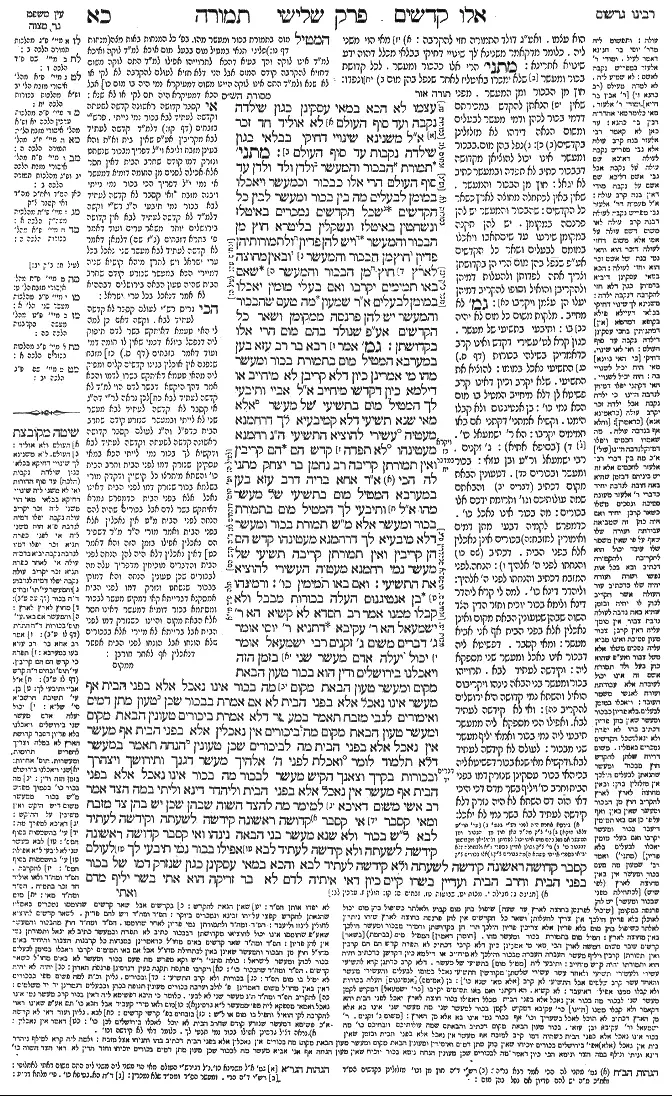
Temurah 21a - Guemara
עצמו לא הכא במאי עסקינן כגון שילדה נקבה ועד סוף העולם לא אוליד חד זכר א"ל משנינא שינויי דחיקי בבלאי כגון שילדה נקבות עד סוף העולם מתני׳ תמורת הבכור והמעשר ולדן ולד ולדן עד סוף העולם הרי אלו כבכור וכמעשר ויאכלו במומן לבעלים מה בין בכור ומעשר לבין כל הקדשים שכל הקדשים נמכרים באיטלז ונשחטין באיטלז ונשקלין בליטרא חוץ מן הבכור והמעשר ויש להן פדיון ולתמורותיהן פדיון חוץ מן הבכור והמעשר ובאין מחוצה לארץ חוץ מן הבכור והמעשר שאם באו תמימים יקרבו ואם בעלי מומין יאכלו במומן לבעלים א"ר שמעון מה טעם שהבכור והמעשר יש להן פרנסה ממקומן ושאר כל הקדשים אע"פ שנולד בהם מום הרי אלו בקדושתן גמ׳ אמר רבא בר רב עזא בען במערבא המטיל מום בתמורת בכור ומעשר מהו מי אמרינן כיון דלא קריבן לא מיחייב או דילמא כיון דקדשו מיחייב א"ל אביי ותיבעי לך המטיל מום בתשיעי של מעשר אלא מאי שנא תשיעי דלא קמיבעיא לך דרחמנא מעטיה (ויקרא כז, לב) עשירי להוציא התשיעי ה"נ רחמנא מעטינהו (במדבר יח, יז) לא תפדה קדש הם הם קריבין ואין תמורתן קריבה רב נחמן בר יצחק מתני לה הכי א"ר אחא בריה דרב עזא בען במערבא המטיל מום בתשיעי של מעשר מהו א"ל ותיבעי לך המטיל מום בתמורת בכור ומעשר אלא מ"ש תמורת בכור ומעשר דלא מיבעיא לך דרחמנא מעטינהו קדש הם הן קריבין ואין תמורתן קריבה תשיעי של מעשר נמי רחמנא מעטיה העשירי להוציא את התשיעי ואם באו תמימין כו' ורמינהו בן אנטיגנוס העלה בכורות מבבל ולא קבלו ממנו אמר רב חסדא לא קשיא הא ר' ישמעאל הא ר' עקיבא דתניא ר' יוסי אומר ג' דברים משום ג' זקנים רבי ישמעאל אומר יכול יעלה אדם מעשר שני בזמן הזה ויאכלנו בירושלים ודין הוא בכור טעון הבאת מקום ומעשר טעון הבאת מקום מה בכור אינו נאכל אלא בפני הבית אף מעשר אינו נאכל אלא בפני הבית לא אם אמרת בבכור שכן טעון מתן דמים ואימורים לגבי מזבח תאמר במעשר דלא אמרת ביכורים טעונין הבאת מקום ומעשר טעון הבאת מקום מה ביכורים אין נאכלין אלא בפני הבית אף מעשר אין נאכל אלא בפני הבית מה לביכורים שכן טעונין הנחה תאמר במעשר דלא תלמוד לומר (דברים יד, כג) ואכלת לפני ה' אלהיך מעשר דגנך ותירושך ויצהרך ובכורות בקרך וצאנך הקיש מעשר לבכור מה בכור אינו נאכל אלא בפני הבית אף מעשר אין נאכל אלא בפני הבית וליהדר דינא וליתי במה הצד אמר רב אשי משום דאיכא למימר מה להצד השוה שבהן שכן יש בהן צד מזבח ומאי קסבר אי קסבר קדושה ראשונה קידשה לשעתה וקידשה לעתיד לבא ל"ש בכור ולא שנא מעשר בני הבאה נינהו ואי קסבר קדושה ראשונה קידשה לשעתה ולא קידשה לעתיד לבא אפילו בכור נמי תיבעי לך לעולם קסבר קדושה ראשונה קידשה לשעתה ולא קידשה לעתיד לבא והכא במאי עסקינן כגון שנזרק דמו של בכור בפני הבית וחרב הבית ועדיין בשרו קיים כיון דאי איתיה לדם לא בר זריקה הוא אתי בשר יליף מדם
Comments from Rashi on Masechet Temurah Page 21a
הוא עצמו . ואע"ג דולד התמורה חזי להקרבה: מאי הוי משני ליה . כלומר מדקאמר משנינא לך שינויי דחיקי בבלאי מכלל דהוה ידע שינויא אחרינא: מתני' הרי אלו כבכור ומעשר . לכל קדושת בכור ומעשר שלא ימכרו באיטליז לאחר שנפל בהן מום ונפדו: חוץ מן הבכור ומן המעשר . מפני שאין הנאתן להקדש במכירתם דדמי בכור לכהן ודמי מעשר לבעלים ומשום הנאה דידהו לא מזלזלינן בקדשים: נפל בהן מום בבכור ומעשר אינו יכול להוציאן מקדושה דבבכור כתיב לא תפדה ובמעשר כתיב לא יגאל: חוץ מן הבכור והמעשר . שאין באין לכתחלה מחוצה לארץ כשאר כל הקדשים: שהבכור והמעשר יש להן פרנסה במקומן . יש להן תקנה במקומן שירעו עד שיסתאבו ויאכלו במומם לבעלים ושאר כל הקדשים אע"פ שנפל בהן מום הרי הן בקדושתן וצריך אתה לפדותן ולהעלות דמיהן ולהקריבן והואיל וסופו להקריב דמיהן יעלו הן עצמן ויקרבו: גמ' לא מחייב . מלקות משום כל מום לא יהיה בו: ותיבעי בתשיעי של מעשר . כגון קרא לט' עשירי דקדש ואינו קרב כדאמרינן בשילהי בכורות (דף ס.) התשיעי נאכל במומו: להוציא את התשיעי . שלא יקרב וכיון דאינו קרב פשיטא לן דלא מיחייב המטיל בו מום הכא נמי כו': בן אנטיגנוס ולא קבלו הימנו . וקשיא אמתני' דקתני אם באו תמימים יקרבו: הא ר' ישמעאל כו' . (בסיפא אתיא): ג' זקנים . רבי ישמעאל ור"ע ובן עזאי: בכור ומעשר ובכורים דטעונין הבאת מקום דכתיב (דברים יב) והבאתם שמה עולותיכם וגו' ותרומת ידכם אלו בכורים: מה בכור אינו נאכל כו' . כדמפרש לקמיה דבעי מתן דמים ואימורין למזבח: בכורים אינן נאכלין אלא בפני הבית . דכתיב (שם כו) והנחתו לפני ה' אלהיך: הנחה . לפני המזבח דכתיב והנחתו לפני ה' אלהיך: וליהדר דינא כו' . למה לי קרא ליהדר דינא ולימא בכור יוכיח וחזר הדין הצד השוה שבהן שטעונין הבאת מקום ואינן נאכלין אלא בפני הבית אף אני אביא מעשר: ומאי קסבר . דפשיטא ליה דבכור אינו נאכל ומעשר שני מספקא ליה: וקידשה לעתיד לבא . תרוייהו בכור ומעשר בני הבאה נינהו ויקריבום הואיל והשתא נמי קדושה היא ירושלים להקריב: ואי לא קידשה לעתיד לבא . ואפילו הכי מספקא ליה ממעשר תיבעי ליה נמי בכור ואמאי יליף מעשר שני מבכור: לעולם לא קידשה לעתיד לבא . ודקשיא מאי שנא בכור דפשיטא ליה בכי האי בכור עסקינן שנזרק דמו בפני הבית וחרב כו' ויליף בשר מדם דכי היכי דאי הוה דם השתא לא היה נזרק דלא קידשה לעתיד לבא בשר נמי לא יאכל:
Comments from Tosafot - Temurah 21a
המטיל מום בתמורת בכור ומעשר מהו . בפ' כל המנחות באות מצה (מנחות דף נו:) פליגי תנאי במטיל מום בבעל מום איכא למ"ד לוקה ואיכא למ"ד אינו לוקה והך בעיא דהכא לתרוייהו אפילו למ"ד התם לוקה משום דחזיא להקרבה קודם המום אבל הני דלא חזיא לעולם להקרבה לא לקי או לא שנא ולמ"ד התם אינו לוקה היינו משום דמעיקרא נמי היה בו מום אבל הכא דמעיקרא היה תם לקי או לא שנא: אי קסבר קדושה ראשונה קדשה לשעתה וקדשה לעתיד לבא בכור נמי נייתי . פרש"י בזבחים (דף קז:) דלמ"ד קדשה לעתיד לבא מקריבין אע"פ שאין בית וא"ת והא בעינן מזבח וליכא וי"ל דפריך מבכור שנשחט ונזרק דמו קודם שחרב הבית דאין חסר אלא אכילה לפנים מן החומה דומיא דמעשר אי נמי י"ל דפריך הכי בכור נמי נייתי ויבנה מזבח ואי קסבר לא קדשה לעתיד לבא בכור נמי תיבעי ה"ג רש"י וקשה דלמ"ד לא קדשה לעתיד לבא אין קדושה בירושלים יותר משאר ערים ועוד דאמר פ' בתרא דזבחים (ג"ז שם) דלמאן דאמר לא קדשה לעתיד לבא מעשר שני נאכל בכל ערי ישראל ויש לתרץ מיהא קושיא שניה דמיירי הכא במעשר שנזרע קודם שחרב הבית שהיה טעון הבאה בירושלים דבההיא לא אמר דנאכל בכל ערי ישראל: הכי גריס רש"י לעולם קסבר לא קדשה לעתיד לבא . וקשה דאם כן למה לי האי טעמא דאיתקש בשר לדם תיפוק ליה דנפסל ביוצא דכמי שאין לו חומה דמי ועוד דאמר בזבחים (דף ס.) מזבח שנפגם אין אוכלין בגינו קדשים קלים ומפיק ליה מהאי טעמא דאיתקש בשרו לדמו והכא אמר דהך היקשא דבשר לדם הוי למ"ד לא קדשה לעתיד לבא לכן נראה לר"י דה"ג אי קסבר לא קדשה לעתיד לבא מעשר שני לא לייתי ובמעשר שנזרע קודם שחרב הבית כדפ"ל וה"ג לעולם קסבר קדושה ראשונה קדשה לשעתה וקדשה לעתיד לבא ודקשיא לך בכור נמי לייתי הכא במאי עסקינן שנזרק דמו לפני הבית וחרב הבית כו' והשתא מיתרצו כל קושיין ודקדק מורי בשלמא בכור שנזרק דמו לפני הבית דאינו נאכל אלא בפני הבית כדמפרש גמרא דאיתקש בשר לדם אבל בכורים שהיה להם הנחה לפני הבית מ"ט אין נאכלין אלא בפני הבית ואמר מורי ה"ר מ"ר דשפיר הם נאכלין אפילו בזמן הזה והא דאמר דאין נאכלין דלא היה להן הנחה לפני הבית והדברים מוכיחין מדפריך עלה מה לבכורים שכן טעונין הנחה והא דמוקי בבכור שנשחט ונזרק דמו לפני הבית אמסקנא דברייתא קאי דמקיש מעשר לבכור ומסתמא בכור דומיא דמעשר דאינו חסר אלא הבאת מקום והיינו כשנזרק דמו לפני הבית אבל ברייתא לא מיירי אלא בבכורים שלא הונחו אבל הונחו לפני הבית אפשר דנאכלין אף לאחר חורבן:
Temurah 21a - Mishnah translated into english
but the offspring itself is not sacrificed as a burnt offering. Rabbi Avin bar Kahana responds: What are we dealing with here? It is a case where the female designated as a guilt offering or as the substitute of a guilt offering gave birth to a female, which cannot itself be offered as a guilt offering. Rabbi Avin bar Ḥiyya asks: This is problematic, as the mishna states that the same is true with regard to the offspring of its offspring until the end of time. But could the mishna be referring to a case where until the end of time not even one male was born? Rabbi Avin bar Kahana said to him in response: I answer forced answers, in the manner of the Babylonians, and say that the mishna is referring to a case where it gave birth to females, and those females also gave birth to females, until the end of time.
MISHNA: With regard to the substitute of a firstborn offering and the substitute of an animal tithe offering, and the offspring of those substitutes and the offspring of their offspring until the end of time, the halakhic status of these animals is like that of a firstborn offering and like that of an animal tithe offering in that they must be treated with sanctity: They graze until they become blemished, and at that point they may be eaten in their blemished state, the substitute of the firstborn by the priests and the substitute of the animal tithe by their owners. They are not sacrificed upon the altar like the original firstborn and animal tithe offerings.
What is the practical difference between a firstborn offering and an animal tithe offering and all the other sacrificial animals? The difference is that all the other sacrificial animals that were blemished and redeemed are sold in the butchers’ market [ba’itliz], and slaughtered in the butchers’ market, and weighed and sold by the litra, in the manner that non-sacred meat is slaughtered and sold. This is the case with regard to all consecrated animals except for the firstborn and animal tithe offerings, which are sold only from the home and not by the litra.
And in addition, all sacrificial animals that became blemished are subject to redemption through sale, at which point the money becomes sacred and the animal becomes non-sacred, and their substitutes are also subject to redemption through sale.This is true for all consecrated animals, except for the firstborn and animal tithe offerings, which are not subject to redemption. And all sacrificial animals come to be sacrificed in the Temple even from outside of Eretz Yisrael, except for the firstborn and animal tithe offerings, which should not be brought from outside Eretz Yisrael ab initio. But if they came unblemished, they are sacrificed in the Temple like a regular firstborn or animal tithe offering coming from Eretz Yisrael; and if they are blemished animals, they may be eaten in their blemished state, the firstborns by the priests and the animal tithes by their owners.
Rabbi Shimon says: What is the reason for this last difference between them? It is that the firstborn and animal tithe offerings have a remedy in their place outside Eretz Yisrael, as they can graze until they become blemished and then can be eaten there. It is not necessary to bring them to Eretz Yisrael in order to eat them. But with regard to all other sacrificial animals, even if a blemish develops in them, these animals remain in their sanctity, and one must redeem them and bring another offering with the money of their redemption. Therefore, when they are unblemished it is proper to bring these animals themselves to Eretz Yisrael.
GEMARA: With regard to the status of the substitute of firstborn and animal tithe offerings that was discussed in the mishna, Rava bar Rav Azza said that they inquired in the West, Eretz Yisrael: What is the halakha with regard to one who inflicts a blemish on the substitute of a firstborn offering or on the substitute of an animal tithe offering? Do we say that since they are not sacrificed on the altar like the actual firstborn or animal tithe offering, one who does this is not liable, as the prohibition against inflicting a blemish on a sacrificial animal applies only when one thereby disqualifies the animal from the altar, and that is not the case here; or perhaps since they are sanctified, he is liable for inflicting a blemish?
Abaye said to Rava bar Rav Azza: And let the dilemma be raised in a case of one who inflicts a blemish on other sacrificial animals, such as the ninth animal counted while selecting the animal tithe offering, which was mistakenly declared to be the tenth. This animal is consecrated in that one is prohibited to work it or shear it until it becomes blemished, but it may not be sacrificed upon the altar.
Rather, what is different about the ninth animal, which one called the tenth, that you did not raise the dilemma about it? It is because the Merciful One excluded it, with the verse: “The tenth shall be holy to the Lord” (Leviticus 27:32), which serves to exclude from the altar the ninth that was mistakenly declared to be the tenth. One may derive from here that one who inflicts a blemish upon this ninth animal is not liable.
Here, too, with regard to the substitute of a firstborn, the Merciful One excluded it from the altar: “But the firstborn…you shall not redeem; they are holy” (Numbers 18:17). This indicates that they, the firstborns themselves, are sacrificed, but their substitute is not sacrificed, and it may be derived from here that one is also not liable for inflicting a blemish upon the substitute of a firstborn.
Rav Naḥman bar Yitzḥak teaches that statement in this way, in the opposite manner to the previous version: Rav Aḥa, son of Rav Azza, said that they inquired in the West, Eretz Yisrael: In the case of one who inflicts a blemish upon the ninth animal counted while selecting the animal tithe offering, what is the halakha? Abaye said to him: And let the dilemma be raised with regard to one who inflicts a blemish upon the substitute of a firstborn offering or the substitute of an animal tithe offering.
Rather, what is different about the substitute of a firstborn or the substitute of an animal tithe that you did not raise the dilemma about them? It is because the Merciful One excluded them, as it is stated: “They are holy,” which indicates that they themselves are sacrificed, but their substitutes are not sacrificed. With regard to the ninth animal counted while selecting the animal tithe as well, the Merciful One excluded it, as it is stated: “The tenth,” which serves to exclude from the altar the ninth that was mistakenly declared to be the tenth.
§ The mishna teaches that although the firstborn and animal tithe offerings should not be brought from outside Eretz Yisrael ab initio, if they came unblemished, they may be sacrificed. With regard to this issue, the Gemara raises a contradiction: There was an incident where ben Antigonus brought up firstborn animals from Babylonia in order to sacrifice them and they did not accept them in the Temple. Rav Ḥisda said: That is not difficult: This statement in the mishna is in accordance with the opinion of Rabbi Yishmael, while this case of ben Antigonus is in accordance with the opinion of Rabbi Akiva.
As it is taught in a baraita that Rabbi Akiva and Rabbi Yishmael disagreed over this matter: Rabbi Yosei says three matters in the name of three elders: Rabbi Yishmael, Rabbi Akiva, and Ben Azzai, each of whom issued a different statement with regard to a firstborn and second tithe. Rabbi Yishmael says that one might have thought that a person may bring up second tithe in the present day to Jerusalem and eat it in Jerusalem.
But the opposite conclusion should be derived through logical inference from the halakha of a firstborn: A firstborn requires that it be brought to a specific place, i.e., Jerusalem, and second tithe requires that it be brought to a specific place. Just as a firstborn is eaten only in the presence of the Temple, so too, second tithe is eaten only in the presence of the Temple. This comparison can be refuted: No, if you said that this is true with regard to a firstborn, that it may be eaten only in the presence of the Temple, as it requires placing the blood and sacrificial portions of the offering upon the altar, shall you also say that this is the case with regard to second tithe, for which this is not required?
Rather, perhaps you will say that the halakha of eating second tithe in Jerusalem in the present is derived from a comparison to first fruits: First fruits require that they be brought to a specific place, i.e., Jerusalem, and second tithe requires that they be brought to a specific place. Just as first fruits may be eaten only in the presence of the Temple, so too, second tithe may be eaten only in the presence of the Temple.
But this comparison is also flawed, as what is unique about first fruits? They are unique in that they require placement before the altar, as it is stated: “And the priest shall take the basket out of your hand, and set it down before the altar of the Lord your God” (Deuteronomy 26:4). Perhaps it is for this reason that they must be eaten in the presence of the Temple. Shall you say that this is also the case with regard to second tithe, which is not obligated in placement before the altar?
The verse states with regard to second tithe: “And you shall eat before the Lord your God in the place that He shall choose to cause His name to dwell there, the tithe of your grain, of your wine, and of your oil, and the firstborn of your cattle and sheep” (Deuteronomy 14:23). This verse compares second tithe to the firstborn: Just as a firstborn is eaten only in the presence of the Temple, so too, second tithe is eaten only in the presence of the Temple. This concludes the statement of Rabbi Yishmael.
The Gemara analyzes the opinion of Rabbi Yishmael: But let the inference return and compare second tithe to both the firstborn and first fruits together, and let the halakha of second tithe be derived by analogy from the common element [bema hatzad] of the two sources: Just as the firstborn and first fruits both require that they be brought to a specific place and are not eaten in the present time, so too, second tithe, which also requires that it must be brought to a specific place, should not be eaten in the present time.
Rav Ashi said: The halakha of second tithe cannot be derived in this manner, because it can be said: What is notable about the common element of these cases? They are notable in that they have an aspect of their halakha that involves the altar: A firstborn must have its blood and sacrificial portions placed upon the altar, and first fruits must be placed before the altar, whereas no obligation with regard to the altar applies to the second tithe at all.
According to Rabbi Yishmael, a firstborn is not eaten in the present day, but with regard to second tithe he is uncertain about the halakha. The Gemara asks: And what does he hold? If he holds that the initial consecration both sanctified Jerusalem for its time and sanctified Jerusalem forever, including the period after the destruction of the Temple, then a firstborn is no different and second tithe is no different, as both are capable of being brought to Jerusalem: In the case of the firstborn, an altar may be built upon which it may be offered, while second tithe may be eaten in Jerusalem, and the presence of the Temple is not required for either one. And if he holds that the initial consecration sanctified Jerusalem for its time but did not sanctify Jerusalem forever, and he is still uncertain about the status of second tithe, then raise the dilemma even with regard to the firstborn.
The Gemara answers: Actually, he holds that the initial consecration sanctified Jerusalem for its time but did not sanctify it forever, and here we are dealing with a case where the blood of a firstborn offering was sprinkled upon the altar before the Temple was destroyed, and then the Temple was destroyed, but its flesh was still in existence.
Since if the blood is still there and had not yet been sprinkled upon the altar, it is not subject to sprinkling, as the Temple has been destroyed, and consequently the meat of the firstborn offering may not be eaten. This halakha comes and is derived from the halakha of the blood, based upon the juxtaposition in the following verse: “You shall sprinkle their blood against the altar… and their flesh shall be yours” (Numbers 18:17–18). This teaches that the meat may be eaten only when the blood is fit to be sprinkled upon the altar. By contrast, there is no such juxtaposition with regard to second tithe, and therefore Rabbi Yishmael remains uncertain whether it may be eaten in the present time in Jerusalem.
Traduction : The William Davidson digital edition of the Koren Noé Talmud, with commentary by Rabbi Adin Even-Israel Steinsaltz.