 Talmud Bavli
Berakhot 52b : Youtube
Daf TubeYoutube
2 video classes :
Berakhot Page 52b
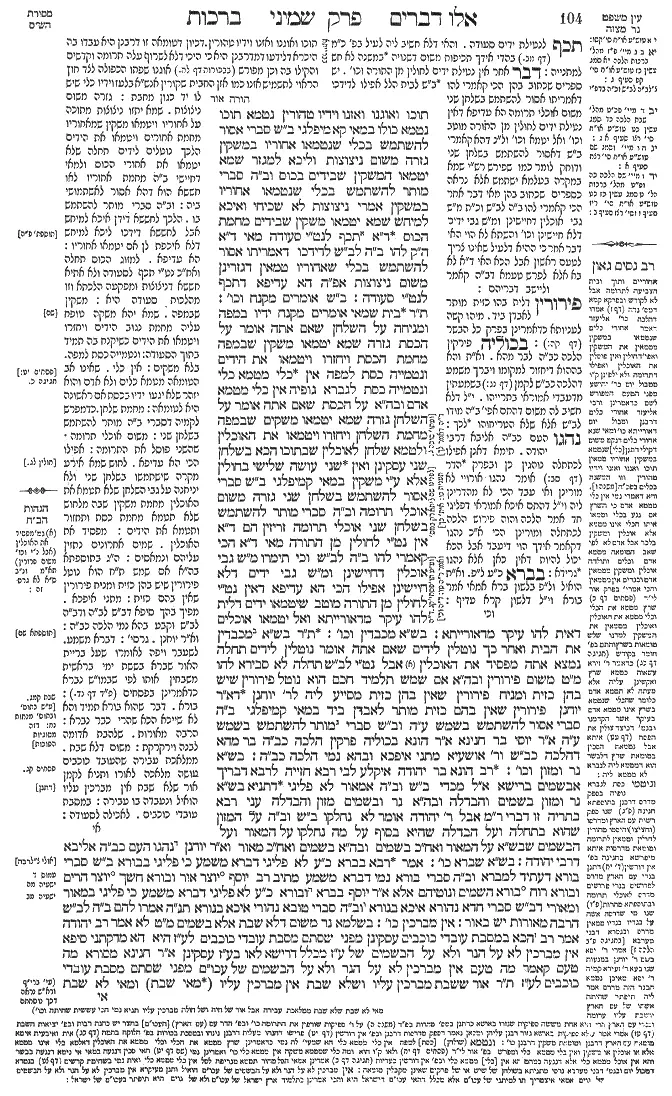
Berakhot 52b - Guemara
תוכו ואוגנו ואזנו וידיו טהורין נטמא תוכו נטמא כולו במאי קא מיפלגי בש סברי אסור להשתמש בכלי שנטמאו אחוריו במשקין גזרה משום ניצוצות וליכא למגזר שמא יטמאו המשקין שבידים בכוס ובה סברי מותר להשתמש בכלי שנטמאו אחוריו במשקין אמרי ניצוצות לא שכיחי ואיכא למיחש שמא יטמאו משקין שבידים מחמת הכוס דא תכף לנטי סעודה מאי דא הק להו בה לבש לדידכו דאמריתו אסור להשתמש בכלי שאחוריו טמאין דגזרינן משום ניצוצות אפה הא עדיפא דתכף לנטי סעודה:
בש אומרים מקנח וכו':
תר בית שמאי אומרים מקנח ידיו במפה ומניחה על השלחן שאם אתה אומר על הכסת גזרה שמא יטמאו משקין שבמפה מחמת הכסת ויחזרו ויטמאו את הידים ונטמייה כסת למפה אין כלי מטמא כלי ונטמייה כסת לגברא גופיה אין כלי מטמא אדם ובהא על הכסת שאם אתה אומר על השלחן גזרה שמא יטמאו משקים שבמפה מחמת השלחן ויחזרו ויטמאו את האוכלין ולטמא שלחן לאוכלין שבתוכו הכא בשלחן שני עסקינן ואין שני עושה שלישי בחולין אלא עי משקין במאי קמיפלגי בש סברי אסור להשתמש בשלחן שני גזרה משום אוכלי תרומה ובה סברי מותר להשתמש בשלחן שני אוכלי תרומה זריזין הם דא אין נטי לחולין מן התורה מאי דא הכי קאמרי להו בה לבש וכי תימרו מש גבי אוכלין דחיישינן ומש גבי ידים דלא חיישינן אפילו הכי הא עדיפא דאין נטי לחולין מן התורה מוטב שיטמאו ידים דלית להו עיקר מדאורייתא ואל יטמאו אוכלים דאית להו עיקר מדאורייתא:
בשא מכבדין וכו':
תר בשא מכבדין את הבית ואחר כך נוטלין לידים שאם אתה אומר נוטלין לידים תחלה נמצא אתה מפסיד את האוכלין אבל נטי לבש תחלה לא סבירא להו מט משום פירורין ובהא אם שמש תלמיד חכם הוא נוטל פירורין שיש בהן כזית ומניח פירורין שאין בהן כזית מסייע ליה לר' יוחנן דאר יוחנן פירורין שאין בהם כזית מותר לאבדן ביד במאי קמיפלגי בה סברי אסור להשתמש בשמש עה ובש סברי מותר להשתמש בשמש עה אר יוסי בר חנינא אר הונא בכוליה פרקין הלכה כבה בר מהא דהלכה כבש ור' אושעיא מתני איפכא ובהא נמי הלכה כבה:
בשא נר ומזון וכו':
רב הונא בר יהודה איקלע לבי רבא חזייה לרבא דבריך אבשמים ברישא אל מכדי בש ובה אמאור לא פליגי דתניא בשא נר ומזון בשמים והבדלה ובהא נר ובשמים מזון והבדלה עני רבא בתריה זו דברי רמ אבל ר' יהודה אומר לא נחלקו בש ובה על המזון שהוא בתחלה ועל הבדלה שהיא בסוף על מה נחלקו על המאור ועל הבשמים שבשא על המאור ואחכ בשמים ובהא בשמים ואחכ מאור ואר יוחנן נהגו העם כבה אליבא דרבי יהודה:
בשא שברא כו':
אמר רבא בברא כע לא פליגי דברא משמע כי פליגי בבורא בש סברי בורא דעתיד למברא ובה סברי בורא נמי דברא משמע מתיב רב יוסף (ישעיהו מה ז) יוצר אור ובורא חשך (עמוס ד יג) יוצר הרים ובורא רוח (ישעיהו מב ה) בורא השמים ונוטיהם אלא אר יוסף בברא ובורא כע לא פליגי דברא משמע כי פליגי במאור ומאורי דבש סברי חדא נהורא איכא בנורא ובה סברי טובא נהורי איכא בנורא תנה אמרו להם בה לבש הרבה מאורות יש באור:
אין מברכין כו':
בשלמא נר משום דלא שבת אלא בשמים מט לא אמר רב יהודה אמר רב הכא במסבת עובדי כוכבים עסקינן מפני שסתם מסבת עובדי כוכבים לעז היא הא מדקתני סיפא אין מברכין לא על הנר ולא על הבשמים של עז מכלל דרישא לאו בעז עסקינן אר חנינא מסורא מה טעם קאמר מה טעם אין מברכין לא על הנר ולא על הבשמים של עכום מפני שסתם מסבת עובדי כוכבים לעז תר אור ששבת מברכין עליו ושלא שבת אין מברכין עליו (מאי שבת) ומאי לא שבת
Comments from Rashi on Masechet Berakhot Page 52b
תוכו ואוגנו ואזנו וידיו טהורין . דכיון דטומאה זו דרבנן היא עבדו בה היכרא דלידעו דמדרבנן היא כי היכי דלא לשרוף עלה תרומה וקדשים והקילו בה וכן מפורש (בבכורות דף לח.) אוגנו שפתו הכפולה לצד חוץ הראוי לתשמיש אזנו כמו אזן החבית שקורין אנש"א בלע"ז וידיו כלי שיש לו יד כגון מחבת: גזרה משום ניצוצות . שמא יתזו ניצוצות מתוכה על אחוריו ויטמאו משקין שמאחוריו מחמת אחורים ויטמאו את הידים הלכך נוטלים לידים תחלה שלא יטמאו את אחורי הכוס ולמאי דחיישי ב"ה מחמת אחוריו לאו חששא הוא דהא אסור לאשתמושי ביה: וב"ה סברי מותר להשתמש בו . הלכך לחששא דידן איכא למיחש אבל לחששא דידכו ליכא למיחש דלא איכפת לן אם יטמאו אחוריו: הא עדיפא . למזוג הכוס תחלה ואח"כ נט"י תכף לסעודה ולא אתיא חששא דניצוצות ומפקעה הלכתא וזו מהלכות סעודה היא: משקין שבמפה . שמא יהא משקה טופח עליה מחמת נגוב הידים ויחזרו ויטמאו את הידים כשיקנח בה תמיד בתוך הסעודה: ונטמייה כסת למפה . בלא משקים: אין כלי . שאינו אב הטומאה מטמא כלים ולא אדם והוא יזהר שלא יגעו ידיו בכסת אם ראשונה היא לטומאה: מחמת שלחן . כדמפרש לקמיה דסברי ב"ה מותר להשתמש בשלחן שני: משום אוכלי תרומה . שהשני פוסל את התרומה: אפילו הכי הא עדיפא . לחוש שמא אירע מקרה שישתמשו בשלחן שני ולא יניחנה על גבי השלחן שלא תטמא את האוכלין מחמת משקין שבה מלחוש שלא תטמא מחמת כסת ותחזור ותטמא את הידים: מפסיד את האוכלין . שמים אחרונים נתזין עליהם ונמאסים: ה"ג בתוספתא בה"א אם שמש ת"ח הוא נוטל פירורין שיש בהן כזית ומניח פירורין שאין בהם כזית: מתני איפכא . מפיך בהך סיפא דב"ש לב"ה ודב"ה לב"ש וקבע בהא נמי הלכה כב"ה: וא"ר יוחנן . גרסי': דברא משמע . לשעבר ויפה לאומרו שעל בריית האור שברא בששת ימי בראשית משבחין אותו לפי שבמו"ש נברא כדאמרינן בפסחים (פ"ד דף נד.): בורא . דבר שהוא בורא תמיד והא לא שייכא הכא שהרי כבר נברא: הרבה מאורות . שלהבת אדומה לבנה וירקרקת: משום דלא שבת . ממלאכת עבירה שהעובד כוכבים עושה מלאכה לאורו ותניא לקמן אור שלא שבת אין מברכין עליו הואיל ונעבדה בו עבירה: במסבת עובדי כוכבים . לאכילה לסעודה:
Comments from Tosafot - Berakhot 52b
תכף לנטילת ידים סעודה . והאי דלא חשיב ליה לעיל בפ' כ"מ (ברכות דף מב.) בהדי אידך תכיפות משום דשנויה במשנה לא חש למתנייה: דבר אחר אין נטילת ידים לחולין מן התורה וכו' . יש ספרים שכתוב בהן הכי קאמרי להו ב"ש לבית הלל אפילו לדידכו דאמריתו אסור להשתמש בשלחן שני משום אוכלי תרומה הא עדיפא דאין נטילת ידים לחולין מן התורה מוטב וכו' ואל יטמא וכו' ול"נ דהא קאמרי ב"ש דאסור להשתמש בשלחן שני ודוחק לומר כמו שפירש רש"י שמא במקרה בעלמא ישתמש אלא נראה כספרים שכתוב בהן מאי דבר אחר הכי קאמרי להו ב"ה לב"ש וכ"ת מ"ש גבי אוכלין דחיישינן ומ"ש גבי ידים דלא חיישינן וכו' והשתא לא הוי האי דבר אחר כי ההיא דלעיל שאינו צריך לטעם ראשון אבל הכא האי ד"א לא בא אלא לפרש טעמא דב"ה קאמר וליישב דבריהם: פירורין דלית בהו כזית מותר לאבדן ביד . מיהו קשה לעניותא כדאמרינן בפרק כל הבשר (דף קה:): בכוליה פירקין הלכה כב"ה לבר מהא . וא"ת והא בההוא דיחזור למקומו ויברך משמע דהלכה כב"ש לקמן (ברכות דף נג:) בשמעתין מדעבדי אמוראי בתרייהו. י"ל דלא חשיב לה משום דהתם אפי' ב"ה מודו לב"ש אלא שלא הטריחוהו לכך: נהגו העם כב"ה אליבא דרבי יהודה . תימא דאנן אפילו לכתחלה נוהגין כן ובפרק הדר (דף סב:) אומר נהגו אורויי לא מורינן ואי עבד הכי לא מהדרינן ליה וי"ל דהתם איכא אמוראי דפליגי חד אמר הלכה והוה פירוש הלכה לכתחלה ומורינן הכי א"כ נהגו דקאמר אידך הוי דיעבד אבל הכא יכול להיות דאין כאן אלא נהגו גרידא: בברא כ"ע ל"פ . וא"ת הואיל ול"פ בלשון ברא אמאי אמר בורא וי"ל דלשון קרא עדיף:
Berakhot 52b - Mishnah translated into english
while its inner side, and its rim, the edge of the vessel that protrudes outwards, and its ear-shaped handle, and its straight handles are pure. However, if the inside of the vessel became ritually impure, it is all ritually impure.
Although the decrees of Beit Hillel and Beit Shammai are different, they are based on realistic contingencies and on concerns shared by both parties. The Gemara seeks to clarify: With regard to what do they disagree? What is the crux of their dispute?
The Gemara explains: Beit Shammai hold: It is prohibited to use a vessel the outer side of which has been rendered ritually impure by liquids. This prohibition stems from a decree of the Sages, due to concern for drips of liquid that would fall from inside the vessel to its outer side, as those drips themselves would be rendered ritually impure by virtue of their contact with the outer side of the vessel. And Beit Shammai hold that there is no reason to issue a decree due to the concern of Beit Hillel lest the liquid on one’s hands will be rendered ritually impure by the cup, as Beit Shammai hold that the use of a vessel of that kind is prohibited.
And Beit Hillel hold: One is permitted to use a vessel the outer side of which has been rendered ritually impure by liquid, as they say: Drips are uncommon, and decrees are not issued on the basis of an uncommon case. Because Beit Hillel permit the use of a vessel of that kind, there is concern lest the liquid on one’s hands will be rendered ritually impure due to the cup.
Alternatively, Beit Hillel hold that one mixes the water with the wine in the cup and then washes his hands due to the principle: Immediately after the washing of the hands comes the meal. Therefore, he mixes the water and wine in the cup, then he washes his hands, and then he immediately proceeds to the meal.
The Gemara asks: What is the point of Beit Hillel adding: Alternatively? The Gemara answers: Beit Hillel said to Beit Shammai as follows: Even according to you, who said that it is prohibited to use a vessel the outer side of which is ritually impure as we issued a decree due to concern for drips, even so, our opinion is preferable to yours, as our opinion adheres to the principle: Immediately after the washing of the hands comes the meal.
We learned in the mishna that Beit Hillel and Beit Shammai disagree over where the cloth that one used to dry his hands should be placed. Beit Shammai say: After washing, one dries his hands with a cloth and places it on the table. And Beit Hillel say: One places it on the cushion upon which he is sitting.
In a Tosefta, the Sages taught in greater detail: Beit Shammai say: After washing, one dries his hands with a cloth and places it on the table, as if you say that he should place the cloth on the cushion, there is room to issue a decree lest the liquids on the cloth, which is wet because he used it to dry his hands, become ritually impure due to their contact with the cushion, and the liquids would in turn render the hands of anyone who touches the towel ritually impure.
The Gemara asks: Even without the liquid, let the cushion render the towel ritually impure directly? The Gemara answers: There is a principle: A vessel does not render another vessel ritually impure.
The Gemara asks: Let the cushion render the man sitting upon it ritually impure. The Gemara answers: There, too, there is a general principle: A vessel does not render a person ritually impure.
And Beit Hillel say: One places it on the cushion upon which he is sitting, as if you say that he should place it on the table, there is room to issue a decree lest the liquids on the towel might be rendered ritually impure by their contact with the table, and those liquids in turn will render the food placed on the table ritually impure.
The Gemara asks: Let the table render the food upon it ritually impure directly. The Gemara explains: Here we are dealing with a table that has second degree ritual impurity status, and an object of second degree ritual impurity status can only confer third degree ritual impurity status upon non-sacred items by means of liquids. By rabbinic decree, liquids that come into contact with second degree ritual impurity assume first degree ritual impurity status and, consequently, can render non-sacred items impure.
The Gemara seeks to clarify: With regard to what do they disagree? The Gemara answers: The basis of their dispute is that Beit Shammai hold: It is prohibited to use a table that has second degree ritual impurity status for purposes of eating because of a decree due to those who eat teruma. A table with that status renders teruma ritually impure through contact. To prevent priests who partake of teruma from unwittingly eating off a table of that sort, a decree was issued prohibiting its use even with non-sacred foods.
And Beit Hillel hold: It is permitted to use a table that has second degree ritual impurity status, and we are not concerned about the priests. As those who eat teruma are vigilant and would ascertain the status of a table before eating.
Alternatively, Beit Hillel hold that there is no requirement of washing of the hands for non-sacred items by Torah law.
The Gemara asks: What is the point of Beit Hillel adding the additional reason introduced with: Alternatively? The Gemara answers: Beit Hillel said to Beit Shammai as follows: And if you say, what is the difference with regard to food that we are concerned that it might be rendered ritually impure by the cloth on the table; and what is the difference with regard to hands that we are not concerned that they might be rendered ritually impure by the cloth placed on the cushion? Beit Hillel continue: We can respond that even so, this is preferable, as there is no requirement of washing of the hands for non-sacred items by Torah law. It is preferable that hands, whose impurity has no basis in Torah law, will become ritually impure with second degree ritual impurity status, and food, whose impurity has a basis in Torah law, will not become ritually impure.
We learned in the mishna that Beit Hillel and Beit Shammai disagree over whether cleaning the place where one ate or washing one’s hands should be performed first after the meal. Beit Shammai say: One sweeps the area of the house where the meal took place and he washes his hands with the final waters thereafter. And Beit Hillel say: One washes his hands and sweeps the house thereafter.
The Sages taught in a Tosefta where this issue is discussed in greater detail: Beit Shammai say: One sweeps the area of the house where the meal took place and washes his hands thereafter, as if you say that one washes his hands first, the water is liable to splash on the remaining crumbs and you will have ruined the food. But Beit Shammai do not hold that the washing of the hands is first. What is the reason? Due to concern, lest the crumbs will be made disgusting.
And Beit Hillel say: If the attendant is a Torah scholar, he removes the crumbs that are an olive-bulk from the table at the end of the meal and leaves only crumbs that are not an olive-bulk, as food that is less than an olive-bulk is not considered food and there is no prohibition to ruin it.
This supports the opinion of Rabbi Yoḥanan, as Rabbi Yoḥanan said: Crumbs that are less than an olive-bulk in size, one may destroy them with his hand without violating the prohibition against ruining food.
Here too the Gemara poses the question: With regard to what do they disagree? The Gemara answers: The basis of their argument is that Beit Hillel hold: One is forbidden to use the services of a waiter who is an am ha’aretz. Therefore, there is no room for concern that food will be ruined as only crumbs remain on the table. And Beit Shammai hold: One is permitted to use the services of an attendant who is an am ha’aretz. Food will remain on the table and, therefore, there is room for concern that food will be ruined. The solution is to clean the food off the table and only then wash one’s hands.
Rabbi Yosei bar Ḥanina said that Rav Huna said: In our entire chapter, the halakha is in accordance with the opinion of Beit Hillel, except for this case, where the halakha is in accordance with the opinion of Beit Shammai. And Rabbi Oshaya would teach the opposite and reverse the opinions of Beit Hillel and Beit Shammai as they appear in our mishna, and in this case as well, the halakha is in accordance with the opinion of Beit Hillel.
We learned in the mishna that Beit Shammai say: One recites the blessing over the candle, then the Grace after Meals blessing, then the blessing over the spices, and finally the blessing of havdala. And Beit Hillel say: The order is candle, spices, Grace after Meals, and havdala.
The Gemara relates that Rav Huna bar Yehuda happened to come to Rava’s house. He saw that Rava recited a blessing over the spices first. Rav Huna bar Yehuda said to him: Now since Beit Hillel and Beit Shammai do not disagree with regard to the blessing over light, as we learned in our mishna that Beit Shammai say: One recites the blessing over the candle, then the Grace after Meals blessing, then the blessing over the spices, and finally the blessing of havdala. And Beit Hillel say: The order is candle, and spices, Grace after Meals, and havdala, why did you recite the blessing over the spices first?
Rava answered after him: Indeed, that is the statement of Rabbi Meir. However, Rabbi Yehuda says in a baraita that Beit Hillel and Beit Shammai neither disagree with regard to Grace after Meals that it is recited first, nor with regard to havdala, which is recited last. With regard to what do they disagree? They disagree with regard to the light and the spices. Beit Shammai say: One recites a blessing over light and over spices thereafter, and Beit Hillel say: One recites a blessing over spices and over light thereafter.
And Rabbi Yoḥanan said: The people were accustomed to conduct themselves in accordance with the opinion of Beit Hillel according to the interpretation of Rabbi Yehuda. The blessing over the spices is recited first.
The mishna cited a dispute between Beit Hillel and Beit Shammai with regard to the formula of the blessing over fire in havdala. Beit Shammai say: Who created [bara] the light of fire. And Beit Hillel say: Who creates [boreh] the lights of fire.
Regarding this, Rava says: With regard to the word bara, everyone agrees that it means created in the past. Where they disagree is with regard to the word boreh. Beit Shammai hold: Boreh means that God will create in the future, and Beit Hillel hold: Boreh also means that He has created in the past.
Rav Yosef raised an objection: How can there be a dispute over the meaning of the word boreh? In the following verses it is clear that it refers to acts of creation in the past: “Who forms light and creates [boreh] darkness” (Isaiah 45:7), “Who forms mountains and creates [boreh] wind” (Amos 4:13), or “Who creates [boreh] the heavens and stretches them out” (Isaiah 42:5). Rather, said Rav Yosef: With regard to both bara and boreh, everyone agrees that they mean created. Where they disagree is with regard to the light of the fire or the lights of the fire. As Beit Shammai hold that there is one light in a fire, and Beit Hillel hold that there are many lights in a fire, as a flame consists of red, green, and white light. That was also taught in a baraita: Beit Hillel said to Beit Shammai: There are many lights in the fire.
We learned in the mishna that one may neither recite a blessing over the candle nor over the spices of gentiles. The Gemara asks: Granted, the prohibition against the recitation of a blessing over a candle of gentiles in havdala, as the flame of the candle did not rest. Because it was burning during Shabbat, one should not recite a blessing over it at the conclusion of Shabbat. However, what is the reason that one may not recite a blessing over spices of gentiles?
Rav Yehuda said that Rav said: Here we are dealing with a party arranged by gentiles and the spices used at that party were prohibited because the parties of gentiles are generally devoted to idolatry.
The Gemara asks: But from that which was taught in the latter clause of the mishna: One may neither recite a blessing over the candle nor over the spices of idolatry, infer by implication that in the first clause of our mishna we are not dealing with idolatry? There must be a different reason why the spices of gentiles are prohibited.
Rabbi Ḥanina of Sura said: These two halakhot are complementary, and the mishna states the halakha employing the style of: What is the reason. The mishna should be understood as follows: What is the reason that one may neither recite a blessing over the candle nor over the spices of gentiles? Because the parties of gentiles are generally devoted to idolatry and one may neither recite a blessing over the candle nor over the spices of idolatry.
The Sages taught in a baraita: Over fire that rested, one may recite a blessing in havdala, and over fire that did not rest, one may not recite a blessing. The Gemara asks: What is meant by rested, and what is meant by did not rest?ב
Traduction : The William Davidson digital edition of the Koren Noé Talmud, with commentary by Rabbi Adin Even-Israel Steinsaltz.