 Talmud Bavli
The learning on the whole site is dedicated : L'ilui Nishmat אסתר בת חיים
The learning on the whole site is dedicated : For the success of Elyahou ben H'anna & family
The learning on the whole site is dedicated : L'ilui Nishmat אליעזר בן רחל
Avodah Zarah 8b : Youtube
Daf TubeYoutube
2 video classes :
Avodah Zarah Page 8b
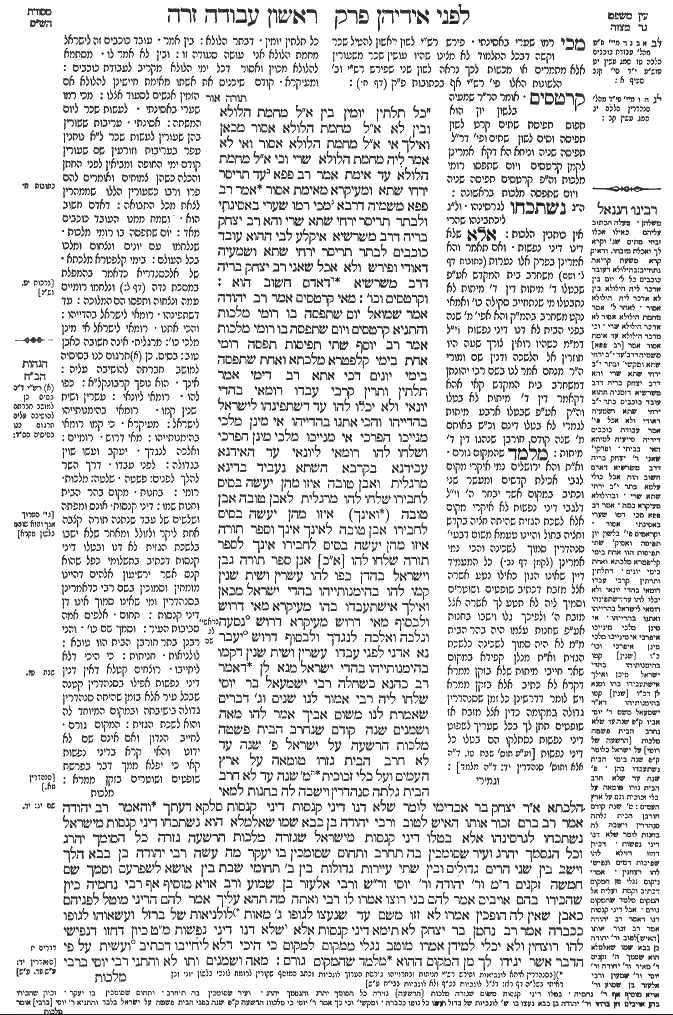
Avodah Zarah 8b - Guemara
כל תלתין יומין בין א"ל מחמת הלולא ובין לא א"ל מחמת הלולא אסור מכאן ואילך אי א"ל מחמת הלולא אסור ואי לא אמר ליה מחמת הלולא שרי וכי א"ל מחמת הלולא עד אימת אמר רב פפא עד תריסר ירחי שתא ומעיקרא מאימת אסור אמר רב פפא משמיה דרבא מכי רמו שערי באסינתי ולבתר תריסר ירחי שתא שרי והא רב יצחק בריה דרב משרשיא איקלע לבי ההוא עובד כוכבים לבתר תריסר ירחי שתא ושמעיה דאודי ופירש ולא אכל שאני רב יצחק בריה דרב משרשיא דאדם חשוב הוא:
וקרטסים וכו':
מאי קרטסים אמר רב יהודה אמר שמואל יום שתפסה בו רומי מלכות והתניא קרטסים ויום שתפסה בו רומי מלכות אמר רב יוסף שתי תפיסות תפסה רומי אחת בימי קלפטרא מלכתא ואחת שתפסה בימי יונים דכי אתא רב דימי אמר תלתין ותרין קרבי עבדו רומאי בהדי יונאי ולא יכלו להו עד דשתפינהו לישראל בהדייהו והכי אתנו בהדייהו אי מינן מלכי מנייכו הפרכי אי מנייכו מלכי מינן הפרכי ושלחו להו רומאי ליונאי עד האידנא עבידנא בקרבא השתא נעביד בדינא מרגלית ואבן טובה איזו מהן יעשה בסיס לחבירו שלחו להו מרגלית לאבן טובה אבן טובה (ואינך) איזו מהן יעשה בסיס לחבירו אבן טובה לאינך אינך וספר תורה איזו מהן יעשה בסיס לחבירו אינך לספר תורה שלחו להו [א"כ] אנן ספר תורה גבן וישראל בהדן כפו להו עשרין ושית שנין קמו להו בהימנותייהו בהדי ישראל מכאן ואילך אישתעבדו בהו מעיקרא מאי דרוש ולבסוף מאי דרוש מעיקרא דרוש (בראשית לג, יב) נסעה ונלכה ואלכה לנגדך ולבסוף דרוש (בראשית לג, יד) יעבר נא אדני לפני עבדו עשרין ושית שנין דקמו בהימנותייהו בהדי ישראל מנא לן דאמר רב כהנא כשחלה רבי ישמעאל בר יוסי שלחו ליה רבי אמור לנו שנים וג' דברים שאמרת לנו משום אביך אמר להו מאה ושמנים שנה קודם שנחרב הבית פשטה מלכות הרשעה על ישראל פ' שנה עד לא חרב הבית גזרו טומאה על ארץ העמים ועל כלי זכוכית מ' שנה עד לא חרב הבית גלתה סנהדרין וישבה לה בחנות למאי הלכתא א"ר יצחק בר אבדימי לומר שלא דנו דיני קנסות דיני קנסות סלקא דעתך והאמר רב יהודה אמר רב ברם זכור אותו האיש לטוב ורבי יהודה בן בבא שמו שאלמלא הוא נשתכחו דיני קנסות מישראל נשתכחו לגרסינהו אלא בטלו דיני קנסות מישראל שגזרה מלכות הרשעה גזרה כל הסומך יהרג וכל הנסמך יהרג ועיר שסומכין בה תחרב ותחום שסומכין בו יעקר מה עשה רבי יהודה בן בבא הלך וישב בין שני הרים גדולים ובין שתי עיירות גדולות בין ב' תחומי שבת בין אושא לשפרעם וסמך שם חמשה זקנים ר"מ ור' יהודה ור' יוסי ור"ש ורבי אלעזר בן שמוע ורב אויא מוסיף אף רבי נחמיה כיון שהכירו בהם אויבים אמר להם בני רוצו אמרו לו רבי ואתה מה תהא עליך אמר להם הריני מוטל לפניהם כאבן שאין לה הופכין אמרו לא זזו משם עד שנעצו לגופו ג' מאות לולניאות של ברזל ועשאוהו לגופו ככברה אמר רב נחמן בר יצחק לא תימא דיני קנסות אלא שלא דנו דיני נפשות מ"ט כיון דחזו דנפישי להו רוצחין ולא יכלי למידן אמרו מוטב נגלי ממקום למקום כי היכי דלא ליחייבו דכתיב (דברים יז, י) ועשית על פי הדבר אשר יגידו לך מן המקום ההוא מלמד שהמקום גורם:
מאה ושמנים ותו לא והתני רבי יוסי ברבי
Comments from Rashi on Masechet Avodah Zarah Page 8b
כל תלתין יומין . דבתר הלולא: בין אמר . עובד כוכבים זה לישראל מחמת הלולא אני עושה סעודה זו: ובין לא אמר לו . מסתמא להלולא מכוין ואסור דכל ימי הלולא מקריב לעבודת כוכבים: ומעיקרא . קודם שיכניס את אשתו מאימת חיישינן להלולא אם הזמין אנשים לסעוד אצלו: מכי רמו שערי באסינתי . לעשות שכר ליום המשתה: אסינתי . עריבות ששורין בהן שעורין לעשות שכר. ל"א נותנין עפר בעריבות וזורעין שם שעורין קודם ימי החופה ומביאין לפני החתן והכלה כשהן צמוחים ואומרים להם פרו ורבו כשעורין הללו שממהרין לצאת מכל התבואה: דאדם חשוב הוא . ושמח ממנו העובד כוכבים מאד: יום שתפסה בו רומי מלכות . שנלחמו עם יונים ונצחום ומלכו בכל העולם: בימי קלפטרא מלכתא . של אלכסנדריא כדאמר בהמפלת במסכת נדה (דף ל:) ונלחמו רומיים עמה ונצחוה ותפסו הם המלוכה: עד דשתפינהו . רומאי לישראל בהדייהו: והכי אתנו . רומאי לישראל אי מינן מלכי כו': מרגלית . אינה חשובה כאבן טוב: בסיס . כן תרגום כנו בסיסיה. למושב חברתה להושיבה עליה: אינך . הוא נופך קרבונקל"א: כפו להו . רומאי ליונאי: עשרין ושית שנין קמו . רומאי בהימנותייהו לישראל: מעיקרא . כי קמו רומאי בהימנותייהו: מאי דרוש . רומיים: ואלכה לנגדך . יעקב ועשו שוין בגדולה: לפני עבדו . דרך השר להלך לפנים: פשטה . שלטה: מלכות . רומי: בחנות . מקום בהר הבית וחנות שמו: דיני קנסות . אונס ומפתה ושלשים של עבד שנתנה תורה קצבה אחת ליקר ולזולל. ומאחר שלא ישבו בלשכת הגזית לא דנו ובטלו דיני קנסות דכתיב בתשלומי כפל שהוא קנס אשר ירשיעון אלהים דהיינו מומחין וסמוכין בשם רבי כדאמרינן בסנהדרין ומי שאינו סמוך אינו דן דיני קנסות: תחום . אלפים אמה סביבות העיר: וסמך שם כו' . והני רבנן בתר חורבן הבית הוו טובא: לולניאות . חניתות: כי היכי דלא ליחייבו . רוצחים קטלא דאין דנין דיני נפשות אפילו בסנהדרין קטנה שבכל עיר אלא בזמן שהיתה סנהדרין גדולה בישיבתה ובמקום המיוחד לה והוא לשכת הגזית: המקום גורם . לחייב הנדון ואם אינם שם לא ידונו. והאי קרא בדיני נפשות קאי כי יפלא ממך דבר בפרשת שופטים ושוטרים בזקן ממרא:
Comments from Tosafot - Avodah Zarah 8b
מכי רמו שערי באסינתי . פירש רש"י לשון ראשון להטיל שכר וקשה דבכל התלמוד לא מצינו שהיו עושין שכר משעורין אלא מתמרים או מכשות לכך נראה לשון שני שפירש רש"י וב' הלשונות האלו פי' רש"י אף בכתובות פ"ק (דף ח.): קרטסים . אומר הר"ר שמעיה בלשון יון הוא תפוס תפיסת שתים קרט לשון תפיסה וסים לשון שתים ופי' דר"ל תפיסה שניה וניחא הא דקא אמרינן לקמן קרטסים ויום שתפסו רומי מלכות וה"פ קרטסים תפיסה שניה ויום שתפסה מלכות בראשונה: ה"ג נשתכחו לגרסינהו . ול"ג ליכתבינהו שהרי אין כותבין הלכות: אלא שלא דינו דיני נפשות . ואם תאמר והא אמרינן בפרק אלו נערות (כתובות דף ל. ושם) משחרב בית המקדש אע"פ שבטלו ד' מיתות דין ד' מיתות לא נתבטלו מי שנתחייב סקילה כו' ואמאי נקט משחרב בהמ"ק והא אפי' מ' שנה בפני הבית לא דנו דיני נפשות וי"ל דמ"מ כשהיו רואין צורך שעה היו חוזרין אל הלשכה ודנין שם ומורי ה"ר מנחם אמר לנו בשם רבי יהונתן דמשחרב בית המקדש קאי אהא דקאמר דין ד' מיתות לא בטלו וה"ק אע"פ שבטלו ארבע מיתות לגמרי לא בטלו דינם וכ"ש באותם מ' שנה קודם חורבן שנהגו דין ד' מיתות: מלמד שהמקום גורם . וא"ת והא ירושלים נמי איקרי מקום לגבי אכילת קדשים ומעשר שני וכתיב במקום אשר יבחר ה' וי"ל דלגבי דיני נפשות לא איקרי מקום אלא לשכת הגזית שהיתה חציה בקדש וחציה בחול והיינו טעמא משום דבעי' סנהדרין סמוך לשכינה והכי נמי אמרינן (לקמן עבודה זרה דף נב.) כל המעמיד דיין שאינו הגון כאילו נטע אשרה אצל מזבח דכתיב שופטים ושוטרים וסמיך ליה לא תטע לך אשרה אצל מזבח ה' ולפיכך גלו וישבו בחנות אע"פ שחנות עצמו היה בהר הבית מ"מ לא היה סמוך לשכינה כלשכת הגזית וא"ת מנלן קפידא במקום שאר חייבי מיתות שלא בזקן ממרא דקרא לא כתיב אלא בזקן ממרא ויש לומר דדרשינן כל זמן שסנהדרין גדולה במקומה כדין אצל מזבח אז שופטים תתן לך בכל שעריך לשפוט דיני נפשות נסתלקו הם בטלו כל דיני נפשות [וע"ע תוס' שבת טו. ד"ה אלא ותוס' סנהדרין יד: ד"ה מלמד]:
Avodah Zarah 8b - Mishnah translated into english
during all the thirty days that follow the wedding celebration, if the gentile invites a Jew to a feast, whether he said to the Jew that the feast is due to the wedding celebration or whether he did not say to him that the feast is due to the wedding celebration, it is prohibited to attend, as it is assumed the festivity is part of the wedding celebration. From this point forward, if he said to him that the feast is due to the wedding celebration, it is prohibited to participate, but if he did not say to him that the feast is due to the wedding celebration, it is permitted to do so.
The Gemara asks: And in a case where he said to him that the feast is due to the wedding celebration, until when is the feast assumed to be connected to idol worship? Rav Pappa said: Until twelve months of the year have passed since the wedding. The Gemara asks: And initially, before the wedding, from when is it prohibited? Rav Pappa said in the name of Rava: From the time when they cast barley into the mortars [ba’asintei] to prepare beer for the wedding.
The Gemara asks: And after the twelve months of the year have passed since the wedding, is it always permitted to participate in a feast? But Rav Yitzḥak, son of Rav Mesharshiyya, happened to come to the house of a certain gentile after twelve months of the year had passed since his son’s wedding, and he heard the gentile giving thanks to his idol for the marriage of his son, and he withdrew from the feast and did not eat there. The Gemara answers: Rav Yitzḥak, son of Rav Mesharshiyya, is different, as he is an important person and therefore his presence caused the gentile to rejoice.
§ The mishna teaches: And Kratesis, and the day of the festival of their kings. The Gemara asks: What is the festival of Kratesis? Rav Yehuda said that Shmuel said: It commemorates the day when Rome seized control of an empire. The Gemara asks: But isn’t it taught in a baraita: Two festivals are Kratesis and the day when Rome seized control of an empire? This indicates that Kratesis and the day when Rome seized control of an empire are two separate festivals. Rav Yosef said: On two separate occasions Rome seized control of an empire. One occurred in the days of Queen Cleopatra, when they conquered Egypt, and one happened much earlier, when Rome seized control in the days of the Greeks.
The Gemara elaborates: As when Rav Dimi came from Eretz Yisrael he said: The Romans waged thirty-two battles with the Greeks but were unable to defeat them, until they formed a partnership with the Jewish people and finally vanquished the Greeks. And this is the condition that they stipulated with the Jewish people: If the kings come from among us, the governors [hiparkhei] will come from among you; and if the kings come from among you, the governors will come from among us.
And the Romans sent the following message to the Greeks: Until now, we attempted to resolve our conflict through fighting battles; now, let us settle the matter by means of judgment. In the case of a pearl and a precious stone, which one of them should serve as a base for the other? The Greeks sent them in response: The pearl should serve as the base for the precious stone, which has a greater value.
The Romans further inquired: If there was a precious stone and an onyx [innakh], a particularly valuable precious stone, which one of them should serve as a base for the other? The Greeks answered: The precious stone should serve as the base for the onyx. Once again, the Romans asked: In the case of an onyx and a Torah scroll, which one of them should be serve as a base for the other? The Greeks responded: The onyx should serve as the base for the Torah scroll.
The Romans sent this response to them: If that is so, then you should submit to us, as we have the Torah scroll with us, and the Jewish people are with us. The Romans are akin to the precious stone, and they are allied with the Jewish people who are akin to the onyx, and they possess the Torah scroll. The Romans therefore forced the Greeks to surrender and took over their world dominance. For twenty-six years the Romans stood faithfully with the Jewish people; from that point forward, they subjugated them.
The Gemara asks: Initially, when the Romans acted faithfully, what verse did they interpret, and ultimately, when they subjugated the Jews, what verse did they interpret? Initially, they interpreted the verse where Esau said to Jacob upon their meeting: “Let us take our journey, and let us go, and I will go before you” (Genesis 33:12). In this verse, Esau equates himself to Jacob, prefiguring the initial Roman treatment of the Jews. And ultimately, they interpreted the verse that recites Jacob’s response to Esau: “Let my lord, I pray you, pass over before his servant” (Genesis 33:14), demonstrating Jacob’s subjugation to Esau, and by extension that of the Jews to Rome.
The Gemara asks: With regard to the twenty-six years during which the Romans stood faithfully with the Jewish people, from where do we know that this was the case? The Gemara cites a proof. As Rav Kahana says: When Rabbi Yishmael, son of Rabbi Yosei, fell ill, the Sages sent the following message to him: Our teacher, tell us two or three statements that you once told us in the name of your father, Rabbi Yosei ben Ḥalafta, as we do not remember the statements precisely.
Rabbi Yishmael, son of Rabbi Yosei, said to them the following statements that were passed down to him by his father: One hundred and eighty years before the Second Temple was destroyed, the evil Roman Empire stretched forth over Israel and ruled over them. Eighty years before the Temple was destroyed, the Sages decreed impurity on the land of the nations and on glass vessels. Forty years before the Temple was destroyed, the Sanhedrin was exiled from the Chamber of Hewn Stone and sat in the store near the Temple Mount.
The Gemara asks: With regard to what halakha is it necessary to know where the Sanhedrin would convene? Rabbi Yitzḥak bar Avdimi said: It is necessary in order to say that they no longer judged cases of fines. The Gemara asks: Does it enter your mind that at this point the Sanhedrin no longer judged cases of fines? But doesn’t Rav Yehuda say that Rav says: Indeed [beram], that man will be remembered favorably, and Rabbi Yehuda ben Bava is his name, as had it not been for him the laws of fines would have been forgotten from among the Jewish people. The Gemara challenges that assertion: Would the laws of fines actually have been forgotten? Let the scholars study them, so they will not be forgotten.
Rather, his intention was to say that the laws of fines would have ceased to be implemented from among the Jewish people, as they would not have been able to adjudicate cases involving these halakhot due to a lack of ordained judges. This is because at one time the wicked kingdom of Rome issued decrees of religious persecution against the Jewish people with the aim of abolishing the chain of ordination and the authority of the Sages. They said that anyone who ordains judges will be killed, and anyone who is ordained will be killed, and the city in which they ordain the judges will be destroyed, and the areas around the boundary of the city in which they ordain judges will be uprooted. These measures were intended to discourage the Sages from performing or receiving ordination due to fear for the welfare of the local population.
What did Rabbi Yehuda ben Bava do? He went and sat between two large mountains, and between two large cities, and between two Shabbat boundaries: Between Usha and Shefaram, i.e., in a desolate place that was not associated with any particular city so that he would not endanger anyone not directly involved, and there he ordained five Elders, namely: Rabbi Meir, and Rabbi Yehuda, and Rabbi Shimon, and Rabbi Yosei, and Rabbi Elazar ben Shammua. And Rav Avya adds that Rabbi Neḥemya was also among those ordained.
When their enemies discovered them, Rabbi Yehuda ben Bava said to the newly ordained rabbis: My sons, run for your lives. They said to him: Our teacher, and what will be with you? Rabbi Yehuda ben Bava was elderly and unable to run. He said to them: In any case, I am cast before them like a stone that cannot be overturned; even if you attempt to assist me I will not be able to escape due to my frailty, but if you do not escape without me you will also be killed. People said about this incident: The Roman soldiers did not move from there until they had inserted three hundred iron spears [lulniot] into his body, making his body appear like a sieve pierced with many holes. It can be inferred from this episode that there were ordained judges who could hear cases of fines for many years after the destruction of the Temple, in contrast to Rabbi Yitzḥak bar Avdimi’s statement.
Rav Naḥman bar Yitzḥak says in explanation: Do not say that after the Sanhedrin was exiled from the Chamber of Hewn Stone they no longer judged cases of fines; rather, emend the statement to say that they no longer judged cases of capital law, as a court does not have the authority to hear capital cases when the Sanhedrin is not sitting in the Chamber of Hewn Stone.
The Gemara explains: What is the reason that the members of the Sanhedrin ceased to meet in their proper place and thereby ended the adjudication of capital cases? Once they saw that the murderers were so numerous and they were not able to judge them and punish them with death, they said: It is better that we should be exiled from the Chamber of Hewn Stone and move from place to place, so that offenders will not be deemed liable to receive the death penalty in a time period when the court does not carry out their sentences.
The Gemara explains why a court may not adjudicate capital cases once the Sanhedrin has left the Chamber of Hewn Stone. As it is written: “And you shall do according to the tenor of the sentence, which they shall declare to you from that place” (Deuteronomy 17:10). This verse teaches that it is the place where the Sanhedrin resides that causes the judgment to take place. In other words, if the Sanhedrin has abandoned its proper place, the Chamber of Hewn Stone, all courts must cease judging capital cases.
The Gemara returns to the earlier comment of Rabbi Yishmael in the name of his father Rabbi Yosei ben Ḥalafta, that the Roman Empire ruled over Israel one hundred and eighty years before the second Temple was destroyed. The Gemara asks: Did Rome rule over Israel for one hundred and eighty years before the destruction of the Temple and no more? But didn’t Rabbi Yosei the Great, i.e., Rabbi Yosei ben Ḥalafta himself, teach:
Traduction : The William Davidson digital edition of the Koren Noé Talmud, with commentary by Rabbi Adin Even-Israel Steinsaltz.