 Talmud Bavli
Nazir 4b : Youtube
Daf TubeYoutube
2 video classes :
Nazir Page 4b
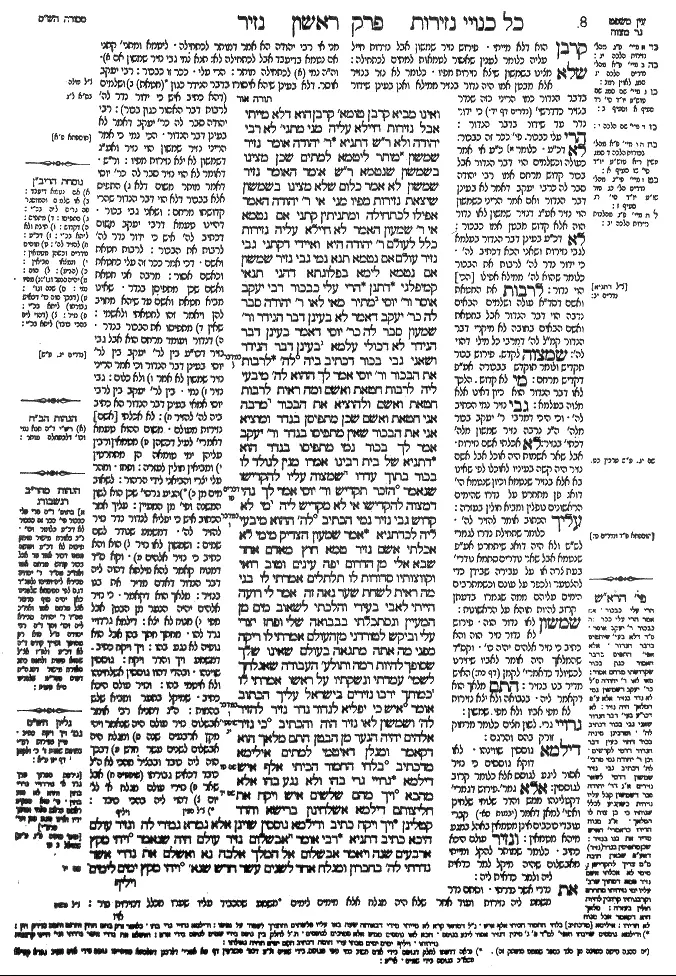
Nazir 4b - Guemara
ואינו מביא קרבן טומא' קרבן הוא דלא מייתי אבל נזירות חיילא עליה מני מתני' לא רבי יהודה ולא ר"ש דתניא ר' יהודה אומר נזיר שמשון מותר ליטמא למתים שכן מצינו בשמשון שנטמא ר"ש אומר האומר נזיר שמשון לא אמר כלום שלא מצינו בשמשון שיצאת נזירות מפיו מני אי ר' יהודה האמר אפילו לכתחילה ומתניתין קתני אם נטמא אי ר' שמעון האמר לא חיילא עליה נזירות כלל לעולם ר' יהודה היא ואיידי דקתני גבי נזיר עולם אם נטמא תנא נמי גבי נזיר שמשון אם נטמא לימא בפלוגתא דהני תנאי קמיפלגי דתנן הרי עלי כבכור רבי יעקב אוסר ור' יוסי מתיר מאי לאו ר' יהודה סבר לה כר' יעקב דאמר לא בעינן דבר הנידר ור' שמעון סבר לה כר' יוסי דאמר בעינן דבר הנידר לא דכולי עלמא בעינן דבר הנידר ושאני גבי בכור דכתיב ביה (במדבר ל, ג) לה' לרבות את הבכור ור' יוסי אמר לך ההוא לה' מיבעי ליה לרבות חטאת ואשם ומה ראית לרבות חטאת ואשם ולהוציא את הבכור מרבה אני חטאת ואשם שכן מתפיסן בנדר ומוציא אני את הבכור שאין מתפיסו בנדר ור' יעקב אמר לך בכור נמי מתפיסו בנדר הוא דתניא של בית רבינו אמרו מנין לנולד לו בכור בתוך עדרו שמצוה עליו להקדישו שנאמר (דברים טו, יט) הזכר תקדיש ור' יוסי אמר לך נהי דמצוה להקדישו אי לא מקדיש ליה מי לא קדוש גבי נזיר נמי הכתיב (במדבר ו, ב) לה' ההוא מיבעי ליה לכדתניא אמר שמעון הצדיק מימי לא אכלתי אשם נזיר טמא חוץ מאדם אחד שבא אלי מן הדרום יפה עינים וטוב רואי וקווצותיו סדורות לו תלתלים אמרתי לו בני מה ראית לשחת שער נאה זה אמר לי רועה הייתי לאבי בעירי והלכתי לשאוב מים מן המעיין ונסתכלתי בבבואה שלי ופחז יצרי עלי וביקש לטורדני מן העולם אמרתי לו ריקה מפני מה אתה מתגאה בעולם שאינו שלך שסופך להיות רמה ותולע' העבודה שאגלחך לשמי' עמדתי ונשקתיו על ראשו אמרתי לו כמותך ירבו נזירים בישראל עליך הכתוב אומר (במדבר ו, ב) איש כי יפליא לנדור נדר נזיר להזיר לה' ושמשון לאו נזיר הוה והכתיב (שופטים יג, ה) כי נזיר אלהים יהיה הנער מן הבטן התם מלאך הוא דקאמר ומנלן דאיטמי למתים אילימא מדכתיב (שופטים טו, טז) בלחי החמור הכיתי אלף איש דילמא גרויי גרי בהו ולא נגע בהו אלא מהכא (שופטים יד, יט) ויך מהם שלשים איש ויקח את חליצותם דילמא אשלחינון ברישא והדר קטלינן ויך ויקח כתיב ודילמא גוססין שוינן אלא גמרא גמירי לה ונזיר עולם היכא כתיב דתניא רבי אומר אבשלום נזיר עולם היה שנאמר (שמואל ב טו, ז) ויהי מקץ ארבעים שנה ויאמר אבשלום אל המלך אלכה נא ואשלם את נדרי אשר נדרתי לה' בחברון ומגלח אחד לשנים עשר חדש שנא' (שמואל ב יד, כו) ויהי מקץ ימים לימים
Comments from Rashi on Masechet Nazir Page 4b
מני אי רבי יהודה הא אמר דמותר לכתחילה . ליטמא ומתני' קתני אם נטמא בדיעבד אבל לכתחילה לא: תנא נמי גבי נזיר שמשון אם . וה"ה נמי לכתחילה מותר: הרי עלי . ככר זו כבכור: רבי יעקב אוסר . דלא בעינן שיהא איסורו בדבר הנידר כגון . (חטאת) ושלמים (דהא כתיב איש כי ידור נדר לה' לרבות דבר האסור כגון בכור): רבי יהודה סבר לה כר' יעקב דאמר לא בעינן דבר הנדור . הכי נמי כי אמר הריני נזיר שמשון הוי נזיר ואע"ג דשמשון לא יצא נזירות מפיו: ור"ש . דאומר לא הוי נזיר סבר לה כר' יוסי דאמר מותר משום דלא התפיס אלא בבכור דלא הוי דבר הנדור שהרי קדושתו מרחם: ושאני גבי בכור . דהיינו טעמא דרבי יעקב משום דכתיב לה' איש כי ידור נדר לה' לרבות את הבכור: לרבות חטאת ואשם . דכי אמר ככר זה עלי כחטאת וכאשם אסור: מרבה אני חטאת ואשם שכן מתפיסן בנדר . שאינו מביא חטאת ואשם עד שיהא מחויב להן ויאמר זהו לחטאתי ולאשמי: שאין מתפיסו את הבכור בנדר . דנדור ועומד מרחם הוא אבל גבי נזיר דכו"ע בין לר' יעקב בין לר' יוסי בעינן דבר הנדור וכי אמר הריני נזיר שמשון לא אמר ולא כלום: גבי נזיר נמי . בין לר' יעקב בין לרבי יוסי אמאי בעינן דבר הנדור הא כתיב . ביה לה' להזיר: לא אכלתי [אשם] נזירות מעולם . משום ההוא טעמא דאמרי' לעיל דכשהן מטמאין ורבין עליהן ימי טומאה הן מתחרטין ומביאין חולין לעזרה: ופחז . ומהר עלי יצרי והביאני לידי הרהור: לשאוב מים מן הגיע גרסי' . שכן הוא לשון המשנה ופי' מן המעיין: עליך אמר הכתוב איש כי יפליא לנדור נדר נזיר להזיר לה' . דמשמע שנודר לשם שמים: ושמשון לאו נזיר הוא והא כתיב כי נזיר אלהים . וקא ס"ד דמנוח קאמר להא מילתא דהוה ליה דבר הנדור דאדם מדיר את בנו בנזיר: מלאך הוא דקאמר . כי נזיר אלהים יהיה הנער מן הבטן אבל מפי מנוח לא יצא: דילמא גרדויי גרד להו . מחתך חתך בהן אבל הוא גופיה לא נגע בהו: ויך ויקח כתיב . דמשמע ויך והדר ויקח: גוססין שוינהו . ובהדי דהוו גוססין אשלחינהו ולא איטמי בהו: ונזיר עולם היכא כתיב . שמיקל בתער ומביא שלש בהמות: ה"ג דתניא רבי אומר אבשלום נזיר עולם היה שנאמר ויהי מקץ ארבעים שנה ומגלח היה אבשלום לשנים עשר חדש . דבכך הוה ליה כובד ובבציר מהכי לא ה"ל כובד דכאיש גבורתו (שופטים ח) אבל שאר נזירי עולם מגלח א' לל' יום דהוי ליה בהכי כובד:
Comments from Tosafot - Nazir 4b
קרבן הוא דלא מייתי . פירוש נזיר שמשון אבל נזירות חייל עליה כלומר לענין שאסור לטמאות למתים לכתחילה: שלא מצינו בשמשון שיצא נזירות מפיו . כלומר לא נזר בנזיר אלא מבטן אמו היה נדור בנזיר ממילא ואנן בעינן שידור בדבר הנדור כמו הריני כזה שנדר בנזיר כדדרשי' (נדרים דף יד.) כי ידור נדר עד שידור בדבר הנדור: הרי עלי כבכור . פי' ככר זה כבכור: לא דכ"ע . כלומר כ"ע אי אמר כעולה וכשלמים הוי דבר הנדור אבל בכור קדוש מרחם אמו רבי יהודה סבר לה כרבי יעקב דאמר לא בעינן דבר הנדור ואם אמר הריני כשמשון הוי נזיר אע"ג דנזיר שמשון לאו נדור הוה אלא קדוש מבטן אמו כבכור: לא דכ"ע בעינן דבר הנדור בעלמא לגבי נזירות ושאני הכא דכתיב לה' . כי ידור נדר לה' לרבות את הבכור כלומר שהוא לה' ממילא אפילו [הכי] הוי נדור: לרבות את החטאת ואשם . דסד"א עולה ושלמים הבאים נדבה הוי דבר הנדור אבל בחטאת ואשם הבאים בחובה לא מיקרי דבר הנדור קמ"ל לה' דמרבי כל מילי דהוי לה': שמצוה לקדש . פירוש בכור תקדיש ולומר תוקדש בבכורה אע"פ דקדיש מרחם: מי לא קדוש . הלכך לאו דבר הנדור הוא כיון דאינו אלא מצוה בעלמא: גבי נזיר נמי הכתיב לה' . וכי היכי דמרבי ר' יעקב בכור מלה' ה"נ נרבה נזיר שמשון מלה' דכתי' בנזיר: לא אכלתי אשם נזירות . אבל שאר אשמות היה אוכל אבל אשם נזיר היה קשה בעיניו לאוכלו לפי שאינו בא אלא בנזיר שנטמא וכיון שנטמא הי' דואג פן מתחרט על נדרו שהימים הראשונים נופלין ומביא חולין בעזרה: עליך הכתוב אומר להזיר לה' . כלומר שתחילת נדרו לגמרי לש"ש ולא היה דואג שיתחרט אע"פ שנטמא אבל שאר נודרים סתמא נודרי' בעת צרה או על עבירה שבידן כדי להצטער ולכפר על עונם וכשמתרבים הימים עליהם ממה שגמרו בדעתן קרוב להיות תוהא על הראשונות: א שמשון לאו נדור הוה . פירוש לא נדור נזיר הוה והא כתיב כי נזיר אלהים יהיה כו'. וקס"ד שהמלאך היה אומר לאביו שיזירנו לכשיולד כדאמרי' לקמן (נזיר דף כח:) האיש מדיר בנו בנזיר: התם מלאך הוא דקאמר ליה . בנבואה ולא יצא נזירות לא מפי אביו ולא מפי שמשון: גרויי גרי . לשון חצים כלומר מרחוק זורק בהם והרגם: דילמא גוססין שווינהו . לאו דוקא גוססים כי נזיר אסור ליגע לגוסס אלא כלומר קרוב לגוססין: אלא גמר' . פירוש דגמרי' דקטלינהו ממש והדר שלוחי שלחינן ואפי' למאן דאמר (יבמות סא.) קברי עובדי כוכבים אינן מטמאין באהל במגע מיהא מטמאין: ונזיר עולם היכא כתיב . כלומר שמותר להקל ומייתי מאבשלום שהיה מיקל למר כדאית ליה ולמר כדאית ליה: את נדרי אשר נדרתי . וסתם נדר משמע ליה נזירות ועוד אחר שלא היה מגלח אלא מימים לימים משמע שהכביד עליו שערו מכלל דנזירות נדר:
Nazir 4b - Mishnah translated into english
but he does not bring the offering for impurity.
The Gemara comments: From the words: But if he becomes impure he does not bring an offering for impurity, one can infer that it is the offering that he does not bring. However, all of the prohibitions of naziriteship apply to him, and it is prohibited for him to become impure from a corpse.
This leads to the following question: Whose opinion is expressed in the mishna? It is not the opinion of Rabbi Yehuda and not the opinion of Rabbi Shimon, as it is taught in a baraita: Rabbi Yehuda says: A nazirite like Samson is permitted to become impure from a corpse ab initio, as we find with Samson that he became impure. Rabbi Shimon says: One who says he will be a nazirite like Samson has not said anything, since we do not find with Samson that an utterance of a vow of naziriteship left his mouth. Samson never took a vow to be a nazirite. He received his status from the angel’s instructions to his mother (see Judges 13:5). Consequently, Rabbi Shimon holds that one who vows to be a nazirite like Samson is not considered to have taken a nazirite vow.
The Gemara explains the question: Whose opinion is expressed in the mishna? If it is the opinion of Rabbi Yehuda, didn’t he say that it is permitted for a nazirite of this kind to become impure from a corpse even ab initio, but the mishna teaches: If he becomes impure, which indicates that he is prohibited from doing so ab initio? However, if you say that the mishna is according to the opinion of Rabbi Shimon, didn’t he say that naziriteship does not apply to him at all?
The Gemara answers: Actually, the mishna is in accordance with the opinion of Rabbi Yehuda, and a nazirite like Samson may become impure from a corpse even ab initio. And since it teaches with regard to a permanent nazirite: If he becomes impure, as it is prohibited for a permanent nazirite to become impure from a corpse ab initio, the tanna also taught the same expression with regard to a nazirite like Samson and used the expression: If he becomes impure.
§ The Gemara suggests: Let us say that Rabbi Yehuda and Rabbi Shimon disagree with regard to the issue that is the subject of the dispute between these tanna’im, as we learned in a baraita: If one says: This object is hereby forbidden to me like a firstborn, Rabbi Ya’akov prohibits the individual from deriving benefit from the object, as he holds that a vow of this sort is valid. And Rabbi Yosei permits it, because the sanctity of a firstborn is not the result of a vow or sanctification. Rather, it is sacred of its own accord, and therefore its forbidden status cannot be extended by means of a vow to other items.
What, is it not the case that Rabbi Yehuda holds in accordance with the opinion of Rabbi Ya’akov, who said that in order for a vow to take effect, we do not require one to extend the forbidden status of an item rendered forbidden by means of a vow? Consequently, just as one can render an object forbidden by extending to it the sanctity of a firstborn animal, one can become a nazirite by accepting upon himself the status of Samson, whose prohibitions were not established by a vow. And Rabbi Shimon holds in accordance with the opinion of Rabbi Yosei, who said that in order for a vow to take effect, we do require one to extend the forbidden status of an item rendered forbidden by means of a vow. Consequently, one cannot become a nazirite by accepting upon himself the status of Samson.
The Gemara responds: No, it can be explained that everyone agrees that we require one to extend the forbidden status of an item rendered forbidden by means of a vow. And according to Rabbi Ya’akov, the halakha is different with regard to a firstborn, as it is written about this in the verse pertaining to vows: “When a man vows a vow to the Lord” (Numbers 30:3). This comes to include the firstborn and teach that since the firstborn is consecrated, its status is comparable to animals designated as offerings by means of a vow, and one can extend its forbidden status to another item.
And Rabbi Yosei could have said to you in response that he needs that expression: “To the Lord,” to include a sin-offering and a guilt-offering. One may not obligate himself to bring these offerings by means of a vow. They are brought only when one becomes liable due to a transgression. Nevertheless, one can take a vow by extending to another item the forbidden status of a sin-offering or guilt-offering.
The Gemara questions Rabbi Yosei’s explanation: And what did you see that indicated to you to include a sin-offering and a guilt-offering and to exclude a firstborn? The Gemara answers: I include a sin-offering and a guilt-offering, as one grants consecrated status to the animals designated for these offerings by means of a vow, i.e., the act of designating specific animals for these offerings is comparable to taking a vow. And I exclude a firstborn, as one does not grant it consecrated status by means of a vow.
And Rabbi Ya’akov could have said to you in response: Also in the case of a firstborn, one grants it consecrated status by means of a vow, as it is taught in a baraita: The Sages of the house of our Rabbi, i.e., Rabbi Yehuda HaNasi, said: From where is it derived that when a firstborn male animal is born in one’s herd, there is a mitzva for him to consecrate it, although it is consecrated from the time it is born? As it is stated: “All firstborns males that are born to your herd and to your flock you shall sanctify” (Deuteronomy 15:19).
And Rabbi Yosei could have said to you in response: Granted that there is a mitzva to consecrate it. But if he does not consecrate it, is it not consecrated of its own accord? Since a firstborn is forbidden principally because of its inherent sanctity and not because of a vow, one cannot express a vow by extending a firstborn’s forbidden status to another item.
The Gemara asks: Both Rabbi Ya’akov and Rabbi Yosei agree that the phrase “to the Lord” indicates that one can take a vow by associating the object of his vow with an item whose prohibition does not stem from a vow. With regard to a nazirite as well, isn’t it written: “Shall clearly utter a vow, the vow of a nazirite, to consecrate himself to the Lord” (Numbers 6:2)? Why doesn’t Rabbi Shimon derive from this verse that one can become a nazirite by accepting the naziriteship of Samson, despite the fact that Samson did not accept his naziriteship by means of a vow?
The Gemara answers: That phrase is required by him for that which is taught in a baraita: Shimon HaTzaddik said: In all my days as a priest, I never ate the guilt-offering of a ritually impure nazirite, apart from the offering of one man who came to me from the South, who had beautiful eyes and a fine countenance, and his locks were arranged in curls. I said to him: My son, what did you see to become a nazirite, which would force you to destroy this beautiful hair, as a nazirite must cut off all his hair at the conclusion of his term?
He said to me: I was a shepherd for my father in my town, and I went to draw water from the spring, and I looked at my reflection in the water. And my evil inclination quickly rose against me and sought to drive me from the world. I said to my evil inclination: Empty one! For what reason are you proud in a world that is not yours, as your end is to be maggots and worms when you die. I swear by the Temple service that I will become a nazirite and shave you for the sake of Heaven.
Shimon HaTzaddik relates: When I heard his response, I arose and kissed him on his head, and said to him: May there be more nazirites like you in Israel, whose intentions are noble, and who would not regret their vow of naziriteship even if they became impure. With regard to you the verse states: “When either a man or a woman shall clearly utter a vow, the vow of a nazirite, to consecrate himself to the Lord” (Numbers 6:2). The verse speaks of a vow that is not undertaken out of anger or spite, but purely for the sake of God. The phrase “to the Lord” in this context means: For the sake of Heaven. It cannot be used to teach that if one declares his intention to become a nazirite like Samson, his statement constitutes a nazirite vow.
The Gemara challenges the assumption that Samson’s naziriteship was not accepted through a vow: And was Samson not a nazirite whose naziriteship was accepted by a vow? Isn’t it written: “For the child shall be a nazirite of God from the womb” (Judges 13:5)? The Gemara answers: There it was the angel who spoke. Samson’s nazirite status did not stem from a vow uttered by a human being.
The Gemara asks: And from where do we derive that Samson became impure from corpses? If we say it is from the fact that it is written: “And Samson said: With the jawbone of an ass, I smote a thousand men” (Judges 15:16), perhaps he thrust the jawbone at them but did not touch them, and he remained pure.
Rather, it is derived from here: “And he smote thirty men of them, and took their garments” (Judges 14:19). Since he stripped the clothes off the dead he must have come into contact with them. The Gemara counters: Perhaps he stripped them first and afterward killed them. The Gemara responds: It is written: “And he smote…and took,” in that order, indicating that first he killed them and then he took their clothing.
The Gemara asks: But perhaps he mortally wounded them and thereby caused them to be in the process of dying, and he then took their clothes before they died so that he would not touch their corpses. Rather, it must be concluded that it is learned as a tradition that Samson would become impure from corpses.
§ The Gemara clarifies a halakha taught in the mishna: And where is the concept of a permanent nazirite written? As it is taught in a baraita: Rabbi Yehuda HaNasi says: Absalom was a permanent nazirite, as it is stated: “And it came to pass at the end of forty years, that Absalom said to the king: I pray to you, let me go and pay my vow, which I have vowed to the Lord, in Hebron” (II Samuel 15:7). And he cut his hair once every twelve months, as it is stated: “And when he polled his head, now it was at every year’s [yamim] end that he polled it; because the hair was heavy on him” (II Samuel 14:26).
Traduction : The William Davidson digital edition of the Koren Noé Talmud, with commentary by Rabbi Adin Even-Israel Steinsaltz.