 Talmud Bavli
Sukkah 43a : Youtube
Daf TubeYoutube
3 video classes :
Sukkah Page 43a
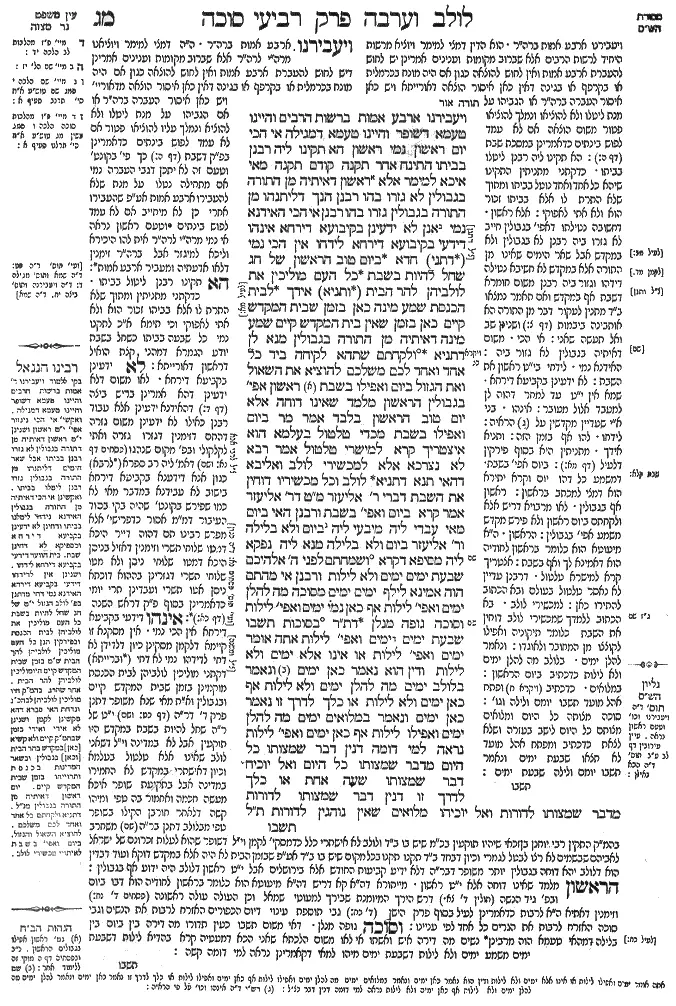
Sukkah 43a - Guemara
ויעבירנו ארבע אמות ברשות הרבים והיינו טעמא דשופר והיינו טעמא דמגילה אי הכי יום ראשון נמי ראשון הא תקינו ליה רבנן בביתו התינח אחר תקנה קודם תקנה מאי איכא למימר אלא ראשון דאיתיה מן התורה בגבולין לא גזרו בהו רבנן הנך דליתנהו מן התורה בגבולין גזרו בהו רבנן אי הכי האידנא נמי אנן לא ידעינן בקיבועא דירחא אינהו דידעי בקיבועא דירחא לידחו אין הכי נמי (דתני) חדא ביום טוב הראשון של חג שחל להיות בשבת כל העם מוליכין את לולביהן להר הבית (ותניא) אידך לבית הכנסת שמע מינה כאן בזמן שבית המקדש קיים כאן בזמן שאין בית המקדש קיים שמע מינה דאיתיה מן התורה בגבולין מנא לן דתניא (ויקרא כג, מ) ולקחתם שתהא לקיחה ביד כל אחד ואחד לכם משלכם להוציא את השאול ואת הגזול ביום ואפילו בשבת ראשון אפי' בגבולין הראשון מלמד שאינו דוחה אלא יום טוב הראשון בלבד אמר מר ביום ואפילו בשבת מכדי טלטול בעלמא הוא איצטריך קרא למישרי טלטול אמר רבא לא נצרכא אלא למכשירי לולב ואליבא דהאי תנא דתניא לולב וכל מכשיריו דוחין את השבת דברי ר' אליעזר מ"ט דר' אליעזר אמר קרא ביום ואפי' בשבת ורבנן האי ביום מאי עבדי ליה מיבעי ליה ביום ולא בלילה ור' אליעזר ביום ולא בלילה מנא ליה נפקא ליה מסיפא דקרא (ויקרא כג, מ) ושמחתם לפני ה' אלהיכם שבעת ימים ימים ולא לילות ורבנן אי מהתם הוה אמינא לילף ימים ימים מסוכה מה להלן ימים ואפי' לילות אף כאן נמי ימים ואפי' לילות וסוכה גופה מנלן דת"ר (ויקרא כג, מב) בסוכות תשבו שבעת ימים ימים ואפי' לילות אתה אומר ימים ואפי' לילות או אינו אלא ימים ולא לילות ודין הוא נאמר כאן ימים ונאמר בלולב ימים מה להלן ימים ולא לילות אף כאן ימים ולא לילות או כלך לדרך זו נאמר כאן ימים ונאמר במלואים ימים מה להלן ימים ואפילו לילות אף כאן ימים ואפי' לילות נראה למי דומה דנין דבר שמצותו כל היום מדבר שמצותו כל היום ואל יוכיח דבר שמצותו שעה אחת או כלך לדרך זו דנין דבר שמצותו לדורות מדבר שמצותו לדורות ואל יוכיחו מלואים שאין נוהגין לדורות ת"ל
Comments from Rashi on Masechet Sukkah Page 43a
ויעבירנו ארבע אמות ברה"ר . הוא הדין דמצי למימר ויוציא מרשות היחיד לרשות הרבים אלא שברוב מקומות וענינים אמרינן יש לחוש להעברת ארבע אמות ואין לחוש להוצאה כגון אם היה מונח בכרמלית או בקרפף או בגינה דאין כאן איסור הוצאה דאורייתא ויש כאן איסור העברה ברה"ר או הגביהו על מנת ליטלו ולא להוציאו ונמלך להוציאו פטור משום הוצאה אם לא עמד לפוש בינתים כדאמרינן במסכת שבת (דף ה:): הא תקינו ליה רבנן ליטלו בביתו . כדקתני מתניתין התקינו שיהא כל אחד ואחד נוטל בביתו ומתוך שלא התרת לו אלא בביתו זכור הוא ולא אתי לאפוקי: אלא ראשון . דחשובה נטילתו דאפי' בגבולין חייב לא גזרו ביה רבנן לא בגבולין ולא במקדש אבל שאר הימים שאינו מן התורה אלא במקדש לא חשיבא נטילה דידהו וגזור ביה רבנן משום חומרא דשבת אף במקדש ואם תאמר נמצאו ב"ד מתנין לעקור דבר מן התורה הא אותבינה ביבמות (דף צ:) ושנינן שב ואל תעשה שאני: אי הכי . משום דאיתיה בגבולין לא גזור ביה: האידנא נמי . לידחי בי"ט ראשון את השבת: לא ידעינן בקביעא דירחא . שמא אין י"ט עד למחר דהוה לן למעבד אלול מעובר: אינהו . בני א"י שעדיין מקדשין על הראיה: לידחו . להו אף בזמן הזה: ותניא אידך . מתניתין היא בסוף פירקין דלעיל (סוכה דף מא:): ביום אפי' בשבת . דמשמע כל דהו יום וקרא יתירא הוא דמצי למכתב בראשון: ראשון אף בגבולין . לאו מרבויא דריש אלא ולקחתם ביום ראשון ולא פירש מקדש משמע אפי' בגבולין: הראשון . ה"א מיעוטא הוא כלומר בראשון לחודיה הוא דאמינא לך ואף בשבת: אצטריך קרא למישרא טלטול . דרבנן עדיין לא נאסר טלטול בעולם ובא הכתוב להתירו כאן: למכשירי לולב . בא הכתוב ללמדך שמכשירי לולב דוחין את השבת כלומר תיקוניה ואפילו לקוצצו מן המחובר ולאוגדו: ונאמר להלן ימים . בלולב מה להלן ימים ולא לילות כדכתיב ביום הראשון: במלואים . כדכתיב (ויקרא ח) ופתח אהל מועד תשבו יומם ולילה וגו': סוכה מצותה כל היום ומלואים מצותם כל היום לישב בעזרה ושלא לצאת כדכתיב ומפתח אהל מועד לא תצאו שבעת ימים ונאמר תשבו יומם ולילה שבעת ימים:
Comments from Tosafot - Sukkah 43a
ויעבירנו ארבע אמות ברה"ר. ה"ה דמצי למימר ויוציאנו מרה"י לרה"ר אלא שברוב מקומות וענינים אמרינן דיש לחוש להעברת ארבע אמות ואין לחוש להוצאה כגון אם היה מונח בכרמלית או בקרפף או בגינה דאין כאן איסור הוצאה מדאוריי' ויש כאן איסור העברה ברה"ר או אם הגביהו על מנת ליטלו ולא להוציא ונמלך עליו להוציאו פטור אם לא עמד לפוש בינתים כדאמרינן בפ"ק דשבת (דף ה:) כך פי' בקונט' וטעם זה לא יתכן דגבי העברה נמי אם מתחילה נטלו על מנת שלא להעבירו ארבע אמות אע"פ שהעבירו אחרי כן לא מיחייב אם לא עמד לפוש בינתים וטעם ראשון נראה אי נמי מרה"י לרה"ר אית להו היכירא וליכא למיגזר אבל ברה"ר זימנין דלאו אדעתיה ומעביר ארבע אמות: הא תקינו רבנן ליטול בביתו. כדקתני מתניתין ומתוך שלא התרת לו אלא בביתו זכור הוא ולא אתי לאפוקי וכי תימא א"כ לתקנו נמי כל שבעה בביתו כשחל בשבת יודע הגמרא דמהני קצת הואיל דראשון דאורייתא: לא ידעינן בקביעא דירחא. לאו משום דלא ידעינן דהא אמרינן בריש ביצה (דף ד:) דהאידנא ידעינן אלא עבוד רבנן כאילו לא ידעינן משום גזרה דהתם דזימנין דגזרו גזרה ואתי לקלקולי ובפ' מקום שנהגו (פסחים דף נא: ושם) דאמ' ליה רב ספרא (לרבא) כגון אנא דידענא בקביעא דירחא בישוב לא עבידנא במדבר מאי לא כמו שפירש בקונט' שהיה בקי בסוד העיבור דמ"מ אסור כדפרישי' אלא מפרש רבינו תם דהוה דייר היכא דמטו שלוחי תשרי וזימנין דאזיל בניסן היכא דמטו שלוחי ניסן ולא מטו שלוחי תשרי דגזרינן בההוא דוכתא ניסן אטו תשרי ועבדינן תרי יומי כדאמרינן בסוף פ"ק דראש השנה (דף כא:): אינהו דידעי בקביעא דירחא אין הכי נמי. אין מסקנא זו קיימא דלקמן מסקינן כיון דלדידן לא דחי לדידהו נמי לא דחי (וברייתא) דקתני מוליכין לולביהן לבית הכנסת מוקמינן בזמן שבית המקדש קיים ובגבולין וא"ת מאי שנא משופר דתנן פרק ד' דר"ה (דף כט: ושם) י"ט של ר"ה שחל להיות בשבת במקדש היו תוקעין אבל לא במדינה וי"ל דשאני לולב שאינו אלא טלטול בעלמא וכיון דאישתרי במקדש לא החמירו במדינה אבל בתקיעת שופר איכא מעשה חכמה ואחמור בה טפי ומיהו קשה דלאחר חורבן הקילו בשופר טפי מבלולב דתנן בר"ה (שם) משחרב בהמ"ק התקין רבי יוחנן בן זכאי שיהיו תוקעין בכ"מ שיש בו ב"ד ולולב לא אישתרי כלל כדמסקי' לקמן וי"ל דשופר שהוא לעלות זכרונם של ישראל לאביהם שבשמים לא רצו לבטל לגמרי וכיון דבחד ב"ד תקנו תקנו בכל מקום שיש בו ב"ד אע"פ שבזמן הבית לא היה אלא במקדש דוקא ועוד דבדין הוא דלולב יהא דוחה בגבולין יותר משופר דבר"ה דלא ידיע קביעות החודש אלא בירושלים אבל י"ט ראשון דלולב היה ידוע אף בגבולין: הראשון מלמד שאינו דוחה אלא י"ט ראשון. מייתורא דה"א קא דריש דה"א מיעוטא הוא כלומר בראשון לחודיה הוא דבו ביום ובפ' גיד הנשה (חולין ד' צא.) דרש הירך המיומנת שבירך למעוטי שמאל וכן העולה עולה ראשונה (פסחים ד' נח:) וזימנין דאתיא ה"א לרבות כדאמרינן לעיל בסוף פרק הישן (סוכה ד' כח:) גבי תוספת עינוי דיום הכפורים האזרח לרבות את הנשים וגבי סוכה האזרח לרבות את הגרים כל אחד לפי עניינו: וסוכה גופה מנלן. דאי משום תשבו כעין תדורו מה דירה בין ביום בין בלילה דמהאי טעמא הוה מרבינן נשים מה דירה איש ואשתו אי לאו משום הלכתא שאני הכא דמעטיה קרא בהדיא לילות דשבעת ימים משמע ימים ולא לילות דשבעת ימים מיהו למאי דקאמרינן נראה למי דומה קשה:
Sukkah 43a - Mishnah translated into english
and in doing so carry it four cubits in the public domain, thereby violating a severe Torah prohibition. And that is the reason for the prohibition against sounding the shofar on Shabbat, and that is the reason for the prohibition against reading the Scroll of Esther when Purim coincides with Shabbat.
The Gemara asks: If so, on the first day of Sukkot that coincides with Shabbat too one should not take the lulav due to this concern. The Gemara answers: With regard to the first day, the Sages instituted that one should take the four species in his house. Since the Sages already prohibited one from taking the lulav out of the house, he will remember that it is prohibited and will not come to take it elsewhere to learn to wave it or to recite the blessing. The Gemara asks: This works out well after the ordinance that one takes the lulav in his house was instituted. However, prior to introducing the ordinance, what is there to say in explaining why it is permitted to take the lulav on the first day?
Rather, the Gemara rejects the previous explanation and explains the distinction differently. On the first day, when the mitzva of taking the lulav even in the outlying areas and not just in the Temple is in effect by Torah law, the Sages did not issue a decree to prohibit taking the lulav on the first day and permitted the mitzva to be performed even in the outlying areas. However, with regard to these other days of Sukkot, when the mitzva of taking the lulav is not in effect by Torah law in the outlying areas and the lulav is taken there only to commemorate the practice in the Temple, the Sages issued a decree to prohibit taking the lulav on the other days.
The Gemara asks: If it is so that the mitzva on the first day is a mitzva by Torah law even in the outlying areas, today too one should take the lulav on the first day of Sukkot that coincides with Shabbat. The Gemara answers: We do not know when precisely the establishment of the month was determined by the court. Therefore, it is possible that the day observed as the first day of Sukkot is not Sukkot at all. Certainly, one does not violate the rabbinic decree to fulfill a mitzva that is not definitely a mitzva by Torah law. The Gemara asks: If so, with regard to the people of Eretz Yisrael, who sanctify the month based on eyewitness testimony and who know when precisely the establishment of the month was determined by the court, let them override Shabbat for the mitzva of lulav on the first day of Sukkot even today.
The Gemara answers: Yes, it is indeed so, and that is their practice, as it was taught in one mishna: On the first day of the Festival that occurs on Shabbat, all the people bring their lulavim to the Temple Mount on Friday. And we learned in another mishna: They bring their lulavim to the synagogue. Learn from the change in formulation that here, where the mishna says that they bring their lulavim to the Temple Mount, it is referring to when the Temple is in existence, and there, where the mishna says that they bring their lulavim to the synagogue, it is referring to when the Temple is not in existence. The Gemara concludes: Indeed, learn from it that this is so.
§ The Gemara asks: From where do we derive that by Torah law the mitzva of lulav on the first day is in effect even in the outlying areas? The Gemara answers: As it was taught in a baraita: “And you shall take for yourselves on the first day the fruit of a beautiful tree, branches of a date palm, and boughs of a dense-leaved tree, and willows of the brook, and you shall rejoice before the Lord your God seven days” (Leviticus 23:40). The Sages parse the phrases and terms in the verse. In the phrase “And you shall take,” the plural form of you is used, indicating that there should be taking in the hand of each and every one, and no one can fulfill the obligation on another’s behalf.
They continue to expound the verse. Yourselves indicates from your own, to exclude a borrowed or stolen lulav. On the day comes to emphasize that there is a mitzva by Torah law to take the lulav on each day of the Festival, even on Shabbat. The word first, used with no qualification as to where the lulav is to be taken, indicates that this obligation is in effect everywhere on the first day, even in the outlying areas. The first, with the definite article for emphasis, is restrictive and teaches that the mitzva of taking the lulav overrides Shabbat only on the first day of the Festival.
The Gemara analyzes the baraita. The Master said: On the day, indicates even on Shabbat. The Gemara asks: Now, since taking the four species entails merely moving the object and is prohibited due to the rabbinic prohibition of set-aside, is a verse needed to permit moving the lulav? Obviously, the Torah does not address prohibitions that are not by Torah law. Rava said: Indeed, the verse is necessary only for actions that are facilitators of the performance of the mitzva of lulav, i.e., to permit actions necessary to prepare a lulav for the mitzva, such as severing it from the tree, which may be performed on Shabbat. And that is in accordance with the opinion of this tanna who permits doing so on Shabbat, as it was taught in a baraita: Lulav and all the actions that are its facilitators override Shabbat; this is the statement of Rabbi Eliezer.
The Gemara explains: What is the rationale for the statement of Rabbi Eliezer? It is as the verse states: On the day, indicating that the obligation exists every day of the Festival, and even on Shabbat.
The Gemara asks: And the Rabbis, what do they do with the verse: On the day? The Gemara answers: They require it to teach that the mitzva of taking the lulav is specifically during the day and not at night.
The Gemara asks: And from where does Rabbi Eliezer derive that the lulav is taken during the day and not at night? The Gemara answers: He derives it from the end of the verse: “And you shall rejoice before the Lord your God seven days” (Leviticus 23:40), indicating that the obligation to take the lulav is during the days and not during the nights.
The Gemara asks: And the Rabbis, why don’t they derive it from that verse? The Gemara answers: If it was derived from there, I would have said: Derive days written with regard to lulav from days written with regard to sukka by means of a verbal analogy; just as there, with regard to sukka, it means days and even nights, here too, with regard to lulav, it means days and even nights.
The Gemara asks: And with regard to sukka itself, from where do we derive that the mitzva is observed at night as well? As the Sages taught in a baraita that it is written: “You shall reside in sukkot for seven days” (Leviticus 23:42), from which they derived: Days and even nights. The tanna continues the discussion: Do you say days and even nights; or perhaps the meaning is only days and not nights? And it may be inferred logically that the latter is correct. It is stated here, with regard to sukka: “Days.” And it is stated with regard to lulav: “Days.” Just as there, with regard to lulav, the meaning is days and not nights, so too here, with regard to sukka, the meaning is days and not nights. That is one possibility.
Or, perhaps, go this way and say the opposite. It is stated here, with regard to sukka: Days, and it is stated with regard to the inauguration of the Tabernacle: “And at the door of the Tent of Meeting you shall reside day and night seven days” (Leviticus 8:35). Just as there, with regard to the inauguration of the Tabernacle, the meaning is days and even nights, so too here, with regard to sukka, the meaning is days and even nights. A source exists for either possibility.
The baraita continues: Let us see to which of the paradigms the mitzva of sukka is comparable. Perhaps one derives a matter whose mitzva is in effect the entire day, sukka, from another matter whose mitzva is in effect the entire day, the inauguration of the Tabernacle, and do not let a matter whose mitzva is in effect for a brief moment, lulav, prove otherwise. Or perhaps go this way and say the opposite: One derives a matter whose mitzva is in effect throughout the generations, sukka, from another matter whose mitzva is in effect throughout the generations, lulav, and do not let the inauguration that is not in practice throughout the generations, as it was in effect only at the establishment of the Tabernacle, prove otherwise.
Since it is impossible to determine the more appropriate source based on logical inference, derive the matter as the verse states:
Traduction : The William Davidson digital edition of the Koren Noé Talmud, with commentary by Rabbi Adin Even-Israel Steinsaltz.