 Talmud Bavli
Shabbat 128b : Youtube
Daf TubeYoutube
2 video classes :
Shabbat Page 128b
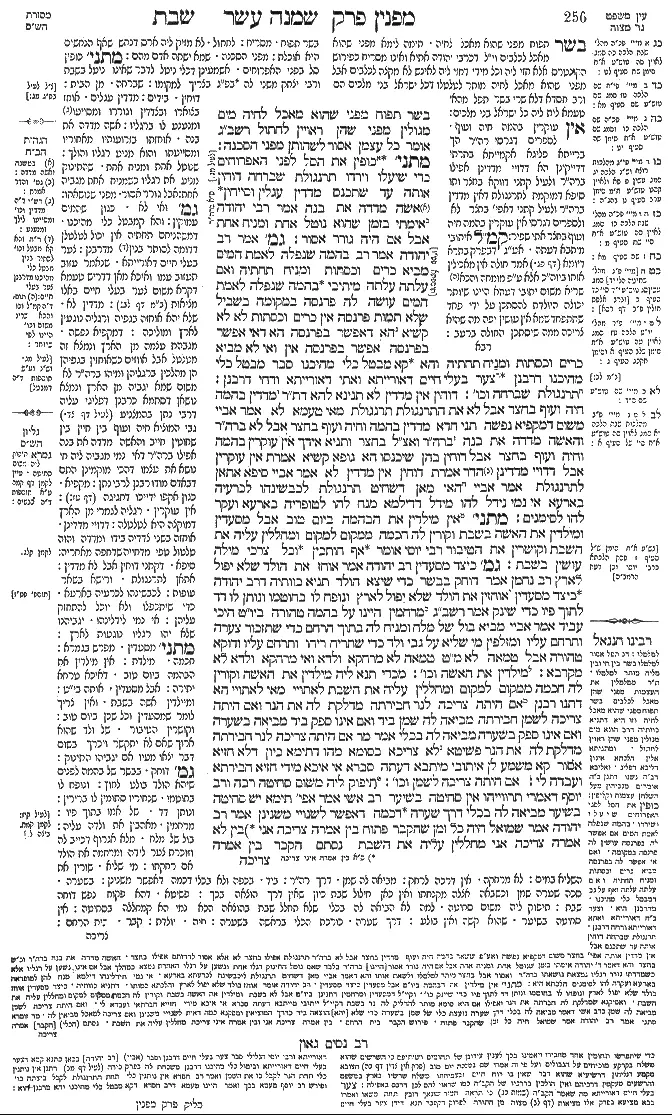
Shabbat 128b - Guemara
בשר תפוח מפני שהוא מאכל לחיה מים מגולין מפני שהן ראויין לחתול רשב"ג אומר כל עצמן אסור לשהותן מפני הסכנה:
מתני׳ כופין את הסל לפני האפרוחים כדי שיעלו וירדו תרנגולת שברחה דוחין אותה עד שתכנס מדדין עגלין וסייחין אשה מדדה את בנה אמר רבי יהודה אימתי בזמן שהוא נוטל אחת ומניח אחת אבל אם היה גורר אסור:
גמ׳ אמר רב יהודה אמר רב בהמה שנפלה לאמת המים מביא כרים וכסתות ומניח תחתיה ואם עלתה עלתה מיתיבי בהמה שנפלה לאמת המים עושה לה פרנסה במקומה בשביל שלא תמות פרנסה אין כרים וכסתות לא לא קשיא הא דאפשר בפרנסה הא דאי אפשר בפרנסה אפשר בפרנסה אין ואי לא מביא כרים וכסתות ומניח תחתיה והא קא מבטל כלי מהיכנו סבר מבטל כלי מהיכנו דרבנן צער בעלי חיים דאורייתא ואתי דאורייתא ודחי דרבנן:
תרנגולת שברחה וכו':
דוחין אין מדדין לא תנינא להא דת"ר מדדין בהמה חיה ועוף בחצר אבל לא את התרנגולת תרנגולת מאי טעמא לא אמר אביי משום דמקפיא נפשה תני חדא מדדין בהמה וחיה ועוף בחצר אבל לא ברה"ר והאשה מדדה את בנה ברה"ר ואצ"ל בחצר ותניא אידך אין עוקרין בהמה וחיה ועוף בחצר אבל דוחין בהן שיכנסו הא גופא קשיא אמרת אין עוקרין אבל דדויי מדדינן הדר אמרת דוחין אין מדדין לא אמר אביי סיפא אתאן לתרנגולת אמר אביי האי מאן דשחיט תרנגולת לכבשינהו לכרעיה בארעא אי נמי נידל להו מידל דדילמא מנח להו לטופריה בארעא ועקר להו לסימנים:
מתני׳ אין מילדין את הבהמה ביום טוב אבל מסעדין ומילדין את האשה בשבת וקורין לה חכמה ממקום למקום ומחללין עליה את השבת וקושרין את הטיבור רבי יוסי אומר אף חותכין וכל צרכי מילה עושין בשבת:
גמ׳ כיצד מסעדין רב יהודה אמר אוחז את הולד שלא יפול לארץ רב נחמן אמר דוחק בבשר כדי שיצא הולד תניא כוותיה דרב יהודה כיצד מסעדין אוחזין את הולד שלא יפול לארץ ונופח לו בחוטמו ונותן לו דד לתוך פיו כדי שינק אמר רשב"ג מרחמין היינו על בהמה טהורה ביו"ט היכי עביד אמר אביי מביא בול של מלח ומניח לה בתוך הרחם כדי שתזכור צערה ותרחם עליו ומזלפין מי שליא על גבי ולד כדי שתריח ריחו ותרחם עליו ודוקא טהורה אבל טמאה לא מ"ט טמאה לא מרחקא ולדא ואי מרחקא ולדא לא מקרבא:
מילדין את האשה וכו':
מכדי תנא ליה מילדין את האשה וקורין לה חכמה ממקום למקום ומחללין עליה את השבת לאתויי מאי לאתויי הא דתנו רבנן אם היתה צריכה לנר חבירתה מדלקת לה את הנר ואם היתה צריכה לשמן חבירתה מביאה לה שמן ביד ואם אינו ספק ביד מביאה בשערה ואם אינו ספק בשערה מביאה לה בכלי אמר מר אם היתה צריכה לנר חבירתה מדלקת לה את הנר פשיטא לא צריכא בסומא מהו דתימא כיון דלא חזיא אסור קא משמע לן איתובי מיתבא דעתה סברא אי איכא מידי חזיא חבירתא ועבדה לי:
אם היתה צריכה לשמן וכו':
תיפוק ליה משום סחיטה רבה ורב יוסף דאמרי תרווייהו אין סחיטה בשיער רב אשי אמר אפי' תימא יש סחיטה בשיער מביאה לה בכלי דרך שערה דכמה דאפשר לשנויי משנינן אמר רב יהודה אמר שמואל חיה כל זמן שהקבר פתוח בין אמרה צריכה אני) בין לא אמרה צריכה אני מחללין עליה את השבת נסתם הקבר בין אמרה
Comments from Rashi on Masechet Shabbat Page 128b
בשר תפוח . מסריח: לחתול . לא מזיק ליה ארס דנחש שאף הנחשים היא אוכלת: מפני הסכנה . שמא ישתה אדם מהם: מתני' כופין סל בפני האפרוחים . אשמעינן דכלי ניטל לדבר שאינו ניטל בשבת ורבי יצחק משני לה בפ"ג בצריך למקומו: שברחה . מן הבית: דוחין . בידים: מדדין עגלים . אוחז בצוארו ובצדדין וגוררו ומסייעו ומנענע לו ברגליו: אשה מדדה את בנה . אוחזתו בזרועותיו מאחוריו ומסייעתו והוא מניע רגליו והולך: שנוטל אחת ומניח אחת . שהתינוק מניע את רגליו כשמניח אחת מגביה אחת: אבל גורר אסור . מפני שנושאתו: גמ' ואי לא כגון שהמים עמוקין: והא קמבטל כלי מהיכנו . דמשהניחם תחתיה אין יכול לטלטלן דדומה לסותר בנין מדרבנן: צער בעלי חיים דאורייתא . שנאמר עזוב תעזוב עמו ואיכא מאן דדריש טעמא דקרא משום צער בעלי חיים באלו מציאות (ב"מ דף לב:): מדדין לא . שלא יהא אוחזה בגפיה ורגליה נוגעין לארץ ומוליכה: דמקפיא נפשה . מגבהת עצמה מן הארץ ונמצא זה מטלטל אבל אווזים כשאוחזין בגפיהן הן מהלכין ברגליהן ומיהו ברה"ר לא משום שמא יגביה מן הארץ ונמצא נושאן דסתמא כרבנן דפליגי עליה דרבי נתן בהמצניע (לעיל שבת דף צד.) גבי המוציא חיה ועוף בין חיין בין שחוטין חייב והאשה מדדה את בנה אפילו ברה"ר דאי נמי מגביה ליה חי נושא את עצמו דהכי מוקמינן התם דבאדם מודו רבנן לרבי נתן: מקפיא . כגון אקפו ידיכו דחגיגה (דף טז:): אין עוקרין . רגליה לגמרי מן הארץ דמוקצה. היא לטלטלה: דדויי מדדינן . אוחזה בשני צדדיה בידו ומדדה והוה טלטול טפי מדחייה שדחפה מאחריה: סיפא . דקתני דוחין אבל לא מדדין: אתאן לתרנגולת . ורישא בשאר עופות: לכבשינהו לכרעיה בארעא . כדי שיתכפלו ולא יוכל להתחזק עליהן: אי נמי לידלינהו . יגביהנו שלא. יהו רגליו נוגעות לארץ: מתני' מסעדין . מפרש בגמרא: חכמה . מילדת: אין מילדין את הבהמה ביום טוב . דאיכא טרחא יתירה: אבל מסעדין . אותה בי"ט: ומיילדין אשה בשבת . ואין צריך לומר שמסעדין וכל שכן ביום טוב: וקושרין הטיבור . של ולד שהוא ארוך שאם לא יתקשר ויכרך בשום דבר יצאו מעיו אם יגביהו התינוק: גמ' דוחק . בבשר של בהמה לפנים שיהא הולד בולט לחוץ: ונופח לו בחוטמו . שנחיריו סתומין לו ברירין: ונותן דד . של אמו בתוך פיו: מרחמין . מאהבין את ולדה עליה: בול של מלח . מלא אגרוף דכייב לה וזוכרת צער לידה ומרחמה את הולד אם רחקתו: מי שליא . שורין את השליא במים: לא מרחקה . אין דרכה לרחק: מביאה לה שמן . דרך רה"ר: ביד . בכפה ולא בכלי דכמה דאפשר משנינן: בשערה . סכה שערה שמן וכשבאה אצלה מקנחתו ואין כאן חילול שבת כיון שאין דרך הוצאה בכך: פשיטא . דהא פקוח נפש דוחה שבת: תיפוק ליה משום סחיטה . למה לא הביאה לה בכלי שלא תחלל שבת בהוצאה הכא נמי הא קמחללה בסחיטה: אין סחיטה בשיער . שהוא קשה ואין בולע: דרך שערה . כורכת הכלי בראשה בשערה: חיה . יולדת: קבר . בית הרחם:
Comments from Tosafot - Shabbat 128b
בשר תפוח מפני שהוא מאכל לחיה . תימה לימא מפני שהוא מאכל לכלבים וי"ל דכרבי יהודה אתיא ואינו מסריח כפירוש הקונטרס אלא חזי ליה וכל מידי דחזי ליה לאינש לא מקצה לכלבים אבל מפני שהוא מאכל לחיה מותר לטלטלו דכל ישראל בני מלכים הם ורב חסדא דלא שרי בשר תפל מהאי טעמא לית ליה כל ישראל בני מלכים: אין עוקרין בהמה חיה ועוף . לספרים דגרסי רה"ר הך ברייתא פליגא אקמייתא בתרתי דדייקינן הא דדויי מדדינן אפילו ברה"ר ולעיל קתני דווקא בחצר ותו סיפא דמוקמת לתרנגולת דאין מדדין ברה"ר ולעיל קתני דאפי' בחצר לא ולספרים דגרסי אין עוקרין בהמה חיה ועוף בחצר אתי שפיר: קמ"ל איתובי מיתבא דעתה . אע"ג דבפרק בתרא דיומא (דף פג.) אמר חולה אין מאכילין אותו ביוה"כ אלא ע"פ מומחה והכא שריא משום יתובי דעתא היינו שיותר יכולה היולדת להסתכן על ידי פחד שתתפחד שמא אין עושין יפה מה שהיא צריכה ממה שיסתכן החולה ברעב:
Shabbat 128b - Mishnah translated into english
With regard to swollen meat that began to putrefy, it is permitted to move it because it is food for non-domesticated animals. With regard to exposed water, from which a snake might have drunk and into which it injected its venom, it is permitted to move it because it is suitable for a cat, which is somewhat immune to snake venom. Rabban Shimon ben Gamliel says: Exposed water itself may not be kept due to the danger that one may inadvertently drink it.
MISHNA: One may overturn a basket in front of the chicks so that they can climb on and climb off of it. Likewise, with regard to a hen that fled that one seeks to retrieve, one may push it even with his hands until it reenters the house.
One may help calves and foals to walk, and likewise a woman may help her son to walk. Rabbi Yehuda said: When is it permitted? When her son picks one foot up and puts one foot down by himself. However, if her son were dragging both his feet, it would be prohibited because it would be like carrying him in the public domain.
GEMARA: Rav Yehuda said that Rav said: With regard to an animal that fell into an aqueduct, one brings cushions and blankets, and throws them into the water ditch, and places them beneath the animal in the aqueduct. And if the animal thereby emerges, it emerges.
The Gemara raises an objection from a Tosefta: With regard to an animal that fell into an aqueduct on Shabbat, one provides it with sustenance in its place so that it will not die. This implies that providing it with sustenance, yes, that is permitted, providing it with cushions and blankets, no, that it is prohibited.
The Gemara answers: This is not difficult, as there is room to distinguish between the cases. This, the Tosefta in which it was taught that one provides the animal with sustenance, is referring to a case where it is possible to provide it with sustenance. That, the mishna in which Rav said that one brings cushions and blankets, is referring to a case where it is impossible to provide it with sustenance. Where it is possible to provide it with sustenance, yes, he does so. And if it is not possible to provide it with sustenance, he brings cushions and blankets and places them beneath the animal.
The Gemara asks: Does he not, by placing the cushions and blankets, negate a vessel’s preparedness? The cushions and blankets are no longer fit for their designated use on Shabbat, and this negation of their designated use is similar to the prohibited labor of dismantling. The Gemara answers: Rav holds that negating a vessel’s preparedness is prohibited by rabbinic law. Causing a living creature to suffer is a Torah prohibition. And a matter prohibited by Torah law comes and overrides a matter prohibited by rabbinic law.
We learned in the mishna: With regard to a hen that fled that one seeks to retrieve, he may push it back to its place. By inference: Push the hen, yes, it is permitted, help it to walk, no, it is prohibited. The Gemara comments: We already learned this, as the Sages taught: One may help domesticated animals, non-domesticated animals, and fowl walk in the courtyard on Shabbat, but not hens.
The Gemara asks: With regard to a hen, what is the reason that one may not help it walk? Abaye says: It is prohibited because the hen lifts itself off the ground. As a result, one actually carries it.
It was taught in one baraita: One may help domesticated animals, non-domesticated animals, and fowl walk in the courtyard, but not in the public domain. And a woman may help her son walk in the public domain, and, needless to say, it is permitted in the courtyard. And it was taught in another baraita: One may not lift domesticated animals, non-domesticated animals, and fowl off the ground in the courtyard, but one may push them so that they will enter.
The Gemara first seeks to clarify the second baraita. This baraita itself is difficult. On the one hand, you said that one may not lift, from which it may be inferred, however, that one may help it walk. Then you said: Push, yes, it is permitted, help walk, no, it is prohibited. Abaye said: The latter clause, which states that one may not help it walk, we came to the halakha of a hen, which, as mentioned above, one may not help it walk.
Having mentioned moving the hen, the Gemara cites that which Abaye said: One who slaughters a hen should force its legs into the ground, or alternatively lift it entirely into the air. Failure to do so leads to the concern lest the hen place its claws into the ground and convulse during the slaughter and dislocate the signs, the trachea and gullet. This would invalidate the slaughter and render the hen an unslaughtered animal carcass.
MISHNA: One may not birth an animal on a Festival, and all the more one may not birth it on Shabbat. However, one may assist it to give birth. And one may birth a woman even on Shabbat, and call a midwife for her to travel from place to place, even when the midwife’s travel involves the desecration of Shabbat. And one may desecrate Shabbat for a woman giving birth. And one may tie the umbilical cord of a child born on Shabbat. Rabbi Yosei says: One may even cut the umbilical cord. And all the requirements of circumcision may be performed for a baby whose eighth day of life occurs on Shabbat.
GEMARA: The Gemara asks: How may one assist in the birth of an animal? Rav Yehuda said: One holds the newborn so that it will not fall to the ground. Rav Naḥman says: One presses the flesh around the womb so that the newborn will emerge.
It was taught in a baraita in accordance with the opinion of Rav Yehuda: How may one assist in the birth of an animal? One holds the newborn so that it will not fall to the ground, and he blows into its nostrils to remove mucus obstructing the air passages, enabling the offspring to breathe, and he places the mother’s teat into its mouth so that it will suckle.
Rabban Shimon ben Gamliel says: We would have mercy on kosher animals on a Festival, to help the offspring. The Gemara asks: How does one have mercy? Abaye said: If the mother does not draw her offspring near and tend to it, one may bring a lump of salt and place it in the animal’s womb, so that it will suffer, remember its suffering while giving birth, and have mercy on the offspring. And one may pour fluids of the afterbirth on the offspring so that the mother will smell it and have mercy on it, her offspring. And this may be done specifically for a kosher animal, but for a non-kosher animal, no, it may not be done.
The Gemara asks: What is the reason one may not do so for a non-kosher animal? The Gemara answers: A non-kosher animal does not distance its offspring, and if it does distance its offspring, it will not draw it near again. No purpose is served by taking these steps with a non-kosher animal.
We learned in the mishna: And one may birth a woman even when that involves the desecration of Shabbat The Gemara asks: After all, it was taught explicitly in the mishna: And one may birth a woman even on Shabbat, and call a midwife for her to travel from place to place. The phrase: And one may desecrate Shabbat for a woman giving birth, what does it come to include? All the possible acts of desecrating Shabbat for the birthing woman were already listed.
The Gemara answers: It comes to include that which the Sages taught with regard to this issue: If a woman giving birth were to need a lamp, her friend lights the lamp for her on Shabbat. And if she were to need oil, her friend brings her oil via the public domain in an atypical manner, carrying it in the palm of her hand but not in a vessel. And if the oil that her friend brings in her hand is not enough, she brings oil in her hair. And if oil that she brings in her hair is not enough, she brings oil for her in the typical manner, in a vessel.
The Master said in the baraita: If a woman giving birth were to need a lamp, her friend would light the lamp for her on Shabbat. The Gemara asks: This is obvious. The Gemara answers: It is necessary to teach this halakha only in the case of a blind woman giving birth. Lest you say: Since she cannot see even with the light it is prohibited to bring a lamp for her, it teaches us that lighting the lamp is permitted to settle her mind. The blind woman thinks: If there is something that needs to be done in the course of childbirth, the lamp will enable my friend to see and she will do it for me.
We learned in the mishna: And if she needed oil, her friend brings her oil in her hair. The Gemara asks: What good is this advice? Derive that it is prohibited due to the prohibited labor of wringing. The friend will need to wring her hair in order to extract the oil for the birthing woman.
It was Rabba and Rav Yosef who both said: There is no prohibition of wringing with regard to hair, since hair does not absorb liquids like other materials. Rav Ashi said: Even if you say that there is a prohibition of wringing with regard to hair, here the friend does not actually bring the oil in her hair. Rather, she brings it in a vessel tied through her hair. She does this because as much as it is possible to change the manner in which one performs a labor that is being done to save a life, we change it.
Rav Yehuda said that Shmuel said: With regard to a woman in childbirth, as long as the womb is open, whether she said: I need Shabbat to be desecrated, or whether she did not say: I need Shabbat to be desecrated, one desecrates Shabbat for her. Generally, a woman in childbirth is in danger, and prohibited labors may be performed in life-threatening circumstances.
Once the womb closed after birth, whether the woman who gave birth said:
Traduction : The William Davidson digital edition of the Koren Noé Talmud, with commentary by Rabbi Adin Even-Israel Steinsaltz.